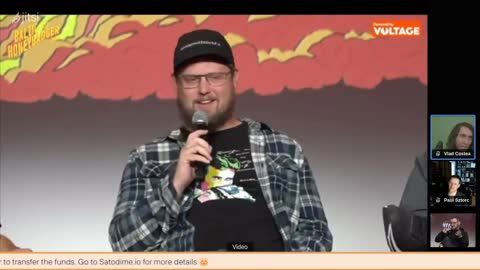
0:01 All right 0:03 Let's get ready to rumble 0:05 Getting joined by John Carvalho from synonym and Paul Sztorc Bitcoin developer to talk about Drivechains scaling 0:14 Pass forward for scaling Bitcoin. I'll sit right here you to sit there 0:21 Are they on 0:23 So I think we start with you Paul. I think it's for people in the audience and people watching the live stream 0:29 It makes sense to start with the history of Drivechains. What is a Drivechain? 0:33 And how that's what this whole thing is about. They prepared a lot for this 0:39 No, we did well because the preparation was so thorough drive was independently 0:44 Made little notes of like things we agree and disagree about. Yeah, so 0:49 But this is probably one of them. I mean, I don't know. This is an idea 0:52 I had a long time ago to solve everyone's problems and 0:55 The everyone included the large blockers and the small blockers and so both of the groups were like 1:00 How can you side with them? 1:01 And they they sort of didn't like the idea 1:04 But it now it's the idea is so good that its merits are slowly being seen by everyone 1:09 Seven years after I wrote about it in November 2015 1:13 John do you agree that they're being seen by everybody? 1:17 No, I 1:20 Guess I'll be 1:22 Dramatic and say I think pretty much all the narratives of Drivechain are false 1:27 All right. All right. Let's do it then. All right, let's do it. We're rumbling 1:32 So do you want me to just say a narrative or something? Sure. Like what do you think is the you know? 1:38 the the biggest problem that Drivechain solve I 1:41 Would say well, that's all quite a few but I'd say that the core problem is that people will never agree completely on 1:48 What the blocks change should contain so you can't have the blocks be both large and small 1:54 So no matter what you have someone has to go away 1:56 Empty-handed and that is one of the problems. That's why I would a sidechain handle that problem better than a shit coin 2:03 Because the with the shit coin you have a completely different investment. You have like a rival investment that has its own 2:10 fate whereas this is just like kind of like converting cash to 2:15 Money in a checking account or something they exchange at par 2:18 That's the whole but I still have to convert my asset into the paradigm of a new blockchain, right? 2:26 the yeah, it depends on exactly like there's like the details of what happens under the hood and then there's like what really so 2:33 But yes, you you have two pieces of software 2:36 They both can be blockchain software one has a large 2:40 Larger block size for example, and when it's a smaller block size, for example 2:43 And one of the things that we could do with this is shrink the layer one block size and then ossify 2:48 But that's going on a slight tangent 2:52 But the point is you have two completely different pieces of software and 2:55 then you have 2:57 You that you'd on the layer one you'd send coins you take coins that you own there and you'd send them into 3:03 Layer two the the other piece of software, but the value 3:08 I want to one right the value won't be one-to-one because the rules will be different on the separate blockchain 3:13 The they exchange one-to-one in the software in the BIP300 rules when they go across 3:18 so if you have four BTC and you 3:22 send them across you end up with four coins and the other network and 3:26 Then if you go through the long withdrawal process that is not intended for lay people to use 3:32 But anyone can use it because it takes so long 3:35 It's not intended for regular people to use 3:37 But you can and if you do that and you have you still have 3.2 coins or something 3:42 You will get 3.2 back on but on layer one 3:46 so even whatever the market rate may be instantaneous, which may be different because of the delay the 3:54 The BIP300 lets you send them at exactly a par 3:58 but my 3:59 my sidechain my side coin is 4:03 Most likely going to have a different market value than Bitcoin, right? 4:06 Well, it could be like point it could be like ninety nine point nine nine cents on the dollar or something 4:10 Well wouldn't it could be anything totally different. And so how do you deal with it? 4:14 What can never be above one right you can see why Robert you would move them in 4:18 Yeah, there would be a delay on the arbitrage and there's more risk to using but moving them inside from layer one to layer two 4:24 Is basically instantaneous. It's like it's like a ten minutes. There's one block or whatever 4:28 So moving that out is 90 days moving them out is takes a very long time 4:33 but so the question is there are certain situations where the 4:37 Market value may not be like 99 cents on the dollar which include the sidechain developers 4:44 Tried a terrible idea and the entire software has crashed and no one can figure out who the rightful owner of the coins is at all 4:50 It's not possible to figure out all blockchains terrible ideas 4:53 It's not a joke, it's not a joke including Bitcoin 4:57 But Bitcoin is like Bitcoin and then blockchain is like pretending you can do other things in Bitcoin 5:03 I think this may be another disagreement between the two of us 5:05 Where do you really think is that hyperbole or do you really think that like every really like you don't see any value in like? 5:11 the Zcash 5:13 Technology even just as a mixer on bit even you stripped away of the the dev tax you stripped away the 5:19 Weird weird stuff that Zuko does 5:22 Each use case I could probably mention a specific reason 5:25 But I think all of them have a reason where they are faulty designs ultimately and you think that's gonna be true 5:31 Forever like no one will ever come up with a good idea. I think it's possible 5:34 But I think that require kind of omniscience on your I don't think you need Drivechains to for that possibility 5:39 Can I break in here? 5:40 So you think these other ideas have faulty ideas what in your mind is like a good idea a secure idea in terms of? 5:49 In other words, why what if somebody presented a blockchain that was like interesting 5:54 What would it look like or why do you see Bitcoin being the only? 5:58 valuable because like a 6:00 blockchain has a specific purpose and solved like a specific problem and a lot of people want to attach this narrative that 6:08 There are actually other things this format solves 6:10 But they all root in the same thing that Bitcoin does and so ultimately a better Bitcoin would be like a simpler or you know 6:18 More streamlined simpler Bitcoin and no all coins are really attempting to do that 6:24 So they're all block chaining is just adding complexity to Bitcoin and adding attack area adding 6:31 Centralization adding censorship in order to make a claim that a blockchain can do something that it can't actually do 6:37 Bringing this back to Drivechain specifically. I think that's the biggest knock that I've heard historically on Drivechains is 6:44 expanding this attack vector and 6:47 Basically creating this incentive to bring insecurity to the chain via yeah 6:52 I think that's just people who haven't really I mean, that's very forgivable that people say that but they just I don't think they really 6:59 Understand what's happening, which is just on layer one 7:02 There's just money like going into a box and then if enough hash rate accumulates on it 7:06 You can take money out of the box to certain destination 7:09 And so if you're relying on an external source of income, and I don't think either of those things are actually true 7:15 I think they're actually both negatives where I think that one if there aren't enough fees for people to run Bitcoin 7:22 It's because nobody's using Bitcoin and Bitcoin is dying 7:24 It's not because we failed to add more features to Bitcoin. It's because people don't need any blockchain for anything and 7:31 That's really unlikely. It is not the trend 7:34 we have seen evidence in the past where you know, the blocks will get full eventually and the fees will be fine and 7:41 Addressing whether or not there's enough fees for minors is mostly just you know 7:46 How many blocks you want to wait to have a confirmation if there's not enough or mine yourself? 7:51 But didn't you read the long article I wrote on exactly this topic which addressed both of those issues you have any short articles? 7:57 No 7:58 There's long, you know, it's like the too many notes from Amadeus. It's like there's long or short as I require 8:05 So I wrote a long post about this though 8:07 But it's like this is the and I wrote I made a long presentation on sidechain risks in 2016. So it's like 8:12 we can get we'll get to something later maybe if we have time, but the 8:18 The number of confirmations is not really relevant because the if the security budget is too low 8:22 The attack is an endless campaign of 51% attacks. So that does that doesn't make any difference at all 8:27 so the fees the second part so comes in the the issue the first part about 8:34 The 8:37 Fees can only be really really low if Bitcoin is failing for some reason 8:40 First of all, I could be failing for some reason 8:42 But second of all as I say in the post 8:45 there's plenty of things that people really like that the market clearing price is very low for and so I give examples like a 8:51 paywalled 8:52 News article or music you can just go on YouTube and type music 8:56 Whatever music you like into YouTube and you get it for free. So the market clearing price is very very very low 9:02 But people love music, you know, people really like music just because and people really like water 9:06 I have water in the article like people love water, but water is cheap because the supply is abundant 9:13 So and this so this is a situation where just because something is really really any of this has to do with Bitcoin 9:24 You can like something and the market clearing price will be low 9:28 Factors the supply and demand 9:30 Responsible for all the things that you like. It is just there to be an abstraction for value 9:35 No, this is nothing to do with what bitcoins responsible for. I'm just telling you that so the other thing 9:39 I took in the post is I do the empirical and theoretical case for the slow the low fees 9:45 Which is that the empirical case is very dire 9:48 The the fees will go up sometimes when there's a big bull market and the blocks get congested temporarily 9:55 But then the bull market goes away 9:58 And even if the price goes up by a factor of 50 and stays up the the fees will go back down 10:05 To less than $1 per transaction. And so they they stay very low that people are not willing to pay the fees 10:12 I think you're trying to predict the future and but the case for sidechains is not built on on this in particular 10:18 This was just because people started talking about this issue and I did the math and I realized how horrible the situation was 10:24 So I thought I would write about it since everyone has such vast misunderstandings about this issue which include that more confirmations 10:31 Make any difference at all, which they do not 10:33 I could just a saint change the assumption to say that the demand for block space is infinite and the only reason it doesn't that's 10:39 Not apparent is that there are actual costs to using it 10:42 And so I think the demand will eventually hit you could you could say but it depends on what? 10:48 What the audience will buy if they really buy that the demand for block space is infinite 10:52 I think what they should buy either of us 10:54 are quite a few more other things to be explained like why you can buy an entire block these days for 11:01 Call it 11:03 $1,500 or something then 11:05 It's not infinite. So 11:08 Instead of a bike shedding this further like in the end 11:11 I think the audience should just say neither of us can actually predict the future and so but all of this is theoretical 11:16 But the second half of what I mentioned is also important 11:20 Which is you portray the idea that miners relying on sidechains for incomes to some degree as good 11:27 I actually think it's bad because like for example 11:30 what if you take what if a sidechain becomes more valuable than Bitcoin or what it and what if 11:35 Becomes the majority of coin becomes more valuable than Bitcoin, you know 11:39 Do you think that would be an existential threat? Do you think all coins compete with Bitcoin or they help Bitcoin? 11:45 Do I think all coins I think every rival investment 11:49 Anything you could put your money in is a rival investment to Bitcoin. So I think they're particularly abstracted monies, right? 11:55 Yes, there's no differentiation. It's the same the competing to do the same thing. They're kind of all flavors of money 12:01 Yes, I agree. So you want to put a bunch of competing monies on Bitcoin? 12:06 No, the sidechain is not a competitor because they exchange a par 12:10 Why would they exchange a par if they had different quality their software exchanges them at par 12:15 If they do it, but why would I why would I value a bit like why it's saying? 12:19 Why would you put $20 bill into an ATM and you say why did I get $20 into my checking because the risk of the 12:24 Designs are going to be much higher 12:25 So the values are going to be lower like if I go to Z kept bit Zcash 12:29 Then there's gonna be a whole different design to how that blockchain works. Yes, right 12:33 But that affects only the people who opt in to that. Why would I think that is lower? 12:37 Lower sorry, why would I opt in if the value is lower? 12:41 know that 12:42 The value may be lower than by a trivial amount that reflects the the inconvenience of coming back slowly 12:50 So but if you but yeah 12:51 The sidechain situation is designed for something where there's a feature that people want it has to be a popular feature 12:57 So if there's no reason but you would use the Zcash sidechain because it's a vastly superior mixer than everything that exists today 13:03 It's vastly superior than all coin join or whatever requires a trusted setup still right? 13:08 Sorry Zcash requires a trusted setup, right? 13:11 No 13:11 But we the Zcash sidechain that we built is just a carbon copy of the so we copied the same set 13:17 But actually they changed the upgraded from four to five and I may be wrong, but I think 13:21 Zcash five 13:23 Doesn't have the trusted setup, although I'm not a Zcash expert 13:26 But I do know that we upgraded the sidechain after they spent a year and a half going from Zcash 13:32 4 to Zcash 5 in about a weekend. We moved the sidechain from I 13:37 Don't know copying Zcash 4 to Zcash 5. Yeah, so I think they got rid of the trusted setup 13:42 I'll say I don't know who is a cash, but I'll mention like I it doesn't matter though 13:46 There's no we there's no way that everyone can keep track of all these ideas 13:49 Because everyone has all these ideas some will be good and some will be bad and it's up to you 13:53 The you the customer should have them all at your fingertips and there's no way that we can keep track of all these ideas 13:59 I'm worried about that suppose that a large amount of Bitcoin ends up in a sidechain and that sidechain becomes a majority of 14:06 The Bitcoin to me this case is analogous to something else becoming more popular than Bitcoin 14:12 So in that case the Bitcoin faces an existential threat and may be destroyed 14:17 I think right, but if you put it on at least it's the sidechains are always 14:21 subordinate to 14:23 The sidechains are always subordinate to to Bitcoin they can't if you run the sidechain software that we have 14:26 They're subordinate to miners 14:27 No, if you run the sidechain software that we have if it cannot find a layer one node to connect to it just won't do anything 14:33 So it cannot exist without layer one so they're very subordinate 14:36 Right, but what like isn't this sort of like a way to hard fork Bitcoin like if I put all the Bitcoin in a sidechain 14:43 No, it's because the sidechains are optional and ignorable that it's not a hard fork 14:47 But it gives you all the freedom of the hard fork with just this tiny assumption that one TXID 14:53 That's acted by the miners every six three six months will be accurate 14:58 And even if that doesn't work it only affects the people who put money over there 15:02 Yeah, I don't think it can only affect the people in the sidechain because miners also mine Bitcoin 15:08 And once you change the incentives for miners caring about external supplemental income 15:14 Let me ask you this, what should they care about instead? 15:18 What's that? 15:19 So like I have a little graph with a little triangle and the article that you didn't read about the security budget at the bottom 15:25 I'm sure I read it and forgot it years ago 15:27 The fees are persistently low then you know because we have Peter Todd has said that he advocates this tail emission concept 15:35 So violating the 21 million coin limit 15:36 I don't know 15:37 You don't agree with that right? 15:38 So the triangle has 21 million coin limit or enormous block size increases or greater than 51% of the revenues come from merge mining 15:46 And you know that we've been doing merge mining already for many years like Satoshi invented merge mining 15:51 This is not like a BIP300 idea 15:53 BIP300 has nothing to do with merge mining 15:55 It was invented by Satoshi in 2010 15:56 We've been doing it with Namecoin for a long time 15:58 Let me ask you this, do you think Namecoin is a good idea? 16:00 Also invented by Satoshi 16:01 So you think it's just not a good idea? 16:02 You don't need a blockchain for that at all 16:04 Really? 16:05 Oh because you have Synonym I forgot about this 16:08 He's doing this 16:09 But I don't think that Synonym is 16:11 I don't want to turn this 16:12 I don't want to go completely off topic 16:14 But with Synonym you have to like pick like who you think is going to be the name provider or something 16:18 Get a whole list 16:19 You can't like own google.com in Synonym right? 16:22 So as like a dynamic primitive 16:25 Names are mutual 16:26 They're not assigned 16:27 And so in other words we both have to agree on what a name is when we're pointing to something 16:31 Yeah I can't just own google.com and say 16:34 Nobody actually owns google.com 16:36 I have a property right on google.com and whatever you think about it I don't 16:38 No one cares 16:39 So I think that 16:40 I think people would prefer the property right personally 16:42 And that's what I think Satoshi thought as well 16:44 When he invented Namecoin 16:45 Co-invented Namecoin in 2010 16:47 But putting a domain name on Namecoin 16:49 Doesn't prevent somebody else from having that domain name in another index 16:52 Yeah I agree but it's a question of 16:54 Does it solve a problem for the actual user? 16:56 I think people 16:57 Only if that user 16:58 The dark net market 16:59 Onion link 17:00 And they get phishing and stuff 17:02 That's one of the actual problems in the real world 17:04 That Namecoin would solve 17:06 And that other things would solve 17:08 Even if you just stamped out the so called horizontal scaling 17:10 Just stamped out copies of Bitcoin core 17:12 You just don't need a blockchain to establish a list of domains 17:18 That only attribute to certain endpoints 17:20 And your reaction to the idea that 17:23 So like Ethereum 17:24 The transaction fees 17:28 To me those represent paying customers 17:30 And so when it goes from one one thousandth 17:32 Of Bitcoin's value in 2015 17:35 To over a hundred times 17:37 And basically a straight line on a log chart 17:39 To you that doesn't mean anything at all 17:41 So can I just use the transaction fees of Visa to compare to Bitcoin? 17:45 I'm saying that those are paying users 17:47 They're paying to use a blockchain 17:49 People pay for Visa too 17:50 What's the difference between Visa and Ethereum? 17:52 Well in this case 17:54 In this particular context of my question 17:56 There is no difference 17:57 Because I'm just saying this is a customer that wants something 17:59 But I'm saying that the Ethereum wants 18:01 If a customer wants something that's not Bitcoin 18:03 Let's not talk over each other gentlemen 18:05 Ethereum is a blockchain in this case 18:07 And more directly a competitor to Bitcoin than Visa is I would say 18:11 Wouldn't you? 18:12 My point is that Ethereum 18:14 It requires the assumption of a censorable centralized blockchain 18:18 In order to have an Ethereum 18:19 You need to be censorable and centralized 18:21 And so what's the difference between that and MasterCard or Visa? 18:24 I don't think it's black and white 18:26 You think it's exactly the same like MasterCard and Ethereum 18:30 As far as how easy it is to just like call them up on the phone 18:34 And say take this person's money? 18:36 I think 18:37 You have private keys 18:38 At the same scale yeah 18:39 Ethereum you have key pairs right? 18:40 You have addresses 18:42 So I think there's much more of a spectrum than you might think 18:45 I think the closer Ethereum gets to the size or scale 18:48 And amount of customers as MasterCard 18:50 They will be one to one that censorable 18:54 I mean I don't know about that 18:55 Because you don't have your own key pair with MasterCard you know 18:58 There's no customer service 19:00 Maybe there will be a customer service number for ETH in the future 19:02 That would be funny 19:03 That would be something 19:05 This is my whole thing about blockchains 19:07 Is they all require accepting the prerequisite 19:10 Of a censorable blockchain 19:12 A broken blockchain at scale 19:15 But that doesn't apply to Bitcoin at all or something 19:17 Like what if the Zcash sidechain had a very small block size 19:20 So that's even easier to run the Zcash node than the Bitcoin node 19:24 That's the hang up for you or what? 19:27 I don't know that 19:29 If there's something that's worth doing on Bitcoin 19:31 It's worth doing on Bitcoin 19:33 And if it requires some sort of other blockchain to do it 19:36 It's just probably not worth doing 19:38 Well I think this brings me to this other idea 19:40 That I wanted to try to mention 19:41 Which is that I think that we 19:43 We do disagree on something else 19:45 Which is that the freedom to ignore good ideas 19:49 Which is that you 19:51 I think you claim it in every case 19:54 You say I don't have to pay attention to this idea if I want 19:58 No one should change Bitcoin 20:01 Unless they can prove to me that this idea is good 20:05 And I can just choose to ignore it 20:07 And I say if you try to claim that always 20:11 Then you actually have to allow people to shitcoin I think 20:16 Think of like a Ricardo Monero situation 20:19 Where he has this ring signature idea back in the day 20:22 As you know, a long time ago 20:24 And then it was kind of like what was he supposed to do instead? 20:26 Like just nothing? 20:28 And then he created Monero 20:29 So I think only when we have sidechains 20:31 And there's no need to shitcoin 20:33 Can you go back to ignoring 20:34 Say I'm just going to ignore all these ideas 20:36 Otherwise you have to pick one of the three 20:38 You either have to say I'm going to research every single idea that exists 20:41 And have a fully informed opinion on it 20:44 Which I think is impossible 20:45 Or you have to say we'll let people shitcoin 20:47 Or you have to say 20:48 I don't quite look at it that way 20:50 I'm not saying that somebody can't come up with a good idea 20:53 I'm saying that 20:55 Nobody has shown me a good idea 20:58 So that's a pretty good way to justify my general disinterest 21:04 And disinterest in accepting risk on Bitcoin to enable this 21:08 Well let me ask you this though 21:10 You think an idea isn't good 21:11 This is why I brought up the Ethereum fees 21:13 Because maybe you say that you don't think an idea is good 21:16 But shouldn't it be up to each individual user 21:19 To decide what they think is a good idea 21:21 They're allowed to sell their Bitcoin for fiat 21:23 They're allowed to sell their Bitcoin for goods and services 21:26 They can buy Solana if they want 21:29 So shouldn't they decide, not you, what ideas are good? 21:33 Like I said, I don't think Bitcoin is responsible for all things 21:36 So if you think something else serves as a use case for you 21:39 Use something else 21:41 Gentlemen, our time is up 21:44 Okay, flew by 21:46 I do want to commend you 21:47 I think it is important to make the point 21:49 This is a very civil discussion 21:51 Obviously you guys agree and disagree on some stuff 21:53 But I like this format, Max 21:55 And I think it's good to have cordial, civil conversations like this 21:59 So I want to thank you 22:00 I like Paul, for the record 22:02 I also like John 22:03 He introduced us so well 22:05 But I was going to sit down and say 22:07 We meet again 22:08 Or something very ominous 22:09 But I never got to say it 22:10 Alright, well gentlemen, thank you 22:12 It was a fascinating discussion 22:13 Thank you, thanks Paul 22:15 Guys, we've got Matthew Mazincus coming up next 22:17 I saw the presentation, it's really good 22:19 I would stick around 22:20 Alright, thank you gents 22:21 That was a fascinating discussion 22:23 Our next talk, our speaker 22:26 He is the host and founder of Porcopolis Economics