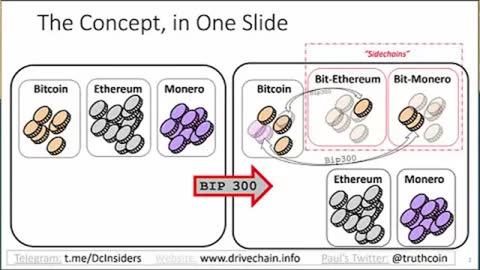
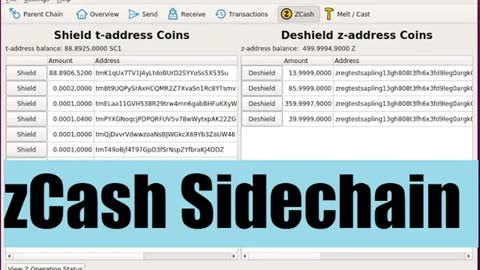
0:00 Okay, hi everyone. I've been asked to speak about BIP300, which is one of my ideas for taking Bitcoin to the next level. 0:13 So, it is in one slide. BIP300 proposes these new layer twos that some call sidechains. 0:21 Sidechains are a response to the threat of altcoins, but they're also a response to the desire of Bitcoiners for more creativity and innovation. 0:31 You know, the desire to try things without asking for anyone's permission. 0:35 So, the deal is, how can we let everyone try ideas that they like? 0:40 And how do I keep other people's bad ideas away from me? 0:44 So, that's the dilemma. So, here you see we have the world of altcoins on the left, and then the revenge of BIP300 on the right. 0:52 We've copied Ethereum and Monero into our own projects that respect the 21 million coin limit of BTC. 0:58 So, there's no inflation. 1:01 So, ideally with BIP300, if some annoying person asks, 1:05 Oh, sure, Bitcoin seems great, but can it do whatever? Smart contracts, DeFi, ZK-SNARKs, whatever, blah, blah, blah. 1:12 You just say, yes, Bitcoin can do that. See BIP300. That's the idea. 1:19 Similarly, if some innovator dreams up a crazy idea, like, hey, I can improve Bitcoin. 1:25 It only needs my new idea, which is, you know, the larger block size or KYC miner coins or whatever. 1:32 Then, similarly, they can now do that without anyone's permission. 1:37 They just don't do it on the Bitcoin base layer. They do it on a BIP300 sidechain. 1:42 So, that is the goal. 1:45 Developers can write any code they want. Users can use the code if they like. 1:49 Everyone gets what they want. 1:51 So, now I'm going to try to explain it with more detail and see if it makes any sense to anyone. 1:55 So, I'm going to go through three aspects of the idea. 1:59 Their full autonomy, protect the base layer, and improve mining incentives. 2:05 But before continuing, I did want to mention that this project is not vaporware at all. 2:09 We've had working code for a while. 2:11 So, the code is open source on GitHub right now. 2:14 And there's downloads with a GUI that regular people can use. 2:19 We even have a Windows version now. 2:22 And finally, there's a YouTube video of me, that's March 1st, using BIP300 on Testnet to copy the Zcash altcoin. 2:30 So, the software can be downloaded today. It's very usable. 2:33 So, this project is very far along, is what I'm trying to say. 2:37 Okay, now back to these three aspects. 2:39 Aspect number one is this full autonomy. 2:42 So, each BIP300 sidechain has its own app. 2:45 And you can change the sidechain software however you like. 2:48 So, it's just like making a new iPhone app. 2:51 So, this is a metaphor here. 2:52 Each app has its own development team. 2:54 The software they write can have any validation rules or no validation rules. 2:59 You can do whatever you like. 3:00 So, for example, you could add zk-snarks, larger block size, whatever. 3:03 Turing-complete scripts, taproot or SegWit, mimblewimble, monero, ring signatures. 3:08 You can do whatever you like. 3:09 Any idea, good or bad, can be done and no one can stop the person. 3:13 It's just like releasing a new iPhone app. 3:16 So, that's the idea. 3:17 The only constraint imposed on the BIP300 sidechain is that they respect the 21 million coin limit of BTC. 3:24 So, the project, when you make a new project, it starts with zero coins on it. 3:32 And then the coins, you have to send the coins from layer one to these other networks. 3:38 So, users have to voluntarily choose to send their BTC over to your software. 3:43 It's kind of like a lightning app. 3:44 So, I have like the lightning apps there and then I have the BIP300 sidechain over there. 3:50 By comparison, the Zcash altcoins don't move anywhere because that's just an altcoin. 3:56 There's not a BIP300 or anything. 4:01 This is going to be like a mega abridged for simplicity. 4:04 But the point of these next two slides is to try to show that an evil sidechain can't cause problems on the base layer, 4:11 which is obviously extremely important. 4:13 So, will it make any sense? 4:14 I don't know, but we're going to give it a try. 4:16 So, there are two blockchains here. 4:19 The squares are block headers and the trailing rectangles are transactions in each block. 4:23 And time is flowing from left to right. 4:26 And even though there would normally be tens of thousands of blocks in this period from December to April, 4:32 that wouldn't have fit on the slides. 4:34 Instead, there are only 17 blocks on layer 1 in blue beneath and 17 blocks above on layer 2 in red. 4:43 And so, now I'm going to add these things in green here, 4:46 which is to represent that three months of sidechain activity are compressed into this one little 32-byte hash 4:54 and 64-character string here. 4:56 And that string is put into layer 1 transaction. 5:00 The BIP300 operates entirely off of the little string plus a lot of logic. 5:04 So, therefore, the full nodes on layer 1 do not check anything that is happening on the sidechain. 5:12 So, they can ignore everything that is happening up there, which is the point. 5:15 The sidechain doesn't even need to be a blockchain. 5:17 It doesn't need to be written in C++. It doesn't need to be decentralized. 5:20 It could be anything. 5:21 The Bitcoin full nodes that are below won't have any idea what's going on on layer 2, and they won't care. 5:27 So, the point is that they can't be harmed by layer 2 because they are not looking at it at all. 5:32 BIP300 just looks at this little hash and does some very simple calculations on it, like addition and subtraction. 5:38 And that will tell layer 1 who wants their coins back. 5:41 But the hash is inside a layer 1 transaction that your full node is already looking at anyway. 5:47 So, I realize this is a little dense, but the first two aspects combined make a cool asymmetry. 5:54 So, this is very important. 5:56 Pay attention to this part if you ignore the rest of this. 5:59 The users can move coins among the networks. 6:02 So, like I was saying before, they can move the coins among the networks immediately and trustlessly 6:09 using the same HTLCs that are in the Lightning Network, actually, if you wanted to do that. 6:13 But they wouldn't be as fast, but you could still do that. 6:16 But in order for anything to go wrong, something very difficult has to happen. 6:21 And what needs to happen is a majority hash rate needs to attack the upper network here 6:26 for at least three consecutive months. 6:29 So, 100% of the blocks misbehaving, or whatever you want to call it, 6:33 for three months consecutively every block, or six months if they do it half-heartedly. 6:38 So, the point is it's extremely asymmetric. 6:42 It's very easy to use it right, and it's very hard to use it wrong. 6:47 So, that was the difficult part. We're almost through that. 6:50 We'll get better, I think. 6:52 Anyway, the third aspect is that we want to improve mining incentives. 6:56 This is technically BIP301, actually. 6:58 I separated the two BIPs to make them easier to read. 7:01 But I think anyone with a brain who uses BIP300 would use BIP301 also. 7:05 But you don't actually have to. 7:07 Anyway, with Blind Merged Mining BIP301, 7:10 the miners don't need to pay attention to sidechains at all, either. 7:13 So, the users were already not paying attention to any sidechains that they didn't like. 7:16 But the miners can also ignore sidechains, if they like. 7:20 They still collect all of the transaction fee revenues from the sidechain transactions, 7:25 even though they're ignoring it. 7:27 And, you know, how does that work? 7:29 Unfortunately, I don't have enough time to explain it. 7:31 But you'll have to take my word for it. 7:34 The design is that if the miners just do what they normally do, 7:37 and include this set of transactions on layer one, 7:41 and pay the highest fees to them, 7:44 which is exactly what they already do today, 7:47 then they'll automatically mine all the sidechain blocks 7:50 and collect the revenue from the transactions. 7:52 So, even if you did this today, 7:54 it would boost the transaction fee revenues to miners by at least 10x. 7:58 And I actually think it could boost fees by 1,000x, or even more. 8:03 But I don't have time to tell you about it. 8:05 I did write an article called Security Budget in the Long Run 8:08 that you can type into Google and find, if you like. 8:10 Security Budget in the Long Run. 8:12 But there's not enough time to explain it out here. 8:15 I will mention one thing, though. 8:17 If miners upgraded to activate BIP300/301, 8:20 that might be the last time they ever need to upgrade their Bitcoin software ever again. 8:25 Because they would start to automatically take care of the new software put on layer two. 8:31 So, that's more convenient for them, 8:33 but also more secure, as well, if you're worried about what happens on layer one. 8:38 Okay, so that was a little dry, but now it's better. 8:41 Because that was the idea, and I'm going to get into the examples, 8:44 the concrete use cases. 8:46 So, basically, these are some altcoins I think we should consider ripping off via BIP300. 8:51 So, obviously I mentioned the Zcash video already, 8:54 but Zcash has these transactions where the sender and the receiver and the amount are all private. 8:59 So, then we Bitcoiners have to put up with these comparisons like this, 9:03 where someone puts up this thing and says Bitcoin versus Zcash or whatever. 9:06 But if we had BIP300, this infographic wouldn't even make any sense at all, 9:10 because we would have our own bit Zcash that would do exactly the same thing that Zcash does. 9:18 Similarly, apparently there's this darknet market. 9:21 I don't actually know if this is true, but it seemed true enough to me, and I tried to figure it out. 9:26 Apparently there was this darknet market that decided to only accept Monero, 9:29 so they dropped support for BTC, which is kind of a slap to the face. 9:33 I mean, if we had BIP300, then there would be no reason for them to accept Monero at all, 9:39 let alone exclusively. 9:41 So, that's the idea behind that. 9:43 This is something that's really interesting, I actually think. 9:46 BitDNS was this idea that was proposed on Bitcoin Talk in 2010, 9:51 and it later became the altcoin Namecoin that many people have not heard of anymore. 9:56 This thread where it's proposed is something that really everyone should look up and read if they can. 10:01 It doesn't take that long, and it's very interesting. 10:04 So, in the thread, Satoshi just invents single-handedly what is now known as regular merge mining, 10:10 not the Blind Merged Mining I said before, but Satoshi just invents that in a post. 10:15 And then he casually assumes that there will be many different blockchains that pay different fees. 10:24 As if this were non-controversial. 10:26 This was 11 years ago, but now it's considered a very bizarre thing to say. 10:29 So, Satoshi just kind of makes some offhand remark that says something like, 10:33 people probably won't want to pay the high, expensive Bitcoin fees. 10:36 They will want to use a blockchain with cheaper fees. 10:39 And Satoshi just says that in 2010 or something, which I think is really amazing. 10:42 It's very different than what you would expect in 2021 today. 10:47 And also, people may use the CERN sidechain numerous times. 10:50 Back in 2010 with the space, which I found to be interesting, and someone was interested in that. 10:54 Before I had thought it, it had really started in like 2014, 2015. 11:00 Anyway, that's enough about that. 11:02 So, the concept of BitDNS is a weird idea, but I think it has tremendous potential. 11:07 So, I don't have enough time to talk about it, because I'm watching that time very carefully. 11:10 But, I did write an article about it a few months ago. 11:15 And this is the URL, Truthcoin.info.blog.bidnames, and you can find it. 11:19 And I'm going to try to give you a few images from the article, 11:23 and maybe you can then read more about it if you're interested. 11:26 So, this is a guy pretending to be Elon Musk on Twitter. 11:29 Are you all familiar with this? 11:31 Probably, it's not really Elon Musk, it's E-L-I-O-N-esque Musk-esque. 11:35 So, that's a problem that I think we can solve. 11:39 This is the Liberty Reserve website domain name 11:44 being seized by the United States Global Illicit Financial Team. 11:48 And this is a guy who does a YouTube video about chess. 11:52 He has a YouTube channel. 11:54 But, you can see in the bottom corner, he has to put all of his names, 11:58 and all of his names are like Facebook, Instagram, whatever. 12:01 And to add insult to injury, his Facebook name, 12:05 he couldn't quite get the exact same name as he had for the other things. 12:09 With BidDNS, or with BidNames, whatever you want to call it, 12:12 he wouldn't have to do this at all, 12:14 and everyone would just know that he has just the one name. 12:17 He would just have the one name everywhere, which is pretty cool. 12:20 And then we have our digital assets. 12:24 People like to collect things. They like tokens. 12:27 Even just for fun, it's fun to collect things. 12:30 But we have this problem that most of the NFTs are on Ethereum, 12:33 which is embarrassing, and it's terrible. 12:35 So if we had BIP300, we could just have a whole ERC-20 chain 12:39 that just specialized in that. 12:42 This is David Vork's project. I saw him earlier today, maybe in the room. 12:46 We're ripping off his project now. 12:48 But his project is very impressive. I like this project. 12:51 A lot of people know about it. 12:52 It's decentralized P2P cloud storage managed and enforced by the blockchain. 12:56 So it's been running for five years. 12:58 It would keep running if everyone there quit. 13:01 The storage cost is one-tenth of what it is on Amazon. 13:05 You can just sit at a blank computer, type in your seed phrase, 13:08 and automatically regenerate all your files on the computer. 13:11 It's very neat. 13:12 People never hear about this because 99% of projects, 13:15 the altcoin projects, are scams. 13:17 And so it drowns out all the useful projects, which is too bad. 13:21 But that is another thing that would be solved by BIP300 13:23 because no scammer would make a BIP300 sidechain 13:27 because you can't use it to extract money from people. 13:30 So I'm getting near the end. 13:32 This is the last example. 13:34 This is my own project, my other project. 13:37 I designed it to be a Bitcoin sidechain from the very beginning. 13:40 But if BIP300 never activates or something else like it doesn't activate, 13:43 then it will have to be an altcoin, which is horrible. 13:46 But please check out my cool project, bitcoinhivemind.com. 13:51 And I'm very passionate about it. 13:53 I gave some screenshots. 13:56 It's a cool website with a lot of information. 13:59 The software can do a lot of things, but a crowd favorite is Futarky, 14:03 which are futures markets for how well certain leaders would perform 14:07 if they were in charge. 14:09 And this idea is very distressing to bad leaders 14:12 because we can learn about exactly how bad they are going to be 14:16 before we vote for them. 14:18 So that's obviously very distressing. 14:22 On top of that, finally, though, 14:24 there's a lot of different things we could rip off. 14:26 BIP300 might improve Layer 1 because we might choose 14:28 to intentionally never change Layer 1 again. 14:30 Matt Corral was talking about this earlier. 14:32 This would have some serious benefits. 14:34 The big one is no drama 14:36 because right now there are people whose job it is to decide 14:39 which software changes make it into Bitcoin and which don't, 14:42 which is a horrible mess. 14:44 And people have very strong feelings about that kind of thing, 14:47 and they have to all agree, so the process is very dramatic. 14:50 But with BIP300, anyone can make their own Layer 2 blockchain, 14:53 and people can just go back to working on the ideas that they like. 14:58 I'm just going to skip the last slide because I have 10 seconds. 15:02 Final thought. 15:06 If you want to get BIP300 faster, the best thing is to learn, 15:10 and the best way to learn is to actually download the software and use it, 15:13 and then talk to other people about your experience. 15:16 So the software has a GUI. 15:18 We even have Windows executable, so that's the best thing. 15:21 Don't ask someone else. 15:23 Just download it for yourself and give it a try, and then talk about it. 15:28 And then also, final thought. 15:30 You might want to change the way you view altcoins. 15:32 They're not like weird rivals that are inherently evil. 15:34 Instead, they're just like this place where the technology is previewed 15:38 and tested out before we copy it into BTC. 15:41 So there we go. So that's the talk. 15:43 Okay, thanks very much. 15:45 Thank you. 15:48 ♪♪♪