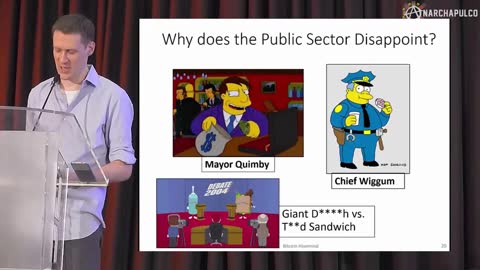
0:01 Okay, we're going to get started. Thank you everyone for coming out. 0:07 I think I know most of you. For those I don't know, hi, I'm Hannah. I'm one of the organizers. 0:12 We also have Ian here, and Chris, who I think has exited the room, but he's around somewhere. 0:17 So we're going to talk about prediction markets today with Paul. 0:22 But first, last chance to participate in the raffle if you want to win any of the cool stuff back on the table over there. 0:29 The Don't Trust, Verify, Hats, Cold Cards, Open Dimes, that good stuff. 0:35 You can go to that website right there, bob.shy.org, slash donate, and buy some raffle tickets. 0:43 We're going to do that after the talk. 0:45 So we are recording this, so if you don't want to be on video, just stay back there. 0:51 I don't think we're going to record Q&A. Are we, Ian, we're going to stop it there? 0:55 Yeah, okay. So the Q&A, when we get to the Q&A section, you will not be recorded. 1:00 Pizza will be coming later. We got some really generous donations today, so thank you to people who donated. 1:07 So we have the budget for pizza. Yay. 1:09 So that will be here soon. Please leave it there until we get to the Q&A, and then we'll all get up and chat and eat pizza. 1:15 We are going to mosey on down to the bar after this if anyone would like to join us. 1:21 And we do do lightning talks before the talk. 1:25 So that's – anyone can come up and tell us, you know, about some project you're working on, 1:29 whatever the case may be, for two minutes. 1:31 So do we have any takers today? Does anyone want to come up and tell us about something? 1:35 No? Shy crowd? Oh. 1:38 I just really want to quickly announce the conference is coming up. 1:41 Okay, we'll make that – 1:42 In case anybody doesn't know. 1:44 Do it properly. 1:45 I'm shy. 1:47 Keep it brief. Come up here. 1:50 Yeah, we'll be very brief. 1:52 So for anybody who doesn't know, we have a large conference coming to Chicago called White's Blockchain. 1:57 It's the second year. 1:58 It's going to be at Benju 610 on September 30th and October 1st. 2:03 That's Monday and Tuesday. 2:05 There's three stages over two days, 200 speakers, Fidelity, TD Ameritrade, Deloitte are among the sponsors. 2:14 And we have speakers from – everything from researchers with Monero and Enigma, SDGrad, 2:22 to the corporate side where we have, like, Samsung, SAP. 2:27 I think it's falling asleep. 2:29 And a bunch of corporate stuff, and then there's a track for the digital assets and markets as well, 2:34 obviously with TD Ameritrade and Fidelity. 2:37 And if anybody wants a discount, there's a code, BOB100, all caps, B-O-B-100, for $100 off tickets. 2:46 So I just want to make sure everybody knows it's happening. 2:48 All right. Thank you. 2:50 Anyone else want to come up and tell us anything? 2:53 No? All right. Cool. 2:56 On to the main event then. 2:58 So I think probably most of you are here because you're already familiar with Paul's work, but in case you're not, 3:03 we'll run through it briefly. 3:05 So you've been interested in market governance and prediction markets your entire life. 3:09 That's true. Yes. 3:11 Yeah, if you can stop it from falling asleep, that would be great. 3:15 That would add a lot of suspense for me. 3:18 I think. 3:20 That got lots of attention and lots of interest, and he left his statistician job at Yale to go build that. 3:26 That's true. 3:28 And then in 2016 started working on Drivechain, which is another really cool project. 3:33 We're not talking about that one so much today. 3:35 We're talking more about prediction markets, and you also do a lot of research, 3:39 which you publish on your website, Truthcoin.info. 3:43 That's it. 3:44 And he's going to be talking to us today about prediction markets. 3:47 We're going to do a bit of Q&A during the talk, and we'll also have a Q&A session afterwards. 3:52 You have to unlock it. 3:54 Unlock what? 3:55 Oh, yeah. 3:58 Slight technical difficulties. 4:00 Standby. 4:02 This is a very secure event. 4:04 All the projectors and the Wi-Fi, everything is extremely secure here. 4:09 Yes. 4:11 There we go. 4:14 Okay, good. 4:15 That would have added a lot of suspense to the talk if I had to move the slide once every one minute 4:20 or whatever that was before it shuts off the thing. 4:23 That would have been something. 4:25 Welcome, Paul. 4:26 Okay. 4:27 Thank you. 4:28 Thank you very much. 4:30 Thanks, guys, for inviting me. 4:33 Chicago is a super cool place. 4:36 Yeah, so we already kind of went through this, so I guess I'm not sure if I really should. 4:41 I'm from Summit, Connecticut, and I have a background in economics and some math and statistics. 4:49 I did work for the Yale Department of Economics. 4:51 The guy I worked for, Bill Nordhaus, won the Nobel Prize. 4:55 He was the most recent winner of the Nobel Prize, which is kind of cool. 4:58 So I feel like I should take credit for it by mentioning it. 5:03 And then I have a bunch of Bitcoin. 5:05 You know, I speak at Bitcoin conferences, especially the scaling conferences 5:10 and some other conferences, and that's really great. 5:13 But this is a talk about – oh, this is not sure. 5:15 Can we zoom maybe? 5:18 I don't think we are getting it 100%. 5:24 It's not like full screen. 5:25 Do you know what I mean? 5:26 Like it's kind of – 5:27 Oh, there we go. 5:32 Oh, yeah. 5:33 There we go. 5:37 Oh, they made it much worse. 5:40 All right. 5:42 Let's see. 5:44 Yeah. 5:46 What is it? 5:47 Yeah. 5:56 I don't see that. 5:57 Oh, there we go. 5:58 Okay. 5:59 Nice. 6:00 This is a very – okay. 6:01 No problem. 6:02 Okay. 6:03 So this is a – the topic of this presentation is an idea for getting the public sector 6:09 – and it's this scary red democracy blob – 6:13 to substantially inherit some of the reasonableness of the private sector. 6:18 So it's not about replacement, which most crypto cypherpunk stuff is. 6:25 It is not about replacing the public sector with the private sector somehow. 6:30 So it's about importing some features. 6:35 And here's the talk in one slide. 6:37 The problem is that politicians install bad policies into society and they get away with it. 6:43 And the solution is to make it easy to detect the imperfect politicians and get rid of them. 6:49 And specifically, we're going to create some blockchain assets whose ultimate valuation reflects a politician's competence. 6:56 So citizens are just going to glance at some prices right before they vote, 7:00 and they're going to pick the – they're going to vote for the person who has better numbers. 7:05 So people might have this information, for example, just before they vote. 7:11 And for every person running, those are the columns. 7:15 They're going to give forecasts about how life could be if the person is elected. 7:19 So you just compare. 7:21 The first row gets how much the government will cost. 7:25 And most people know that they're paying for that. 7:28 And the second row is how economically prosperous the citizens are. 7:32 The third row can cover all kinds of things like invasion, health care, mental health, gun safety, whatever. 7:39 That's kind of a macabre one, but this is just an example. 7:43 A person will just – a voter will just look at the two columns and they'll just say, 7:46 well, this is a better number, cheaper government, and I might earn more or someone will earn more. 7:52 And these numbers are kind of like the same. 7:55 I mean, this one's better, but, you know, they're similar. 7:59 So the talk is where do these numbers come from and why is anyone going to take them seriously? 8:05 Because it's easy to just put up a table here, but this is the – 8:08 so the talk is going to give – there's going to be some background knowledge, 8:11 and then I'm going to talk about why I think elections don't – you know, why they have trouble working, let's just say. 8:18 And then I'm going to talk about event derivatives, and then I'm going to combine all this. 8:22 And then the last point, we'll just ramble on and on for as long as it takes, 8:27 but it will be about how to get this idea to be persuasive enough to actually make a difference. 8:34 So – but the meat of it will be the first four points. 8:39 So the background knowledge that you need to have is that this idea is very old. 8:42 I even have a slide later. 8:44 This goes back – the general version of this idea goes back almost 1,000 years, 8:52 and there's even a quote about betting on who will be elected pope. 8:57 And this idea having been described as very old and widespread as of like the year 1507 or something. 9:06 But even this specific idea of futarchy for democracy is also pretty old, 9:13 and it's actually a favorite of a – well, okay, let me just stick to my notes here. 9:19 This is why I always do this. 9:21 Anyway, so the second thing is that I basically already implemented the idea, 9:25 and the third thing is that there's no kind of weird scam ICO or any other kind of weird scamming here. 9:31 So I'm going to drop some names. 9:34 This idea is a favorite of Hal Finney's. 9:36 Hal Finney wrote this post. 9:37 A lot of people think that Hal Finney was Satoshi Nakamoto. 9:41 He received the first Bitcoin transaction. 9:43 The idea is also a favorite of Robin Hanson's, who was endorsed by Ralph Merkle. 9:48 Ralph Merkle built most of the technology that ended up in Bitcoin. 9:54 This is a paper that was put out in order to convince the government to stop interfering with prediction markets 10:00 or event derivatives, as I prefer to call them. 10:02 It's signed by a ton of people, and a lot of them have won the Nobel Prize or will win the Nobel Prize, 10:10 or they're just these huge names. 10:12 So Hal Varians, chief economist at Google, Tom Schelling, Ken Arrow, these people all won the Nobel Prize. 10:20 This is just like a big – it's a big widespread list of extremely elite people. 10:28 Put out a little two-page paper to try and get some types of gambling less regulated, 10:35 but they didn't succeed, hence the blockchain strategy for this project. 10:42 So this talk assumes that someone will solve the so-called blockchain oracle problem in order to make these assets. 10:48 And I think that I've solved it, so there's nothing for you to worry about. 10:53 I wrote this paper about it a long time ago. 10:56 And here are some reviews of the paper, because going into that paper, that would be a lot of work 11:02 and it would make for a terrible talk, but you just have to take some of these people's word 11:07 and just kind of roll with it as being whether or not it's still worth your attention to pay attention in this talk. 11:13 But yeah, you can see there's Roger Ver, but there's also Adam Back, and then there's Peter Todd and Andrew Polster. 11:17 I think Andrew Polster is probably the brightest mind in the space, his critique of design-wise. 11:24 And so the paper spawned many, I would say all of the projects in this area, 11:31 some of which I'm more proud of than others. 11:34 But this one I like is the one at the top, which is that I oversaw its development personally. 11:40 It's a fork of Bitcoin Core, and it was assembled by two Bitcoin Core developers over a period of about 24 months. 11:46 And I run the project website where I put all the content. 11:50 Like today's presentation, we'll eventually end up there. 11:53 And here are some screenshots. 11:55 I just provide these to give you an idea that this is all test, fake information, 12:00 but there's still a lot of Vaporware projects in the space, 12:03 and so I just thought it would be cool to have some screenshots for people to look at. 12:09 This information here, this price data, will be ultimately where those numbers from the table come from. 12:18 Here's some cool screenshots. 12:22 So theoretically the project could be live with real Bitcoin by the end of this year, 12:28 but that's how software works. 12:31 Probably it'll take another 100 years in reality, but it's almost there. 12:36 But that's what everyone will say when they work on software. 12:39 And I finally have to mention that there's no ICO or utility token. 12:43 There is a second token, which often leads to misunderstandings, 12:46 but the second token is more analogous to mining. 12:49 So in Bitcoin, if you transact, you don't need to mine. 12:53 In this project, the users don't need to know anything about the second token, 12:58 and they don't need to own the second token. 13:00 So only if you want to go into that line of work would you care about it. 13:04 So the customers use Bitcoin only to create and trade in all the markets. 13:08 It's a Bitcoin-only project. 13:10 Okay, so that was some background information. 13:13 So why is the public sector so disappointing? 13:17 It's not like everyone hates it. I have a congressional approval slide later, I think. 13:21 But it's not just like libertarians are weird cypherpunks. 13:25 This is a mainstream culture that the public sector is terrible. 13:29 And it's really funny. You've got to watch. 13:31 YouTube has Best of Mayor Quimby. 13:33 It's really so funny if you are a libertarian person, 13:37 and you just watch the things he says, 13:39 and he blames problems on immigrants for no reason. 13:42 It's really funny. And people just eat it up. 13:45 And then, of course, the famous South Park episode, 13:48 the giant douche versus the turd sandwich. 13:50 I couldn't put that up. 13:51 But it's just so funny. 13:53 And when Eric Carpman rolls into the scene, 13:55 and he's trying to get people to vote for the candidate he likes, 13:57 and he just says, 13:58 this is the most important election of our lives. 14:00 And then you're just like, do people fall for that? 14:02 But then in the real world, people always fall for it. 14:05 It's very funny. 14:08 So you have to have a theory. 14:10 In order to improve something, you have to say, why is it broken? 14:13 So my theory is really about feedback. 14:16 So this is a basic feedback loop in the free market. 14:18 You have a terrible product being sold. 14:21 Customers hate it, and they stop buying it, 14:24 which punishes the merchant. 14:26 You've got to make or sell something that carry goods that people want. 14:31 So a free market doesn't mean instant utopia, right? 14:34 But it does mean that things improve. 14:36 You have some recourse if stuff isn't good. 14:38 Things improve basically as fast as they possibly can. 14:42 So the public sector also has feedback, which is called voting. 14:49 And when the government is too unsatisfying in any way, 14:52 it can be dismissed with a majority vote. 14:57 Now, it's a little more complicated than that, 14:59 but it's not important to really go into the details of it. 15:02 This is basically the gear of the machine. 15:04 So you're firing people with this secret ballot. 15:07 So the free market feedback differs from electoral feedback. 15:13 We know that's the case because one of them works pretty well 15:15 and the other one doesn't really work that well. 15:18 Frequency is one difference. 15:19 The market feedback fires every time a merchant loses a sale. 15:22 That's millions of times per day. 15:24 But the electoral feedback fires once every four or two or six years, 15:27 however often the election is. 15:30 But I think that difference is very small. 15:32 The real difference is this idea that I'm going to call research 15:35 because I couldn't think of another name for it. 15:39 And there's more feedback than you originally thought 15:42 because when a disappointing sale is completed, 15:45 the consumer suffers and the desire to avoid suffering 15:50 stimulates the consumer's search for alternatives. 15:54 And I call that search effort research, for lack of a better word. 15:58 And the interesting thing is that in both sectors, public and private, 16:04 you have to do your own research and you have to pay for it. 16:07 Research consumes your scarce resources, especially your time, 16:10 but not limited to your time. 16:12 And the important thing is you research a lot. 16:14 So if you're buying a house, you research a lot. 16:17 But if you're just picking out a hotel room, 16:19 you still do a little bit of research, but you don't do that much 16:22 because it doesn't matter as much. 16:23 You'll be out of the hotel room soon. 16:25 But if you want to do some cosmetic surgery or something, 16:27 you would do a ton of research. 16:29 But if you're just buying a new pair of shoes, less research. 16:33 The problem with elections is that your single vote will almost never affect the outcome. 16:37 So people pretend that their vote matters in order to feel important, 16:41 but really they know it doesn't matter. 16:43 So if you master the issues and the candidates, you just wasted a bunch of your time. 16:47 It won't actually change your life in the slightest, 16:50 so there's no reason to really look into it. 16:53 This is obviously a big oversimplification, 16:55 but I think it is the main thrust of what's going on. 16:58 Voters usually admit that they don't know what they're doing, 17:02 and 71% of people can't even name their congressional representative. 17:06 You only have one of those, so it's even easier than remembering your senator's name. 17:10 There's two of those. 17:12 But if you can't remember the name, 17:14 how are you supposed to compare that person's performance with the rival? 17:20 It's very funny. 17:21 A lot of people, they do these gotcha questions where they ask people, 17:24 like, who was Hillary Clinton's running mate? 17:26 And people, like two or three weeks after the election, 17:29 people just forget. 17:31 People just don't even remember. 17:34 But I don't blame them because it's rational, as I've just indicated. 17:37 There's no reason to look into it at all. 17:40 It's just a waste of your time. 17:42 So on election day, if you go and get breakfast somewhere, 17:45 you're going to weigh all the costs and benefits of different breakfast foods, 17:49 but when you go in to vote, 17:51 you won't really know anything about the costs or the benefits. 17:53 You just haven't looked into it at all. 17:55 And I know people who have admitted they go in there and they're like, 17:58 this person had a nice name or whatever. 18:01 They can't remember a single thing about it. 18:03 Or they have no idea. 18:04 You go in to vote for president, 18:06 but then you have to vote for city council or something. 18:08 And you're just like, I don't know who these people are. 18:10 People make a zigzag pattern or something. 18:13 So that's what we're dealing with here. 18:15 It's just like controlling society. 18:18 But an implication of this theory that the research is the issue 18:22 is that the strategy of educating people in order to make them libertarians, 18:26 which is very popular, or make them experts in economics, 18:31 which is also, you know, that strategy won't work 18:35 because it will never solve the problem. 18:37 It's noble and worth doing in the same way that chemistry and music are worth doing 18:43 and like bird watching is a real skill 18:45 and mastering the skill of bird watching can be fun. 18:48 But ultimately, if persuasion were effective, 18:50 then the elections themselves wouldn't be so problematic. 18:53 The lay person is never going to be as smart as a specialist by definition. 18:57 The specialist has looked into it with their spare time. 19:01 So, you know, if you think that Friedrich Hayek is right 19:05 and that knowledge is diffused among lots of different people, 19:08 then it's actually going to be tough for you to have the experts be as smart 19:13 as the 51% of lay people who will be voting. 19:16 And teaching them is just another way of saying that you can't solve the problem 19:21 because the research incentives are the whole problem in the first place, as I've argued. 19:25 So that's me complaining about what I think the problem is, 19:28 but now this is where the solution starts to take place. 19:32 And as I've said, the solution is to have people show up on election day 19:36 and open their cell phones and check some prices. 19:39 And it should be as easy as checking an NFL score or the S&P 500 19:42 and then they just vote for the candidate with better prices. 19:44 But the question is, prices of what? 19:47 And this is an example from InTrade. 19:49 So we have the InTrade example. 19:51 One of the first of many, maybe. 19:55 This is a graph of prices of something called a prediction market or an event derivative. 20:01 And it's an asset that pays you money if something happens. 20:04 If it happens, you get paid. 20:06 If it doesn't happen, you don't get paid. 20:09 And so this was created in 2011. 20:14 It ran from 2011 to the end of 2012. 20:17 The bet would have been worth $1 if the year 2012 had been the warmest year on record, 20:24 as reported by these NASA satellites that measure surface temperature. 20:29 And they put it on a website where anyone can look at it. 20:32 If that doesn't happen, the asset's worth zero. 20:34 If it does happen, the asset's worth $1. 20:36 This is the price in cents on the right. 20:40 And the asset traded at 40 cents in January 2011, over here, 40 cents. 20:50 But then as 2012 went on, this is January 2012, 20:54 it became clear that 2012 would not be the warmest year on record. 21:01 And so the price collapsed. 21:02 But 2014 was the warmest year on record for those of you who are interested. 21:07 So this topic often shows up, betting on elections, 21:12 in a way that is slightly interesting but annoying for me 21:15 because people are interested in the least subversive aspect of it, 21:21 which is that people like to do this type of betting, betting on who will win. 21:29 Oh, excuse me, I had a pretty good note and I'm going to go back to it. 21:31 The big difference between this and betting, 21:34 with betting, the odds are fixed, usually at 50-50. 21:38 But that's not very interesting. 21:40 With these assets, the market price is going to co-vary with everyone's behavior. 21:46 And so that is why it can change and reflect the objective likelihood of the event in question. 21:53 Anyway, as I was saying, people like to use election betting in this way, 21:57 and this is the type that is popular for many hundreds of years. 22:00 There are assets that pay out of the candidate. 22:02 These assets pay out if the candidate wins the 2016 Republican presidential nomination. 22:09 After the Iowa Stroup poll, Trump's price plummeted and Rubio's did very well. 22:17 But eventually, when Trump won, whatever, South Carolina, 22:22 yeah, it surges up to, and this is about 80%, 22:27 so you can see that various events happen and make certain candidates more or less likely to win. 22:35 But this is not what I suggest that we do, and I think I put, yeah, I put a big N, no, 22:40 because this is very boring. 22:44 And I'm going to describe what we should do instead. 22:47 This certainly makes election years more fun, but it only tells us who is likely to win, 22:53 and that's not what this idea is, the Hal Finney, Robin Hansen idea, my idea, 22:59 is to change the outcome. 23:04 We want to change who wins. 23:05 We want the bad people to lose, and we want the good people to win. 23:09 And so in order to explain that, I have to explain just a tiny bit of statistics, 23:14 and this is nine slides. 23:18 The first two are super easy, and four of them are really one slide that is just broken into four pieces. 23:25 Anyway, so on the left, I have a series of coin flip events. 23:30 In this table, we are describing the behavior of the 303rd coin flip event, 23:36 which we can't see because it's in the future, or it's unknown for whatever reason. 23:43 We don't know what will happen in the flip, but we know that we can fill it in. 23:46 50-50, it's so easy. 23:48 It's the easiest example ever. 23:49 That's why everyone uses it first. 23:52 This is the same thing, but with a dice roll instead. 23:55 There's some list of dice rolls somewhere in the universe, 23:59 and we don't know what the outcome will be, 24:02 but we know that there are six, and not one is more likely than the other, 24:06 so each has one sixth probability. 24:09 So those are the first two that are super easy. 24:11 This one starts to get a little difficult. 24:15 This example is the previous two examples smushed together. 24:19 So we have the coin flipping green along the left vertical edge. 24:22 We have the dice roll across the top horizontal edge, 24:26 and I have some probabilities circled in red. 24:30 The probability that two will be rolled is one sixth, 24:34 and the probability that our tail will be flipped is still one half. 24:38 It's all the way over there. 24:42 Those are called marginal probabilities because they're written in the margin, so to speak, 24:45 and the probability that both of those events will happen is one twelfth, 24:49 so probabilities multiply together. 24:53 Now we'll talk about relationships among events. 24:56 I'm going to draw a contrast between these two tables here. The first table has coin flip 305 and coin flip 304. 25:02 They're both about unknown future coin flips, but in the second, something very unrealistic has happened, 25:08 something very bizarre, which is that someone has plotted coin flip 304 against itself. 25:17 It's only useful for teaching purposes. This would never happen in the real world. 25:22 But if it did, what probabilities would we write in the table? We know what we would write, 25:26 and it's not 25, 25, 25, 25. It's 50 along the diagonal and zero because 304 is either going to be heads or it's going to be tails. 25:35 And then I have the example again with the dice. 25:38 Say that some crazy person again is plotting the same dice roll against itself. 25:43 Well, if the dice is either going to be four or it's not, 25:46 so the probabilities are one sixth across the diagonal and zero. 25:50 So what I'm getting at is that there are a lot of values that are logically impossible if the events are related. 26:00 So the more related the events are, the more they clump up along this line. 26:05 So relatedness equals clumping is the point. 26:10 So all we do is measure these two things at once, and we look for the clumping. 26:14 So you build assets that only pay out on the entangled information. 26:19 So you say instead of just will candidate X be elected, 26:23 and separately, instead of just will American voters earn higher incomes, 26:27 you build something that only pays out if they both happen, if the candidate is elected and people win. 26:33 So it's zero otherwise. 26:35 It's very likely to be zero now because there's three ways of it being zero and only one way of it being worth a dollar. 26:40 So of course, as you divide the probability space, they all get smaller, 26:43 but you can buy them in pairs or sets and things like that. 26:48 And so what you ultimately do is you make these four different markets, 26:53 and you divide them by the probability space. 26:57 And so what you ultimately do is you make these four different markets for each, 27:03 and you just look for the clumping. 27:06 If it clumps, then they're related. 27:07 So then it would be candidate X is causing American incomes to go up. 27:13 So that is how you get to... 27:20 Anyway, this is the synthesis. 27:22 I think I'll skip this part. 27:24 So this is where these numbers come from. 27:36 Anyway, the laypeople never have to see anything complex. 27:38 They just have to see this table. 27:40 And that is how you get these numbers to show up. 27:43 Maybe I should actually emphasize this. 27:46 You have these, and you just do a little adding and dividing, 27:50 and you get whatever the situation is. 27:53 You can just reduce it down to this one conditional likelihood. 27:59 So here it's like Elon Musk has basically no chance of being elected. 28:04 His odds of winning are less than 1%. 28:07 But if he is elected, the economy is not going to do poorly. 28:13 All of his, 100% of his .009 points are in the yes. 28:18 The value that he's got, all of them are in the yes. 28:22 But regular voters wouldn't need to do that or do any arithmetic. 28:24 You could just show them this table. 28:27 And this is where all these numbers come from. 28:30 Now there's a lot to say about why would anyone ever care about this. 28:36 So the plan collapses if no one cares enough to trade in the markets 28:41 or look at them on election day, 28:44 something I call no trade and no attention. 28:51 So no trade, how do we get knowledgeable people to trade? 28:55 It's actually a pretty severe problem. 28:57 There's more in trade. 28:59 We've got three more in trade screenshots. 29:03 So this is what happened on in trade. 29:05 There were low trading volumes. 29:07 As someone who loved the site, it was my favorite site really on the internet at the time, 29:13 more than half the markets had zero trading as far as I can remember. 29:16 This was pitifully low. 29:18 Here's just a few that I could find on the internet. 29:21 And the volume is these bars and I deliberately changed the saturation 29:25 because it was almost invisible before. 29:27 But maybe you can still see some of them a little bit, these lines here. 29:32 And this is the volume scale. 29:35 It's quite pitiful. 29:37 In trade is so long ago that I couldn't remember 29:39 if this is number of contracts or notional value. 29:42 Since the price on in trade always ranged from $0 to $10, 29:46 you can only be off by half an order of magnitude. 29:49 And the price here is $150. 29:52 Anyway, the point is that this is on its best day, 29:56 something about whether or not Obamacare is declared unconstitutional. 30:02 That was like $1,000 in volume in a day 30:06 for something that affected obviously trillions of dollars in healthcare expenditure. 30:10 And then this is something about Hamas and Israel 30:13 that apparently no one cared about at all. 30:15 It had like $40 of trading in a day. 30:18 And here's something important. 30:20 The U.S. entering a recession in 2012, 30:25 but no one cared, $60 per day on its absolute best, 30:28 assuming that it's notional value instead of number of contracts. 30:32 These are the only markets that I was popular enough for someone 30:35 to screenshot them and write like a blog post about them 30:37 so I could even find them. 30:39 This is an issue. 30:41 It's greatly, I think I'll come back to this. 30:44 It's greatly exacerbated when you split the market into more states. 30:48 So you need at least four buyer-seller pairs of people 30:51 to get a full table of prices. 30:56 And the problem is, oh, here we go. 30:58 And yeah, and I want there to be many states 31:01 because then we can get many conditional probabilities as I explained. 31:06 So we want to like make this thing really big. 31:08 But this is something with 24 states, 31:10 and you'd really need people to be buying and selling each of those. 31:13 So this is a big problem. 31:16 Yes. 31:18 The problem gets much worse 31:21 because prediction market transactions have no consumption element. 31:25 They're 100% synthetic. 31:27 They're like artificial markets. 31:29 So in a prediction market, you're only betting 31:31 when you think everyone else has it wrong. 31:33 You're a speculator. 31:35 So you need to believe that you're smarter than all the other traders. 31:38 In contrast, when you buy milk over here, 31:41 it's just because you want to buy milk. 31:43 You don't like go look around the supermarket and think, 31:46 aha, all these suckers think they know milk pricing, 31:49 but they don't know what they're talking about. 31:52 This milk's a steal at $2.99. 31:55 They're going to regret this later or something or whatever. 31:58 You just want to buy the milk because you want to consume it. 32:02 And it's actually, I think it's the same 32:04 if one person invests in the stock market for retirement. 32:06 Obviously, you prefer to get the best price you possibly can, 32:09 just like you prefer to get the best price for milk. 32:11 But really, you just want your portfolio to have a certain risk-reward thing. 32:16 So you have a reason for buying them. 32:19 And prediction markets do have some consumption elements. 32:22 You can use them for insurance or for recreational gambling. 32:25 If you use them just to have fun, 32:27 then you're just having the fun that you wanted. 32:30 And you can use them for insurance. 32:33 I'm going to bet that Trump wins the next election 32:35 because I don't know what I'm going to do with my life if he wins, 32:38 so I want at least to get a ton of cash if he does win. 32:41 And in that case, it's more like a consumption thing, 32:44 but in general, it's very synthetic. 32:46 It's this very kind of artificial thing that's happening. 32:51 And so this all makes it much worse. 32:53 But fortunately, there's a way of solving that problem completely, 32:58 and it's actually the same solution as the second problem. 33:00 So I'm just going to ramble about this second thing and then get to the solution. 33:03 But I think this type of thing that does interest me tremendously, 33:07 this is the second problem of no attention. 33:10 So how do you get people to care on election day? 33:12 Why would it actually make any difference 33:14 when lots of other people have tried to make a difference in the past 33:17 and try every four years using everything they can to push for their side, 33:21 and they don't make a difference? 33:23 Well, we have to consider some facts, 33:25 which is that election outcome is very sensitive to voter turnout, 33:28 and voter turnout is very sensitive to this lack of knowledge or this frustration. 33:33 And prediction markets provide knowledge which can influence outcomes. 33:36 So I have some slides about this. 33:38 One is that people will be on their phones because they'll be in line. 33:41 So this is the first Google result for election line, 33:44 and there's two people who are on their phones in the screenshot. 33:47 So we've got them on their phones. That's the easiest part. 33:50 But the other thing I wanted to list of things that I want to mention 33:53 is that the victory margins are actually very narrow. 33:57 This is the presidential popular vote. 34:00 It's actually pretty narrow, 34:03 and you can see the red and blue bars are about the same length. 34:08 And voter turnout is very low. 34:11 You can see how low it is here. 34:13 For the midterm elections, which are the congresspeople who actually make all the laws, 34:18 Congress is more important than the president for, like, good policy, I think, in my opinion. 34:24 But you see for president it's like 60%, 34:27 and for the midterm congressional elections it's like 40%. 34:31 It's very low. 34:33 If all the people who didn't vote formed their own political party, 34:35 they could beat the other two parties combined. 34:38 So it's actually quite low. 34:40 And you may think that maybe it's low just because everyone's okay with what's happening. 34:45 Everyone's just like, everything's going great, so it doesn't matter because I won't vote. 34:48 But actually, everyone really hates Congress particularly. 34:53 This is actually the low, the one with the low turnout. 34:58 And you can see it's in our modern era. 35:01 I actually do think it was below 10% for at least, 35:05 I remember Jon Stewart making a joke about it before he went off the air. 35:08 Someone, he had Nancy Pelosi on or something, 35:11 and then right before I cut the commercial he said, 35:13 good luck getting that approval rating back up to 9% or something, 35:17 and then she tried to say something and it just cut away. 35:20 That's funny. That's funny. He's a funny guy. 35:23 Anyway, so why, when people are surveyed anyway, why don't they vote? 35:28 They say, well, you know, they hate both the candidates 35:30 and they don't know which candidate is worse. 35:32 I mean, that's the reasonable position to take. 35:35 And they just think, they don't know what to do. 35:39 But that's exactly where this project could help. 35:44 So at this point, the critical, I have to say, the FUD agent here, 35:49 I have to say, ignore all prediction markets because they're stupid, 35:53 or prediction markets are great, sure, 35:56 but this one in particular about my favorite candidate, whatever, 36:00 is one you should ignore. 36:03 So I'm going to do these one after another. 36:05 The first, though, is going to be tough because it actually has 36:07 a strong track record of accuracy. 36:09 Since they do work, people will learn over time how accurate they are. 36:15 The other thing that interests me is that it's actually a very old idea. 36:18 I have this and I have this other one about Google Trends for InTrade 36:21 and some CNBC appearances. 36:23 But in general, this idea of betting on elections and obsessing about it 36:29 is actually extremely old. 36:31 And I have this quote here about whatever, 36:33 wagering on selection for offices in the Catholic Church. 36:37 Odds on papal succession appear as early as year 1503 36:41 when such wagering was already considered an old practice. 36:46 There's a bunch from the U.S. I have two down here. 36:49 Well, I'll just read this last one. 36:52 This is from Andrew Carnegie in 1904. 36:54 From what I see of the betting, I do not think that Mr. Roosevelt will need my vote. 36:58 I am sure of his election. 37:00 Andrew Carnegie in 1904. 37:01 The New York Times used to publish the prices. 37:04 So actually, I think it is. 37:07 People will warm up to it. 37:09 I think they already like it, actually. 37:11 The strategy is to ramp it up over time by betting on things 37:14 that people already love betting on, 37:16 like Super Bowl, March Madness, Oscars, Tonys, whatever. 37:22 So you can get people familiar with the institution 37:24 in a context that is not as subversive. 37:27 And then they'll eventually have to say that prediction markets are great. 37:30 So we're still... 37:32 Oh, I skipped two slides, but that's okay. 37:35 What I wanted to finish my thought is we'll still have this second problem 37:38 where someone will say, sure, prediction markets are great, 37:41 but this is one you should ignore. 37:43 So let me get back to that, though. 37:45 I do want to mention that eventually almost every source of information 37:49 will be biased or captured by people who want to use it. 37:55 It's like how they get Bruce Springsteen to endorse someone, 37:58 which is like, I love Bruce Springsteen, but what difference does it make? 38:02 He endorses a Democratic candidate. 38:04 What does it mean? 38:06 But the point is that... 38:08 So one example is debates. 38:11 Everyone, when a Democrat watches a debate, 38:13 they're certain that the Democratic candidate won. 38:15 And when a Republican watches a debate, 38:17 they're certain that the Republican candidate won. 38:20 And that's because this source of information about the candidates 38:25 requires some kind of interpretation. 38:27 But in these prediction markets, there's only one interpretation. 38:30 It's just what numbers the people are probably going to hit. 38:32 And it's the same interpretation for everyone. 38:34 So people have to fold and say that these markets are unhealthy 38:37 or manipulated or something, which is what I'll get to. 38:41 Another thing is that it's tiresome to listen to all these politicians speak 38:46 and all their supporters speak about things, 38:48 because everyone knows that it's all nonsense, 38:52 but we sort of put up with it anyway. 38:54 Like people will say, oh, my favorite candidate is Andrew Yang, 38:58 but he came out for a higher minimum wage, 39:01 even though I'm a libertarian or whatever. 39:03 But he didn't mean that. 39:05 And it's like, well, what does anyone mean then? 39:07 It just becomes kind of nonsensical. 39:10 But in this paradigm, things are very different. 39:13 Politicians would start competing on the metrics. 39:15 So in order for their number to go up, though, 39:17 they have to actually hit the target in reality. 39:19 It doesn't matter what they say. 39:21 It makes absolutely no difference what they say, 39:23 just what the market believes. 39:24 So as a kind of crazy example, 39:26 a politician could announce that they want everyone to die 39:29 and that if elected, they'll kill everyone. 39:31 But if traders don't actually believe that, 39:34 traders survive, will survive somehow. 39:36 They'll kill everyone except the traders. 39:38 But if the traders don't actually believe that, 39:40 then the death number, that third row from before, 39:43 that won't actually move. 39:46 Because it's only about, 39:49 the asset only pays out much later 39:51 when the event is actually measured. 39:53 So this is just a different world 39:55 where you just don't have to listen to. 39:57 I mean, it's possible that, 39:59 I mean, in the ideal, my sort of ideal world, 40:01 the ideal world of this idea, 40:03 the politicians would just kind of put out 40:05 some PDF document of their plan 40:07 and then they just wouldn't speak again 40:09 and then the election would just happen. 40:11 And there would just be no speaking at all 40:13 and none of these weird rallies or this weird other stuff. 40:15 So that's kind of the idea. 40:17 But we still haven't addressed these two lingering issues, 40:20 which we will now, 40:21 which is about how do we get people to, 40:24 I'm sorry, this paragraph I didn't read 40:26 is about what I was saying about the strategy involving, 40:29 how it's different from milk and stuff. 40:31 So it's not really that important. 40:33 But yeah, you can have, 40:35 many of the in-trade markets 40:37 had very little liquidity and very few trades. 40:40 Some had no trading, literally. 40:42 And so we're going to solve that 40:44 with this sort of standing army of automatic traders 40:46 that I'm going to explain. 40:48 And then you have people 40:50 try to stigmatize one market and say, 40:52 this market is a bad one, this is a bad egg, 40:54 don't pay attention to it. 40:56 But we can actually make it, 40:58 it's the same solution for both points, 41:00 we can make it so that, 41:02 you can create a market such that X dollars 41:04 can always be earned by betting in it. 41:07 You know, if the prices are wrong, 41:09 you disagree about the price, 41:11 you can always extract X dollars out of it, 41:13 even if no one else on earth is trading. 41:15 And then the plan is to make X like a million dollars or something. 41:18 That would be very persuasive to a layperson voter. 41:22 Someone living in a swing state, 41:25 in like Ohio or whatever, 41:27 they're going to be like, really? 41:29 There's millions of dollars at stake if the prices are wrong, 41:31 but this guy is saying that I should ignore this? 41:34 Even though there's millions to be won? 41:36 I mean, as much as possible, ideally. 41:38 But, okay. 41:40 So, yeah. 41:42 This is Robin Hanson's response to this critique, 41:44 which is that you don't have to get the information for free, 41:47 you can buy it, 41:49 and you're going to use this sort of sacrificial trade 41:51 that loses against all the outcomes at once, 41:54 using something called the market scoring rule. 41:56 And this presentation is almost over, 41:58 there's a million things in it, 42:00 but it's winding to its end. 42:01 This is the last part. 42:03 So, this market scoring rule is very different 42:07 from the way trading usually happens. 42:10 And I'm just going to go through it. 42:13 And I don't know, this is like the first time I've tried to explain it, 42:16 but it has many differences. 42:18 One is there's no offers, there's no bids, asks. 42:21 Stuff just happens immediately. 42:23 Let me see, I should put some of my notes. 42:26 So, everything just happens. 42:28 There's no bids or asks, you just start with someone, 42:30 and then a trade happens, and, oh well. 42:33 Okay. 42:34 Another difference is there's no interaction between buyer and seller, 42:37 you just interact with this one fixed thing in a big line. 42:42 And there's no limbo. 42:44 So, this limbo is this thing here. 42:46 So, this is a usual timeline, 42:47 it's called a double auction market, 42:49 where some people do bids and some people do asks, 42:51 and they overlap, 42:52 and you have to wait until they overlap for a trade to happen. 42:54 So, this is how everything normally works, 42:56 probably that you've ever seen in your entire life. 42:59 And it's, someone creates this market, and the market exists, 43:02 and trader one submits a bid, 43:04 and this bid is hanging in limbo. 43:07 And trader two sees this buy wall, 43:10 and they see the bid, 43:11 and they say, okay, I'll take it. 43:13 I accept it. 43:15 And then, it transacts for both of them. 43:18 This person sells, and this person buys. 43:20 So, the thing goes here, and the money goes up to there. 43:24 But, in this scoring rule thing, 43:27 you create a market, 43:28 and you put some sacrificial cash up front immediately. 43:33 And then, when this person wants to buy, 43:35 they can just do so immediately, 43:37 without interacting with anyone. 43:38 It's just very atomic, it just happens. 43:40 And then, the market changes state. 43:43 So, the market's gonna change state 43:44 in a big line of state changes, 43:46 and the latest state will be the real state. 43:51 So, it fits really well with the blockchain. 43:54 And then, when the person wants to sell, 43:56 they just interact with the market directly. 43:57 So, they don't have to do anything, 43:59 and there's a, this is a weird example, 44:03 but to try and give you some example, 44:05 some instance of what happens here, 44:08 is that the first thing that happens in the timeline 44:10 is that you put some money here, 44:12 in this sort of seesaw. 44:14 So, you have this election that has two states. 44:16 Normally, you'd create a market for like a no asset. 44:19 In this case, there's only two, 44:20 so the no and yes would be exactly the same, 44:22 so you'd only have one of them. 44:23 But, the point is, you could have a bunch of stuff, 44:27 no shares, stacks of paper that are worth a dollar, 44:30 if Hillary Clinton is elected, 44:32 and worth nothing if she is not elected. 44:35 And then, here would be the reverse. 44:36 They'd be worth a dollar if she is not elected, 44:38 and nothing if she was not not elected, 44:42 if she was elected, so. 44:45 Anyway, then you'd have these markets here 44:47 that have these prices. 44:49 Each of them would have their own price, 44:51 and you'd swap money for little receipts, 44:55 little pieces of paper. 44:56 That is how it would normally work. 44:57 But here, you start it off, 44:59 and you put some money in the center. 45:01 The trader, and then the trader could buy some 45:04 by putting money on the left side. 45:06 And as they buy, 45:07 they'll be bidding up the price of no up, 45:10 so these are reversed. 45:11 It's from zero to 100%, 45:14 or 100 cents on the dollar. 45:16 So, as you buy, you'll be tilting. 45:18 You'll eventually be betting against yourself, 45:20 if you put too much money on here. 45:21 And you'll be buying something for $1 a share 45:24 that could be worth, at most, $1 a share. 45:28 But then, if you buy, the price of yes will go down. 45:31 This, in Euclidean space, it will go up, 45:35 but this price of it will go down. 45:38 And traders over here would then maybe buy more shares. 45:42 When you put some shares on this at a lower price, 45:44 there's like an automatic machine off the side 45:46 that's printing out receipts. 45:47 It watches people put money and take money off of this, 45:49 and it gives them receipts. 45:50 If you want to sell, you put receipts back in the machine, 45:53 and it lets you pull money off of the seesaw, so to speak. 46:01 This is an example 46:04 describing the market state. 46:07 This is in Microsoft Excel. 46:09 If any of you want this, it's on the website, 46:11 along with a lot of other examples. 46:13 But you start out with zero shares issued of each. 46:17 So, like, Hillary wins, Hillary loses. 46:20 You start with zero, but it costs 485 units, 46:25 45 Bitcoin, $45, whatever. 46:27 But it costs that much to create this in the first place. 46:31 That's the hippo money in the middle. 46:33 And then someone buys. 46:34 They have to pay .51, but they get one share. 46:39 And it alters the prices. 46:43 And then when this person wants to buy six, 46:45 they have to pay 3.4. 46:47 And so this time is flowing down this way, 46:49 and you just keep updating these states. 46:52 At the end, no matter what happens, 46:54 you can never need more than this. 46:56 No matter how many shares are bought and sold, 46:58 you'll always have enough. 47:00 It's fully collateralized to redeem 47:03 when A equals zero actually happens. 47:07 42 people have shares somewhere, 47:09 and you need 42 units, $42 or whatever, 47:12 to pay them back. 47:16 So, now the cool thing is, 47:19 the math is totally indifferent to the number of states. 47:22 So I said before, it's terrible with a lot of states. 47:25 But in this case, it's actually completely fine. 47:27 And in fact, something grows. 47:29 The required amount of capital grows logarithmically 47:32 with the number of states. 47:33 So you have a seesaw in the example I gave, 47:35 but if you wanted to do the cross that I described 47:38 with four states, 47:40 then you just have some money in the middle, 47:41 but it's in the middle of a four-way pyramidal seesaw. 47:45 And then this is kind of like a plate on a pin or something. 47:49 And you can have as many states as you want, 47:51 all with the same initial money in the middle. 47:54 And that means that everyone will be able to... 47:57 this solves the problems I mentioned before, 48:00 because someone will always be able to trade at any time, 48:06 and you can have huge amounts of money in the center 48:11 that's a small amount of money in the grand scheme of things, 48:14 maybe like $1 million or $2 million, 48:16 but would be very persuasive to someone. 48:19 You say, ignore this market, 48:20 but you say, actually, if the prices are wrong, 48:22 if the price is off by 5 percentage points or something, 48:26 someone could make $100,000, $200,000, $300,000, $1 million, 48:30 then people will be like, I'm not going to ignore it, 48:34 because there's a lot of money I could earn if it was wrong, 48:36 and there's a lot of money that anyone could earn if it were wrong. 48:39 So that is... 48:41 and as again, this section of the talk could probably go on forever, 48:44 but I think it's winding down at this point. 48:46 Let me see. 48:47 So, yeah, I'll just skip all this. 48:51 So, yeah, this is the very last part. 48:53 I think two slides. 48:54 So it's like, where would you get the money? 48:57 But actually, I think when the time comes, 49:00 if the money is needed, 49:01 like if there really is someone creates the markets 49:04 and they're stalling out 49:05 because there's not enough trading activity, 49:09 I think it would actually be pretty easy to get the money, 49:12 because you can draw a comparison 49:13 to three other types of donation activity. 49:15 So we have donations to presidential candidates, 49:18 super PAC donations, 49:20 and donations to, like, a charity 49:22 that helps keep politicians honest, 49:24 for example, the Annenberg Political Fact Check. 49:29 And you can see that actually, 49:31 just in terms of money raised, 49:32 it's unbelievable as much as Bernie Sanders 49:35 raised $18.2 million in just six weeks, 49:38 Kamala Harris raised $12 million in quarter one of 2019, 49:43 Pete Buttigieg $7 million, 49:45 Elizabeth Warren $6 million. 49:47 The super PACs in fiscal year 2016, 49:49 they had $1.79 billion in donations. 49:52 That's a ridiculous amount of money. 49:54 And just this one tiny little charity 49:56 that helps to check what politicians say for accuracy, 50:02 even they got $1.16 million in total donations in a year. 50:09 You only need to assemble this money 50:11 once per important election cycle, 50:14 so maybe once every two, four, six years. 50:18 You just need to have enough 50:19 to be persuasive to most voters, 50:20 and most, I mean, I think average household wealth 50:23 is, like, I think it's 44K. 50:26 I'd say around 50K here. 50:28 So if you have a lot of wealth, 50:30 you could at least get the attention of many people. 50:34 I think you might need 50:35 as little as $5 million per four years, 50:37 which in the grand scheme of all this, 50:40 I think is sort of achievable. 50:42 It's also easier to, 50:44 this is an easier sell in a couple ways. 50:46 I'll skip to number four, 50:47 and then go back to three. 50:48 But one cool thing is that this is, 50:50 you're giving money, and it's 100% efficient. 50:53 So normally if you give money 50:54 to the Bill and Melinda Gates Foundation, 50:56 some of it goes to administrators, 50:58 where it's just gone. 50:59 You have to pay the secretary or something. 51:01 And then you don't know how they spend it. 51:05 They say they spend it a certain way, 51:06 but you don't really know. 51:07 But with this, it would all happen on the blockchain, 51:09 not to be cliche about it. 51:11 And so all the donated funds contribute directly 51:13 to the election reform cause. 51:17 There's no overhead. 51:18 None of the money goes to me, for example, at all. 51:20 And none of it can possibly be wasted. 51:22 It goes directly, you have a direct impact. 51:25 Another thing is that it's private, uncensorable. 51:28 No one can stop you or someone like Roger Ver 51:30 or something from donating, 51:32 just because they don't like him. 51:34 You can add a little message to your donation. 51:37 If you want to be unanonymous, 51:38 you could say this donation in memory of whatever 51:41 and something like that. 51:42 So you can do stuff like that. 51:44 But another point is this third point, 51:45 is that a lot of people are unsatisfied, 51:48 but they don't know what to do, 51:49 what specifically to do. 51:51 And the people who do come up with things to do 51:53 often end up, they sort of split the vote in a sense, 51:57 which is that you have people who are like, 51:59 both parties suck, so I'm voting Libertarian. 52:01 But you also have people who are like, 52:02 both parties suck, so I'm going to vote Green Party, 52:05 because what difference does it make? 52:06 Or I'm going to vote for, 52:08 I don't remember who Jill Stein is. 52:10 Is she the Green Party? 52:11 I don't even remember. 52:12 But there's another one. 52:15 We have a small, at least in Connecticut, 52:18 there's a small labor party. 52:19 And I think there's a reform party 52:22 that's a real party. 52:23 Yeah, there's extreme. 52:24 So that's the other thing, 52:25 is that if you're Libertarian, 52:26 there's extreme factions of Libertarianism as well. 52:28 There's anarcho-capitalist, 52:30 and then there's Ron Paul sort of people. 52:34 And then there's many different groups, 52:36 and they all disagree. 52:37 But with this, it's kind of easy. 52:39 You're all agreeing not to agree. 52:42 You're just saying, 52:43 this money is going to go in the center, 52:45 and we don't know which candidate 52:46 it will end up helping, 52:48 because the process hasn't even started yet. 52:50 So you don't have to think about it too much. 52:52 You can just think about how angry you are 52:54 at the existing options. 52:56 And you don't need a third-party candidate to win. 52:58 You can just induce the two major candidates 53:01 to compete on those metrics. 53:04 And you can add as many metrics as you want 53:06 because of this dish thing. 53:07 You can make millions of rows 53:09 and have tons of states, 53:11 and it will only be diluting the liquidity log and size. 53:14 So it will dilute it somewhat, 53:16 but not that much. 53:18 And so, yeah, that is the talk. 53:21 Yeah, that was a lot of stuff, 53:22 but thank you for listening to it. 53:24 Thank you. 53:29 Yes. 53:30 I'd be happy to take any questions.