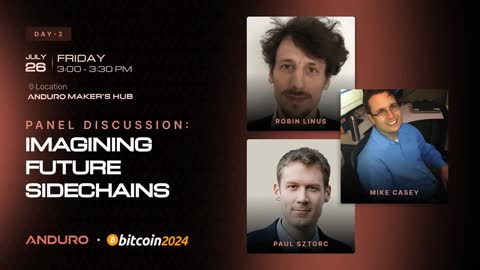
0:00 Hey everyone! I mean, you guys can keep talking, that's cool. We're going to talk about LayerTwos. 0:07 So maybe, I think we'll just start off with like, I'm going to introduce each of you, introduce ourselves, 0:12 say what project you work on, maybe how long you've been working on it. That's kind of a fun thing. 0:18 And like, you know, is it a LayerTwo? Yes, no? I don't. Oh. 0:26 I like that. Yeah, okay. And then we can maybe like, see where we end up there. 0:31 Also, if you guys have questions and stuff, this is like supposed to be kind of just like a relaxed chat, so that's cool too. 0:37 Ask questions, ask questions about anything. Yeah. We'll hear your questions. 0:43 Yeah, so I'll start. My name is Lisa, also Nissy. I've been working on Lightning for about four and a half years now. 0:50 I'm on the core Lightning side, doing spec stuff. I think Lightning as a project has been around since 2017, 2018, I think. 0:59 That's a crazy look. Well, the paper was in 2015, right? But the end code, okay. 1:06 Okay, so since 2015, so we're closing in on eight years in Lightning, which is pretty cool. 1:14 When was your first, was it like March 2015, the original MIT presentation? 1:19 I was there for that one. 1:23 Cool, so Lightning is like a payment channel thing, and it definitely counts as LayerTwo in my mind. 1:30 Cool. 1:32 I don't know what I work on independently. What do you do? 1:36 I'm SuperTestNet, and I'm a freelance software developer focused on Bitcoin Lightning, and most recently Doster. 1:42 And I don't, it really does depend on the league what I'm working on. The thing I presented here was called SpaceChain, and no, it doesn't count as LayerTwo. 1:53 It doesn't count as LayerTwo. And SpaceChain is like the, didn't you guys just like have a project launch? Like we had Josh just put out Selma, right? 2:01 Yes, we had Josh put out the second implementation of SpaceChains on Cygnet with Selma. 2:09 Is that the first Cygnet, is that the first SpaceChain like launch implementation, or is there like another one that came out earlier? 2:16 I came out with one earlier, and that one is on, mine is on TestNet, and then also Stacks came out with, Stacks is a blockchain tech, technically needs the qualifications to be a SpaceChain. 2:28 Oh, cool. 2:30 Oh, so Stacks is late, okay, cool. 2:32 Yeah, it was SpaceChain before SpaceChains. 2:35 SpaceChain, SpaceChain. 2:37 Yep. 2:38 Gotcha, cool. 2:40 Yes, I'm Paul Sztorc, a Bitcoin scholar and also founder and CEO of LayerTwo Labs. 2:49 I love BIP, BIP300, which enables 2A Bitcoin transfer for sidechains from Bitcoin. 2:57 And that BIP has been around for a while, I think I got assigned the BIP number in like 2018. 3:03 Wow. And do you look at implementation of? 3:06 Yeah, we have software, we have cloned the latest version of Zcash as a sidechain, and cloned the latest version of Ethereum as a Bitcoin sidechain. 3:15 We have special versions of it, there's like NFT or C20, but that has a UTXO model, so like a BitAssets sidechain. 3:25 We have a version of Namecoin that we resurrected that changed a lot, and we, I don't know if we published it yet, but we have it. 3:33 Yes, and we have some other things. 3:35 We have a blank template, like a blank sidechain template, and we have also just a blank template with a larger block size. 3:42 But we're going to do something very cool with that soon, it'll be like a hackathon. 3:46 We're going to eventually do a contest where whoever can improve the software performance of the large block size chain the most will win a huge prize. 3:54 And we have lots of money, so the prize will probably be like, I think we'll do it like once a month, and it'll be like $20,000, $30,000, $40,000 each every month. 4:01 And we'll probably split it up so that like two or three people can win the top prize, which is the biggest winner. 4:08 What network are these? 4:10 This is not on anything yet. 4:12 We have a completely, it's kind of like a hard fork of Bitcoin, but this is a test for testing purposes. 4:17 We have like a Bitcoin test in there. 4:19 Most of the stuff that people do, we're just doing rank test mode anyway, but we have a fake net network where the difficulty has been reset to one. 4:29 So it's as if it started over, but it is just a new, like, separate thing. 4:35 Now, we call it DriveNet, but it's not really it. 4:38 Is it a layer 2? 4:42 It is a layer 2 because, well, when BitTorrent activates on Bitcoin, the coins will go there. 4:46 They go up to this upper realm where stuff will happen to them, and then they will come back. 4:50 It's a very weird layer 2. 4:53 It's what we might call loose coupling because there's – so the guarantees that they come back correctly are necessarily loose because you don't know what the upper chain is doing. 5:03 There's a lot of opacity. 5:05 You don't actually know what the upper chain is doing, and at any given point in time, you cannot immediately – because this is rare check-ins. 5:13 Periodic. 5:15 It's not like Lightning where you could check in at any time and bring it back up no matter what. 5:19 Check-in is what I mean. 5:21 It's like going to court and getting it before. 5:24 So even on Lightning, that usually takes a while. 5:27 Well, you can go immediately, but you don't think you should get it. 5:29 Whoever does that gets the money after whatever. 5:31 It's a two-week period. 5:33 I don't know exactly when. 5:34 This sounds like something we should come back to, the period of the tone. 5:37 Yes, check-in philosophy, I think, is interesting where the different layer 2s have very different parameters, and the people – people seem to be very, very, I would say, hung up. 5:51 The ability to go immediately to layer 1, where I think that if you sacrifice that, you get an awful lot. 5:56 Okay, let's return to this. 5:58 Let's finish out with a layer intro. 6:00 So yes, layer 2. 6:02 Space means layer 2? 6:03 Yes, no? 6:04 I would say no, because it doesn't come back. 6:06 It's a one-way street. 6:07 Oh, okay. 6:08 Interesting. 6:09 Okay, cool. 6:10 Yeah. 6:11 Go ahead. 6:12 John Lighton, also known as Lightcoin on Twitter. 6:15 I do Bitcoin research. 6:17 I received a grant from the Human Rights Foundation to work on a report that is at bitcoinrollups.org. 6:24 It's focused on validity, rollups, and how we could potentially bring that type of layer 2 to Bitcoin. 6:34 And I also work on a project called Sovereign, which is building financial tools for Bitcoin on the every-stock sidechain. 6:44 I would not consider that a layer 2. 6:46 Okay. 6:47 And then for the rollup work that you've been doing, almost like research into what Bitcoin rollups, what are the options, what they look like, that sort of stuff. 6:55 Your report has a lot of different ways we could do rollups on Bitcoin. 6:59 If you just look at validity rollups, is there a version of validity rollups that ships? 7:06 Is it an implementation phase? 7:09 Are we on the path to getting rollups as a layer 2 on Bitcoin? 7:14 Yeah. 7:15 Right now, it's still, I would say, in the conceptual phases. 7:18 So the talk that Samantha Gautam gave yesterday is actually, I think, the most detailed description of what a validity rollup on Bitcoin could look like. 7:29 Another researcher from previously at MMPBTI, Trey Delvanus, also published a pretty detailed design document of how it could work. 7:40 And yeah, I think that's as far as we've gotten. 7:44 As far as I know, there's not really any code written. 7:48 Although there has been experimentation with not layer 2 rollups on Bitcoin, called sovereign rollups. 7:55 Celestia Labs released this roll kit, proof of concept of how to build a sovereign rollup on Bitcoin. 8:04 There's a team at Lambda Class that's working on a sovereign rollup for Bitcoin with the longer term vision of making a validity rollup on Bitcoin. 8:13 So yeah, there's some work in that direction, but nothing really concrete or usable yet. 8:20 Cool. 8:21 Do you guys require, does your project require a soft fork on Bitcoin in order to make it activate, if that makes sense? 8:31 Maybe this is another, maybe they go there next and they come back to this with a check-in idea. 8:35 This is a really fun one. 8:36 Yes, it's very different. 8:38 Mine does. 8:41 When I had this idea, it was back in November 2015, and it wasn't a big deal to do soft forks at all. 8:47 In fact, in the next month, we did three soft forks in the same month. 8:54 And in fact, you can chart out how many soft forks Bitcoin has done over time, which I've done. 9:02 In the first seven years, there were, I think, 16 or 17. 9:06 And then in the second group of seven years, there have only been, if you count 2023, it's a full year. 9:11 But there's not going to be any, in fact, in this year. 9:13 So the earliest would be like January. 9:16 So if you count the second period of seven years in Bitcoin's history, just like the 2016 to 2023, there are only two. 9:23 And the first one, the second one had enormous contention. 9:27 I think it took 28 months or 20 months. 9:31 It depends on how you count from when it was first proposed on the Bitcoin.dev mailing list when it was coded and activated. 9:37 And then Taproot was proposed in January 2018. 9:41 It didn't activate until November 2021, which is 46 months or something. 9:47 So it's doubling. 9:49 Yeah, so it's getting much slower. 9:51 So in general, the soft fork idea, while it was very common when I first proposed this, has become less common. 9:57 It's also intriguing that I could just launch the software with UASF or just go to the miners and activate the soft fork. 10:05 But over time, the culture of Bitcoin has become very unusual to do and seen as extremely suspicious or improper. 10:16 You can't just post your binaries on Bitcoin.com and have people download them. 10:22 I liked it when you told the mailing list, we're soft forking on Tuesday. 10:26 That was my favorite time. 10:28 Wait, whose turn was it? 10:30 You didn't really say that. 10:32 See, that's the interesting thing is that Jeremy Rubin, he didn't really do that, but he did something like that. 10:40 And it was met with a disastrous result. 10:44 It's hard to know exactly how to interpret that because some would say that it is up about. 10:50 It didn't really have anything to do with what he was even working on per se. 10:55 It was the general principle of exactly what the procedure is. 10:59 Mine doesn't require the soft fork, but it would be greatly assisted by any crypto. 11:04 APO? 11:05 Yeah. 11:06 And APO requires the soft fork, right? 11:07 APO requires the soft fork. 11:09 Yeah. 11:10 What about the living roll-ups? 11:12 Living roll-ups would need a soft fork. 11:15 The project I'm working on right now, the Lost Sovereign, doesn't need a soft fork. 11:21 But if we wanted to improve the security of the branch so that it doesn't rely on the Federation, 11:27 but instead on Bitcoin consensus, then we'd need some kind of soft fork. 11:32 Yes. 11:33 See, a funny idea would be, what if someone secretly, they needed a soft fork hypothetically, 11:39 they secretly go to the miners and say, activate this soft fork secretly. 11:43 Because no one knows. 11:44 There's a tightening of the rules. 11:45 There's certain soft forks. 11:46 Actually, this is one of the things that I was learning about soft forks, 11:48 is that the word actually, the distinction between soft and hard fork has been eroded over time. 11:54 And actually, it doesn't mean very much anymore. 11:56 But this type of, the Bitpreambler soft fork, or the AnyCrypt app soft fork, or these other soft forks, 12:01 they are all the kind where you could go to the miners and say, activate it secretly, 12:06 and then just wait five or six months. 12:08 And then just, you know, write to the mailing list or whatever. 12:11 Now it's kind of complicated. 12:12 Actually, it has been activated this whole time. 12:14 You just didn't know. 12:16 And here it is. 12:17 Surprise. 12:18 Here's the, whatever, the magic numbers or the, which I think that so much, 12:23 that would be funny if someone did that. 12:25 I would clap for that, personally. 12:27 I mean, what would that take? 12:29 I mean, I guess it could be like. 12:30 The miners have to agree to keep it a secret. 12:32 They have to run their own new software, which they hate upgrading software. 12:36 They're like, can we just not run the same piece of software? 12:39 It's like the only job is to run a piece of software and collect money. 12:45 So do I have to do something? 12:47 I have to do another thing? 12:49 Why can't I just collect the money? 12:51 I like stuff. 12:52 Whatever. 12:54 We should upgrade mining. 12:55 We should go to the miner's system and activate all the soft forks. 13:00 Okay. 13:01 What about, okay. 13:02 What about like Cignet Inquisition, right? 13:04 Are they basically doing this on Cignet? 13:06 They're like, so how many of you guys know what Cignet Inquisition, 13:09 Inquisition Cignet is? 13:11 He's talking about it at consensus. 13:13 Guys at consensus are going to know more about it than you guys. 13:15 No, I'm just kidding. 13:16 But Inquisition Cignet is this project by, I think, 13:20 AJ Towns is kind of believed of behind the heretics leading the Inquisition. 13:25 Or maybe it goes the other way. 13:27 The fundamentalists. 13:29 He's testing the heretics. 13:31 He's testing the heretics. 13:32 Yeah. 13:33 So, yeah. 13:34 So, the Inquisition Cignet. 13:36 So, Cignet is a different test net for Bitcoin that, I don't know, 13:43 doesn't do mining. 13:44 So, they kind of made. 13:46 Each block is signed. 13:47 So, a new block comes out. 13:49 But there is no, like, Shopify Cignet. 13:51 Yeah. 13:52 It's AJ Towns net. 13:53 It's designed specifically so that you can actually force weird things to 13:56 happen, like reorgs or whatever. 13:59 Michael Tibbo has a very confused look on his face. 14:01 It's a small piece of work, right? 14:03 You still need to do small amounts of work. 14:04 Yeah, it's work. 14:05 Even with Cignet, you still have to do it a little bit. 14:07 There's still some work. 14:08 But that's the point, though. 14:10 The difference between. 14:11 It's more like the truth of. 14:12 Fairly good. 14:13 That regular. 14:14 It's more like hundreds of millions of dollars invested in, like, 14:18 a specialized warehouse full of, like, marine containers that have, 14:21 like, specialized chips. 14:23 Okay. 14:24 So, it's Cignet. 14:27 The cool thing about Inquisition Cignet is that they take all these 14:32 proposals, like all these software proposals. 14:34 And it's basically gone to the miners and they, like, 14:36 implemented it like that, right? 14:38 It's launched them on Cignet. 14:39 If you run a special version of Bitcoin Core, 14:41 which is the Inquisition Bitcoin Core version, 14:44 you can still be on Cignet. 14:45 You can try out all of these, like, new proposals. 14:48 There's some mental policy stuff they're trying out. 14:51 Like, you can get that on Anchor, V3 stuff. 14:53 I don't know if it's out yet. 14:55 It's a much better testnet than the real testnet. 14:57 It's not better than the real testnet. 14:59 The real testnet is the worst. 15:00 And RegTest is, you know, 15:03 RegTest matches Bitcoin's consensus rules, and Cignet doesn't. 15:06 So, if you want to actually see what it's like on Bitcoin, 15:08 you ought to use testnet. 15:09 Testnet is, like, barely usable because it's insane. 15:13 Because other people are connected to it. 15:14 It's not like a sterile laboratory environment. 15:16 It's much smarter than a bunch of people are in. 15:19 Cignet is cool, though. 15:20 It's a testnet. 15:21 If you go to Mempool's face and you click the Cignet button, 15:24 the Cignet you're looking at is the Inquisition Cignet. 15:26 Ah, okay. 15:27 Oh, that's not Mempool. 15:28 So, they show the Cignet. 15:29 So, the default Cignet on Mempool is the Inquisition version. 15:33 The one that everyone looks at is the one with all the softboxes activated. 15:36 That's the Cignet. 15:37 So, the solar project, the space chain that you guys put out. 15:41 Maybe one... 15:42 I don't really know what a space chain is. 15:43 You said it's not a leertune? 15:45 I don't think it's not a leertune. 15:47 Maybe we can give everyone a quick... 15:50 Do you think a leertune is a leertune? 15:54 No. 15:55 What do you think a leertune is? 15:57 Let's not... 15:58 We can argue about it. 15:59 I want to hear this. 16:00 Oh, yeah. 16:01 Okay. 16:02 So, let's start with... 16:03 Maybe we can start with what is a space chain. 16:05 You might want to clarify what these things are before we... 16:07 Yeah, yeah. 16:08 So, let's get a little definitions on the board first, 16:10 and then we can argue about where we put it. 16:12 Yeah. 16:13 I think that... 16:14 Cool. 16:15 Okay. 16:16 So, the space chain, it's on the Inclusion Thicknet. 16:18 That's because you needed one of... 16:20 Is that because you needed one of the proposals, the software proposals for Soma? 16:24 You wanted to do... 16:25 Okay. 16:26 VFTF wanted to do one that was better than mine. 16:28 Okay. 16:29 The one that I launched has a lot of problems. 16:31 So, you make one that has fewer problems. 16:33 And that one uses APO to fix the bugs in mine. 16:36 Okay, cool. 16:37 So, you guys are doing APO, which is using... 16:40 It can only exist on Inclusion Thicknet. 16:43 Yeah. 16:44 For software reasons. 16:45 For software reasons. 16:46 Yeah, okay. 16:47 So, what is a space chain? 16:48 Like, what is this thing that you can now do using Soma on Inclusion Thicknet? 16:52 Yeah, a space chain is a blockchain that is separate from Bitcoin, 16:57 but it has the following connection to Bitcoin. 17:00 Every time you create a space block, or a block of transactions for the space chain, 17:05 you take a hash of it, and you put the hash of that block in Bitcoin. 17:10 So, if you want to find out, if you're trying to sync the sidechain, 17:13 and you want to know the order of blocks, 17:15 you don't need special proof-of-work or a special proof-of-stake consensus system. 17:19 You can just follow the trail of hashes in Bitcoin. 17:22 Okay, the next block has this hash, because that's what Bitcoin says, 17:25 and the next one has this hash. 17:27 How do you find the next... 17:28 How do you, like, find the next hash? 17:30 Like, Bitcoin does that with a lot of... 17:32 It's kind of like if you have, like, many different versions of Counterparty, 17:35 where instead of each message being in the blockchain, 17:38 each block, they compress it into a block first, 17:41 and put that in. 17:42 So, it's like, there's this line of transactions in Bitcoin. 17:47 Oh, okay. 17:48 So, you look at them, and maybe you can interpret them, 17:51 and maybe you can interpret some of these blocks. 17:53 You create something called a linked list. 17:55 So, you start out with one Bitcoin address, 17:57 and then you spend from that one into the next one, 18:00 and spend from that one into the next one. 18:02 Who's paying for all that? 18:03 Like, every time you make this, you get so upset. 18:05 So, in order to make a new block on your sidechain, then, with spacechains, 18:10 you need to make a new transaction on Bitcoin. 18:12 Transactions on Bitcoin, sometimes are really cheap, you know, 18:15 every once in a while, right? 18:17 Sometimes they're really expensive. 18:18 Like, who pays for that? 18:20 Because your chain stops if you can't keep doing that, right? 18:24 Yeah, it stops if you can't. 18:26 No one wants to pay for the next block. 18:28 Typically, people have some sort of currency on the spacechain 18:31 that they pay spacechain miners with, 18:36 and those spacechain miners use that funding to buy transactions based on Bitcoin. 18:43 I see. 18:44 Yeah, but none of that is the important thing about the spacechain. 18:46 The important thing about the spacechain is it's just a sidechain 18:48 where the coins, instead of being able to come back, are just immediately destroyed. 18:52 Oh. 18:53 So, it's kind of a very silly idea. 18:55 People don't actually use it for anything, because it's tons of fun. 18:59 And so much, you don't actually have to destroy any coins. 19:02 You just use lightning to pay for transactions. 19:05 That's true. 19:06 Soma did manage to get rid of the stupidest thing about spacechains. 19:10 Wait, why are coins disappearing? 19:14 How did that happen? 19:15 So, people hate Bitcoin. 19:17 No, I mean, it's funny. 19:19 Wait, does spacechain have an attack on Bitcoin? 19:21 It makes all other Bitcoin holders very terrified. 19:26 It's a tabloid that people have done on the internet. 19:29 The theory is that if you burn a Bitcoin and you prove that, 19:34 you've created a scarce asset. 19:36 I would say you've destroyed one. 19:38 But that's the theory, is that now you've got a ghost of a Bitcoin. 19:41 You've got to prove that you've destroyed a Bitcoin. 19:43 And that's valuable somehow. 19:45 Oh, it's like a Banksy thing, where they destroy stuff and put it in an NFT. 19:49 Because NFTs rip a lot. 19:50 You destroy something to make it. 19:52 Yeah. 19:53 As you know, whenever you have a car and you set it on fire, 20:00 that always produces something of equal and opposite value. 20:04 So, one of the problems of mine is that it burns Bitcoins. 20:08 And Fiat Jeff, that's one of the things he fixed. 20:10 Oh, okay. 20:11 So, that's a good thing. 20:12 So, how does Fiat Jeff not burn Bitcoin? 20:15 So, what he does is, when you want to change the state of the spacechain, 20:20 you create a little piece of text that you want to add to a block. 20:24 You submit that to a spacechain miner, and he gives you a lightning invoice. 20:27 And he says, I will add this to my next spaceblock for this fee. 20:31 I see. 20:32 And then you pay him, and if he doesn't mine the next block, 20:35 he cancels your invoice and you get your money back. 20:37 If he does mine the next block, he takes the money. 20:42 Can he take the money and not? 20:45 Yes, he can. 20:46 Okay. 20:47 It's a trusted system. 20:48 Trust payments. 20:50 But it avoids burning Bitcoin. 20:51 And typically, you're only trusting him with about five cents. 20:54 And if he did take it, you just don't use that miner again. 20:57 So, he burns his reputation. 20:59 He would burn his reputation. 21:01 Yeah. 21:02 Well, you could also waive that on the affair and say, 21:05 hey, nobody should trust this miner because he stole my money, whatever. 21:09 And you can prove it. 21:10 You could prove it. 21:11 That seems important. 21:12 Yeah, but all this is a regression, though, 21:14 because there is the one-way staging, 21:17 which is like how to upgrade Bitcoin from one thing to something else. 21:21 That was already this idea that we could release a new version of Bitcoin, 21:24 and then people could, if they wanted a new feature, 21:27 they could even get the hard fork or something, 21:29 where it's like this is the origin of this idea of 2012 or something, 21:33 where you have a new version of Bitcoin, 21:35 it's completely new, 21:36 and then as people move coins from the old version to the new version, 21:40 they would destroy them on the first piece of software, 21:43 and they would start to show up on the new piece of software 21:45 with the goal of eventually everyone moving it across. 21:48 That was this original idea from 2012. 21:51 And then people became curious about the idea of 21:53 what if instead of destroying them, 21:55 you spend them on something, 21:56 and then if people change their mind on the new piece of software, 22:00 they can actually go back and get the coin and reclaim it. 22:03 The coins of the first piece of software. 22:05 That was the so-called two-way peg, 22:07 which is a really silly name. 22:09 Out of all the names we have, it's just really weird. 22:12 You don't have pegging. 22:13 Yeah. 22:14 The new term is bridging. 22:15 Yeah, so now it's called bridging. 22:17 Are bridges and pegs like the same thing? 22:19 Unlike the 30-minute stuff? 22:22 I'm trying to remember. 22:24 So then, eventually, it came to the paper in October 2014, 22:29 and then my idea in November 2015 is the two-way bridge peg. 22:38 And then later on, there was this bridge pegging. 22:42 Well, mine was still critique, saying like, 22:46 well, what if we move the coins over, 22:49 and then the wrong person gets them back, and they won. 22:51 And then, after all that, 22:54 Ruben Thompson came up with this thing of like, 22:56 well, we can move the coins over, and then they won't be stolen. 22:59 But it was really kind of going backwards. 23:01 Yeah. 23:02 So when I invented the person taking the coins back, 23:05 one of the many people working on this bi-directional bridge peg, 23:10 I was like, it's not going to happen. 23:15 It's not going to happen. 23:16 Stop trying with the bridge peg, Kevin. 23:20 I was like, oh, this is what the people want? 23:22 Like, you know? 23:23 Oh, you want the people to watch this? 23:25 It's like a car that can drive you to work, 23:29 and then back from your job, back to your house. 23:32 And then, because before, you know, 23:35 there was like a bike path you could only take in one direction, 23:39 and I was like, this is a car. 23:40 Seems like you should make rules. 23:41 You want to be at work, you want to be at home. 23:44 I was like, I've got this car that goes both ways. 23:46 And people were like, OK, here we have the car, 23:48 but now it only goes one way. 23:50 It only takes you to work. 23:51 And I was like, I thought that. 23:53 I was like, I thought that's not what we wanted. 23:55 I think there's going to be a lot of cars in that parking lot. 23:59 I mean, do you guys think there's like appetite for this layer? 24:02 Like, why would anyone use it? 24:05 Like, this is only really useful if you don't want to use Bitcoin on the other chain, or like, I don't know, you're willing to use like a trusted bridge, and for some reason you still want to pay Bitcoin miners for your blocks. 24:18 I think. 24:19 For some reason, I think something really strange happened psychologically, honestly, where it was like, the idea, some of those face-chained people early on, they seemed to speak as though, 24:30 Oh my gosh, there's a bug in front of here. 24:33 There seems to be like a, oh my gosh, they don't want me to speak. 24:36 They don't want the truth to come out. 24:39 I don't see the bug. 24:44 They were saying something along the lines of like, well, it will still be, in one way, the peg will still hold, the bridge peg will hold. 24:51 And so then that's like, we're like halfway done or something. 24:55 And I was like, that's not that true. 24:58 They're like, the price will never go above one Bitcoin, because one of the problems I have is face-chained Android chains. 25:05 I can't think of anything I would actually use one for. 25:08 Anything you'd use the Drivechain for? 25:09 No, no. 25:10 Is there like a Zcash privacy? 25:13 Yeah, because there are three things people bring up. 25:15 They say we could make a Monero or a Zcash one, we could make an Ethereum one, and we could make a BigBlock one. 25:22 And I don't, I'm very satisfied with CoinJoin, it's a privacy tool. 25:26 I'm very satisfied with BitcoinScript, it's a scripting tool. 25:29 And I don't want BigBlocks. 25:32 What am I going to use the Drivechain for? 25:35 What if you, let's say you have a family gathering, and you're having people over, and you say, not everyone likes this kind of food. 25:47 Some of my in-laws want, they want to have vegetarian food or something. 25:51 Would you say, well, I don't really want, I don't like vegetarian food, so no one else can have it either. 25:57 No, no, I'm not, I don't oppose face-chains or Drivechains. 26:01 I'm in favor of having them. 26:02 I just don't, I can't think of anything I'd want to use. 26:04 Why not just use a different chain? 26:05 Like, why even involve Bitcoin in this scheme? 26:07 Like, why do we have Bitcoin? 26:09 Because we have the altcoin, of course. 26:10 It justifies the existence of the altcoin, which is a distraction, because we want Bitcoin to be, we want network effects to grow for Bitcoin. 26:17 We want Bitcoin to continue to be a bigger and bigger project. 26:20 And we want to ultimately take down, like, you know, the banks and all the viable fiat currencies. 26:25 It's kind of like, you know, if for some reason, for every store that, like, popped up in your town, you needed to use a different currency to, like, pay that merchant. 26:36 It would just get very cumbersome. 26:39 Oh, you can use their wallet. 26:40 You can get, like, their wallet. 26:41 Fat wallet. 26:42 What do you want? 26:44 What do you want from a sidechain? 26:46 I want, uh, I definitely want, like, you know, better privacy. 26:50 Coinjoin is definitely, like, not the... 26:54 I don't think Coinjoin is great. 26:55 The Zcash, actually, the Z-address. 26:57 You get one reusable Z-address. 26:59 What do you want? 27:00 One reusable address. 27:01 But you understand that the Z-address, no one can tell that you're using it, because no one knows which one is being used. 27:06 It just seems like a non-problem. 27:08 Like, I want this so I don't have to make it, so I can reuse addresses. 27:12 I mean, there are so many problems with Coinjoin. 27:14 We could take up the rest of our time here talking about them. 27:17 But, uh, like... 27:19 So you want, like, privacy. 27:21 Yeah. 27:22 Is there anything other... 27:23 Do you want to... 27:24 Would you, like, root stuff to become a sidechain? 27:26 Yeah. 27:27 Like, hold onto something? 27:28 More trustless. 27:29 Yeah. 27:30 Sidechain. 27:31 Yes. 27:32 So you can use bitcoins in, like, many different types of smart contracts without having to rely on federations. 27:39 You could have, you know, smart wallets that have, like, spending units. 27:43 Like, you can always, you know... 27:45 Like, if your key was compromised, the attacker could only take a small amount of your money, not all of your money. 27:51 Like, there are lots of different, you know, kind of spending conditions that might be interesting to be able to, you know, apply to your coins. 28:01 That you couldn't do on Bitcoin today. 28:03 Or, like, you know, every time somebody comes up with one of these cool new spending conditions, do we want to have to soft fork? 28:09 No. 28:10 So we can just have a system... 28:12 Kind of a lot of fun in 2017. 28:15 We could just have a system where people can come up with these spending conditions, and people can just opt into them freely without having to change it one way or another. 28:24 I think that's the value here. 28:26 This is a funny joke about 2017, but it is hard to actually explain, like, in a way that regular people who understand... 28:33 Like, new people who understand the sheer amount of, like, hurt feelings and stress and, like, people threatening each other. 28:40 And then one guy hacked, like, a power plant and, like, took out power in, like, the state of Arizona or something at one point. 28:46 Really? 28:47 Yeah. 28:48 It was like a Bitcoin XT, like, crazy... 28:51 Something weird happened with that. 28:54 Was it, like, in, like, a veteran or, like, in the military or something? 28:58 Some sort of Bitcoin cash guy. 28:59 Something weird like that happened. 29:01 So a lot of really crazy stuff was... 29:03 It was not very pleasant at all. 29:05 And it's just, you know, it's what you're relying on if you don't have the ability to be able to use different chains for different people. 29:11 And you're relying on everyone just kind of being similar enough to each other. 29:15 But that's not really, you know, going to happen. 29:17 People are just very different. 29:19 Not only people are very different, but also, of course, different transactions are different. 29:23 So, you know, like, the coffee transaction is very different than, you know, when you're fleeing China for your life or something. 29:31 And you have to leave all your possessions behind. 29:34 And you can, like, memorize a 12-word C-blog. 29:36 That's very different than the coffee transaction. 29:38 Yeah. 29:39 So, I think you're kind of bringing up an interesting kind of meta-commentary about sovereignty. 29:46 And, like, sovereignty and what do you call it? 29:50 Like, you know, each of these roll-ups, to some extent, you're kind of saying, like, you make a roll-up so you can set the rules of what happens on that roll-up, right? 30:00 And so it's like, okay, well, that's kind of nice. 30:02 You can kind of have your own little sovereign system, which has, like, this nice tie to Bitcoin. 30:07 But it's not actually, like, you can do your own rules, right? 30:12 So you can, like, use, like, the sound money that we're building on Bitcoin. 30:15 And you can have your own sovereign system on top of that. 30:18 And it's kind of like, I think this is, like, sort of, like, I don't know, maybe a little political here. 30:22 But I think this, like, kind of matched an interesting problem in terms of sovereignty in general, like, in governance, in terms of, like, okay, like, yeah, I want to be, like, a self-sovereign individual. 30:32 But, like, when you do that with, like, a money or a system, you lose the network effects of, like, being able to transact across whatever, right? 30:40 So if you build a roll-up or a side-by-side system where you have a certain amount of sovereignty, like, over and above, like, maybe the larger system you're tied to, then the problem is, though, you need people to participate in that sidechain in order to have value in, like, transacting them, right? 30:54 For the most part, like, when you build these side systems, like, the sovereignty only extends to, yeah, maybe it's your own thing, but you're the only one over there, like, the value of that is being able to, like, use it as a system to, like, transact with other people, like, further lower, right? 31:07 So, like, there is, I think, kind of, yeah, there's something to do with that problem. 31:11 Hey, guys, could you guys just be, like, a little quieter? 31:14 Sorry. 31:15 Thank you. 31:16 I think it depends. 31:17 Like, there are some applications that are, like, you can call them, like, maybe we should be a little quieter. 31:22 There are some applications that you can call, like, one-player applications where you don't, it doesn't really depend on, like, a network effect. 31:31 For example, like a wallet, right? 31:34 Yeah. 31:35 Like, you could move your coins over to, like, a vault chain, and you could be the only user, and, like, it doesn't actually matter if there aren't other users there because you can encumber your coins in this vault, and then whenever you want to pay somebody who's on layer one or a different roll-up, then you just move your coins out of the vault and spend them, you know, to a layer one address or, you know, do, like, some cross-roll-up, like, atomic swap thing to pay somebody else. 32:03 Like, there, I think there's, yeah, there's still some utility there, but certainly there's other types of applications. 32:10 Yeah, they have network effects, and so you need to get people to, like, move their coins over there and start using it. 32:16 Like, the privacy thing, that's definitely, you know, it depends on network effects. 32:20 Right. 32:22 You know, if you can't, if no one else is using it, then your privacy becomes a little bit limited because then you have to move your coins out of the privacy system every time you're going to pay somebody. 32:31 So, you don't, like, that's not completely useless, but it's still, you know, it's still, of course, better if you can keep your coins and pay within the privacy system, so. 32:43 I've got a question for John. 32:45 I think it's for John. 32:46 Okay. 32:47 It seems like Drivechains are pretty much ready to go in terms of code. 32:51 And it seems like roll-ups aren't, or at least I'm not aware of anyone who's written a start-to-verify-on-code or proposed, like, this is the one we should implement. 33:00 Oh, yeah. 33:01 They're probably miles apart in terms of readiness. 33:04 Yeah. 33:05 Oh, okay. 33:06 I thought— 33:07 There you go. 33:08 You got a perfect, short answer to your question. 33:10 Yeah. 33:12 I think they all feel like that, too. 33:14 I think we have a question. 33:19 I have a question. 33:20 We have a question. 33:21 Yeah. 33:22 Michael, I was always ready to ask that question. 33:24 Sure. 33:25 So, I guess, I'm from Fort Worth, actually, in Texas, and I took one class. 33:28 And so, we don't really know as much as, you know, as you guys are talking, so it's weird to know. 33:35 But did you kind of run into, like, some of the, like, Layer 2 technologies? 33:40 Like, I know there's Lightning and SpaceChain. 33:42 Like, what are the differences? 33:44 Like, why do people want to know? 33:46 Why do I want to know? 33:48 Well, SpaceChain is not a Layer 2. 33:51 Okay. 33:52 So, let me repeat the question. 33:54 The question was, can't we just name a bunch of Layer 2s with, like, a bullet point about a few? 33:58 Okay. 33:59 So, it's funny, because Lightning takes mostly the air out of the room, and it's mostly, like, energy with Lightning. 34:04 Three cheers for Lightning. 34:05 Lightning is, yeah, what is Lightning? 34:07 Lightning is a payment channel Layer 2, right? 34:11 You multi-signally share outputs on Layer 1. 34:14 You and a friend, you broadcast this money that you share, and before you agree that the money is in there, 34:22 you sign the funding transaction and the transaction is taking the money out. 34:27 They require both of your permission. 34:30 And then you update those, and then you delete all the states. 34:33 Yeah. 34:34 That's the deal we are? 34:35 The general idea is... 34:37 I've got a decent head in the universe. 34:39 I'm attached, so... 34:41 I think the general idea is that you've got, like, a bunch of two pairs of people with money, 34:46 and then you network them together, and then payments can move from each of these little shared accounts. 34:51 You, like, kind of network the shared accounts together to channels, 34:55 and then you have to network the channels together, 34:57 and then when payments flow through it, they flow through these, like, little accounts that people have made, 35:03 and you, like, publish where they are, and then you find routes. 35:06 If you have a routing problem... 35:07 I actually don't look at the routing, I look at the channels. 35:09 I think I should do the Lightning network part. 35:11 I think the one important detail I was missing here is that all of these transactions that are happening in the Lightning network 35:19 are off-chain, so these are actually unconfirmed Bitcoin transactions, 35:24 but the most recent recipient of one of these unconfirmed Bitcoin transactions 35:29 can always take it to Layer 1 to actually, like, cash it in for the Bitcoin that it represents, right? 35:35 Yeah. 35:36 It's like a bar tab where, like, you have your card, and they can run it at any time, 35:41 but they just wait, and you say, okay, I need another, you know, another great piece of rock. 35:47 So what were the other examples that we had? 35:51 I think there's also state chains. 35:53 State chains. 35:54 It's very obscure, but it's real. 35:56 It involves the UTXOs. 35:58 There's a group of people that's moving the UTXO around, and there's, like, a history of it. 36:04 A coin of value cannot change. 36:06 So actually, they're not trading the UTXOs, they're trading the keys. 36:09 Yeah. 36:10 That's a key, right? 36:11 That's a key, but it's the ownership of the UTXO. 36:13 Isn't that kind of like the, like, a good, I think, real-world example? 36:16 Like, what are those, like, the coin type, the little off-the-key thing, you know? 36:19 Open dime. 36:20 Open dime. 36:21 There's a coin there, too. 36:22 Yeah, but that's the same thing as, like, the state chain. 36:25 It is. 36:26 Well, in the case of state chains, you need a multi-sig still. 36:29 So it's like the state chain entity and you have a multi-sig together, 36:33 and then you transfer the key to the person you're trying to, like, want your key to the person that you're trying to pay, 36:43 and then the state chain will, like, co-sign that so that, you know, now the multi-sig has, like, moved over to the new person. 36:50 Right. 36:51 And then the state chain entity promises, I think it promises, not to sign any transactions from any of the previous owners of the key. 36:59 They'll only co-sign transactions from the most recent owner of the key. 37:05 I mean, what if someone, like, an old owner, can't they, like, maybe trick the central binding party into thinking they're, like, the current most recent? 37:12 No, we have to only give people a point for each. 37:15 Oh, right, yeah. 37:16 Okay, sorry. 37:17 No, because they're just keeping track of, like, who they most recently co-signed the key over to. 37:22 Oh, I see. 37:23 So they have, like, another key. 37:24 Another key. 37:25 So as long as they don't lose state, you're okay, I guess. 37:27 Yeah, if their database crashes and they have no backups, then that could maybe be disastrous. 37:32 And for the state chain, okay. 37:34 But in practice, so, like, Connors Block developed the implementation of this, and they say that they have an HSM that is basically doing the co-signing. 37:45 So it's basically just an HSM. 37:49 Everyone says that you can't use an HSM. 37:51 I'm not using an HSM. 37:53 You might be able to do remote attestation. 37:55 Speaking of that, the liquid is also a Layer 2. 37:58 They also said they had HSMs. 38:00 Does anyone know that they do? 38:01 I don't consider it a Layer 2. 38:03 I haven't specifically seen the boxes, but I think that, like, now she's crying. 38:08 She's about boxes having to be moved around. 38:10 You know, like, shipping them internationally, like, a box full of, like, explosives. 38:13 Yeah, yeah. 38:14 You know, it's, like, it's nasty. 38:16 I'd like to know how they get them. 38:18 Core Lightning has a file they call HSM, and that's where you store your private keys. 38:22 So I think that's probably what Link was doing. 38:25 HSM.txt. 38:27 It's like mailboxes. 38:29 They're, like, you know, there's like eight of them. 38:32 There's, like, you know, firmware designers that, like, we're devising on and stuff. 38:36 So let's say maybe sidechains are a Layer 2. 38:40 I don't think they are. 38:41 Sidechains are a Layer 2. 38:42 I don't think they are. 38:43 Just for showing you a Layer 2, it's just, like, you go on Coinbase, and then you say, 38:46 what's it called? 38:47 Coinbase Commerce or something, or whatever. 38:49 Kraken has a version of this, too, right? 38:50 It's, like, you go online, and you can, like, you can, like, buy things with your coin, 38:54 and it's, like, linked. 38:55 You could pay at it, too. 38:56 Like, there's a credit card. 38:57 You would, like, buy stuff there, and it would, like, debit your account to free. 39:01 Yeah. 39:02 And that was managed by a different, managed by, like, a company that holds all the funds, 39:06 so it's much more like that. 39:07 Or open down to a Layer 2. 39:09 Open down to a Layer 2, a physical Layer 2, yeah. 39:11 Yeah. 39:12 Because you change hands in the physical world, and then you bring it back down to Layer 1 39:15 when you redeem it. 39:16 Spend it, yeah. 39:17 I would say. 39:18 There's also, so I have one, too, which is this BIP300. 39:20 This is Layer 2 idea, where the coins go into this script that it can be slowly unlocked 39:26 by the miners, but only very, very, very slowly. 39:28 You have to announce where it's going first, and you, like, slowly pull the money out, 39:33 and then direct for, like, three to six months, and wherever you say it's going to go. 39:36 So in that way, it's kind of like the miners have the mining process as custody of the 39:42 funds, but the miners gain transaction fees from the rival blockchains being used, the 39:48 upper system being used through merge mining, which is something else that I didn't invent 39:54 by Satoshi, but I take advantage of. 39:57 And then, also, the coin itself has more value as a result of being, this is the theory, 40:03 the coin has more value as a result of being useful in new ways. 40:06 So they kind of only, the theory is for certain types of things, they only withdraw the funds 40:11 accurately. 40:12 Yeah. 40:13 And then there's Emigitaro's teaching. 40:15 I'm sorry, were you going to say something? 40:17 Teaching? 40:18 Yeah, I don't know what happened to this idea, but it was like this secure, whatever execution 40:22 environment-like thing, and it's like this weirdo thing, but it is a layer two, right? 40:27 What's a bullet point for roll-ups? 40:30 Yeah, so a roll-up is like a separate blockchain that has a secure bridge with a parent blockchain. 40:39 Let's take, say, Bitcoin's a parent blockchain. 40:42 Users can deposit their funds into a smart contract on Bitcoin layer one. 40:48 The Bitcoin will appear in the roll-up chain on layer two. 40:52 And then when they want to make a transaction, that gets put into a block, a roll-up block, 40:58 and then the roll-up block gets, the data of that roll-up block gets put into a Bitcoin 41:04 block. 41:05 In a very compressed way. 41:08 Yeah, in a very compressed way, along with a validity proof that proves the validity 41:13 of that block. 41:15 And what the validity proof provides is a cryptographic guarantee that nobody can steal 41:22 your money out of the roll-up, because they can't fake a cryptographic proof that says 41:28 actually it's their money and they're taking it out of the roll-up. 41:32 So you can move your Bitcoin back and forth between Bitcoin blockchain and this roll-up 41:36 blockchain securely. 41:39 And the last benefit of this design is that every roll-up block confirmation is equivalent 41:47 in security to a Bitcoin layer one block confirmation. 41:51 So it's just as difficult to double spend transactions on the roll-up as it is to double 41:57 spend transactions on Bitcoin layer one. 41:59 So all of those features combined mean that roll-ups are fully trustless. 42:06 There's no new trust assumptions or security degradation for using a validity roll-up. 42:12 I have a question from the audience though. 42:14 Except for a single sequencer, right? 42:16 No, even if there's a single sequencer, all those coins still hold. 42:21 The question was except for a single sequencer. 42:24 Yes, yes, thanks. 42:27 Any other audience questions? 42:29 Yes. 42:30 What are the risks of a single sequencer? 42:33 The question is, what is the risk of a single sequencer? 42:36 So in that case, you have a liveness. 42:40 It's a trade-off of liveness for the roll-up. 42:44 So if there's a single sequencer, they shut down or get shut down or whatever. 42:51 The roll-up might stop producing new blocks if there's no way to replace that single sequencer. 42:59 But even in that case, users can still make a transaction on layer one to get their funds out of the roll-up. 43:06 So you don't lose security in the sense that you're not going to lose your money, 43:12 but you wouldn't be able to use that roll-up anymore. 43:15 Is there any other questions? 43:18 We have to. 43:19 The audience outweighs the… 43:21 All right. 43:22 So these are students or whatever. 43:24 Michael, is it you? 43:25 It's Clay. 43:26 Yeah. 43:27 He'll be able to answer questions. 43:28 Here, give us a question. 43:29 Yeah. 43:30 Just a quick follow-up. 43:31 A quick follow-up is, in terms of censorship risk, like Celestia, where you have like an enforced transaction, 43:37 you like, some of that works, so like, how do you deal with the censorship risk? 43:42 So the question is, how do the validity roll-up deal with censorship risk if there's a single sequencer? 43:51 And so this would be a question of, you know, what if the single sequencer is like not allowing your transaction into a roll-off lock? 44:01 Well, you could have a rule that says, like, there's an inbox on layer one, 44:08 and if you put your transaction into that inbox, it has to be included in a roll-off lock within a certain number of blocks or something like that, 44:18 or else maybe the sequencer will get punished in some way. 44:22 And so this is the idea. 44:24 I think, you know, in Ethereum role designs, they call this like the priority inbox. 44:30 And so like the roll-up block producer couldn't produce a block without including that transaction. 44:37 That's like one option for dealing with it. 44:40 The other option is, as I mentioned before, if the roll-up sequencer or block producer is uncooperative, 44:46 you could just do a transaction on layer one to get your funds out and move to a roll-up that's not trying to censor you. 44:53 It seems like there are a lot of Solidity contracts that have zero-knowledge proof systems in them, 45:02 but how hard would it be to convert one of those over to proof? 45:07 Say, let's use this one for Bitcoin. 45:09 Oh, yeah, it wouldn't really translate. 45:11 You would have to just totally rebuild it for the script context. 45:17 But they're building them all the time. They're putting up a new one every week. 45:20 We just have a common one. 45:22 It seems like we could just hire some of them to write one for us, right? 45:25 I think you could make some similar, like take a particular logic and see how they're dealing with all the edge cases 45:36 and try to translate that into a Bitcoin context, but it's not like you can build a Solidity-to-script transpiler. 45:43 I think it's just there's a lot more. 45:46 But it seems like they don't find it difficult to write these ZK-proof verifiers. 45:53 Is it hard for us to write them? 45:55 Why isn't there one yet? 45:58 I think it's just a matter of interest and awareness. 46:01 There's a lot of Bitcoin developers that are already working on it in their own families. 46:06 We don't have any new people. 46:08 There are a number of new people working on it now. 46:10 Like the guy yesterday that presented Simanta, his team is working on it. 46:14 The Lambda class I mentioned earlier, they're working on it. 46:18 I think there's a third team out there that's working on it. 46:22 People are working on it. 46:24 It's about awareness. 46:26 This conference and the MIT Bitcoin conference were the first, just like last weekend, were the first conferences ever 46:32 to feature a talk about the Libby role of some Bitcoin. 46:35 So it's just this very, very new idea in the Bitcoin community. 46:39 You had questions? 46:41 What I understand from the Layer 2 network is that one of its primary advantages is that it frees up the main network. 46:48 I know this is a little bit of a controversial topic, so what are your thoughts on this? 46:54 It seems like rather than free up the network, it adds more stuff. 46:59 The question was Layer 2s move transactions into the off-chain, right? 47:06 So it kind of frees up the main blockchain. 47:09 You can do more stuff on it, so you have less transaction traffic. 47:12 What do you think of something in a project like Ordinals, where all of a sudden it's adding lots of data? 47:18 It's almost doing the opposite. 47:20 It's adding all the data to a block. 47:22 So suddenly you've got lots of stuff going in the blocks. 47:25 How does that work? 47:27 I think I'm going to be a little bit pedantic here and be like, 47:30 Ordinals don't have anything to do with what's going in the blocks. 47:33 The thing it does is call descriptions. 47:35 It's definitely maybe a little bit of an important distinction, but Ordinals are just a numbering system. 47:42 They literally have nothing to do with data in the blocks or whatever. 47:45 It's just additional numbers that they're putting onto 2Gs. 47:49 And inscriptions are where you're taking a bunch of data, you're putting it into a block, 47:53 and saying it belongs to this number. 47:55 And then you can trade the number, and that means you own the thing. 47:58 Anyways, kind of silly. 48:00 I would say that the way the block space fee market is supposed to work, 48:10 and is designed to work on Bitcoin, 48:12 is that things that are valuable to people will be paid for at the rate at which their value is ascertained. 48:22 So when you start having competition, let's say all these projects, 48:27 a lot of these projects that we're talking about haven't launched, aren't at operational scale. 48:31 Maybe they're just the concept phase. 48:33 But all of them, to some extent, use block space to move their chains forward. 48:37 I think the exception is this. 48:40 It's a fixed amount. There's no margin of space. 48:43 Yeah, okay. 48:44 But to a certain extent, every single Layer 2 proposal has a different requirement on block space, 48:53 but they all require block space. 48:55 So then you get competition, right? 48:58 Is your chain producing enough value for the people that are using it 49:03 to justify the cost of continuing to consume Bitcoin block space? 49:08 And so if you build a protocol which is kind of expensive in terms of block space requirements, 49:14 I would say Lightning is like... 49:16 very expensive in terms of block space requirements across the network. 49:20 Is that going to continue to provide enough value to keep it moving in the system or whatever? 49:27 What do you guys think? 49:29 Depth to inscriptions. Inscriptions are the worst. 49:32 I think it would be better for everyone if they... it's like an example of the sidechain idea, 49:36 where people are different, some people are interested in that, other people do not like it. 49:40 So it would be better for everyone if you carved out your own chain and you put them all there 49:45 and then the people who want them can hang around with them and the people who aren't bothered by them. 49:50 I do think part of the reason... it's hard to explain all the cultural factors that lead up to this particular phenomenon 49:56 because I think part of it is certainly Udi and Eric Wall and others just enjoy trolling the people 50:03 who never took security by their own. 50:06 If you want to talk about stamps, which seems more overtly trollish. 50:11 It's more than those inscriptions that cannot be pruned. 50:14 So they are just deliberately going out of their way to graffiti the top of Trump Tower or something. 50:21 The question was about stamps. Does anyone know what stamps is? 50:26 Sort of what portals are? If you're going to do it, you're going to do it that way because it's cheaper 50:31 and it sort of makes sense and you can prune it. 50:33 But then stamps is like, no, we're going to intentionally make it unprunable 50:37 and make it in all these multi-sigs. 50:39 I don't think anyone's done it yet, but you could make one of those keys actually spendable and unspendable 50:44 so if someone tries to prune it, it'll fork off the network. 50:47 I mean, no one's done this, but you could. 50:50 So it's this kind of... 50:52 Spiteful description. 50:54 Yeah, you're trying to make it bad. 50:56 Part of the, you know, 50:58 unhealthy atmosphere we've created over years of block sizes and working online. 51:05 Well, one of the big differences between like Casey and like the Mike in Space guy or whatever 51:10 is that like, if you're like, I mean, all of you guys know this, right? 51:13 I'm like the thing that can grow unbounded that really annoys Bitcoin 51:17 and like makes it kind of annoying as like a dev and as like an onboarding people 51:20 is the size of the UTXO set of just like, it can grow unbounded, right? 51:25 You get UTXO or whatever, but that's like a, you know, it's like a... 51:28 It's one of those things where it's like, hey, they know what they're doing and they know... 51:32 Because like that's what all the stuff that Casey did was like, 51:35 how do I make these inscription things in such a way that I don't grow the UTXO set unbounded? 51:40 He was like, well, I have like this ordinals thing where it's like Bitcoin needs to have no knowledge of it 51:44 and we're just going to apply a way that we can move these things, 51:47 but you only write it once and it never expands the UTXO set, right? 51:50 That's like a big... 51:51 We can sort of continue in that direction even further if we wanted to. 51:54 We could say, well, I only put the hash of the image on the screen. 51:58 Yeah, one other cool thing in terms of like the engineering that went into the ordinal scripts, 52:02 I mean, the inscription scripts, I think it's really cool, 52:05 is they're built such that any of the data that's included for the object 52:09 is not ever executed by any of the nodes that sees it. 52:13 So there's like, it doesn't matter what you put in it, it's never really even... 52:16 I think you have to load it into memory in terms of like whatever, 52:19 but it never actually gets executed. 52:22 The script is constructed such that execution stops before you get to where it is. 52:27 So from a computation standpoint, they're very well designed. 52:31 It's a very well-engineered script object compared to what anyone else is doing, I think. 52:37 It's over-engineered garbage. You should suck more than that. 52:41 I think we've got time for maybe one more question on Layer 2 stuff, 52:46 and then we'll wrap it, and then we'll be back here at 3 o'clock. 52:50 One more question. 52:51 I think there's just lunch going to be outside here in a minute. 52:55 Yeah, so we have like one more question. 52:58 Wait, Mike, you had your hand up. Have you had your question yet? 53:01 Okay, great. Mike, what's your question? 53:03 Well, I've had like 10 questions, but I'll go with my very first question I had, 53:07 which was SuperTestNet said something interesting, 53:10 which was like he doesn't consider space chains or Drivechains Layer 2, 53:15 and I was just kind of curious. 53:16 It seems a little novel or nuanced. 53:18 I just was curious, like, what's your take on that? 53:22 Yeah, because I consider them custodial, at least of any Drivechains are, 53:27 because the phrase miners can steal means miners have custody. 53:32 Yeah, but see, the miners can also steal from the Lightning Network 53:36 by censoring the justice transactions. 53:38 I agree. Do you just say that? 53:40 I think Layer 1. 53:41 Nobody in Layer 2? 53:43 I feel like Layer 1 can already also reorg Layer 1 and hold transactions hostage, 53:50 so they can also – so it's kind of like – the thing is if you use proof of work, 53:55 you're kind of just like – you're really beholden to what the miners want, 53:59 like in every single case. 54:01 It's very difficult if they're absolutely against something. 54:03 A lot of things is like they still want to update their software. 54:06 What do miners want? 54:08 Miners want to just run their machine into the ground, right? 54:12 It seems like a rom-com about that, like what the miners want. 54:15 Does that answer your question? 54:16 What do you consider a Layer 2? 54:18 Well, I would consider something a Layer 2 if there was no one who had custody of your coins 54:26 and you could get them back in Layer 1. 54:28 Are there no current examples of Layer 2? 54:31 My definition of a Layer 2 is that it is a separate accounting system 54:36 where the control of updating who owns that asset on a separate accounting system 54:41 has to be held with the asset. 54:42 So this would – we'll have coinbase. 54:44 This would, I think, open dimes kind of work because the control would be 54:49 to physically hand the object over. 54:51 So it kind of makes it such that like lightning is definitely a Layer 2 54:54 because in order for funds to move in a channel, you need a signature from both parties. 54:58 Roll-ups, I'm assuming, are Layer 2s because you would need – 55:02 you need signatures from the people who say they own that asset. 55:05 E-cashments, you have to get a signature from the person with the token or remove it, right? 55:10 So like anything where you need the permission that you're just holding that thing. 55:14 But this question was for SuperTestMan. 55:17 Like you said the least or besides John. 55:22 It's like I was trying to think. 55:24 I don't have the same definition as – 55:26 Right. I was just curious. 55:27 Like it's very like nuanced or there might be some nuance here. 55:30 It's very novel. 55:31 I was just curious. 55:32 Maybe you can just elaborate a little bit. 55:35 It is true that there are situations where miners can steal from the Lightning Network 55:40 and in order to do that, they have to coordinate with one another. 55:44 It's very difficult right now it seems to me to coordinate with one another. 55:48 I'm not aware of anyone who has written any software to help them do that 55:52 and I don't see any evidence of them running such software. 55:55 So if I write the software, then Lightning will switch from being a Layer 2? 55:58 Yes. Well, I'm not sure it currently is a Layer 2, but if it is, 56:01 then the only thing that we would do would take to make it not be one anymore 56:04 would be for miners to easily be able to steal from it. 56:06 Layer 2s have never really been tried. 56:09 Nothing exists. 56:12 Nothing has been tried. 56:14 Also, the custodial or not custodial distinction is very helpful 56:19 and I think you can continue to apply it for Layer 1 and Layer 2. 56:22 Coinbase is a Layer 2 or whatever. 56:24 Custodial Layer 2s are real. 56:26 My couch is open now. 56:27 I've got some open dimes in there. 56:29 Yeah, what happened to that guy? 56:31 What happened to that Latin American guy? 56:33 Stalky and my sofa is a sidechain. 56:36 One of the seminal quirks. 56:38 He's still, he's still, he's still a seminal quirk. 56:41 Great. 56:43 Cool, so can we do some... 56:45 We've got to look him up. 56:46 Could you ever buy me Bitcoin and be like a multi-millionaire? 56:48 Should we do some math? 56:49 Let's wrap up. 56:50 Alright guys, so I think we've had a pretty good discussion of what Layer 2s are. 56:54 Thank you so much for joining us. 56:56 If you can find me, you can find out more about your projects and what you're working on. 56:59 My website is liteco.in, L-I-T-E-H-T-E-C-O.in 57:05 and you can follow me on Twitter and go into that kind of thing, 57:08 at litecoin, L-I-T-E-H-T-E-C-O-I-N. 57:12 I'm out there at drivechain.info. 57:14 That's a good site. 57:16 And Truthcoin. 57:17 Yeah, Truthcoin on Twitter. 57:18 So you're litecoin, you're Truthcoin. 57:20 It is awesome. 57:23 Long before they were all coins. 57:26 You can follow me on Nostr. 57:28 If you want my pubkey, try and guess it. 57:33 That's it. 57:35 Cool. 57:36 And I'm nifty, I'm nifty9 on Twitter. 57:38 Yeah, I have 5 months on Twitter. 57:40 Cool. 57:41 Alright. 57:42 Thanks guys. 57:43 We're going to have a hackathon. 57:44 Keep working on stuff. 57:46 Lunch is going to be now-ish. 57:48 I think we had about 30 things sandwiched. 57:50 We're going to run lunch until 1.30, I think. 57:52 So get out there, get a sandwich, come back, hack on stuff. 57:56 We're going to be here at 3. 57:58 The first thing is going to kick off at 3.20 for the hackathon. 58:01 Cool. 58:04 I guess that's everything. 58:05 Thanks guys. 58:06 Cool.