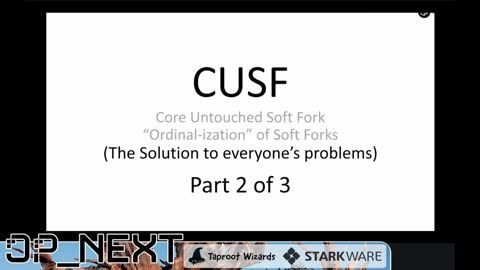
0:30 Hello there and welcome to the Bitcoin Takeover podcast. 0:49 This is Season 15, Episode 68, and we are live with Paul Sztorc, CEO of LayerTwo Labs, which is one of the four sponsors of the show, alongside Sideshift and KnowOnce, which is the new one that just joined, and also Hodling.ch. 1:06 And it's really exciting because I spoke with Paul for the last time on the show. 1:10 I think it was in June when you decided to have this spontaneous contribution to the interview with Chris DeRose, but you didn't mention too much about what you're up to. 1:20 Prior to that, you joined in January to talk about Drivechains, and at the time you were still hoping to get through this BIP process. 1:29 But in the meantime, what became really interesting about the evolution of your attempt to create sidechains for Bitcoin was that you decided to not pursue this BIP process anymore. 1:41 And you came up with the CUSF, which is the Core Untouched Soft Fork, which is a way for miners to activate and deactivate soft forks without consulting the opinions of the conservative core developers. 1:56 And to me, this is pretty interesting. 1:58 I did see some reactions in regards to your proposal. 2:03 I did see how Peter Todd tried to trash everything about it and say that instead of improving your ideas, you're trying to activate them in a different way. 2:15 And I don't know where this is going to lead, but it's exciting because... 2:19 I definitely think that the fact that Peter doesn't like it is a very good sign. 2:23 But notice that he just kind of shotgunned a bunch of things. 2:29 So he said, like, number one, this is a terrible idea. 2:32 Like, the idea is objectively bad. 2:34 And then number two, he said, we should remove invalidate block from Bitcoin, which would be extremely dangerous and would also not work in preventing the idea because the idea has ways of working that don't involve invalidate block. 2:45 That's just the simplest way. 2:47 But he said, we should remove invalidate block to prevent anyone from doing it. 2:51 And then he said something like, you know, some people I was sitting next to said it's a terrible idea and they'll never do it. 2:58 So it's kind of like in A Few Good Men when the guy transfers the guy off the base and he says his orders are always followed or whatever. 3:07 It's kind of like, you know, jumping off a cliff is a terrible idea. 3:13 We need to build a fence around the cliff so that no one ever tries to do it. 3:16 And then he's like, I talked to a bunch of people and they said they would never jump off a cliff. 3:19 It's like, if the idea is really bad, then those other two things don't add up. 3:23 So I think the fact that I actually think that this is the, you know, the end game and all these people are going to be like, I'm not sure, defeated is the right word. 3:36 But, you know, like, there's only so much longer. 3:38 Something has to give, I think. 3:40 Because the actual bit process doesn't work. 3:43 And it becomes more apparent over time to everyone that they either have to have a process that actually works. 3:53 Like an alternative to CUSF, the Core Untouched Soft Fork, that would be something that actually works for activating bips. 4:01 So where's that thing? 4:04 And then otherwise people have to say it's terrible to do any soft forks. 4:10 But that also doesn't work. 4:13 Because in the world of open source, where you have all this variation and innovation all the time, you will eventually not be competitive. 4:23 Of course, there are a lot of people who say that. 4:25 They say that, you know, Bitcoin is the thing that is the most stable and it does not add features. 4:30 But this ignores a lot of the realities as well. 4:33 Like soft fork doesn't change Bitcoin. 4:35 It leaves the old Bitcoin network exactly the way it is. 4:39 So the soft fork is the thing that doesn't change Bitcoin. 4:44 But that's the funny part, right? 4:45 Because I think it was a couple of days ago that you had this disagreement with Luke Dasz, Jr. 4:52 And he believes that a soft fork is something that everyone must upgrade to. 4:56 So it's sort of like a slow, hard fork. 5:00 Right. 5:00 This is like the opposite of the truth for me. 5:02 But Luke has always had this point of view. 5:05 And I think it's even a fringe point of view among even ossifier people and among elite core developers. 5:13 I don't think that a lot of people share his point of view. 5:17 Not that that makes it wrong, but it is wrong. 5:18 But not that that makes it wrong. 5:21 I just bring that up because Luke is... 5:23 I mean, Luke is great and Luke is a genius. 5:26 But he does have... 5:27 He and I completely disagree on this idea of the soft fork. 5:30 I mean, I have discussed this with Luke a bunch of times. 5:35 And we just don't agree. 5:37 But basically, Luke has his own private vocabulary of words, which make it very confusing to talk to him. 5:45 But from my point of view, a soft fork is miners could build on one of two blocks. 5:51 They may not even exist. 5:52 They may just be aspirational blocks. 5:54 They may be about to come into existence. 5:56 But miners could mine on one or the other. 5:59 They choose one path every time. 6:02 They always choose to mine on the block that enforces the new tightened rules. 6:08 To me, this is really like... 6:10 We don't see... 6:12 In the case of a soft fork that's written in code, we all know why they are mining one side over the other. 6:19 It's because one of the functions returns... 6:21 You know, the script interpreter returns false or something. 6:25 But to me, it's not fundamentally different than them just deciding to say, 6:28 I'll never build on a block that ends in an even... 6:33 The hash of the block is odd or something. 6:36 Where it's something that we never see. 6:38 So to me, there could be like 100 soft forks that have been activated that we just don't know about at any given moment. 6:44 But according to Luke, everyone must run the latest version of the software. 6:48 I mean, it's very difficult to steel man Luke. 6:51 Because again, Luke has his own weird definitions of things. 6:53 But according to Luke, if you run the... 6:59 If you do not... 7:00 Like if everyone is not running a full node, then Bitcoin has died, according to Luke. 7:04 It's like Bitcoin just becomes a CBDC. 7:06 So he's very black and white, of course. 7:08 There's no sense of... 7:10 It's like we have totally decentralized Bitcoin and then it's like, bang, it just becomes a CBDC. 7:15 The moment a few people aren't running the latest version of Bitcoin Core. 7:21 And he has never unraveled like the numerous threads that this makes... 7:25 This is a cure worse than disease. 7:27 Because now you need to go to Luke to figure out which version is the latest version. 7:32 You know, if there's... 7:34 Or you need to go to Bitcoin Core. 7:36 Or you need to go to like Bitcoin.org. 7:37 You need to go to somewhere to figure out. 7:39 Or you need to be an elite Bitcoin developer yourself. 7:42 In which case, you need to be a super specialist. 7:46 That's how you find the next... 7:47 Which version is the latest version. 7:49 Whereas many people take a much more reasonable point of view. 7:51 And they just say, I will research it for a little bit, download a version. 7:55 And then I will wait to upgrade until I am ready to upgrade. 8:00 Which is very, very reasonable for a lot of reasons. 8:02 You don't have to be... 8:04 Could be an issue with the new software. 8:06 You have the opportunity to look around and see who's going to be hit by the bug first. 8:10 They're going to hit Coinbase or whatever with the bug. 8:14 So you have an opportunity to get familiar with it before switching. 8:17 It's just annoying to upgrade. 8:19 Software in general. 8:20 So don't break it. 8:22 If it's not broke, don't fix it. 8:23 It's ironically a very pro-ossification point of view. 8:26 To just upgrade like slowly and behind... 8:30 Three to six months behind everyone else. 8:33 That's a very reasonable thing. 8:34 And that's what most people do. 8:36 But according to Luke, you can like trip some wire at some point. 8:40 And then Bitcoin is dead or Bitcoin becomes a CBDC. 8:44 He has this totally black and white point of view. 8:47 That I think is ridiculous. 8:50 I mean, it goes against even what Satoshi said, right? 8:53 Because he was counting on people running SPV wallets. 8:58 Right, he was. 9:00 There's actually research in the white paper about it. 9:03 Yeah, and he is... 9:05 This is a big debate. 9:09 The SPV wallets have the flaw that they must get some information from a full node. 9:16 So it's kind of like cheating in a way. 9:18 But it's really not cheating because most people do not... 9:22 I mean, it's actually a non-starter to ask someone who's new. 9:25 This is another thing that I have debated with Luke about. 9:29 Luke says that you have 100 users. 9:32 They all use full nodes. 9:35 According to Luke, if you add 10,000 users to that who are SPV. 9:40 Then like Bitcoin is dead or something. 9:42 I mean, this is me trying as hard as I possibly can to understand Luke. 9:46 He may go on Twitter and say this is not it at all. 9:49 But he says something like 80% of the network or some percent. 9:55 Then people try to pin it down. 9:57 And they say, well, what percent needs to be full nodes? 10:00 And then he gives some kind of evasive answer. 10:02 I mean, I don't know. 10:03 All I can do is tell people that this is... 10:05 I'm doing the best I can to try to figure out what his argument is. 10:10 But he thinks like if you have 100 users and maybe 50 of them are full node 50 SPV. 10:19 Then Bitcoin is a failed project. 10:21 The whole thing is failed. 10:22 It doesn't matter. 10:22 Like it's no difference between it going to zero or the price going to zero. 10:26 Or no one using it. 10:26 Or this is just 100 black and white. 10:30 It's dead. 10:31 And so then... 10:32 But I asked him like, what about how are we going to get new users? 10:36 You know, regular lay people who are just normal people. 10:40 They are not going to... 10:41 If the pitch is, oh, you should try this new thing. 10:45 It's called Bitcoin. 10:46 It's going to take up 700 gigabytes on your hard drive before you can use it. 10:53 Most people are not going to do that. 10:56 You need to give them at least at the very minimum, you need to give them the SPV wallet first. 11:01 So that they can play around with $50, $20, $50 worth of Bitcoin. 11:07 Yeah, but it's not black or white, right? 11:10 Because you also have Neutrino, which is this BIP that was actually developed to support 11:15 Lightning Network wallets, which basically lets you download block filters. 11:21 And it works on mobile wallets. 11:24 It's sort of... 11:25 It is a slightly improved SPV mod. 11:28 Yeah, exactly. 11:29 And there's also something that these zero knowledge proof people are trying to achieve, 11:34 which is to verify against the zero knowledge proof within a few seconds. 11:39 Yeah, I'm very skeptical of this. 11:41 I think this is totally misconceived. 11:43 So, for example, having the zero sync, sync the headers. 11:51 All of this is actually a mistake, I think, actually. 11:53 And we can get into that if you want. 11:54 But I think that this whole thing is a mistake. 11:57 There's one thing, which is there's the so-called full node, 12:01 which has the property that it contains the whole blockchain. 12:04 And it doesn't have any data availability issue. 12:07 Because you have the whole blockchain. 12:09 And you can send... 12:10 Interesting, because I thought that the full node is something that only validates your 12:14 transactions. 12:15 So you can prune it to only contain the transactions that make sense to you. 12:20 Right. 12:20 So I kind of disagree with that. 12:22 But, you know, it's a complicated issue. 12:25 But basically, I think there's the full node, which is like... 12:28 That's the archival. 12:30 Yeah. 12:30 And it's like, if everyone on Earth, their computer is hit with a meteor, 12:34 you can like regenerate the whole network with this node. 12:39 And the other thing is, all those other things that try zero sync SPV. 12:44 It's like you have... 12:45 SPV is kind of a little bit like you have a big library with like a photocopying thing. 12:50 And you can go into the library, find a book and turn it to a page, make a photocopy of 12:54 the page. 12:55 That's like your transaction. 12:56 Walk out with the photocopy. 12:58 But if everyone only has SPV nodes, it's like you just have photocopiers. 13:02 There's no library. 13:04 So that's the free riding. 13:06 Everyone's free riding on the full node. 13:09 And in order to get all this information in the first place, like it has to come from 13:14 somewhere. 13:15 So I think the data availability problem is the problem. 13:20 And people say stuff like, oh, we have this new thing and it solves all these things. 13:25 It's a full node, but it doesn't have data availability. 13:29 But I think data availability is the only thing, because it's the only thing that you 13:35 cannot get. 13:37 You can't, like, if no one does the data availability, the data is not there on the 13:43 blockchain. 13:44 No one knows if the blockchain contains valid transactions or not because no one knows what's 13:48 in the blockchain. 13:49 So now you have no idea. 13:50 You have no choice but to just go back to the last point in the blockchain where people 13:55 actually have the data. 13:57 And then to start again. 13:59 Because you have no choice. 14:00 You have no. 14:01 So the data availability is the whole thing. 14:05 And everything else is just a different version of SPV. 14:07 And what's worse is all of those other things, you know, zero sync, zk-SNARK, whatever, all 14:13 that stuff. 14:14 I think most of that is really a big waste of time. 14:16 I think Neutrino is actually a good idea, because it helps with the privacy of the SPV 14:22 mode. 14:22 But the reason it's a waste of time, it would, let me explain, it would not be a waste of 14:29 time. 14:30 It would be a good use of time. 14:32 If we lived in a world where people were constantly being tricked, they would get a bunch 14:35 of block headers, 80 byte block headers that have the proof of work. 14:39 And they were constantly being tricked into going onto the wrong chain. 14:43 And so they said, oh, I have three confirmations. 14:47 But they're not real blocks. 14:48 They have the valid proof of work, but they are fake blocks. 14:53 But that has literally never happened. 14:55 And it never will happen, because the headers already have, the miners have to do all the 14:59 proof of work on the header. 15:00 So I don't know if this explanation is going to make any sense to anyone. 15:03 But the headers, Satoshi's SPV mode already basically is a zk-proof. 15:08 The proof of work is a zk-proof that the block is valid. 15:11 It's not a literal proof, but actually its reliability is the same, it's in the same 15:17 class of thing of like being 99.999% reliable. 15:20 So it actually makes no difference in practice. 15:25 Okay. 15:25 I'm trying to remember how we got here. 15:28 We're talking about Luke and Luke's weird, people's weird ideas about like Luke's 15:33 ideas, a theory about what constitutes Bitcoin surviving, which is that a very high percentage 15:39 of the nodes are full nodes. 15:41 Otherwise, Bitcoin is dead. 15:43 His refusal to accept the fact that there are like aspirational users who you would 15:48 have to ramp up. 15:50 At first, on day one, they don't run any kind of node. 15:56 You know what I mean? 15:59 On day one, they don't run any coins, they don't run any kind of node. 16:02 So if we can get them up from nothing to SPV node, and then maybe three months from now, 16:07 they will run a full node, because they'll see that this actually has the privacy benefit 16:12 that they like. 16:13 Because one benefit of the full node is you download every transaction. 16:18 So no one knows which transaction is yours, because you download them all. 16:29 So anyone watching you, they have no idea. 16:33 Whereas the SPV has this trick that you're asking about, oh, what about transaction number 16:39 45,203? 16:41 Then anyone who's watching you or the full node who's talking to you, they know, well, 16:47 he's really interested in this transaction. 16:49 So that's what Neutrino tries to confuse that by. 16:52 You ask for like this mask that could apply to many different transactions, or you ask 16:58 like a bunch of decoy transactions or something like that. 17:00 So that is why I like that idea. 17:03 That's very clever. 17:06 Yeah, and it goes back to a proposal. 17:09 It's similar in philosophy, but different in what it tries to achieve. 17:13 There was Dandelion++, which was proposed for Bitcoin Core, and it was meant to basically 17:20 mix the IP addresses of nodes so that you cannot pinpoint to a specific node and associate 17:28 it with an IP address. 17:30 And for some reason, that was never implemented. 17:32 It made its way into Monero. 17:34 It made its way into, I think it's Zcoin or Zerocoin, which is an early version of Zcash. 17:42 And now it's called Firo. 17:45 It's a very clever name, Dandelion, because the first person broadcasts the transaction 17:49 with like a little counter, and then it goes like in a line, like a stem. 17:55 It goes from node to node to node, only forwarding it to one person. 17:59 And then after the timer runs out, that person broadcasts it to the whole network. 18:04 So it poofs out like a dandelion, you know? 18:08 It's a very clever name. 18:09 And then no one knows, just because you broadcast the transaction to the whole network, no one 18:14 knows if that is yours or if you just were the last one, the hot potato. 18:19 So I thought that was a clever idea. 18:21 But yeah, there was some technical argument given for why not to do it, but I don't remember 18:28 what it was. 18:30 It probably, I mean, it seemed like it was a perfectly fine idea. 18:33 I mean, what exactly, what's the downside? 18:38 I don't know. 18:39 It doesn't seem like there is any, but it must have been something. 18:42 Or maybe not. 18:43 This is the other part of the issue, which is that the competence of Bitcoin Core is 18:48 the competence of Bitcoin Core has been steadily declining. 18:53 And that is the real issue, is that it's become bureaucratic. 18:57 No one wants to actually take responsibility for making the software good. 19:02 It's just a committee, a round robin, which is, on one sense, understandable, because 19:08 no one wants to be like, oh, we're pointing to you and saying, you are responsible for 19:15 Bitcoin Core, like you are basically like a Satoshi and we don't like Bitcoin, so we're 19:21 going to take it out on you. 19:23 But it has the problem that when no one is responsible, then the quality degrades very 19:34 much. 19:36 Well, something that I do want to mention on the topic of full nodes is that we have 19:41 this alternative client of Bitcoin, which is called LibBitcoin, and the maintainer of 19:47 the project, Eric Voskiel, was able to get this, I think he ordered like a $300 computer 19:55 and was able to synchronize a full node from Genesis on that one in like two hours. 20:01 Yeah. 20:02 In fact, I think he said 53 minutes is like he was achieved a few times. 20:08 And there's one at one point, there's a theoretical limit, which is just your internet 20:12 speed divided by the size of the blockchain, like divided by your internet speed. 20:19 And I think he thinks that he can he can like come very close to that limit, which is shocking 20:24 because Bitcoin Core takes like, you know, at least a day. 20:29 Depends on machine, depends on everything, but it takes a while. 20:34 Yeah, you need a lot of RAM and fast internet. 20:37 At least that's been my experience. 20:39 But my question is, why do you think we're not getting these? 20:43 We're not getting down the line. 20:44 We're not getting fast sync with these optimizations from LibBitcoin. 20:49 And it seems like we look at Core like it's sacred and it's not meant to be touched. 20:54 Well, I mean, Eva Chao has explicitly explained on Twitter that the policy is not to do anything 21:00 controversial. 21:01 And the policy is that if anyone threatens any kind of lawsuit or whatever, that they 21:06 will yield completely to that threat. 21:08 So it is like a threatocracy. 21:11 So it's a horrible decision. 21:13 But, you know, so we have to find a way around. 21:19 Around this disastrous governance scenario. 21:24 I mean, I do understand that all of them got sued by Craig Wright, and it was not a pleasant 21:28 situation. 21:29 But I've reacted to that by saying we will preemptively avoid letting the terrorists 21:35 win. 21:35 Basically, they're saying we will preemptively act in a way such that it's like appeasement. 21:42 You know, they're just saying we will not we don't want to be sued. 21:45 So we will not touch any anything important. 21:49 They don't they have a view. 21:50 That's just how can I deflect? 21:52 It's a very bureaucratic EU. 21:55 You know, everyone's sitting in a circle kind of like you don't know there's no one that 21:59 says. 22:02 Like there's no one to actually address any problem to. 22:06 They all just want to deflect the blame to someone else and that no one wants to do the 22:11 right thing, which is display any kind of responsibility for the project being good. 22:19 They only think about how can they deflect blame away from themselves. 22:22 So, of course, it's in that sense, it should not be a surprise that it's that Eric Voskall 22:28 is just like one guy tinkering with it, but who actually cares? 22:31 Because when Eric Voskall does his work. 22:35 He's getting up every day. 22:36 I mean, I don't think he's literally working on it every day, but when he sits down to 22:40 work on, you know, his project, he is thinking, how can I make this project really good? 22:45 But the Bitcoin core people are not. 22:47 They're thinking, how can I get more social status? 22:50 How can I avoid being criticized? 22:55 Of course, that's like hell on Earth, basically, who wants to be a part of that project? 22:58 Eric Voskall is this engineer slash mechanic type. 23:03 I do know that he built his own motorcycle from parts and he is the tinker type. 23:09 So I do see him as a tinkerer. 23:12 And he is the tinker type. 23:14 So I do see him spending a lot of time playing with parameters, seeing what works, what is 23:21 a good idea, what's not a good idea. 23:24 I do know that LibBitcoin was exploited and they did lose some money like a couple of 23:29 years ago. 23:31 And that was a major incident. 23:32 I'm not familiar with the details of that, but I do think there was something like he 23:35 had like a randomness thing early on. 23:39 And he had in the comments, it says like, do not use this. 23:44 But someone else used it. 23:47 So I think there was a little bit more nuance. 23:49 I do remember that, though. 23:51 And he should, I think, even though that sounds like an unfortunate situation, I don't really 24:00 know anything about it, knowing nothing, basically nothing about the details, though. 24:03 But I would say that Eric should, he should not go in the direction of Bitcoin Core and 24:09 try to deflect responsibility. 24:11 He should say, OK, listen, I did say not to use this and the user screwed up also. 24:18 But since I want LibBitcoin to be the absolute best piece of software on planet Earth, I 24:23 will now take responsibility for fixing not only all the Bitcoin Core performance sub 24:31 optimalities, but I will also take responsibility for fixing this other thing. 24:39 So I think that he should, you know, whatever, sort of, I'm not saying that he is to blame, 24:47 but I think he should, the more responsibility someone takes, the better. 24:51 So that's just how it is. 24:56 Better the product will be. 24:58 It's sort of messed up because I do have this feeling, and I'm not sure if you share it with me, that as Bitcoin becomes more mainstream and we get to this phase, I think David Bailey is pushing it into this political sphere where he, I saw him today tweeting about super nations that are going to be accumulating a lot of Bitcoin and getting a lot of hashrate, and it seems like the stakes are getting much higher. 25:25 And this window of opportunity for improving Bitcoin is narrowing down. 25:31 I don't agree. Well, I mean, I do agree, but I think I wouldn't despair. 25:34 I think everything David Bailey is doing and even to some extent what Michael Saylor is doing, even though Satoshi would like if Satoshi could see that if he were today and he could see that the plan is to have corporations and nation states adopt Bitcoin, I think he would just be like. 25:52 Like, what the heck, you know, he'd be like so confused as to how, because he'd be like, but he would be, my guess is he would be thinking like, OK, but which people, who's, who has the private keys and like, won't those people just steal the coins, which I think we will continue to see this, the FTX, Mt. 26:10 Gox pipeline, I think it will continue. 26:15 It's only a matter of time before. 26:16 And I don't want to name any names because then it looks like I'm like, but I hate to say anything. 26:21 But, you know, it could be all of all of the. 26:25 In El Salvador, you know, you have a giant pot of money, OK, so that's the same thing as running an exchange, you have a huge pile of money there, El Salvador, MicroStrategy, whatever. 26:37 BitGo, I hate to say, I'm not trying to say anything about these particular, I'm just saying this, this type of thing is set up to to fail where you have you have Mt. 26:46 Gox, you have Bitfinex, you have whatever, it's just a giant pile of money. 26:53 Everyone's going to try to steal it, everyone's going to try to do whatever they can to take it. 26:57 So this type of thing, the idea of having government have this huge thing, it's going to be very difficult to pull off. 27:03 And there will be Black Swan, FTX type thing where people say and the thing that collapses will be whichever thing people most overconfidently believe is the most secure thing. 27:15 So whatever, whatever, wherever the delusional optimism is, that is the thing that will, you know. 27:21 That's where there'll be the next hack, could be an actual hack, could be just be an inside job where the person says we got hacked. 27:28 Meanwhile, they take all the coins. 27:29 So I mean, it's I just think it's it's a force of nature. 27:36 It's like a guarantee it will happen again. 27:39 It will happen over and over. 27:40 It will happen forever. 27:41 So. 27:44 Yeah, this sort of messed up and you did say indirectly that you believe that Michael Saylor and whatever he's doing right now is going to be the next FTX or the next Terra Luna or whatever. 27:55 Well, OK, he has this point of view where he thinks like Bitcoin with yield is better than Bitcoin without yield. 28:02 He insisted on that, even safety and tried to and I, you know, I think safety and is I don't have a super high opinion of safety, but he was looking like a genius when he was talking to Michael Saylor and he was trying to even let him off the hook with like a little lighthearted joke about, oh, I'd rather have like five million percent and Saylor doesn't even understand like what safety is talking about. 28:24 Like safety and tries to take like an extreme case to make the argument very clear. 28:32 And like Michael is going right over his head, I don't I don't know, I don't know. 28:36 Like, I think he's got some nutty ideas, but the reason I bring it up is David Bailey, Michael Saylor, whatever, all these other people. 28:43 El Salvador president. 28:47 All the adoption is good, and it may mean that Bitcoin core, the software suffers as a result in some ways. 28:55 But it does open the door to certain things. 28:59 OK, so you have like wrapped a Bitcoin. 29:02 The Bitcoin, like it could be the case that BTC is like. 29:09 The interface with it's the bridge between the U.S., the fiat world and the the crypto world, the HDLC world or something, you know, and so then you have all these other things. 29:20 HDLC wrapped Bitcoin. 29:25 You can have all these things that. 29:29 Where those things cryptographically swap for BTC and then BTC swaps for it, so even if BTC became like central bank digital currency coin and it was like only adopted by corporations and governments and it had like some kind of KYC. 29:43 As long as it retains the ability to interface cryptographically. 29:49 Like hash functions and other things. 29:52 It will still be a bridge into the privacy coins. 29:57 So and if it doesn't, so either it will be the the the USB port into the privacy world, at which point the whole thing will be still pretty private or. 30:11 Or. 30:13 BTC completely 100 percent captured, in which case I think BTC has no value in that situation, so I think that that won't happen, you know what I mean, because in a world where everything is. 30:25 Everyone is KYC, this was actually what the 2016 era, the DeRose, Chris DeRose, Josh Unseth era. 30:33 In a world where everything is like KYC and everyone's identity is known, then the entire proof of work thing is completely superfluous and has no value over just signatures. 30:44 And the entire blockchain structure is just a pointless seven transaction per second limitation that is completely and you see this, you see this, we have seen this play out consistently with Ethereum versus like Solana. 30:59 Or like you can say Bitcoin versus Ethereum, Ethereum is way less decentralized. 31:05 But still, there's a bunch of users that don't care. 31:08 And then Ethereum, the issue is now Solana outflanks Ethereum. 31:14 Solana says and then the Ethereum people have to say, oh, that's that's not as decentralized. 31:18 Oh, then you have BTC versus Bitcoin Cash versus Bitcoin SV. 31:22 And then Solana is now outflanked by, you know, Base and all these other things. 31:26 So we have a situation where it will go, we'll have the whole spectrum of decentralization. 31:36 And so it doesn't actually matter if. 31:38 So more adoption is always better, because even though it will, it might screw up the BTC software or even the BTC coin, it will still be the bootloader or whatever. 31:48 It will be the like. 31:50 Like the first, you know, like in an atomic bomb, they need the first explosion to trigger like the second explosion, like a two stage explosion. 31:58 I'm not sure if that's the common knowledge or not, but but they need in fact, I think they need a few. 32:04 It depends on the design. 32:06 But like, so. 32:09 You know, like I think, right, don't you have like the first one has to like heat everything up and make it really and then the second one like explodes and destroys the city or something. 32:17 I'm not, I'm not an expert on such things. 32:21 But some things have two stages. 32:25 Like Starship Heavy, you know, Starship is the booster. 32:29 And then there's the detachments. 32:31 So there's two stages. 32:32 So. 32:34 So anything that gets this up, maybe that's just the booster. 32:38 And so what the bizarre implication is that it may not be Bitcoin that is the winning coin. 32:44 But that depends on like a million factors. 32:48 But I do think that in general, we want more adoption, even among the crazies, the governments and corporations. 32:57 So I think. 32:59 You know, even what Michael Saylor is doing is a net positive. 33:04 Even though it caused a lot of negatives. 33:06 And I think David Bailey also is very positive. 33:09 The political stuff is. 33:12 That's much better than the reverse. 33:15 Although it does change everything around, I think. 33:19 I mean, this is why I enjoy inviting you, Paul, because every time you get on the show, you have a fresh perspective. 33:26 I did notice and it's impossible not to pay attention to the fact that WBTC has more liquidity than Lightning and Liquid and Rootstock. 33:38 And yeah, by like a hundred or something. 33:40 Yeah, yeah, right. 33:42 And it has more volume simply because people want to use their Bitcoin for smart contracts and stuff. 33:48 And Ethereum provides that. 33:50 And I did see news like yesterday or something. 33:53 There's this. 33:54 So basically, it's like Monero, but with tokens and it's called Xano and Roger Ver is promoting the whole out of it. 34:01 And it's trying to tokenize Bitcoin right now. 34:03 So basically, you're going to have ZBTC or something. 34:07 And that one's going to be moved around with Monero level privacy. 34:12 And I do see some value, like there's going to be a change for contracts and there's going to be another one for privacy. 34:19 And it's messed up because this is exactly my tweet from yesterday. 34:24 I said, you know, some guys would rather see Xano succeed instead of activating Drivechains. 34:31 Yes. 34:32 So the key point here, and this is a very good thing that you brought up. 34:37 It's very, very important, which is that one, this is an implication of the view that Bitcoin core isn't very good right now. 34:45 And also that just Bitcoin core is not aggressively pursuing new features as quickly as possible. 34:50 Which I think everyone would admit that now. 34:52 That's not even a controversial thing. 34:54 You know, the Bitcoin core priority is not improve the software as rapidly as possible. 35:03 Everyone would agree with that statement, right? 35:05 Because everyone says, well, now it's like, don't break it. 35:10 Change it very slowly. 35:11 Never change it, you know, et cetera. 35:14 So in that world, there is no Bitcoin maximalism. 35:21 Because now anyone who wants the new feature must, by definition, get it from a different project. 35:27 So you can't have it. 35:28 You have to pick your poison, right? 35:30 Either you say Luke-Jr or ossification. 35:34 Ossification people say, it's basically Luke-Jr says no changes without total agreement. 35:40 And the ossification people are like a subset of that. 35:42 They say, well, the only thing we will agree to is no changes. 35:46 So either you say no change unless everyone agrees. 35:49 But then on the other hand, innovation is just change if one person wants a change. 35:55 So now, once you've explicitly said that there's no, we are not prioritizing innovation 36:01 and we are not prioritizing adoption and we are not prioritizing features. 36:06 Then anyone, now all the entire altcoin thing is totally legit. 36:12 And it is, in fact, anti-competitive guild monopolism to like just say, 36:19 oh, we want Bitcoin core to be the only thing. 36:21 Because now you're just saying, we know our thing doesn't have the features, 36:26 but we want you to buy it anyway, even though it doesn't solve your problem. 36:30 So it actually flips the whole thing around completely. 36:35 So it's quite an interesting development. 36:39 I would never have thought this. 36:40 And one final thing to point out is that BIP300, the whole point of BIP300 is that it is not, 36:46 as a soft fork, it is not a change. 36:48 It is not a change to BTC, like the Bitcoin core at all. 36:54 And it gives you all these new features without them being on Bitcoin L1 and without anyone 36:59 on Bitcoin L1 noticing them at all. 37:02 So it's like even that type of a thing, where the change is not even seen by anyone 37:09 who doesn't want to see it. 37:11 People say, oh, we have a problem with that. 37:13 Well, now Bitcoin maximum is completely dead, I think, because people are saying it doesn't 37:17 matter. 37:20 Like people are just saying, we just want to kill the feature just for the sake of killing 37:25 the feature, even if the feature has no effect on L1 Bitcoin at all, to the point where you 37:30 wouldn't even notice if some other people were using it. 37:33 The same reason why I don't, you know, if someone does a Bitcoin transaction, I don't 37:37 know if they wanted to buy, if they're buying hot dogs or hamburgers. 37:42 Or something else. 37:44 That motivation is invisible to me. 37:46 The same thing is the L2 would be invisible, the BIP300 L2 would be invisible. 37:50 People say even that. 37:51 So then now what they're saying is they just want to kill all the features out of spite, 37:55 even though it has no effect on L1. 37:58 So that is where we are. 38:00 And I think that that and so now, of course, now it makes perfect sense to launch an altcoin 38:06 because you have you what, because you literally have no alternative. 38:14 And it makes no sense at all to call Bitcoin core meritocracy. 38:16 It's an anti-featureocracy. 38:20 So people could try to say that something's better if it has less features. 38:27 No, it's silly because you are one of the true Bitcoin maximalists who are trying to 38:32 maximize what Bitcoin does. 38:34 But for some reason, the term has been redefined to mean conservative. 38:40 So you're a maximalist right now if you just, I guess, post yours. 38:48 I don't want to get there too much, but there are a bunch of guys who just post their gains 38:52 from micro strategy stocks. 38:55 And they are proud in the fact that Bitcoin hasn't changed and they're rejecting. 38:59 I think there is a very strong resistance even against these covenants, which honestly, 39:04 I don't see as being harmless. 39:06 And I appreciate that there is Floppy, the Floppy guy, who was also on the show. 39:12 And I know he also works for LayerTwo Labs. 39:15 And he's making this effort to. 39:19 He's a very cool guy, but he showed up for like a month and then he didn't really. 39:24 He's like a very interesting. 39:25 I think that guy's a genius, but he doesn't really like he poked his head in and did a 39:31 couple one or two things and then departed kind of like a Mary Poppins figure, you know. 39:36 But he is a very interesting guy. 39:39 He's putting together this Wikipedia page where he puts names of developers and what 39:44 they think about various covenant proposals. 39:48 And it's interesting to see where people agree and where they disagree. 39:51 And well, I can just it's clear that all of them are harmless in the sense that you 39:58 could lay every soft fork, you could just shut off later. 40:01 So 51 percent hashrate to turn it on and then 51 percent hashrate to turn it off. 40:07 And as I said before, my view is that there could be 18 soft forks that miners have already 40:13 activated that we don't know about. 40:14 So I like the idea of them being harmful is ridiculous to me, that all of them, it's 40:20 impossible for them to be harmful, including BIP300. 40:25 So they should all just be activated. 40:28 It's like it's very funny that everyone else is tying themselves into these weird knots 40:33 and saying. 40:36 Something will happen, but it doesn't make any sense if it's if it's something that miners 40:41 incentive, if it's something that makes more money for miners, they will do it and you 40:45 cannot stop them. 40:48 And so the whole discussion is pointless. 40:51 If it will not make them more money, they will not do it. 40:55 If it does have it has some kind of negative consequence that actually affects users who 40:58 are paying transaction fees or the price of the coin, miners can shut it off and they 41:03 will shut it off and you can't stop them from shutting it off. 41:06 The only the key thing in our era, I think, is that the miners are specialists at mining. 41:11 They get they find cheap power and those other stuff, but they don't they have yet to. 41:17 Because the block reward is still higher than the transaction fees, they are not interested 41:22 in what the software does. 41:23 They're only interested in mining. 41:25 Eventually, this will all flip and then at that point, it will be impossible for I mean, 41:30 all every idea that I've ever had will be, I think, totally vindicated and the equilibrium 41:35 will just switch to exactly what I have always said it would be back in 2015. 41:39 But we are living through a period where temporarily the miners do not care about the 41:46 software, but that will change. 41:50 Eventually, it will change because they have to maximize the transaction fees. 41:56 Yeah, at this point, let me plug LayerTwo Labs, which has been a sponsor for many months now. 42:00 I'm on the show. 42:01 You don't have to plug this. 42:03 You guys have been shipping code and it's important to describe this and explain to 42:09 people that it's not just an idea. 42:11 It's actual code that you can run on the Bitcoin Signet. 42:14 You go to LayerTwoLabs.com slash download and you're going to find software for I guess 42:20 it's on all major desktop operating systems. 42:23 And this can give you a pretty good idea of what the future is going to look like. 42:27 You have the Z-site sidechain for privacy. 42:30 You have a big block sidechain for low fees and scaling. 42:35 And you also have prediction market and assets. 42:39 Yeah, that's not finished. 42:41 OK, so if you go to releases.drivechain.info and then there's a folder with all the old 42:45 the pre-CUSF stuff, which all work to some extent. 42:49 But now to retool it to do the CUSF, which is sort of new, I think only one of them will 42:56 actually work and it may not work on Windows right now. 42:59 But what the point is, if you go on GitHub, you can see people are working on it every 43:03 day. 43:04 So pop in, try to run it and then pop into the Telegram and tell us why it didn't work. 43:10 Because redoing it, we're redoing it a lot for CUSF. 43:14 But yeah, we had all this stuff that worked earlier this year, then decided that this 43:19 CUSF thing is the way to go. 43:21 So the CUSF thing is, instead of waiting for Bitcoin to activate a soft fork, which 43:27 I think will take like a long time, a prediction market on when the next soft fork will activate 43:32 would be very, very interesting to me, because I think a lot of people know that it will 43:39 come back to that. 43:39 That's a very important point. 43:40 Don't let me forget. 43:41 But instead of waiting around for Bitcoin Core to activate a soft fork or code one or 43:49 whatever the process is, no one really knows what the process is anymore. 43:53 But instead, the Core Untouched Soft Fork is just a thing that miners run in addition 43:58 to Bitcoin Core. 44:00 And this activates the soft fork, even with Bitcoin Core just staying exactly the way 44:05 it is. 44:06 No changes to the code, no changes to the binary or anything. 44:10 So when you download it now, what it does differently than what it does earlier in the 44:14 year, it just downloaded our, which is like our own version of Bitcoin Core that we had 44:18 like a fork of like $16.99 from like a long time ago. 44:22 Now, it downloads the latest version of Bitcoin Core, like the real one. 44:26 It does change the SIGNET 60 seconds, but that has nothing to do with anything. 44:31 Downloads the actual real Bitcoin Core and runs it in the SIGNET mode, which is with 44:37 fake coins, but it's the same software. 44:41 And then it downloads this activator thing, and then it downloads the, it now downloads 44:45 a new graphical user interface that I've been working on, which I think is great. 44:51 And then it will download the L2, the large block L2 that I call Thunder. 45:00 So yeah, give this a try. 45:02 And, but because we have recently changed it from something that worked to this new 45:07 CUSF thing, not everything works, but you can go to releases.drivechain.info and find 45:13 all the old software that did work. 45:16 And, you know, once we fix this, it should be easy to port all the changes that we made, 45:22 the software that we wrote the first time. 45:25 We'll just move it into this new version. 45:27 The CUSF thing is way better because there is no, you know, like now we have to talk 45:35 about this whole line of argument, which is like, okay, Jeremy Rubin did CTV. 45:39 I think, I don't even know when that was finished. 45:41 I think it may have been finished in like 2018 or 2019. 45:46 The code is finished then. 45:49 OpVault, you know, cat. 45:54 All this stuff, like the code is finished, but you have to go through the BIP process, 45:59 which is just like a lot of people talking for years and years and nothing getting done. 46:04 No one wants to take responsibility. 46:06 A perfect example is Taproot where they finished the code and the people who worked on the 46:10 code refused to even discuss activation because everyone knows that it's a politically sensitive 46:15 issue. 46:17 So then someone else had to propose speedy trial. 46:19 That was very controversial. 46:20 Everything's controversial because it's very political. 46:24 But you can see the timeline. 46:26 Let me get returned to my, I know this is a lot of bizarre points. 46:28 So, but let me return to a point that I was making about, you know, Moon Settler. 46:32 I love Moon Settler. 46:33 Great guy. 46:35 And he, I was talking to him, I believe this was a December of last year. 46:42 So I think it was a whole 12 months ago on a space, Twitter space. 46:47 And he said he was getting behind L Enhance because he thought it had the best chance 46:53 of getting consensus, you know, among the developers. 46:59 And I said, well, what are you going to do if it reaches the end of 2014? 47:02 Excuse me, 2024. 47:04 Whoa, my mistake. 47:05 What are you going to do if we get, time travel is the best. 47:07 What are you going to do if we make it to the end of 2024 and there's still no progress 47:13 on L Enhance being activated? 47:15 And then he's like, oh my God, then I think I would just quit Bitcoin. 47:19 You know, stuff like that. 47:20 I don't want to put words in his mouth. 47:21 But the point is, it's a recorded space and people can look it up. 47:25 The point is that people feel like the next soft fork is always like three months away 47:32 or something, but really when you get there, it's another three months and it just goes 47:37 on and on and on and on and on. 47:38 And there's no progress towards actually getting any of them activated. 47:42 So, like what I'm saying is, I mean, where's L Enhance now? 47:55 You can say that maybe there's been a little bit of progress over years. 47:59 But so the question is, we extrapolate that out. 48:02 Where are we going to be 12 months from now? 48:06 Probably we'll make about as much progress in the next 12 months as we made during the 48:10 previous 12 months. 48:12 And I have, as you may have seen, I had a graphic about what we used to do soft fork 48:19 every six months. 48:20 We used to do two a year. 48:22 Then we did only in the first seven to eight year period, we did 16. 48:30 In the second seven to eight year period, we did two. 48:34 And one was SegWit took 26 months from when it was coded to when it was activated. 48:40 And then Tapper took 40 months. 48:43 So, it's just been getting slower and slower. 48:46 So, that is why I redid what I was working on for this Qstiff idea. 48:52 And another interesting property of the Qstiff idea is that it's very, very, very, very easy 48:56 to, because it doesn't even mess with the full node software. 49:02 It's very easy to deploy it on a different L1. 49:08 So, any L1 can do it, Litecoin or whatever. 49:10 So, some people are interested in that. 49:13 So, it does expand the new dimension of competition, which is kind of neat. 49:25 But yeah, if you go to the software, if you go to the site you can download, you can see 49:29 our software. 49:30 If you go to the GitHub LayerTwo Labs organization on GitHub, you can see all the 49:37 work that people are doing every day to ship the code. 49:42 Please try to run the code, but it may not, because if you pop into the telegram and tell 49:48 us what happened, if you go to work, we, but yeah, it was actually annoying because months 49:54 ago I had like, everything was like working very well. 49:57 And then I decided to switch to the Qstiff thing. 50:00 Which is pretty complicated because you have Bitcoin Core, then you have this other thing. And what, what does everything talk to is just a little bit of a grind, but it is much better because the alternative is to deal with Bitcoin Core, which is, again, they're determined to, like, Bitcoin Core is set up so that, you know, it's, you know, 50:27 you, it's like, you have to go through a lot of people and justify all of your decisions. 50:35 So, if you are, if you have the best decisions and you are actually have the smartest, 50:41 best idea, you are, you're at a disadvantage because everyone else is still catching up to you. 50:49 It is pretty political and it's easy to be hated when you're participating in the, these discussions. 50:57 I think it got to a very ridiculous point where people are shilling custodial solutions and they claim, you know, it's the best that we have, and we don't want to change Bitcoin too much. 51:07 So you either use this or you're a shit coiner. 51:11 And I don't like it too much. I don't know. I don't like, I like the idea of eCash. 51:19 I do get the point that people who use custodial lightning can get better privacy, but I don't see the value in it when it's being promoted as the scaling and privacy solution. 51:31 The problem with eCash and the problem with this whole, the whole ecosystem is evolving in the wrong direction. 51:39 So it's always just like assuming that people use custodial lightning, what can we do? 51:43 And same with, so, I mean, I love Taj Draja and Joseph Poon, who invented the lightning network. Those guys are great. 51:51 I love Taj. Up next, Taj presented on, can we have an L1 block size increase? 51:57 So even Taj has decided to use an enormous political capital as the creator of lightning. 52:04 And he's trying to say, he's trying to, he's trying to expand the creative direction of saying, can we de-stigmatize the L1 block? 52:12 So I don't agree with that, but I think he's doing the right thing by trying to say, okay, can we just talk about what is actually a good idea? 52:22 And so he's great. And then Barack, who invented ARK, Barack is also great, but these two ideas are not good. 52:33 Lightning and ARK will take us in the wrong direction for a lot of reasons, but they take us in the direction of developers collecting salaries, 52:45 confusing things that the VCs will be confused by, so they'll fund. 52:52 They take us in this direction of just not caring about the end user's experience because the experience is terrible, 53:00 where you like have to keep refreshing your funds and you need to be, I need a live connection. 53:06 It's terrible for privacy. It's terrible for everything, really. 53:10 And it ultimately won't work because the transaction fees on those L2s are not piped down to the miner. 53:16 So they cannot compete with an L2 that does, such as BIP300, which, where the transaction fees are sent down to the L1 miners. 53:27 So ultimately, it's going to be a huge waste of time. And you can see, I mean, imagine you had time traveled to the past. 53:36 You time traveled to Scaling 2, which was in December of 2015. So you go nine years in the past. 53:42 And people said Lightning Network is three months away. And then you time travel to the past, and then the people there ask you, 53:48 Oh, like, you know, how did, you know, what was, what was Lightning Network like in 2016, or in 2017, or in 2019, you know? 54:05 These are the same mistaken people who have a track record of being totally wrong. 54:12 Again, the Lightning Network, you know, the number of coins is like, you know, four or 5,000, whereas Wrapped Bitcoin is like 150,000 or something. 54:20 So Lightning, so if you are not paying, if you pay 10 times as much attention, if you think Lightning Network gets a certain amount of attention, 54:34 Wrapped Bitcoin should get like, you know, 10 times, that's still too much, too little for Wrapped Bitcoin. 54:40 It's not disproportionate. But of course, Lightning gets a ton of attention, and these other things that people actually use get no attention. 54:49 And so this just speaks to how, and it's like, the other thing is the psychological and social aspects of it are horrendous, which is people feel very uncomfortable criticizing Lightning. 55:01 If you, when you talk to people in a bar, you know, this happened for years, and I would bring, I would say, well, you know, like, it doesn't, it doesn't work. 55:11 Probably wouldn't say, what do you have against the Lightning Network? I'd say, well, no one, it doesn't work. 55:15 The HTLCs don't work. They don't work when the fee, nothing works when the fees are high, nothing works when the fees are volatile. 55:22 No one wants to be online and have their private key. They need to sign to receive money. They need to have a hot wallet with their private key on the internet. 55:32 None of it works. Like, the whole thing, you can't onboard enough people. 55:37 Like, not thinking about it works, but then people would say, oh, you know, you shouldn't criticize Lightning because then you won't get, like, invited on stage. 55:46 People will say things like that. So when you see the integrity collapse like that, you know, actually, the whole, the whole culture is actually a sinking ship. 55:55 And so the, the crazy thing about that is the software space is so competitive that it means that there may be more opportunities to make a huge amount of money off betting against these people. 56:10 But that's a kind of a complicated conversation. But, but basically, the big problem with the Lightning Network is the followers. So everyone wants to just look the other way. 56:20 Every Lightning person either is totally ignorant of the facts, or they know that the facts are bad. 56:28 And they are lying about, you know, they're lying to try and hope that they, it's, it is like Theranos, where they're just trying to get the, or Thomas Edison, where he didn't have the working light bulb, it was all fake for a while. 56:42 And then he, just in time, he figured out how to get the cheap light bulb right before he ran out of money. And Elizabeth Holmes modeled Theranos on that. All the demonstrations were fake. 56:55 The little blood machine didn't work, and everyone knew it didn't work. 57:01 But they were just going to keep it going, try to keep it going until they get it and make it work. And that is what ARK is. 57:07 ARK is just the latest attempt to get it to work. 57:11 But it doesn't work. And it will be, think about like how long it will take to even get the soft fork and to even then get software that understands the dev tooling to get like the wallets, the front-facing user interface. 57:24 And that is stuff that we had, we already had working earlier this year. And when the CUSF transition is complete, we already have like a graphical user interface, a wallet and all this other stuff. 57:37 So, I don't, I think all this whole thing is, because this is why I'm going on this speech, as you mentioned, this idea of like eCash. 57:49 And okay, if people are using custodial lightning, then they can get, but everything is going to evolve in the wrong direction. 57:56 And that is why BIP300 and CUSF are so controversial, because they put us back on the right track and they, no one is going to care about what any of these other people had to say after it's, their incompetence is revealed. 58:13 There's a lot to unpack there, but I think ARK is just a more centralized version of lightning. 58:21 And I did interview the guys from Decred and this guy who is one of the lead developers of the Decred project explained to me that he was able to make the lightning network much more efficient with something that would require some changes to the base layer and Bitcoin. 58:42 But I don't see or hear anyone talking about this in the Bitcoin space saying, you know, these guys with their altcoin, they were able to make lightning work more efficiently. 58:53 How about we look into this? 58:55 Well, probably, I don't know the details of that, but think about, this is the other issue, is the more difficult the BIP process is, the more it deters people from even investigating in the first place. 59:10 I mean, we have seen over the last few years, the big line is, oh, we can do this on Bitcoin without a soft fork. 59:20 But the whole point of the soft fork was that you could do it without everyone upgrading and without, you know, you could do it without a hard fork. 59:28 That was the trick before. 59:31 So I think people just want to live in a world where, I mean, in one sense, people say Bitcoin is the best software and you can't improve on it. 59:43 But then that's, you know, the reality is that very few people are even looking. 59:49 Because, like, what would you do if you found this, what would you do? 59:53 You find an improvement. 59:55 Oh, I can make lightning more efficient. 59:57 What are you going to do? 59:59 Most people don't know how. 1:00:01 It's a huge amount of time. 1:00:03 Then everyone will hate the BIP, because now another perverse incentive is that since the BIPs are not activating, there's this jostling in place for line, in the line of activation. 1:00:17 Because it's perceived as an either or, when in reality, we should just activate them all. 1:00:21 So it's perceived, like, if you have a new BIP, like, you have CPV and then someone has TX hash, it's like, which one are we going to do first? 1:00:31 When in reality, we should just activate them all. 1:00:33 Because we can always deactivate them later, so it makes no difference. 1:00:37 But now, if you have a new BIP, then all the other BIP authors are going to, like, they have an incentive to criticize your BIP. 1:00:43 And then you get this table, which I think the floppy disk guy is great. 1:00:47 The previous version of that table was for SegWit2x, and that was to create political opposition to SegWit2x. 1:00:55 And I was also on there as saying SegWit2x is not a good idea. 1:00:59 And one of the reasons why I said is that there's no reason for SegWit2x, because we could just have large block L2 Drivechain that was back in 2017. 1:01:12 So now the floppy disk guy has copied that, and he has made it multidimensional. 1:01:18 So you can now weigh in on multiple BIPs. 1:01:22 But this is why the prediction market would be good. 1:01:27 Because the prediction market would be something that pays off a certain amount of money based on, like, you know, when the BIPs activate. 1:01:39 And my guess is that the smart money would be betting that none of them will activate for a while. 1:01:46 Even when they did LNHance and CTV, the activation parameters, like, they don't even start for, like, a few months. 1:01:55 And then the miner signaling period is, like, multiple years. 1:02:00 And then they activate in, like, 2028 or something. 1:02:04 So the fact that people would even consider that shows you that how little everyone still understands about, like, the soft forks can be turned on with a soft fork and then shut off with a soft fork. 1:02:17 And it's true that we don't want to create emergency situations. 1:02:20 But, like, what the emergency situation is, like, people are spending money into a certain type of script and then spending money out of it. 1:02:29 It's very limited, the emergency. 1:02:32 The whole thing is about political control. 1:02:36 Because the more that the L1 changes with respect to these optional opt-in soft forks, which, again, Satoshi put in the op-nops exactly for them to be used for this purpose, and they have already been used for this purpose. 1:02:51 But the more that the L1 changes, the easier it is to build a better mousetrap, an outflank lightning, an outflank arc. 1:03:01 So people want to build a little fiefdom. 1:03:04 They want to have, like, a lightning fiefdom. 1:03:07 And then they don't want Bitcoin to improve. 1:03:10 And including the custodial fiefdom. 1:03:12 They want the custodial fiefdom. 1:03:15 The last thing you want, if you want people to have their Bitcoin in a legal framework, like a corporation. 1:03:30 So if you want a corporation to have Bitcoin in custody with BitGo or something, or Fireblocks or whatever, but it's protected by a legal document. 1:03:42 The worst thing in the world for BitGo would be if multisig improved, if it was easier to run a full node, and that improved, key management improved. 1:03:52 The worst thing in the world for, like, Michael Saylor's corporatist position would be if more people took an interest in running full nodes and taking self-custody. 1:04:02 Then they would think, why am I giving my clients to someone else? 1:04:08 So the custodial fiefdom is one of these many fiefdoms that the more L1, the worse L1 gets, the better something else gets. 1:04:18 So that is part of it. 1:04:23 Today, we would really have to weigh the, you know, like, the computers and internet speeds have improved enormously. 1:04:30 The idea that the full node would be negatively affected by these opcode types is, you know, like, absurd. 1:04:41 There's a lot of concern trolling, right? 1:04:44 People come up with ideas that are no longer feasible. 1:04:48 It seems like some guys are stuck in 2017, and that was the peak of their involvement and their willingness to learn. 1:04:56 And afterwards, they just embraced this ideology where they said, you know, we're the smartest guys in the room. 1:05:01 Blockchains don't scale. 1:05:03 Don't even think about doing this and that. 1:05:06 You can't scale blockchains with other blockchains. 1:05:09 You should build second layers. 1:05:11 You should do client-side validation, even if it's hard. 1:05:14 Maybe take 10 more years to figure it out. 1:05:20 I agree. Yes, I agree. 1:05:23 And even so, I'm not sure if you take any sides in this whole Covenant situation. 1:05:29 I do know that some Covenants can enable Drivechains, even though it's not the ideal way to do it. 1:05:34 And it doesn't grant the users the right protections. 1:05:38 But my point is that I did join the Cult of the Covenant group on Telegram. 1:05:45 And people pointed out to me that I should look into the conversations that were being had in 2021 or 2022 between Adam Back and Jeremy Rubin. 1:06:00 And it's fascinating to see how Adam Back basically joined the group, spent some time trolling the project. 1:06:06 And within two weeks, he was able to demoralize everyone and delay the activation debates by another two years. 1:06:15 Yeah, I don't know if he intended to do that or not. 1:06:18 Because, of course, he is a sharp guy. 1:06:22 But there's also – let me finish. 1:06:25 There's also the marketing side that's trying to portray Jeremy as this insane guy who has no idea what he wants. 1:06:32 There's Grubbles, who is very much against anything that Jeremy does. 1:06:37 And my suspicion is that Blockstream is either working on a CTV alternative. 1:06:43 And they're going to promote that as the soft fork that we need to push forward. 1:06:48 Or else, maybe they just want to maintain political control. 1:06:54 Because Blockstream is not a profitable company. 1:06:56 They're not selling anything that's profitable. 1:06:59 I think mining might be the only product that's making them money. 1:07:03 No, I think mining is certainly losing them money. 1:07:06 Liquid is not making money. The Jade Harbor wallet is not making money. 1:07:10 Mining is so real that you cannot fake. 1:07:13 You cannot just get up there and say, well, we have Adam Back. 1:07:17 Because Adam Back is great, but it's not like Adam Back can just smile at the miners and make them more profitable or something. 1:07:25 But I think the sun is setting on Blockstream. 1:07:28 It's a miracle it made it this long, in a way, because they don't put anything out. 1:07:32 I don't know how much actual – I think people love Adam Back, including me. 1:07:36 And Adam Back is a huge supporter of mine, which I appreciate. 1:07:43 But it doesn't just make a profitable company. 1:07:48 Okay, so let me – a lot of different things to say. 1:07:53 So my position on covenants is that the entire covenants project is a mental illness. 1:08:02 Every single one of them is a mistake. 1:08:05 But nonetheless, we should still activate all these soft forks because they are completely harmless. 1:08:12 The idea that we must debate a soft fork is just Luke Dashjr.'s mistaken idea of needing consensus for soft forks, which we don't. 1:08:23 And we can – miners should turn them on and off as they think that they will increase the price of Bitcoin. 1:08:31 Imagine a completely different conversation where Foundry announces and they say, CTV has been invented by Jeremy Rubin. 1:08:39 And we hope that this will bring these new use cases and new options to Bitcoin, and we hope that this will make us more money. 1:08:45 And in fact, as a publicly traded company, we must – we have a fiduciary duty to maximize our own shareholder value, and we must. 1:08:55 That would be a rational world, actually. 1:08:58 But then all these people say, oh, if we do soft fork, we might do this. 1:09:01 This is – again, this is all because people do not want the L1 to improve because it alters which L2 tradeoffs are better. 1:09:13 So, for example, people who are bad on BidVM and you tool the whole thing on BidVM. 1:09:21 So, it's ironic because Robin Linus is a huge fan of mine. 1:09:25 I think he's great also. 1:09:26 But I think – and Sergio is also a huge fan. 1:09:28 Everyone's a huge – but Sergio is doing like a BidVM thing. 1:09:31 Now, he's not going to want BIP300 to activate because all the work he's done related to BidVM would be unnecessary, and it would just not do anything. 1:09:41 So, this is the real issue is people make investments. 1:09:43 They make specific investments in their tech stack that rely on the L1 being a certain way. 1:09:54 All these people are making a huge mistake because, as I've said, the end game, when the miners care more about fees than the block reward, the end game will all be mined L2s. 1:10:07 L2s that pay the transaction fees to miners. 1:10:11 So, I have a lock on the end game. 1:10:14 There's no way – I mean, of course, anything can happen in technology, but this is all a mistake. 1:10:22 And I don't think any – people really don't even care. 1:10:24 They just think, oh, I can be like Lightning Labs. 1:10:26 I can raise $55 million, $90 million, whatever, and we'll just raise all this money. 1:10:34 People don't even care about the fact that it's not going to work. 1:10:39 And it's like an ego thing, too. 1:10:40 With Blockstream, they have simplicity, although no one has heard from simplicity in a while. 1:10:46 So, is it still around? 1:10:49 Simplicity. 1:10:50 The joke is that it should be renamed complexity, but whatever. 1:10:55 So, they want that. 1:10:56 So, again, this is the incentive. 1:10:58 When you have a situation where it's difficult to activate the BIP, where the BIP activation is scarce, you must care about which one is first in line. 1:11:09 So, then the BIPs compete with each other. 1:11:11 But this is all – all of it's irrational. 1:11:13 So, the entire covenants thing is a mistake. 1:11:15 Covenants are a mistake. 1:11:17 Lightning was a mistake. 1:11:19 The last nine years have been wasted and have made the project worse. 1:11:23 We've been making the project worse and worse and worse and worse. 1:11:28 BIP300 teleports us out of this, back to safety. 1:11:35 But, nonetheless, all of the – I mean, I thought about adding my name to the table, but I don't know if I should or not. 1:11:41 I would just put, like, weak. 1:11:42 There's one that's, like, better than nothing. 1:11:44 I would just put that for all of them. 1:11:46 But I don't know if that would be seen as a troll. 1:11:48 People would think, oh, he's just trolling the table. 1:11:51 But that's my honest opinion, is that all of them are better than nothing. 1:11:54 All of them are perfectly safe. 1:11:56 The idea that we need consensus for softworks is flatly untrue. 1:12:02 And, in fact, it is just an excuse for all these people to pretend to be important by talking to each other on Twitter instead of shipping something that actually works. 1:12:10 And then competing for real users. 1:12:12 The users are not going to use something where the payment can fail. 1:12:16 So, the Lightning – your Lightning stack, your Arc stack, it needs to have a – it needs to hit 399 times out of 400. 1:12:32 You know what I mean? 1:12:33 Like, if you have two cards, you have a Visa and a MasterCard, and you know that maybe MasterCard will miss one out of every 200 times. 1:12:48 And Visa always works. 1:12:52 And you're in line at the supermarket. 1:12:56 You will never take out the MasterCard. 1:12:58 You'll say, oh, this one doesn't work sometimes. 1:13:00 It's embarrassing. 1:13:02 It's annoying. 1:13:03 I mean, so, of course, there's a tradeoff, and there's some number, but really, Lightning is too interactive. 1:13:12 The fees are high. 1:13:13 When you – it's either custodial, a wallet of Satoshi gets pulled from the App Store, or to actually make it work, the fees are high. 1:13:23 It's difficult to manage the liquidity. 1:13:25 People cheat on managing the liquidity with the submarine swaps, where there's – for every Lightning transaction, there's an L1 transaction. 1:13:31 And it's like, well, wait a minute. 1:13:32 I thought you were doing that. 1:13:35 You were taking care of the – I thought I didn't have to use L1. 1:13:39 That's the whole point of this. 1:13:41 So, none of this stuff will be competitive in the long run. 1:13:45 It's all just a developer grift. 1:13:47 So, the whole Covenants thing is – but nonetheless, we should activate all the software. 1:13:51 So, I've been repeating. 1:13:52 That's my point. 1:13:55 I think that's the best approach, to let the free market decide, to let the users try all of them and figure out for themselves if there's anything valuable. 1:14:04 Because obviously, there's going to be investments in one or the other. 1:14:09 And maybe this might dictate which one is going to win eventually, because marketing and user experience are also important. 1:14:17 It's not just the best idea that wins. 1:14:20 But it's important to have competition for finding solutions to scale Bitcoin and make it more private. 1:14:27 It's just that it seems like some people have given up. 1:14:30 The ETF seems to be the scaling layer. 1:14:33 And for privacy, I went to Monerotopia last month, and I did see that quite a lot of OG Bitcoiners were there. 1:14:41 And it seems like they sort of gave up on the idea of even trying to improve privacy in Bitcoin. 1:14:46 And now that we've seen Bitcoin, they're saying, OK, we're fine. 1:14:48 We're going to have not 21 million, but maybe 100 million coins in the world for the stuff that we want. 1:14:55 And that's fine. 1:14:59 Well, I mean, Monero is like... 1:15:01 The Monero people are have their like, you can only serve one god, right? So Monero people are serving the privacy god. And as I explained earlier, the official position of Bitcoin is not that we will make Bitcoin as private as possible as rapidly as possible. 1:15:24 So it's intentionally not doing that, unfortunately. 1:15:34 So this open, if anyone who wants to be creative and do something new must do this different thing. 1:15:47 You know, they must do the altcoin route. 1:15:51 I mean, that's where you find the interesting experimentation, because it doesn't have the same boundaries. 1:15:57 You can see people actually trying something like there are a lot of academic papers that get published with ideas and proposals. 1:16:06 I did have Nick Jonas from... 1:16:10 No, it's Jonas Nick from Blockstream and Liam Egan from Alpenlabs. 1:16:17 And also was the third one. 1:16:19 Oh, Robin Linus from ZK Sync or Zero Sync. 1:16:25 So they did co-author this paper in which they described shielded client-side validation and how that can work as a protocol on top of Bitcoin and to provide a large number of transactions per second with good privacy, Zcash level privacy. 1:16:44 And that's fascinating, except that there's almost zero demand for it. 1:16:49 So they put out this paper in the wild and the reactions from Bitcoiners were at most a retweet, but they don't seem to care. 1:16:59 And it takes money, it takes a few years of your life to build something like this, and if you do it and then you discover that there's no demand, I think that's one of the most painful experiences you can have. 1:17:11 Well, I mean, I don't really know. You might be right about that. 1:17:14 I do think like, you know, science is kind of like everyone is someone is lost on the mountainside and we need the rescue operation to find them, you know, and so someone takes the north side and someone takes the west side or whatever. 1:17:29 We all were a search party, right? 1:17:32 And we all go out, we're looking for the person. 1:17:34 And then the other person and then someone you hear on the radio, oh, we found the person. 1:17:38 OK, then we all meet back at base camp, you know, at the lodge and they say, where was they? 1:17:44 And then, oh, they were in the they were on the south part of the mountain. 1:17:49 It's not like you say, oh, I searched the west part, but it was, but it was, but I wasted my time. 1:17:58 But it was, but I wasted my time. 1:18:03 Right. 1:18:05 That's you wouldn't say that because you would say, oh, I. 1:18:11 We all had to look everywhere to find the thing that worked. 1:18:16 Does that make sense or no? 1:18:21 It does make sense. 1:18:22 Sorry, I was reading the comments. 1:18:24 It seems like we have a very colorful and active chat, but people commenting stuff, 1:18:30 they're saying anything good. 1:18:32 They do say some good stuff. 1:18:35 So I guess at one point we're going to stop and read what they're saying. 1:18:39 And I do agree with your point that like people have to choose how to invest their time. 1:18:44 And if they if they look at this and they think. 1:18:47 Well, no one cares, then, of course, they're going to, you know, they'll be at Manero Topia or 1:18:51 whatever. 1:18:52 So then the maximalist position starts to look really stupid because then it's just like, oh, 1:18:57 you have your thing that you really want to do that other people want you to do. 1:19:01 And that will actually have an effect on the world. 1:19:02 And then it will make people money. 1:19:03 And they'd be so happy that you did it. 1:19:06 You shouldn't do that thing. 1:19:07 Like, you know, whatever, like then. 1:19:11 But well, OK, I mean, I mean, do you want to read it? 1:19:14 What did they say? 1:19:14 Did anyone say anyone have a good question or anything? 1:19:18 We'll get to that. 1:19:19 I just also wanted to mention that I did an interview with the guys from Starkware because 1:19:25 they were working on this proposal to do covenants without a soft fork. 1:19:31 Right. 1:19:33 With Tapscript and something that's already available. 1:19:36 But that's one of the most expensive ways to do a covenant. 1:19:39 It's almost like a way to prove that, yes, you can do this, but no, it's not useful. 1:19:46 So, of course, you need some sort of covenant to make it affordable for the end user. 1:19:52 There's two interpretations of this. 1:19:55 The good interpretation, and this is what I think people are doing. 1:20:00 Similarly to I think this is part of what Andrew Polster was doing of. 1:20:06 Saying. 1:20:08 Right now, it's basically saying, listen, this thing that you think we should never, 1:20:12 ever, ever be able to do. 1:20:14 We actually can do it now. 1:20:15 It's just kind of expensive. 1:20:16 So why don't you just drop the issue? 1:20:19 So I think that's a good interpretation. 1:20:21 All of these things also have a cynical interpretation, which is that this is all 1:20:25 just for the attention, and this is just to show off. 1:20:29 Look at my look at my weird paper. 1:20:32 I can make weird collisions, you know. 1:20:35 So that is the cynical interpretation. 1:20:38 Kind of similarly for CUSF, for the software CUSF. 1:20:42 It's like, listen, these softworks will happen if they make miners money. 1:20:45 They will not happen if they do not. 1:20:47 Miners are the only one who throws the switch. 1:20:50 So complete non-issue now. 1:20:55 The question of how to activate softworks, which is the question, doesn't exist anymore. 1:21:02 And yeah, so those are the two interpretations of that. 1:21:12 I mean, what will people actually use at the end of the day? 1:21:15 That's what I'm most interested in. 1:21:16 I try to build that. 1:21:18 I think that is the long run winner. 1:21:23 And the other stuff, I think people don't actually care if anyone uses it or not. 1:21:28 People will want privacy. 1:21:32 It's interesting that people have been trained not to use the software. 1:21:35 They've been trained to just go on Coinbase and buy Bitcoin the same way you would buy 1:21:39 a stock, the same way you would buy MicroStrategy. 1:21:41 People have been trained to do that. 1:21:42 So, and again, the worst the software is, if there's no user-friendly multisig, if there's 1:21:48 no user-friendly wallets, Bitcoin Core didn't support the BIP39 word list for a long time. 1:21:56 And as far as I know, it still doesn't. 1:21:58 I haven't really checked in a while. 1:22:00 No, they don't. 1:22:01 Why is the multisig is, you are 100 times more likely, I'm making this up, 80% of statistics 1:22:08 are made up, but you are very likely to just destroy all of your own money if you try to 1:22:14 use multisig. 1:22:15 Because people do not know that you have to back up the whole thing with all the keys 1:22:20 and the public keys and the number, the quorum number. 1:22:28 You have to back up this whole thing. 1:22:30 The private keys are not enough. 1:22:33 You need to back up this giant file. 1:22:35 And people don't know that. 1:22:38 So if you try to, but we could easily fix all this. 1:22:43 But there's no interest in the front end. 1:22:46 There's no interest in the graphical user interface. 1:22:50 There's no interest in the user experience. 1:22:52 In other words, people want the software to just continue to get worse. 1:22:55 And that's what, and then people, you know, whatever, Ava Chao, whatever, they just say, 1:23:01 that's exactly what we want. 1:23:02 We want this status quo. 1:23:06 So that's the problem. 1:23:09 They say, if we change it and it gets worse, we'll be blamed. 1:23:12 So then there's zero changes, there's zero improvements. 1:23:16 Well, that's why I still do the podcast, right? 1:23:18 Because it's easy to get jaded and disillusioned and have no hopes for the future and just 1:23:25 assume by default that Bitcoin is never improving and we're playing it safe. 1:23:30 It's never improving and we're politically captured. 1:23:33 And this is actually a delegated proof of stake system where the guy with the most coins 1:23:38 can actually shut down innovation. 1:23:41 But I'm trying to change the culture. 1:23:43 I'm trying to present to people that there is a lot of interesting stuff out there. 1:23:49 Listen to it with an open mind, try to understand what it does. 1:23:52 Look at it as software and don't think too much about the money aspect of it. 1:23:57 Because it makes no sense as long as it's not even activated. 1:24:01 Just experiment with stuff. 1:24:04 Well, you won't get the last laugh because eventually the difference between what the 1:24:09 technology will support, like what Eric Voskel can do and what all these other people can 1:24:16 do, everyone else, Fluffy Pony and everyone, Roger Ver, because adoption is the kind of 1:24:25 technology. 1:24:26 So there's a kind of innovation. 1:24:28 I suppose it's a kind of innovation if it's not a kind of technology. 1:24:32 So if Bitcoin Core stays here and the state of the art of the technology increases, then 1:24:38 there'll be this gap. 1:24:40 And if something cannot go on forever, it won't. 1:24:45 So eventually the gap will be so big that it'll be possible for anyone to just launch 1:24:50 a new coin that scales to the whole planet and has user-friendly multi-sig and it has 1:24:55 bit 39 and it has sidechains and it has privacy. 1:24:58 Eventually the tech stack will get so powerful when just anyone can do that and the full 1:25:04 nodes fit on everyone's laptop and everything syncs in 35 minutes despite processing 1:25:11 transactions for 8 billion people. 1:25:13 The tech stack will get so big that it will eventually just become whatever is adopted 1:25:19 fastest will have the network effect. 1:25:23 And you understand that that will be once you reach a situation where something's big 1:25:28 and it has network effect and something smaller, which is for the non-network effect reasons 1:25:34 it is better, it catches up, then it will be a blowout and that thing will take over. 1:25:40 That will go planets. 1:25:41 So one thing, one coin will reach planetary scale and there will only be one survivor. 1:25:48 I have always believed that and I still believe that. 1:25:51 None of the reasons why that has, you know, because you have a strong network effects, 1:25:55 but you also have strong other effects. 1:25:58 If only the network effects matter, then the US dollar would win. 1:26:03 But there are these other effects. 1:26:07 One is that it's very hard to use the US dollar in a country that, you know, like in Europe 1:26:12 or in, no one wants to give up the seniorage benefits. 1:26:15 Another issue is that using the US dollar in the United States has the disadvantage 1:26:19 that you pay the inflation tax. 1:26:23 Which is going to be very high because our budget. 1:26:26 I mean, maybe the funny thing is it would be disastrous for Bitcoin if Elon could actually 1:26:30 cut 2 trillion from the deficit and balance the budget and we don't get the whole money 1:26:35 supply shrinking again and there'd be deflation and there'd be American prosperity is in some 1:26:41 sense bad for Bitcoin. 1:26:43 Not completely, you know, it's a little more nuanced than that, but anyway, you're going 1:26:48 to get the last laugh because the technology will continue to improve. 1:26:53 And eventually it will be, you know, an iPhone versus a Motorola Razr or something, you know. 1:27:00 Yeah, at the end of the day, it is technology, even if some people worship the current version 1:27:06 of the code, like it's some sort of holy scripture. 1:27:11 Is that the way you describe it? 1:27:14 Holy textbook or whatever, they just make some assumptions that this is where it's at 1:27:20 and it can never get replaced. 1:27:22 And, you know, it's only been 16 years and. 1:27:26 You know, it's only been 16 years and Bitcoin was built with technology, with libraries 1:27:33 that were available in the early 2000s. 1:27:38 In the meantime, we have a lot of interesting stuff that was built by virtue of Bitcoin 1:27:42 existing, and it's only a matter of just reaching not just scale, but also the features that 1:27:49 people want. 1:27:50 And I do see some of that in Solana. 1:27:52 Of course, it doesn't scale because it's centralized. 1:27:56 So it's silly to assume that it does scale, but it seems like they're pushing and they 1:28:02 have a very optimistic philosophy for reaching their goals. 1:28:07 And possibly that's why they keep on succeeding. 1:28:13 I mean, they have more decentralized now than they were in, I think, January 2022, when 1:28:18 there was just one node. 1:28:20 So that's part of the spectrum. 1:28:23 We're going to explore the whole spectrum of decentralization. 1:28:28 So there will be totally centralized, very centralized, very decentralized, everything 1:28:33 in between, probably. 1:28:36 I used to hate Eric Voorhees for making this point that decentralization is a spectrum. 1:28:40 I know, the competition point. 1:28:41 No, he got the last laugh on the competition point. 1:28:42 He did. 1:28:43 Yeah. 1:28:44 And also decentralization as a spectrum. 1:28:47 Like this guy was very much ahead of his time. 1:28:51 He was a Bitcoin maximalist in 2013. 1:28:53 Yeah, because back then it was like what's competing with Bitcoin was like Litecoin, 1:28:58 which is like exactly the same. 1:28:59 So the competition was really kind of like a sham, like in the sense that there was nothing 1:29:04 really new about Litecoin. 1:29:05 You know, the altcoins were not really, there was nothing really new and they were just 1:29:09 people launching the coin to make money. 1:29:12 And plus a bunch of really weird people, NXT, which had like 100% pre-mine and BitShares, 1:29:19 Dan Larimer, you know, so the competition was just horrible. 1:29:25 And so anyone who walked up and said, oh, well, don't you want, why should we just bet 1:29:30 everything on Bitcoin? 1:29:31 It was like, yeah, because of network effects, because it's the only good idea. 1:29:36 Now it's kind of traded places to some extent where the Bitcoin maximalists have no idea 1:29:42 the issues with Bitcoin and they have no idea that they may in fact be the retail that is 1:29:47 dumped on as something else gets out the vote, you know, gets on the adoption and tech stack 1:29:57 and it's reversed. 1:29:58 And the people who are pro competition are just having fun and doing whatever they want. 1:30:05 And just having a great time. 1:30:07 So yeah, competition is, a monopoly can destroy anything, you know, because of complacency. 1:30:14 And as with Bitcoin Core, after winning the block size war, after winning all this other 1:30:19 stuff, now we have a situation. 1:30:23 I mean, do you think that, what is it? 1:30:26 Xano or whatever, what is it called? 1:30:28 The privacy, privacy lightning or whatever that you were mentioning before. 1:30:35 They're not, they're thinking, how can we make the product as good as possible, as quickly 1:30:42 as possible? 1:30:44 They're not making a stupid little Wikipedia table and asking people's opinions about. 1:30:49 No, but their goal has been from the very beginning to use the crypto node protocol 1:30:58 for tokens. 1:31:00 So they're trying to be like sort of the Ethereum of the Monero world, where you can issue assets 1:31:07 and do some very light contracts because they don't have the EVM side of it. 1:31:12 But on the blockchain, all the assets are equal to the native assets. 1:31:19 So there is no distinction. 1:31:21 You cannot really tell between them. 1:31:23 And I think that's pretty interesting. 1:31:26 On the other hand, I wish this was happening on Bitcoin and it hurts to see. 1:31:31 I mean, of course, it's useful for experimentation to exist elsewhere. 1:31:35 But what hurts is that nobody even cares to look at it and say, you know, maybe let's 1:31:40 figure out how to bring this to Bitcoin. 1:31:42 And this is why I like you, Paul, because you think in terms of how to make this side 1:31:48 chain work. 1:31:50 And of course, there are tradeoffs. 1:31:52 They're very clear that I think it's outlined in BIP300 that these are minor controlled 1:32:00 sidechains. 1:32:01 But it's so much better to have that within the ecosystem as opposed to giving up on the 1:32:08 whole pursuit and submitting to a federation. 1:32:13 There is so much cowardice in this space. 1:32:17 I did this privacy magazine and I wrote an article that's called On the Limitations of 1:32:23 Bitcoin Privacy. 1:32:24 And I made the argument that pretty much all the ideas that are right now in privacy projects 1:32:30 started out as Bitcoin proposals. 1:32:32 And the more time you spend searching for Bitcoin talk, you're going to find even Satoshi 1:32:37 mentioning zero knowledge proofs and the idea that you can rewrite the Bitcoin client in 1:32:42 a more efficient way if you have better cryptography and better libraries. 1:32:48 And the fact that Bitcoin is stagnant and is not improving is not an accident, is not, 1:32:56 you know, it's maybe the sum of a lot of people's willingness to not improve it. 1:33:05 And they became complacent. 1:33:07 They discovered this powerful narrative that they can push to investors, to governments. 1:33:15 And maybe that it's the way it's meant to be, right? 1:33:18 Because they believe in this Trojan horse approach where basically you're welcoming 1:33:24 governments to invest. 1:33:25 And once they have some skin in the game, it's going to become impossible to regulate. 1:33:30 And you also have this entire crypto space alongside Bitcoin that's trying new stuff. 1:33:37 Maybe eventually we'll get to the point where Bitcoin becomes the one currency. 1:33:41 But right now, it seems like we're heading towards this multi-chain world. 1:33:46 And I'm not, in the beginning, I was not very comfortable with the idea. 1:33:51 I just realized that maybe that we failed. 1:33:54 But on the other hand, maybe that there is no other way to succeed. 1:33:57 And if Bitcoin had everything, it could be easier to ban from the beginning. 1:34:04 And now we get these, you are in Nashville, right? 1:34:08 Yes, of course. 1:34:09 And you saw all these politicians praising Bitcoin. 1:34:14 But that has been going on for a long time, even since the 2019 conference, 1:34:17 the first conference in San Francisco, where you'd have, you know, I think. 1:34:20 Sure, there was the mayor and stuff like that, or I guess the guests, the hosts, 1:34:27 and they were welcoming everyone. 1:34:30 But my point is that it's very strange to have all of these people who otherwise are 1:34:37 very ignorant of Bitcoin suddenly praising it. 1:34:40 And then you have, have you seen that documentary that David Bailey has produced 1:34:44 with celebrities who talk about Bitcoin? 1:34:46 No, I haven't. 1:34:48 Thank God for Bitcoin. 1:34:50 I think that's what it's called. 1:34:51 It's on YouTube. 1:34:52 It's insane. 1:34:54 You feel replaced to a degree. 1:34:56 You're like, well, why am I even here? 1:34:58 We got to this point where we have these big names talking about Bitcoin, 1:35:02 like it's the best thing since bread came sliced. 1:35:06 And it solves all the problems. 1:35:07 And it's basically the talking points that you've seen from Saifedean and Jimmy Song, 1:35:12 but said by, I don't know, what's the name of the Shark Tank guy? 1:35:19 Kevin O something. 1:35:20 Kevin O'Leary. 1:35:21 And there's also Mark Cuban. 1:35:23 So you get both of them who were critics of Bitcoin, now praising it. 1:35:29 You're like, what am I even doing here anymore? 1:35:31 I don't think it's necessarily. 1:35:32 I mean, okay, think about it like this. 1:35:34 Imagine that your life is a series of you being first to something that later goes mainstream. 1:35:41 Oh, it sounds so hipster-esque, right? 1:35:43 We find the cool band and then we. 1:35:45 Think about it like this. 1:35:46 You're going to be making a huge amount of money. 1:35:48 There's going to be a next Bitcoin. 1:35:50 Just as no one early in the early days of Bitcoin, you didn't. 1:35:53 I'm just saying hypothetically in this example, but I think it could literally be true as well. 1:35:59 If your life is just a series of being early. 1:36:04 Then you can be the, you know, you can be the first investor in Google. 1:36:07 You can be the first investor in SpaceX. 1:36:09 You can be the first investor in Bitcoin. 1:36:11 You can be the first investor in whatever, all these other things. 1:36:13 And you can say, well, I understand all these people are just. 1:36:16 They're just doing what the people around them do. 1:36:18 They're sheep. 1:36:20 But, you know, I understand what, what they're going to like in five to 10 years. 1:36:24 So that doesn't sound so bad, you know? 1:36:28 Yeah. 1:36:28 But this also means that all of our ideas of turning Bitcoin into the currency that's 1:36:34 going to replace everything. 1:36:36 I don't think that those ideas are not dead. 1:36:38 I think those ideas will survive in, in fact, as I pointed out with the, the, the whole 1:36:44 gap thing, eventually there may be a coin. 1:36:47 There may come a time when the complacency is so strong that a different coin is poised 1:36:53 to just take over and hit 8 billion users and, and go to 300 trillion. 1:36:58 And then Bitcoin will go to zero in that scenario. 1:37:00 So the fact that we have a more of an awareness of how it actually works is not necessarily 1:37:07 like a curse. 1:37:09 Like a curse. 1:37:10 It's, it has beneficial aspects. 1:37:15 I also believe that at one point, someone's going to figure out a way to do internet money 1:37:21 without a blockchain in a decentralized way. 1:37:23 So solve the trilemma somehow. 1:37:26 And if someone ever does that, I think that's the end of the entire industry. 1:37:30 That's going to be like a reset. 1:37:32 Well, I mean, I think that's the thing about innovation is innovation, you know, it, it 1:37:40 destroys the, you know, when you out innovate someone, then they, they, everything goes 1:37:44 to zero, you know, Netflix versus Blockbuster or whatever. 1:37:48 So I think, again, the idea that you are early and that everyone around you is catching up 1:37:55 to you and now it's going mainstream and, but it's going mainstream in a lame version 1:38:00 that is not, that is a cheap knockoff of the real deal. 1:38:08 That, that's not really so bad. 1:38:12 I wouldn't worry about that too much. 1:38:16 Okay. 1:38:16 Let me plug the sponsors and then we can get to questions that we have in the chat. 1:38:22 Yeah, we have to do that. 1:38:24 So Sideshift.ai, we are in the middle of this bull market. 1:38:28 Everything is going up. 1:38:30 It's irrational for you to hold stable coins. 1:38:33 Honestly, if someone offers to pay you in those, just swap them for free market money 1:38:39 and use Sideshift because they have pretty good liquidity. 1:38:42 They have low fees and I don't think they work in the US, unfortunately. 1:38:48 You can, I'm not going to tell you exactly how you can make it work in the US because 1:38:52 I'm not allowed to, but if you have a brain, you can figure it out and it's pretty cool. 1:38:58 They have a nice interface to just swap that CBDC wannabe for free market money and they 1:39:05 have a very rich offering. 1:39:07 There's a lot on the menu. 1:39:09 You have BTC, you have, used to have Lightning, but now you have Rootstock BTC. 1:39:17 I think Sideshift was the first exchange to implement Lightning and Liquid also, but maybe 1:39:24 the first to remove, you know, like there's a terrible ideas and the volume is very low. 1:39:28 I mean, I hate to interrupt the ad read, but yeah, they did give up on Lightning, I think 1:39:35 last year and they were very much ahead. 1:39:40 Yeah, first in, first out because they were the only, because these people who talk about 1:39:44 Lightning, they have never used it. 1:39:46 These are people who tweet about it. 1:39:47 They don't, they haven't formed their opinion of Lightning based on their experience with 1:39:51 the product. 1:39:54 By used, I guess you mean that they haven't run a node because maybe that they have this 1:39:58 mobile wallet and they're like, oh, well, it works. 1:40:02 They don't, they don't even realize that that's not Bitcoin. 1:40:04 That's not Lightning either. 1:40:06 Anyway, Sideshift, it's very cool, Sideshift.ai, check them out. 1:40:11 And there's also no one's, they're a new sponsor. 1:40:13 It's the first episode that they sponsored today. 1:40:16 It's this peer-to-peer marketplace that's trying to unite the global 1:40:20 South with the rest of the world to destroy the financial apartheid. 1:40:25 Ray Youssef is the CEO and the founder. 1:40:28 You might know him from his days in Paxful and now he's trying to build 1:40:32 something that's pure ideologically and not just pure from a Bitcoin only 1:40:38 perspective, he's trying to build something with free markets for gift 1:40:42 cards, for lots of stuff that people want to use and to create, you know, 1:40:48 there was this whole idea right back in 2013 that was circulating in the 1:40:54 Bitcoin space that we're going to bank the unbanked and I think these 1:40:59 peer-to-peer marketplaces are sort of filling into that role and they're 1:41:04 trying to do it with lower fees and pretty good scale and with products 1:41:10 that people actually want to trade. 1:41:13 And Ray also has this philosophy that everyone eats, which means that you 1:41:18 have these ambassadors and hustlers from the global South who are selling 1:41:23 products and they're making some fees and they're able to put food on the table. 1:41:28 It's pretty cool. 1:41:28 So check it out. 1:41:29 It's noones.app, if I'm not mistaken. 1:41:33 Let me check the URL, noones.com, but they also have an app and they 1:41:41 don't do KYC and that's important. 1:41:46 And there's also hudling.ch, which is this business from Switzerland, 1:41:53 which specializes in self-custody. 1:41:55 If you hold a lot of Bitcoin or else you're part of a company that wants to 1:42:00 start buying Bitcoin because it's very hip these days, you can reach out to 1:42:04 these guys, they'll provide you a service with very good confidentiality 1:42:09 because they're from Switzerland and they'll let you know what kind of setup 1:42:13 you should be using for your use case. 1:42:15 So for example, they will tell you if you need a multi-sig, if you should be 1:42:21 hardware wallets, how you should be distributing them, which ones you should 1:42:25 be using and stuff like this. 1:42:28 And also if you have this seed phrase with scrambled words or you're missing 1:42:32 a few words, they can also help you recover. 1:42:35 So check them out. 1:42:35 They're hudling.ch and I also did an interview with them. 1:42:39 You can listen to that one for some free tips. 1:42:43 Those were the ads. 1:42:44 Thank you for sitting through them. 1:42:45 And now let's get to the question part. 1:42:49 We have hundreds of comments in the chat. 1:42:52 I'm scrolling through them. 1:42:56 Most of them are comments for what we spoke about. 1:42:59 So let's get to Twitter because this is where the action is happening. 1:43:03 There's a guy named BitFrankie in the meantime, and he says, Paul, can 1:43:07 you please unblock me on Twitter? 1:43:11 Who is that? 1:43:12 It's BitFrankie. 1:43:14 B-I-T-F-R-A-N-K-I-E. 1:43:22 Oftentimes I'm very happy with who I block, but growing up. 1:43:33 If people block me, then I block them back. 1:43:35 And I don't, I just think it's, I kind of laugh when I do it. 1:43:39 I don't really like, but, uh, I don't remember. 1:43:44 But yeah. 1:43:45 And then other things that I think it's totally fair. 1:43:47 Sometimes if you just reply, like the replies have to be good, you know, if 1:43:54 the reply is just noise, then it's one thing to say that you disagree or 1:44:01 that you think an idea is really terrible. 1:44:03 But if the, if, if you're putting stuff out and then people are just 1:44:06 stapling a bunch of junk, then I just, it is really about trying to improve 1:44:12 the quality of my own feed. 1:44:15 I don't know. 1:44:16 These are reasons why I block, but if people block me, I usually block. 1:44:18 Usually I think I'm 99% of the blocks are because someone has blocked me and I'm 1:44:22 like, okay, fine, I'll block you then. 1:44:26 But I don't, I don't really know what it achieves, especially now. 1:44:30 I think Elon's making a mistake with the block button. 1:44:32 He should go the other way. 1:44:34 He is, in one sense, he is saying, okay, if you just open it in a private 1:44:44 browser, private browsing mode, you can still see all the tweets. 1:44:47 So, but I think that he should re-conceptualize the block as the 1:44:55 person is like a bad person and they should get de-boosted. 1:45:00 If people block you, you should get de-boosted, but I don't know. 1:45:03 I haven't totally figured that out. 1:45:07 I don't know. 1:45:08 Well, you cannot comment if someone blocks you. 1:45:11 And that's sort of the point. 1:45:12 You can still see what they're posting, but you cannot interact. 1:45:15 You cannot like, you cannot comment. 1:45:17 You cannot retweet. 1:45:18 I mean, it's like, I can go to you, you say something and then I can say, 1:45:21 oh, I'm going to reply to this. 1:45:23 I block you. 1:45:25 Then I reply to you. 1:45:28 Then you can't reply to that reply. 1:45:31 I don't know, it doesn't really make any sense. 1:45:33 But I'm sure they're working on it over there on Twitter. 1:45:37 I mean, ex-formerly Twitter. 1:45:40 I still call it Twitter. 1:45:42 Anyway, you have some questions. 1:45:45 There's early NFT.bit who says many hardened Bitcoiners see you as an enemy of Bitcoin. 1:45:51 If you cannot open the eyes of the miners to CUSF without the blessing of those 1:45:57 hard asses, then there has to be a point where we, capital W, capital We, you know, 1:46:05 we need to give up on BTC as the unit of account of the real Bitcoin and openly 1:46:11 embrace another, right? 1:46:15 Yeah, I agree. 1:46:16 And says we'll be heretics, branded chip coiners, which doesn't so much matter, but 1:46:22 which may bring undue animosity to the legitimate projects we elect to support. 1:46:28 Knowing how this all will likely play out, we should temper our message moving forward 1:46:33 to minimize collateral damage. 1:46:37 Well, that's a very intelligent point. 1:46:40 That person is correct. 1:46:41 Very nice vocabulary. 1:46:45 However, I think so the miners don't know anything about anything. 1:46:51 I mean, no offense to them, but again, I think they find all this stuff totally baffling. 1:46:55 But. And they have a very low incentive to even look into it, because even if you, you 1:47:04 know, the mining pools are thinking I'm competing with another mining pool, the 1:47:08 individual hashers are thinking, how can I get cheap electricity? 1:47:12 If everyone increases like transaction fees by a factor of 10, then that's a little bit 1:47:22 of a gain for a while, but after a few weeks, the difficulty rises and then it's wiped 1:47:28 out. So actually, it's a little bit of a puzzle, who would invest the time to learn 1:47:35 all of this? I further agree with that person. 1:47:39 I mean, that was a kind of me disagreeing, but the idea that. 1:47:48 If Bitcoin is like the door slams closed. 1:47:52 On Bitcoin, then there will have to be a different project that succeeds, as I was talking 1:47:57 with you before. 1:48:00 That will help happen no matter what, even if we meet you and I, that person, we have 1:48:05 nothing to do with anything. 1:48:07 And being labeled a shit coiner, the crazy thing is I'm already labeled a shit coiner, 1:48:15 even though there's literally zero or negative shit. 1:48:18 So it's true that that literally means nothing. 1:48:23 And like the Ordnos people are called, which at least makes a tiny bit of sense because 1:48:28 they're selling a different thing that you can invest in, even though it's 100% on 1:48:31 Bitcoin. So even that is like that word has really changed its meaning from someone who 1:48:39 believes in altcoin is better than Bitcoin to like your Bitcoin project. 1:48:48 Your Bitcoin art is for sale, but so as far as hampering the message, I think I don't 1:48:58 know if that would work because we need. 1:49:02 We have to actually build a reputation of integrity and telling the truth. 1:49:07 So that is the message and the. 1:49:15 That is there's no choice but to go. 1:49:19 I think so, I don't know, I'm not sure exactly what that means. 1:49:23 But if it means lie and tell everyone that lightning is a great idea, which is what that's 1:49:27 used to mean. I think like that's just eventually, eventually people will just say that 1:49:35 there was no difference between. 1:49:38 I'll send the people who were overly optimistic about. 1:49:44 Lightning, so I don't think that that is, I don't know, I'm not sure that person maybe 1:49:49 should be more specific. 1:49:51 Yeah, there's another comment from A.O.I.Y.N.U.L.M.X.C.3, that's quite a mouthful. 1:50:03 Could we see USF BIP300? 1:50:06 What are the other avenues does he see for improving Bitcoin privacy and what are his 1:50:11 thoughts on Monero? 1:50:13 Yes, BIP300 can be activated by CUSF, C-U-S-F, the other options are adding Bitcoin 1:50:24 privacy. These are kind of slightly different questions. 1:50:28 I did have this thing called deniability that I wrote and that someone coded and put as 1:50:32 a pull request in the Bitcoin Core, the patent holder, creator of Google Autocomplete, which 1:50:37 later became all this AI stuff. 1:50:39 Alex K., he had a pull request in the Bitcoin Core for this thing, deniability. 1:50:46 The BIP300 question is more of like a life or death thing, because it's like, do we 1:50:50 actually care about improving the software or not? 1:50:53 And do we actually care about getting Zcash level privacy in a way that does not even 1:50:57 affect L1 Bitcoin? 1:51:00 So it's kind of like it's just such a good idea that it's almost, you know, it's a 1:51:06 it's just such a good idea that it's almost the people who are against it are really 1:51:12 hilting their hand and revealing that their priority is not Bitcoin success. 1:51:18 They have some other priority. 1:51:21 So the fact that BIP300 gives us Zcash level privacy is like a very small effect, in my 1:51:29 opinion. It is just one of the infinite things that it does. 1:51:38 So Monero, I think, you know, Monero has a focus on actual users, so that is much 1:51:48 healthier. I still think that, you know, I think one coin is going to win. 1:51:53 So if you're going to win, you have to be the best. 1:51:54 You have to be good at everything and you have to have the biggest network effect. 1:51:57 So I don't know if I would like invest and hold Monero. 1:52:02 I mean, I don't. So. 1:52:06 So I don't know, that could be a mistake. 1:52:11 Of course, but I do think most people are sticking with like the number one coin, the 1:52:15 Bitcoin coin, and the. 1:52:20 Everyone, I think, will jump ship if there actually is a situation where Bitcoin doesn't 1:52:25 make it, because it's either going to make it, Satoshi was 100 percent correct when he 1:52:29 said. In 20 years, there will either be very large transaction volume or no volume, he 1:52:35 said, I'm certain. And I think he said that in the year 2010, so that gives us six 1:52:46 years. So we're 20 years from when he said that, so so six years from now, I think he's 1:52:54 right, Satoshi was right, either everything will be on Bitcoin, Bitcoin maximalism, and 1:52:58 there will be huge transaction volume. 1:53:01 Or everything will be on something else and Bitcoin will be zero. 1:53:06 But at the same time, Satoshi was very supportive of Namecoin, so. 1:53:11 Yes, of course. But this is, yeah, I think that Satoshi was pro-technology and he was 1:53:24 pro-inventing all this stuff, he was pro-merge mining, he was pro, that's not the same as 1:53:31 and in fact, in the thread where he sort of invents Namecoin and merge mining with a 1:53:36 bunch of other people who deserve credit. 1:53:39 But in that thread, he talks about having blockchains of different sizes where there's 1:53:44 there are many unrelated blockchains and some have very low transaction fees and some 1:53:47 have higher, the Bitcoin L1 would have a high L1 because it would be the most prestigious. 1:53:54 So he did think of all that, but I think, you know, once the sidechain, in fact, in that 1:53:59 thread, he talks about, oh, unfortunately, it would be a different coin. 1:54:04 So it would not be a peg. 1:54:06 But actually, I take that as evidence that once the peg idea comes out, Satoshi would 1:54:12 be a buyer of that idea, just as he is a buyer of the, as if he was pro-merge mining. 1:54:22 So I think that if Monero wants to succeed, it has to actually have its own small block 1:54:26 L1, its own sidechains, its own whatever. 1:54:29 So I don't, that's like my guess. 1:54:31 I'm not sure about that, but. 1:54:33 It's definitely possible. 1:54:36 There's another question by Vilela, V-I-L-E-L-A. 1:54:42 How does Truthcoin CUSF handle mempool policy? 1:54:46 It tackles block consensus with invalidate block. 1:54:50 But what about commands like test mempool accept, get mempool info, get AW mempool? 1:54:59 That's a very good question. 1:55:00 Get block template and submit block. 1:55:03 These rely on consensus rules and will not be affected. 1:55:08 This is a very good point. 1:55:09 So we have, if you go to BIP300CUSF.com, which is the site, and then there's a bunch 1:55:15 of software in the download section, and we're actually changing this around. 1:55:19 So I feel terrible answering this question on this exact day. 1:55:21 But if you go to the site and there's a thing called the block maker and that the 1:55:26 actual, its actual name on GitHub, which we're going to change, but the actual 1:55:31 name is BIP300 mempool enforcer. 1:55:34 I think we're going to change it to CUSF mempool enforcer. 1:55:36 So it's unfortunate. 1:55:37 A lot of the stuff is like in flux right now because it's being actively developed. 1:55:44 And, but basically this is a tool that it does basically does like get block 1:55:48 template, but these are very good questions where it, what it does is it, it 1:55:54 looks at the regular mempool from Bitcoin core. 1:55:58 It looks through that and says, which of these transactions would get bounced? 1:56:03 And also which Coinbase transactions must we include if we, because some of BIP301 is 1:56:07 like a transaction is only valid if there's a Coinbase transaction that matches. 1:56:12 So the weird, same for BIP300, the withdrawal has to match something that. 1:56:18 So, it's kind of like purifies, you have like get block template from Bitcoin core 1:56:26 and then the template is like refined and these transactions are all tagged as like 1:56:31 requiring like a 21 million Bitcoin fee, which will never happen. 1:56:36 So they are sorted out, but that's a very good question. 1:56:39 That person is a very, whoever that is, is very serious about whether or not the 1:56:44 idea will work. 1:56:44 So that would be great if that person would look into, because we are actually 1:56:48 tinkering with it now, because it's actually kind of a little confusing if you 1:56:51 don't draw a giant diagram, like when, who is doing what? 1:56:58 So let me make a diagram, because the transaction come in on Bitcoin core side, 1:57:06 and then the miner is going to construct the, what is the aspirational next block 1:57:10 using the mempool? 1:57:11 And they cannot include anything that would break a rule that the CUSF enforcer 1:57:17 would enforce. 1:57:18 So that's a great question. 1:57:20 And the answer is that the enforcer not only does the enforcer scan a new block 1:57:28 that has come in for any rule breaking, and if it finds rule breaking, it bounces 1:57:32 the block and says invalidate block. 1:57:34 That's the full node side. 1:57:36 There is a separate mining side that says when we construct what we want the next 1:57:41 block to be, which transactions can we not have in the mempool? 1:57:50 So there is a piece of software for that. 1:57:52 And if someone wants to help us test that, and we, it's all, this is all active 1:58:01 development right now. 1:58:03 So check it out. 1:58:08 Another question that you have is from Sean A in the YouTube chat. 1:58:12 And he says, could the issues with core be due to a Bitcoin variant of Conway's 1:58:17 law? 1:58:20 Just got to refresh my memory on Conway's law. 1:58:24 Actually someone asked in the chat, what is Conway's law? 1:58:28 And I'm reading right now. 1:58:31 Let me just look it up. 1:58:32 No, he didn't say. 1:58:33 I'm familiar. 1:58:39 Yes, this is it. 1:58:44 Can you read it for the people who are not aware? 1:58:48 The connection between a company's internal structure and the results it 1:58:52 delivers to end users. 1:58:53 So in Bitcoin core's case, it is the structure is like this big circle of no 1:59:00 one taking responsibility. 1:59:02 And as a result, the end user who doesn't take responsibility for their life, the 1:59:07 end user says, oh, the what's it's the, what am I trying to say? 1:59:14 The, like the end user wants to go on the darknet market and it only accepts 1:59:18 Monero. 1:59:19 So they switch. 1:59:19 The end user can always switch to the better thing. 1:59:23 The end user can always switch from Bitcoin to Monero for their particular use 1:59:26 case. 1:59:30 But so because of that reason, the organization must be optimized to put out 1:59:35 the best possible product to minimize the switching, because the end user can 1:59:39 switch at the drop of a hat. 1:59:42 But we are not set up, we are not optimized for that because there is no 1:59:45 structure and because there is no leadership. 1:59:49 No one says. 1:59:51 If we lose customers to Monero, I will resign and I should be fired, no one says 1:59:57 that. 2:00:00 I do something else to do a three, so can we quickly, how many questions we have? 2:00:04 Are there good ones? 2:00:05 I don't want to miss any. 2:00:06 I'm scrolling right now. 2:00:07 There's a lot of hateful comments. 2:00:11 Right. 2:00:11 That's not directed towards you, directed towards Bitcoin. 2:00:16 What do they say? 2:00:18 It's the worst shit coin, blah, blah, blah, 70 PS. 2:00:21 I don't know how these guys found the show, but subscribe anyway. 2:00:25 Has serious problems syncing on a hard drive, unfixable, blah, blah, blah. 2:00:33 I think it is true. 2:00:34 Someone said something to me once. 2:00:36 I hope this person won't mind that I'm taking a brilliant point. 2:00:39 I may have brought it up to you before, Vlad, but someone told me at a very 2:00:44 prestigious Bitcoin conference with a lot of smart people and someone said, you 2:00:48 know what, it's not a, it's not a shit coin if you don't have a hard drive. 2:00:52 It's not a, it's not a shit coin. 2:00:55 If you, if you say you're a shit coin, then you're not a shit coin. 2:01:00 And what they were getting at is we in Bitcoin, we are so sanctimonious 2:01:04 and we're so high and mighty, you know? 2:01:06 And we say like, we're so great. 2:01:10 But, but then we say we lie about lightning all the time. 2:01:13 And we try to say like, we try to say that we, we, we lie to 2:01:18 ourselves and to other people. 2:01:21 And we have been doing that for years. 2:01:22 So that's what makes it a shit coin. 2:01:25 And that person was correct. 2:01:26 I think you just go out there with self-awareness and you say, you know, I 2:01:33 mean, base is the perfect example. 2:01:35 Base is like, we are not, we're going to be a less decentralized version of 2:01:40 Solana and we don't, we don't care, you know? 2:01:45 There's also Sean A who asks, seems like it would be preferable 2:01:50 for Core to support CUSF-like tooling to take pressure off consensus 2:01:56 decision slash responsibility. 2:01:59 This is true in an ironic way, which is that many of these people who are 2:02:04 very legit people, including Francis Puyo, the bull Bitcoin guy, he's great. 2:02:09 Love Francis Puyo. 2:02:10 His point of view is that Core should never do soft forks. 2:02:13 Someone should build a different client somewhere else, get consensus 2:02:17 that, and then Core should update to become compatible. 2:02:20 And ironically, this is kind of what CUSF does. 2:02:23 And the second irony is that Core doesn't want to take responsibility for this. 2:02:26 So you would think, oh, this is great. 2:02:28 This is now a tool that removes the responsibility from us. 2:02:32 And it has a very clear criterion. 2:02:34 It's just as miners run it, if it will make them more money. 2:02:37 So they would think, oh, this is this, you'd think this would be great. 2:02:40 But the fact that Peter and Luke don't like it proves that 2:02:44 actually they are on the bad team. 2:02:47 It's like you're playing a game of Mafia or Among Us or something. 2:02:50 You know, you're playing a game, one of these games. 2:02:53 You know what I'm talking about? 2:02:53 One of these games where some people are secretly on the evil team and then the 2:02:57 other people are on a good team. 2:02:58 You got to figure out who they are. 2:03:00 It's like this reveals that they are against good Bitcoin ideas in a way. 2:03:10 I'm not sure how long it will take for everyone else to figure that out. 2:03:13 But for now, I guess it's the easiest to frame you as the one who's sabotaging 2:03:20 the project or at least trying. 2:03:22 One weird thing is that they say is that they say they try to say something like, 2:03:26 oh, if Paul were just nicer or if Paul would engage with the process, then his 2:03:29 thing would be further up the line. 2:03:32 Yeah. 2:03:33 So it's not about the idea. 2:03:34 It's about the politics. 2:03:36 Exactly. 2:03:36 It has nothing to do. 2:03:36 That is an argument that has literally nothing to do with the 2:03:39 objective merit of it. 2:03:40 So that's why you actually see that that when I hear something like that, I think, 2:03:44 OK, I got to run away from the process and and do something else. 2:03:50 It's the whole thing is being derived from the from their assessment of the 2:03:54 process, according to them and their infallible knowledge of consensus or 2:03:59 whatever. 2:03:59 So when I interviewed Andrew Polstra, I think this was in April. 2:04:04 He did mention something which made me feel a bit concerned when he said, I 2:04:10 think it was about a covenant software proposal. 2:04:13 And Jeremy had the same thing. 2:04:16 I believe it was any prevout. 2:04:19 And he said that he doesn't see it happening because the person who proposed 2:04:23 it has lost passion for it. 2:04:25 And I'm like, is this really about the best proposal? 2:04:28 It makes no difference. 2:04:29 Right. 2:04:29 Exactly. 2:04:29 If the idea is good, it would be literally irrelevant. 2:04:33 In fact, the idea could come from Jamie Dimon or something or could come from 2:04:37 one of our great enemies, whoever, Janet Yellen or whatever. 2:04:40 They could write the BIP and then they could they could hate the BIP and say 2:04:44 this is the worst because it because it'll make Bitcoin so good. 2:04:48 But the fact that they wrote it makes no it's a complete ad hominem. 2:04:52 And Jeremy had the similar thing happen with him where people said, oh, the 2:04:54 problem is not with CTV, the problem is with Jeremy. 2:04:57 They said explicitly. 2:05:00 That is explicitly ad hominem, so it's all ridiculous. 2:05:04 OK, Paul, let's make a closing statement of sorts and just explain to people why they should consider CUSF. 2:05:14 Well, it's inevitable and it is the future of this and it's the way out of this tangled mess. 2:05:19 And the alternative is to do this process on Twitter where you're trying to build consensus among people. 2:05:28 Who all hate each other and whose motivations for disliking the other rival projects are inherently strategic and insincere and have nothing to do with the merit of any of the ideas. 2:05:39 So the alternative is horrible. 2:05:41 I mean, there's like do nothing ossification, which is also not a very appealing idea. 2:05:47 And then there's like try to do whatever. 2:05:50 I mean, in a sense, there is no alternative because what is the BIP process? 2:05:53 No one knows. So whereas I have this other thing. 2:05:57 That. It's just something that miners can either run and they can stop running it at any time, the software deactivates, whoever used it may lose money at that point, whoever has coins in the feature. 2:06:11 But no one actually there's no one on Earth who's going to the software activates and they're going to pour like one hundred million dollars into the everyone will just be testing it at first. 2:06:21 We need to get to an idea where. 2:06:24 Miners, there's a little bit where there's less of a risk of each soft fork, we reduce the risk, then it's possible to do more soft forks and be more experimental. 2:06:33 The the existing ideas about why the soft fork and why not are all incorrect. 2:06:39 The soft fork does not require consensus, the soft fork is not a change to the existing protocol because the existing protocol survives intact and may not even be aware of new version variants of it that have a soft fork activated. 2:06:52 So the whole situation is, oh, and the soft fork, you know, the soft fork is the difference between us being able to have ossified L1 with a small block size plus. 2:07:02 A huge list of features, planetary scale, Zcash privacy, EVM compatibility, the ability to issue assets and do Namecoin, all that stuff. 2:07:12 So so this is like the like a huge issue. 2:07:17 This is the number one thing to make Bitcoin a success. 2:07:20 And the is just to have these soft forks. 2:07:26 And the thing blocking them is this consensus process that doesn't work. 2:07:30 And CUSF is a complete solution to that problem. 2:07:34 But it does require everyone to admit that how wrong they were about the soft fork process and what the soft fork is, which I think very few people actually understand it to this day. 2:07:47 Although another benefit of CUSF is that it does kind of teach you what a soft fork is. 2:07:51 It's something where invalidate block is triggered if something happens. 2:07:55 And that's why it's so harmless, because you could already trigger invalidate block just because miners just wake up and they just decide that every block that ends in a three, they're going to invalidate or something. 2:08:08 So so those are some those are some reasons. 2:08:11 I hope that's enough for people to at least look into it a little. 2:08:15 Now, one final question and then I'll let you go. 2:08:17 All right. 2:08:19 For the longest time, for longer than a decade, you have been known as the prediction market guy. 2:08:24 And you've been trying to push this and you've been speaking highly of the potential of prediction markets. 2:08:30 And you try to build it on Bitcoin and you tried to bring it on the second layer on the sidechain. 2:08:37 And then all of a sudden you see Polymarket taking off on Ethereum. 2:08:42 And it's good to see that the idea succeeded the first time that I interviewed you. 2:08:49 I don't I don't feel that bad. 2:08:50 It's not like I'm pinning my entire life on whether or not I'm the prediction market guy. 2:08:56 I really like the prediction market idea. 2:08:59 And it's not the worst thing if I can just point in the past and say, listen, I was I mean, I still do that now. 2:09:04 I say, listen, this is something that I was saying in 2013 we should put on. 2:09:10 I'm BTC. 2:09:12 And so I was right about that. 2:09:14 I'm also right about Drivechain and BIP300. 2:09:17 And I'm right about CUSF also. 2:09:19 I'm right about all these things. 2:09:20 So it's like, what do you want me to do? 2:09:23 It's not my fault that everyone else is so slow. 2:09:26 But the prediction market thing is a great idea. 2:09:29 There's still if you look at what I present on BitcoinHiveMind.com, I have lots of presentations and documents and things. 2:09:36 The version what is done on Polymarket is still only the tip of the iceberg. 2:09:40 A small percentage of what is possible is prediction. 2:09:42 And I have mentioned this many times and written about it. 2:09:46 So there's still plenty of time for Bitcoin to be the better prediction market thing. 2:09:53 Prediction markets are the future. 2:09:55 They are better. 2:09:56 They're just better at everything because they aggregate information from all sources and then broadcast it back out to all observers. 2:10:03 So many such cases, you know, I've been right about lots of different things. 2:10:09 And I'm right about these things I'm talking about today also. 2:10:12 So you don't have to wait. 2:10:13 You don't have to wait 11 years to get on board with CUSF. 2:10:17 You can just do it today. 2:10:21 Thank you very much, Paul. 2:10:23 And thank you to the 850 plus people who listen to this live. 2:10:27 I hope there will be a thousand more listening offline. 2:10:31 Not offline, when we go offline. 2:10:33 And also special thanks to the sponsors, LayerTwo Labs, NoOne'sHodling.ch and SciTube.ai. 2:10:40 I'll let you go, Paul. 2:10:41 And thanks, everyone, for listening. 2:10:43 Thanks.