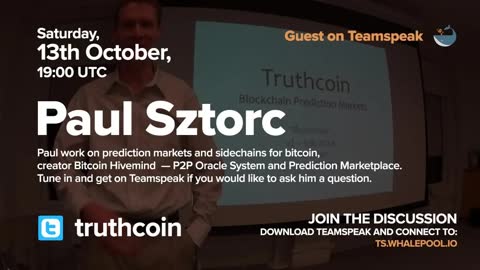
0:00 So, it mostly got a copy over from Windows to Mac, okay, but some things are a little weird, but I looked at all the slides and they're mostly fine. 0:10 So, this talk is about my project, which is Bitcoin Hivemind. It was originally called Truthcoin. I was working on it before I was working on Drivechain, and I put it on hold. 0:24 But it's a very different thing than what a lot of other people have worked on, and I worked on it very early. 0:32 So, this presentation is going to be about the problem that Hivemind solves, because almost all of the blockchain projects out there today don't actually solve any problem at all. 0:44 So, it's a complete waste of time. So, I'm going to try to talk about that. I'm going to talk about why Hivemind works is too complicated. 0:54 Or at least I'm not very good at explaining it, even though I don't think it's that complicated in reality. 1:00 So, governance. This project is about governance, and that's defined as group decision making. 1:06 So, we have some people here. They have some will or some preferences, and then groups. 1:12 They come to some agreement, and then there's a policy that's enforced on the entire group. 1:18 Governance has a lot of problems, which include rational ignorance and preference aggregation. 1:26 The goal is to solve these problems with conditional prediction markets. 1:30 So, let's just check. See, this is what I didn't want to happen. 1:38 It will blind it on both ends, which is not what I want to happen, but that's okay. 1:42 So, here's what the talk is going to be about. I'm going to talk about... 1:46 I'm really curious about if you may even have to do this first part, because I would like to know... 1:50 So, could people raise their hands, please, if they consider themselves to be a libertarian? 1:55 If you're a libertarian, could you please raise your hand? 1:58 Raise your hand if you really just don't care at all about politics, and you just try to avoid talking about it as much as possible. 2:05 That's great. The project is really dedicated to those people. 2:09 So, is anyone here one of these fringe anarchists or anarcho-capitalists or something like that? 2:16 There are many in the Bitcoin. Please don't be shy. I'm just curious how many, to what extent, there are in New York. 2:22 You can just do a weird noncommittal hand gesture. 2:25 So, maybe I won't need to go into this a lot, because the first part of the talk is really about that. 2:31 And, unfortunately, what I plan to do is deliver it kind of professor-style and just give a talk, 2:37 and then I was just going to read this with it blinded out, but when I press the blind thing, it blinds it out on mine, too, 2:44 so I'd have to do it from memory, which I could probably do, but it wouldn't be great. 2:48 So, maybe I won't emphasize that part. 2:51 But then I'm just going to talk a little bit about how society reacts to problems in general, very quickly. 2:56 Then I'm going to talk about the governance problem in particular, 2:59 and then I'm going to talk about prediction markets, which I think is where we'll really get going, 3:03 and then I'm going to talk about, in particular, these conditional prediction markets that are on the blockchain 3:09 as the solution to this problem, and then just like two or three slides about, in practice, 3:16 how to actually get any of this done in the real world, which is the goal. 3:21 The goal is to use this project to basically fix the U.S. Congress, so it's a very big project. 3:30 But before that, you do often run into people who say that there's a sort of total moral objection to governance existing at all, 3:40 and they say, I don't want to have any decision forced on me, and I didn't sign any social contract or whatever, 3:46 and these people believe that every individual should have a pure veto on everything, 3:51 or rather that consent can never be estimated. 3:55 But I think since there's not a lot of people, and this is like a room for more practical people, 3:59 I might be able to skip all this, which is great, because it's a lot of text. 4:02 I think what I'll do is I'll come back to it at the end, if anyone cares. 4:06 So I do talk a little bit about – I will say one thing. 4:09 We do have one example of where governance is very clearly useful, 4:14 which is we had the ozone layer that we tore a hole into in the 1980s, 4:20 and then everyone met in Montreal and agreed to replace the CFC gases in refrigerators with something else, 4:27 and that reversed the destruction. 4:31 If I'm remembering correctly, there were already animals dying and people getting skin cancer in Cuba, Chile, and other places. 4:41 As a result of the ozone layer, it was a very rapid problem, and the deal is you only have one Earth. 4:46 It's not like all the Earths compete on their carbon tax policy and their climate policy, 4:52 and you can just teleport from one Earth to another. 4:54 We're all trapped in one. 4:56 So as much as I hate saying that as someone who has a strong background in economics, 5:00 sometimes we are all in it together, and that is – so in those cases, you absolutely have no choice. 5:06 You have to use governance. You have no alternative. 5:09 There's this other thing like a giant nuclear explosion that obliterates the planet or something. 5:13 You can come up with this grey goo, self-replicating nanotechnology. 5:16 You can come up with these weird cases where – but I think basically I'll just skip a lot of this 5:20 because this is a cool part about Karl Popper. 5:23 Everyone should read Open Society and Its Enemies. It's really short. 5:26 It's described by all the isms. 5:28 Every ism is a waste of time, including anarchism and libertarianism and everything. 5:34 So this is kind of like dedicated to all the people who don't care about isms because they're all false. 5:42 So that's good. So I can just skip all that because normally you wouldn't believe, 5:45 if you're in the Bitcoin world and you give a talk about something, 5:48 people will just – they won't be undecided from the beginning 5:52 and just think governance is totally a waste of time, problem to solve 5:56 because we just need to go on vacation to Anarchapulco 5:59 and that will make all the bad policies in the world just go away somehow. 6:04 So that's a little bit about the second part, which is just about problems in general. 6:09 So I have an example about this where there's no rain and a bad harvest. 6:14 So what I'm saying is there are different ways of looking at a problem. 6:18 The best way is to just solve the problem where you have more knowledge and technology 6:22 and then the problem is just solved. 6:25 But at first, you really may not understand your problem at all, 6:28 and you may waste a lot of effort, 6:31 and you may misunderstand it to such a great degree that your misunderstanding of the problem 6:37 becomes almost part of the culture or is used as a kind of pretext. 6:42 So that is when – in this example that I'm about to show you, 6:46 it's sort of like the idea of praying for rain. 6:50 Culture may eventually rely on these false solutions 6:53 because that's just what people have always done, 6:56 and anyone who does something different sort of looks strange. 6:59 But the point is you really may not know what's going on in the uppercase here, which is red, 7:05 and then you may reach a zone where you know that there's a problem, 7:08 but you don't know what to do about it, so you just sort of deal with it. 7:11 But then finally you do know what to do about it, 7:13 and then you feel like an idiot for all those other things that you were doing before. 7:16 So if there's bad rain, you can either pray where you're not doing anything to get more water to the plants. 7:24 You think the problem is not water. 7:26 You think it's just the problem of you not behaving the right way or not praying enough or something. 7:32 And people use the false solution as an opportunity for socialization. 7:36 So I think that that summarizes most of politics, really, that no one is trying to get anything done. 7:41 If you are a Democrat, you just want to show people how much you care about the poor and minorities, 7:47 and if you are a Republican, you just want to show people how much you care about kind of like grit or duty or something like that. 7:55 And if you're a libertarian, you want to show off how much of a wacky free thinker you are, 8:00 and it's not really about doing anything, and so that's where I think this is. 8:06 Yeah, it's very much of a signaling type thing. 8:09 And then the other thing is if you're not getting enough rain reliably, you can just say that you're just going to settle. 8:15 You're going to give up, basically, and you're going to say rain is just not reliable, 8:20 and I need to do something else like ration the food more or have fewer children or livestock, food-eating things, 8:27 and maybe I can go hunting instead or whatever. 8:30 I can plant more seeds to overcompensate for the eventual loss, which is like you could just work harder. 8:37 But in contrast to that, you will eventually feel like an idiot 8:40 because one day you will discover that you could have done something else that would have just solved your problem. 8:46 So this is the idea here that eventually we figure out how to make pipes and water and other things like that. 8:52 So that's kind of like where this is going where, I mean, I love Ron Paul a lot, 8:57 but it's not practical to vote for someone who can't win in a first-past-the-post democracy. 9:04 So the question is, why do we do it? Just to express outrage or other things? 9:11 With respect to the problem of governance, which is what this talk is about, 9:15 you have these three kind of modes here, and I see just kind of vague complaining as the Frerer case up at the top, 9:23 and I see the sort of cypherpunks and encrypted email and Bitcoin as this middle case where you say, 9:30 well, governance doesn't really work, so I'm just going to shield myself from all the craziness that's going on. 9:35 But then I think that you can try to solve the problem with this technology, which is the traditional prediction market, 9:43 and I'm not going to go into a lot of detail about what it is. 9:45 That's not to say that this is like a better, more likely to succeed project than Bitcoin or better. 9:50 Bitcoin is obviously a really awesome project, but I'm just trying to say that the style of approaching the problem 9:59 is sort of defensive in Bitcoin. It just says that you want to ignore or be immune to all the crazy stuff that is happening in Congress, 10:10 whereas you would want to maybe take a more active role in the lower part to just make sure that only good things happen. 10:18 So okay, so now that ends part two. So now why is governance such a hard problem to solve? 10:24 Well, if you ask me and some other people, we say that it's something called multi-factor competition, which I'm now going to explain. 10:31 But first I'm going to talk about single-factor competition. 10:33 So let's say you've got $20 and you want to buy some dinner. 10:36 Life is going to be good for you because you have three restaurants and you're choosing and dining alone, 10:43 and you just have the one thing, which is what can you buy with $20 and how much will you enjoy it? 10:48 So this is your expected satisfaction vertically here by spending $20 or less at whatever restaurant, 10:54 and those are your three choices, and you have one choice that is the best choice. 10:58 And so you always get the highest satisfaction possible. 11:01 You may not get infinite satisfaction, but you have the highest satisfaction possible. 11:05 And the restaurants are induced to compete on this metric of satisfaction per dollar. 11:12 So everything works pretty well during this world. 11:15 And even if it doesn't work well, it improves over time. 11:19 So that's pretty awesome. 11:22 The problem is when you have multi-factor. 11:26 So this is fine. 11:29 This thing glitched over when he copied it from this map. 11:34 So in a multi-factor world, your decision depends on lots of different things at once. 11:43 So imagine a slightly different situation where many people are choosing to eat somewhere, at some restaurant. 11:50 And in addition to having preferences about the food, they strongly prefer to all meet at the same place. 11:57 So it's like you're going on a date or something, and you don't want to end up at a different restaurant. 12:02 That would not really be helping you achieve your goal. 12:06 It depends on how much you like the food at one certain place. 12:09 But that's my point, is that sometimes you can't get everything. 12:12 So this question is much harder. 12:15 The decision that you ultimately make is going to depend on what you prefer, which is what I had before. 12:20 That's the first factor. 12:22 But it's also going to depend on where other people might go. 12:25 And now you have a giant infinite recursion problem. 12:28 But basically, where other people go, that is going to be a function of what they prefer. 12:34 And maybe they prefer the same thing as you, but that's not going to get you out of this mess, 12:38 because where other people might go is not just a function of what they might prefer, 12:43 but where they think other people are going. 12:45 Because they also think that they want to be near where other people are, 12:49 and so maybe they want to sacrifice where they are eating in order for the sake of having better company or something. 12:55 So where they think other people might go, technically it goes on forever. 12:59 But in general, it's a function of everyone's collective best guess on where most people currently plan on going, 13:07 which I'm going to call status quo. 13:09 So they have some guess that is just their default guess. 13:13 And it doesn't literally need to be the status quo that happened in the past, 13:16 but the point is just whatever their state of mind is right now, that is what it is. 13:22 And then their state of mind might be changed, so it's a function of the status quo, 13:27 and since it's the case that time, attention, and communication are not free, 13:32 in some cases they're very costly. 13:35 So because of that, it's not only the status quo, but it's also how open to communication or negotiation is. 13:41 So we have these preferences thing, and then we have this vague measure of whether or not people are willing to talk about this 13:49 for hours and hours, discuss the whole time. 13:52 It's important to keep in mind that the negotiation doesn't really improve the set of options. 14:00 So although it might bring you to a better option, every minute you spend negotiating is wasted, 14:06 because the best thing is to get the best option first, 14:09 but if you're not going to be able to ultimately change the option, 14:13 then you're just digging yourself further and further into a hole and wasting more time. 14:18 Now the weird thing is you have four or something like two or like one plus f of x, 14:24 you have more than one criterion, but you can't broadcast how you feel about each of them. 14:33 At the end of the day, you just have to pick one place about where you're going to go, 14:37 and so you must aggregate these four different things. 14:41 And in this little example, these preferences are the same. 14:44 This is the same little figure that I put on the previous slide. 14:47 So it's the same shape. You see that the little middle one is the tallest. 14:51 And so even though everyone believes the same thing, 14:54 I also have assumed in this example that everyone thinks that they're going to the one that no one likes, 15:02 and so they just assume that they're all going there even though no one likes it there. 15:05 So there's a little bit of pluralistic ignorance going on, 15:08 and if all these three are the case, then if finally it's also the case that people aren't open to communication or negotiation, 15:18 then they will not be able to talk about the fact that none of them like this place. 15:24 They'll all just assume. 15:26 It'd be kind of like a weird, awkward, extended family gathering 15:30 where you've always met at the same place for Thanksgiving 15:34 and no one is afraid to say that they don't really like it there anymore, 15:37 and so awkward just kind of keeps going because people are afraid to be open about that or whatever it is. 15:44 We have a big problem with this self-fulfilling prophecy with respect to this last one 15:50 where if everyone believes that negotiating to pick a better restaurant is a lost cause, 15:55 if they think that the negotiation is a waste of time, then they won't want to be the first to open the negotiation. 16:02 So it's a circular logic, and either everyone will negotiate and then they will make it as best as possible, 16:09 or really no one will, and it will always stay at the status quo. 16:14 Negotiation is especially hard when there are lots of people and lots of alternatives, right? 16:19 Because that just geometrically explodes the number of things that people can talk about 16:24 and who you have to talk about them with. 16:26 It goes on and on and on forever. 16:29 And so when there's a lot of people, just like in the United States there's 250 million adults 16:34 and there are infinite number of policies, the prophecy is likely to self-fulfill in the lost cause direction. 16:41 So that is too bad. 16:43 So, oh yeah, this is too bad. This glitched a little bit, but it's okay. 16:48 That weird thing that I brought up in the last slide is not like some weird fringe thing that I just kind of invented. 16:55 It's a very common desire to want to stay in sync with other people, 17:00 because that reduces ambiguity, it reduces the need to negotiate for things, and it reduces conflict. 17:06 And it also gives you network effects and economies of scale. 17:09 So I was going to drive on the left in Australia. 17:11 It doesn't really matter whether you prefer driving on the left or driving on the right. 17:15 It doesn't matter that much. 17:16 The point is just that you really want to be doing the same thing as everyone else. 17:20 It's the dominant thing that you would care about in that scenario. 17:24 And then I had a cool thing here, but the formatting is messed up. 17:27 You've got to compare the idea of competing, starting a new competitor to Facebook or Craigslist, 17:33 and you compare that with competing, you start up a new barbershop or something like that. 17:38 It's a totally different mode of competition. 17:42 I thought this was so funny I had to put it in. 17:44 It says, why you should stop asking, is Google Plus dead? 17:48 And I just think that's kind of a funny joke, because if you have to ask, right, then it is dead, right? 17:53 So let's see. Yes. 17:57 So again, you get moral arguments sometimes, so I have to talk about them. 18:01 But basically, we know that people will put up with Facebook. 18:05 You know, Facebook changes the format, and especially if they were doing this like five years ago, 18:08 they would change the format all the time, and everyone would be like, I hate this format. 18:11 But everyone puts up with it because the alternative is no Facebook, 18:15 or number two, an endless and ultimately futile negotiation with unmotivated friends and family 18:21 to switch to one particular alternative among many, right? 18:24 So if you're going to leave Facebook, where are you going to go? 18:26 There's too many potential options. 18:29 Then the people that you're talking to, they need to then go and convince all of their own friends. 18:34 Who would need to convince their own friends? I don't know. 18:36 It's literally impossible. 18:39 In the same way we put up with governments and the question of governance, 18:44 even though they are incompetent, because the alternative is no property rights, 18:49 which is like the naive anarchism death spiral. 18:54 But then the other alternative is some really weird, potentially endless negotiation 18:59 with a potentially violent, maybe not, but possibly violent transition period. 19:05 And who knows whether or not what you end up with is even better or not. 19:09 Animal Farm by George Orwell is probably my favorite book. 19:12 And for them, they did not end up any better. 19:15 They just did a lot of effort, and then just to suffer more at the end. 19:22 Obviously there's a big similarity between this scenario of just sadness and unalterability and voting. 19:29 So a big problem with voting is that it costs too much to figure out who to vote for. 19:35 You need to know the existing option and the challenger and both plans. 19:42 So the policies that they plan to enact, that's what I mean by that. 19:47 And the likelihood of follow through. 19:49 So sure, I remember very clearly that Barack Obama said that he would close Guantanamo Bay. 19:58 But it's still open. 20:00 So maybe Barack Obama has a plan to close Guantanamo Bay, but he never got around to following through on it. 20:08 And then you need to know the effect of these plans on you. 20:11 So if someone has something weird like a new tax plan or like a health care bill or something like that, 20:15 how are you supposed to know? 20:17 Some of these policies are super complicated, and there's no way you can ever know really for sure. 20:24 Definitely not as much as some specialist would know what effect the policy will have on you. 20:30 So most people don't even care about any of this at all. 20:35 So 71% of Americans can't even name their congressional representative. 20:39 I can't name my own congressional representative, and I will randomly quiz people out of sort of curiosity. 20:47 I've been surprised. My estimation is that more than 29% can. 20:55 So I don't know. I have some smart friends or something, I guess. 20:58 Because the point I'm trying to make is it's totally useless to know this because it can't improve your life at all. 21:03 So I don't know why people would know, and I don't know myself. 21:07 But the point is that we're very far away. 21:09 I mean you want to know your name, the name of the person, and you want to know their challenger, 21:14 and you want to know all the proposed policies and their voting records, 21:17 and the likelihood of something new happening, and you need to know this not just for one U.S. Congress, 21:26 but what about the state senators, let alone the governor or the mayor or something. 21:31 I have a funny story about this, which I think I have a little bit of time to tell, which is that 21:37 I was talking to someone who was literally herself, she was a U.S. Congress person. 21:43 And I was like, I've got to tell them about this funny thing that most people can't name their Congress person. 21:49 And she told me a really great story. 21:51 So she's from State A, let's say. I didn't really clear this with her, so I don't want to say anything. 21:56 But she's from State A, and she was flying from State B to the capital in Washington, D.C. 22:03 And she happened to be sitting next to a bunch of lobbyists on the plane. 22:07 So she's like, oh, how funny is this? I'm a Congress person. I'm sitting next to lobbyists on the plane. 22:12 And so obviously they were talking, and the lobbyists, they all live in State B, 22:17 but they were going to the capital. They were flying from State B. 22:20 And so the lobbyists, they obviously had these targets for these people that they were going to hit 22:26 to try to persuade them to pass various laws and other things. 22:29 And they knew those guys. I think in one case they knew them literally down to their shoe size 22:35 because they were literally buying them shoes or something absurd like that. 22:39 So they knew all this stuff about the Congress people that they were trying to persuade, 22:46 that they had been paid to persuade. 22:48 But then she asked them about their own Congress people, the Congress people in State B, 22:54 and they had no idea who they were. 22:56 So even lobbyists who are paid to know things about representatives and senators, 23:04 even they don't know their own. 23:06 So this idea of the civic duty is kind of a joke on my part. 23:10 And so the reason is this multi-factorness. 23:14 There's a lot of things, but in particular it's electability. 23:17 So I don't know if anyone here or how many people here are interested in this super cool thing 23:23 called Arrow's Impossibility Result. 23:26 He won the Nobel Prize in Economics for this. 23:29 And it demonstrates that you have these things that are four assumptions that are very, very reasonable. 23:37 They're like more than one voter or something. 23:40 And if you don't have more than one voter, you're not really voting. 23:43 And the deterministic – these first two are technicalities. 23:47 You can't even bring them up. They're so simple. 23:50 But what he says, of these four things, you can never have all four of them be true at once. 23:55 He demonstrated this using some math, which is pretty neat. 23:58 But the first two are so important that you can't dismiss them at all. 24:02 It's only the second two where you have to choose one to sacrifice. 24:05 And it's shocking that in no normal voting scheme where you pick your favorite one, 24:11 and other people pick their favorite one, and then you try to choose one winner. 24:15 No voting scheme can satisfy all four, so you have to sacrifice one of these two. 24:19 The first one is you can't hurt an option when everyone ranks it higher. 24:24 So it's like, well, it seems like we might need that one. 24:27 But the second one is even more ridiculous, which is the irrelevant alternatives really are irrelevant, 24:32 which is that you can't hurt an option by re-ranking the options below or above it. 24:36 So if you're trying to vote on Jeb Bush versus Bernie Sanders, 24:42 and then people rank – they decide they like Hitler more than Stalin or Stalin more than Hitler, 24:47 that cannot hurt either Sanders or Jeb Bush. 24:51 And you think like, oh, my God, both of these two seem pretty reasonable. 24:55 But unfortunately, you can't have them at all, and the point is this phenomenon of strategic voting. 25:01 Most practically, it is the idea of splitting the vote. 25:04 So if Jeb Bush had run, he would probably have split the Republican vote. 25:09 And so even though he may have dragged people's preferences towards the political right, 25:14 the outcome would have been worse for the right. 25:17 And so hence why we have all these things like political parties and primaries and superdelegates 25:24 and all these weird techniques to try to stop this from happening. 25:28 So when a vote is split, all the votes that were cast with a lost cause don't contribute at all 25:32 to the one battle that really matters. 25:36 So it all leads to this circular concept of electability, 25:41 which is kind of like the status quo of the restaurant before, 25:44 which is that some people believe that a choice is a lost cause, 25:48 and so you can't throw your vote away for that. 25:51 It ends up being a lost cause, and even just random people like CNN 25:56 end up having a lot of influence just because they can flag people as lost causes. 26:01 So in order to solve this problem, we're going to need a reliable source of information on who to vote for, 26:06 and we're going to need a way of crunching the multifactoriness back down, 26:10 and we'll also need a way of preventing people from capturing this process. 26:15 That is the blockchain, obviously. 26:19 So first we're going to talk about this prediction market thing, 26:23 and hopefully it won't take too much time. 26:26 A prediction market is a market for a special kind of derivative. 26:29 So this is an example from Intrade, which was my favorite website on the Internet 26:34 before it closed in 2012. 26:37 But this is a screenshot. I don't remember this. 26:39 I guess this is from January 2013. 26:42 This thing is some asset that is worth $100 26:46 if the year 2012 is the warmest year on record 26:49 as measured by some NASA satellite that calculates surface temperature abnormalities. 26:54 So you have some exact source, and it says, 26:57 if 2012 is the warmest year on record, this thing will be worth $100. 27:01 Otherwise it's worth $0. 27:04 So as you can see, although 2014 I think was the warmest year on record at this time, 27:19 2012 was not. 27:21 And this runs from January 2011 to the end of 2012, which is right there. 27:27 And you can see that the price is going down. 27:30 As it's going down, it becomes more and more obvious that it's not going to work for 2012. 27:36 As the likelihood of this event happening goes up, the price goes up. 27:41 And as the likelihood goes down, the price goes down. 27:44 And so that's just a random example. 27:49 And let's see, this glitched a little bit too, but it's okay. 27:52 So these are just normal derivatives. 27:55 This is like a binary call option that says I owe $20 to someone who has this 28:00 only if stock price of some corporation is above $20 a share. 28:05 The idea of an event derivative or a prediction market, they're the same thing. 28:09 That's saying I owe $20 to whoever owns this derivative on some date 28:14 only if Hillary Clinton is elected president. 28:17 So I owe $20 if she is, and otherwise I owe nothing. 28:21 And the idea is that – I think I'm going to skip this. 28:24 Actually, I'm going to explain this part. 28:28 So the price was $40 out of $100 at the beginning of January 2011. 28:36 So since the price is $40 and the maximum price is worth $100 if it actually happens, 28:42 that implies that the objective likelihood of the event is 40%. 28:47 And it just conjectures that. It doesn't prove that or anything. 28:50 But it says that it's open to refutation. 28:53 So if someone doesn't agree that it's 40%, they can make a trade in this market 28:59 and pick up expected value. 29:01 And since anyone can do that, it's just assumed that if you're not doing it, 29:05 it's because you actually agree. 29:07 And so it's a way of getting everyone to agree. 29:09 And let's see how bad this glitched out. 29:11 Okay, it's not that bad. 29:12 This looked a lot better on Microsoft. 29:17 So what happens is markets aggregate all of society's information 29:21 because anyone who disagrees with the current market price can make money 29:24 by trading against it. 29:26 A lot of people will say that they disagree, but they won't trade. 29:29 The real reason is because they don't actually disagree. 29:31 They're phonies, which is great because we get to just ignore them, 29:35 which is exactly what you should do. 29:37 But when members of the public observe this price for free, 29:44 which is free, just like checking the stock price of Apple or something, 29:47 you get reliable information, which is to say that it's right 29:51 or it's at least as little wrong as possible because anyone can refute it 29:55 at any time while making money for themselves in expectation. 29:59 But not only is it reliable, but it's also common. 30:02 So it's broadcast to everyone, and everyone knows that everyone got it. 30:05 And that's going to make a really big deal in a couple slides. 30:09 But basically it does all the research for us on any given issue, 30:12 which in this case is the likelihood that 2012 would be the warmest year on record. 30:18 It does all the research for us, and it also does all the persuading. 30:21 Everyone knows. 30:23 So this is like all these people, and you try to aggregate. 30:26 One expert tells you that global warming is fake, and one tells you that it's not, 30:30 and one tells you that, well, it's real, but it's a good thing, 30:32 and other people say, well, it's real, but it's not caused by humans. 30:35 And you're just confused, and everyone's confused separately, 30:38 but all the information sources, some of them are very bad, 30:41 but listen to them, some of them are very good. 30:44 They go into the prediction market, and everyone is happy, 30:48 and they all have reliability. 30:52 I'll probably skip this part. 30:54 But I will say that prediction market supports a clear definition. 30:57 So people don't just talk about nonsense all day, like global warming is very abstract. 31:01 But when it comes time to make the market, you have to define exactly what you mean. 31:06 You have to pick like a real satellite or like a NASA log or something. 31:11 So that's nice. 31:13 That already helps people a lot. 31:15 Now hopefully that was, I don't know, that may have been confusing, 31:18 but it's about to get a lot more complicated because you can do very easily markets 31:24 that have more than one dimension. 31:26 So here's one where Hillary Clinton is elected in 2016. 31:28 She either is or she is not. 31:30 This is just like the global warming example where either it happens or it does not happen. 31:35 But you can also do two things at once. 31:38 So if some law or something is passed, you can sort of buy and sell based on that question 31:52 or that exposure. 31:56 And you can separately do that for this other question of whether or not 32:00 unemployment will be low, whether or not we'll have a good economy. 32:04 And you can do those separately as there'd be an example of this, 32:07 but just stamped out twice. 32:11 But if you do them together, you get all the benefits of what you had before 32:16 plus some other cool stuff. 32:19 In particular, you get the relationship between the two. 32:22 So while you have one question over here on this dimension, what have you, 32:31 when you add these probabilities up, these are called joint probabilities, 32:34 and you add them up, you get exactly what you had before, 32:38 which would indicate that in this case would indicate that the outcome of yes 32:42 is 60% likely here because you add up the price of these two assets and you get 60, 32:47 and you add up the price of these two no assets and you get 40. 32:50 So you get everything you got before. 32:52 And this question, will 2016 be the warmest year on record? 32:55 This is a 50-50 thing. 32:57 So you get everything you got before, 32:58 but you also get the probability of both happening at once. 33:01 And when you do that, you also get what's called the conditional probability, 33:06 which says if you do something, would it influence something else? 33:11 So the probability is that not only will X happen, but also would Y influence X? 33:17 So positive relationship, negative relationship, no relationship. 33:22 And that is where it really gets going, 33:25 where you do these markets that say which CEO, or if we fired the CEO, 33:31 would most increase the stock price, which president would most decrease unemployment, 33:35 which Fed policy would most decrease GDP, if any, 33:39 or which law would most decrease violent crime. 33:41 That's where we could make the talk. 33:44 So we have the cheap, reliable source of information to vote for. 33:48 We have a way up. 33:49 We're going to capture it as a blockchain. 33:52 Now the last part is this crunching the multifactorness. 33:55 So here's an example where you have this multidimensional market 34:01 where someone is going to win the election in 2020, 34:03 and as I said, you add these up to get the likelihood. 34:07 So just guessing here, this is all invented by me, 34:10 but the Democrat would have a 61% chance of being elected in 2020 as president, 34:17 and the Republican candidate might have a 38% chance, 34:20 and then Elon Musk might have a 0.9% chance of being elected, 34:26 making him the lost cause that we mentioned before, 34:29 and then someone else might win. 34:33 But then this is the likelihood of a good economy in 2021 defined by some specific thing. 34:39 This is no, and this is yes. 34:42 So then you add this up, and you see we've got a 99.05% chance of having a bad economy 34:48 and a 0.95% chance of having a good economy. 34:53 But the crucial thing is that of those, 0, 0, 9, 5, almost all of them belong to. 35:02 So this is the map behind the conditional likelihood of the good economy. 35:07 So you go line by line, and you say, if someone else wins, then all this didn't happen. 35:12 So it's equally split here. 35:14 You have a 50% likelihood along this dimension of a good economy. 35:18 If the Democrat wins, of course they'll screw it up. 35:21 So it's certain that they'll have a bad economy with 0%. 35:26 And the same thing for the Republican candidate. 35:29 They will also start to screw it up with certainty. 35:32 But with Elon Musk, it's certain that it will go the other way. 35:35 Obviously, this is an exaggeration and just made up by me. 35:38 But the point is that we can fix the multi-factor by doing this. 35:45 And I'm going to demonstrate why. 35:47 It's because the election hasn't happened yet. 35:50 So even though there is a likelihood of winning that may be very small for Elon Musk, 35:55 these numbers might all validly describe the situation at time equals 1 or time equals whatever. 36:04 So you have here a case where someone is likely to be good for the economy but unlikely to win. 36:11 So the election hasn't happened yet. We have these numbers. 36:14 Everyone knows the election hasn't happened yet, and everyone knows these numbers 36:17 because they're the same for everyone, just like the Apple stock price. 36:20 And so what you have here is the voter who may decide, you know, 36:25 these numbers here are decided by me, and you can renegotiate them at any time, 36:30 especially last minute. 36:31 It's like if you're in the voting box and you just do some last-minute research on your cell phone 36:37 before you walk in to go voting, then you can do like an immediate, cheap, tacit, 36:43 renegotiate tacit, which means without speaking. 36:45 So without doing any negotiating at all. 36:48 You can do a renegotiation to elect this guy. 36:51 And it's better for unformed or angry voters. 36:54 And the less that people actually know, the better because they just say, 36:57 well, I don't know about any of this. 37:00 I've invested nothing in this process, so I'm just willing to just kind of go with this on a bark. 37:06 And the less that people interact with manipulative media or campaign ads, 37:11 the better because they're not invested emotionally in any candidate. 37:14 They just show up and they just pick this thing, 37:16 and we have returned actually to the single factor competition from before. 37:20 So people just pick whichever one they think is the best on this thing. 37:25 And now finally, just two slides on being practical. 37:29 How do we really get this going in practice? 37:32 Well, the idea I think is to ramp it up over time by creating the platform 37:36 and then using it on popular things like sports, like the Super Bowl or the Oscars or something. 37:44 And just kind of keep it up over time and just show people how accurate the results are, 37:51 which they should be maximally accurate. 37:53 People should be interested in them or maybe get more interested over time. 37:58 Even better though, the election process is so broken and people already hate it so much 38:03 that I think people will actually come around. 38:05 They have a high chance of coming around eventually or pretty quickly. 38:10 And I think especially we have these congressional elections where it makes a big impact who controls Congress 38:16 because Congress is in charge of everything. 38:18 There are some problems that you can only solve, I think, really in that kind of process, 38:24 as I tried to explain before. 38:26 And the voters are really uninformed. 38:28 The turnout is super low, like no one cares. 38:31 So I think more people don't vote than do for these elections. 38:35 So even if you've just got all those apathetic people who are just like, 38:38 oh, I'm not going to vote because this process doesn't work, 38:41 if they could be induced to do something that is really, really cheap, 38:45 and it just takes five seconds of their time, 38:48 I think that is a good avenue for maybe getting that to actually work. 38:53 And then how do we measure those things, like the likelihood of a good economy? 38:58 That, unfortunately, is talked about all the time, and that is the end of the talk. 39:02 So I don't know. 39:03 I started a little late, so I don't know if we have time for questions. 39:06 But that is the talk, so I hope that you enjoyed it. 39:09 Yes, questions? 39:10 Well, I have one observation. 39:12 If people are interested in net neutrality, 39:16 there's a website called battleforthenet.com, 39:20 and you can immediately see your representative. 39:22 With two clicks, you can send them a Twitter tweet, 39:25 put in your zip code, and you can immediately send them an e-mail, 39:29 and you can actually get involved very easily. 39:32 Well, that stuff is good, but the problem is when you vote, 39:35 it doesn't help you replace a leader who is bad. 39:38 If you go into the bad restaurant, you're just stuck in there 39:42 because you can't get enough people with you to replace someone that you don't like. 39:46 So that's better than nothing, but it doesn't really help, I think. 39:50 So the problem with governance. 39:52 Yes, question? 39:53 So I'm sorry, but I'm going to continue to break into the marketing thing. 39:57 Okay, great. 39:58 So the question I have for you is I hear what you're saying 40:04 about having two dynamics and trying to predict out of those two dynamics. 40:09 The thing is I follow you as you state the election 40:13 and the yes or no with bad economy. 40:16 Do you, I mean, is there something that you as an individual do? 40:20 Like, for instance, the climate and the bonus on your credit? 40:24 Because I'm probably going to find two types of data. 40:27 I'm just going to give them to you. 40:29 Yeah, that's a really good question. 40:31 So these are decided after the fact. 40:33 So before the election, there's no election on here, 40:36 but before the election you don't know who's going to win. 40:39 But you can place these conditional, I guess you could call them wagers almost, or bets. 40:48 You place them in advance, and then they don't settle until afterwards. 40:52 Now after the election is over, it would be very easy to observe who the winner was. 40:57 So you'll know whether or not Hillary Clinton won. 41:01 Everyone will know. 41:02 But you don't know before. 41:03 No one knows before, but afterwards everyone knows. 41:06 So there's a delay. 41:09 And what I don't think I explained very well is that there's four states here, 41:14 and when you buy this thing, this is the joint. 41:17 There's four things here instead of before. 41:20 So this thing, there's only one thing. 41:23 There's only one thing here, and there's no reason to plot the second thing 41:29 because in the case of here, if there's only one thing, 41:32 like if you only plot that was the yes outcome for the climate thing, 41:36 there's no reason to plot no because it would just be a mirror image of it, 41:39 so it's pointless to plot. 41:40 But when there's four, then there is a reason to plot them 41:42 because they'll all be different. 41:44 So if you buy this thing, you only get paid the $100 if the Climate Act is not passed 41:52 and if 2016 is not the warmest year on record. 41:55 So these are all joints. 41:56 So there's no combining until after the fact when you just throw a little switch 42:01 that says did it actually happen, yes or no. 42:03 So these things are all market assets that have their own market price, 42:07 and they'll be trading whatever they want. 42:09 So if you want to buy this thing, it will cost you whatever the market price is. 42:12 It might be $0.15, and then you'll get $1, 42:15 or it might cost you $15, and you'll get $100. 42:18 But this thing will only be worth any money to you if this outcome is no 42:23 and this outcome is no. 42:25 This outcome will only be worth any money to you if this outcome is no 42:28 and this outcome is yes. 42:29 If anything else happens, you don't get anything for what you own here, 42:32 which is why you would buy them in sections if you wanted to redo this thing. 42:38 If you wanted to recreate this two-state world, all you would do is you'd say, 42:42 instead of buying just one, where you would buy one over here, 42:48 instead of buying one, you would buy one and two 42:53 and the sum of their prices would be totally equivalent to the one in the previous case. 42:59 Yes, okay, good. 43:00 You said I have six minutes left? 43:02 Okay, so that's cool. 43:03 If there are more questions, that's great. 43:05 Yes? 43:06 I still don't quite understand something. 43:08 I'm repeating the same question, but I was wondering, 43:11 you have two independent things. 43:13 How can you come up with a joint probability? 43:20 These things, when they're created, they may not be connected at all. 43:31 In this case, they're not. 43:33 So they may not actually be connected at all. 43:36 That doesn't prevent you from creating a market that says something like, 43:39 I'm going to flip a coin and I'm going to roll a dice, 43:43 and if it's less than three, then it goes this way, 43:46 and if it's less than four, or three, or one, two, or three, it's over here, 43:49 and if it's four, five, six, it's over here, and if it's tails, it's over here, 43:52 and if it's heads, it's over there. 43:54 You could still have a market with that. 43:56 You'd have four assets or four tokens or something. 44:00 This one would be worth $1, let's say, 44:03 only if the dice roll is one, two, or three, 44:09 and the coin flip is heads. 44:13 If that happens, then this is worth $1, and all these are worth zero. 44:16 But if the dice roll ends up at five, and the coin flip is heads, 44:20 then this one will be worth $1, and the rest will be worth zero. 44:24 So it's not really until the end that they are entangled. 44:28 They're entangled by the structure that you impose here. 44:32 But there doesn't have to be anything in the real world that actually connects them, 44:36 other than, of course, the fact that we're all living in the same universe. 44:41 Just informed by people's belief, that's what you're saying. 44:43 Absolutely, right. 44:44 But see, the point is, someone might actually know. 44:47 Very few people would. 44:49 Very few people would, but some people might actually know 44:51 whether or not this act has any effect on 2016 being the warmest year. 44:58 Maybe it only has an effect on 2017. 45:00 Maybe it won't actually have an effect. 45:02 So someone might know, and that person will trade and try to make some money, 45:06 and other people will not. 45:07 They will be like, well, that doesn't look right to me, 45:09 but I don't want to trade because I don't know anything about it. 45:12 And then all of us get to ignore those people, which is exactly what we want. 45:16 Does that make sense? 45:17 Does that make more sense? 45:18 I think so. 45:19 I've got to think about it a little bit more. 45:21 Okay. 45:22 Each of these are what is – this thing right here with the 15, 45:27 that is now this thing. 45:30 So this thing is going around to 15, and it can go anywhere from 100 to 0, 45:37 and it's at 15 right now in this example. 45:42 And this thing is trading at 15. 45:43 This thing is trading at 5 cents. 45:45 So here's the thing is that almost no one thinks that if the act is passed – 45:55 no one thinks that both of these things are going to happen at once. 45:59 You can get those for pennies on the dollar. 46:02 So since you can get those for pennies on the dollar, 46:05 but this one is really expensive. 46:07 Imagine if this one cost almost $1. 46:10 So no, that would mean almost everyone thinks the act is not going to be passed, 46:14 and almost everyone thinks that 2016 is going to be a one-time thing. 46:18 Yes? 46:19 Is this what Gnosis is trying to do? 46:23 Yeah, so I know the guys behind Augur and Gnosis, 46:28 and I don't have a lot of – I don't think – yeah, it is what they are trying to do. 46:33 But I actually – they actually met me in April 2014, 46:37 and I know a lot about them and their projects, 46:40 and I've been waiting to be impressed for a long time. 46:43 And it's actually kind of shocking because we – I finished this – 46:47 a lot of the code for this was another person around 2015, 46:51 and I just can't believe that some of these other people haven't launched already 46:55 because what they did was kind of a fork of our thing. 46:57 I think if they just rebased off of ours, they could launch. 47:00 But part of the problem is that Ethereum has lots and lots of other problems that interact with this. 47:06 So this is why I really wanted this to be a Bitcoin sidechain. 47:09 It's much better at home. 47:11 Ethereum has all these problems with the gas costs 47:13 and with other smart contracts attacking each other, 47:16 and just with generally being more unstable and kind of ridiculous, you ask. 47:21 But yeah, they are – I had slides about that. 47:25 Yes? 47:26 For most of the privation markets I've seen, they rely on NASA, let's say, to have the outcome. 47:33 Is that something that this project you have sort of trusted? 47:38 Yes, there is a peer-to-peer Oracle system that I don't know. 47:44 I have a bunch of slides about it, but it's a little complicated to explain. 47:48 But that doesn't get around the fact that you need – 47:51 what the peer-to-peer Oracle system does is it maps information that you could easily find into the blockchain. 47:57 And so that's already a huge amount of work. 47:59 So the Oracle that I described, the peer-to-peer Oracle that I described, 48:03 it only works for things that are very easy to find. 48:05 So you need it to be as easy as who won the election, Donald Trump or Hillary Clinton. 48:13 It needs to be that easy because the human attention is very scarce and very unreliable. 48:18 So even those things that are very easy take some human people to map that into the blockchain 48:27 in a way that does not require trust and holds up strongly to attack 48:31 or people's computers catching on fire and stuff. 48:34 So that is what the white paper is really about. 48:36 It's not about any of this at all. 48:37 It's about the peer-to-peer Oracle. 48:40 And you can go to bitcoinhivemind.com and you can read about it. 48:43 And the white paper is still called Truthcoin, and Truthcoin is my Twitter handle 48:47 because no one can spell my last name. 48:49 It's impossible, Polish last name. 48:51 I think we're out of time then, right? 48:53 Yes? 48:54 Okay, great. 48:56 Thank you. 48:57 Thank you.