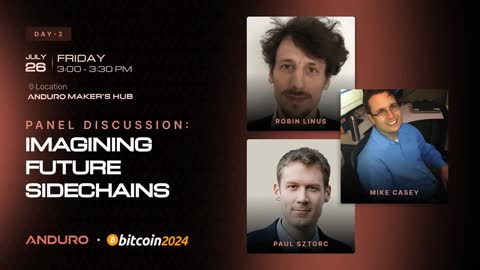
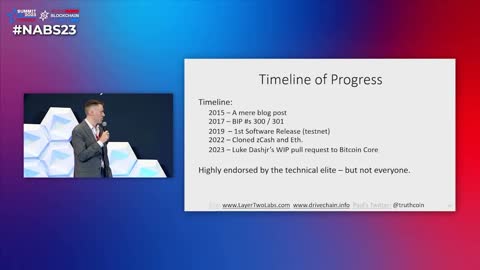
0:01 Hello. 0:03 Do you want to sit here, Paul? I don't know, it's a bit far otherwise. I can sit here, you can sit there. 0:07 Alright, sure. 0:11 Alright, welcome everyone to the Future of Sidechains panel. My name is Adolf Wittem. I work for Bitcoin Magazine. 0:20 I'm joined by Adam Back. Adam is the inventor of HashCash, which is the proof-of-work system in Bitcoin essentially. 0:28 And he's also the CEO of Blockstream. Paul is an independent Bitcoin researcher. He has one of the best, maybe the best blog on Bitcoin. 0:38 I would say it's Truthcoin.org, is that it? 0:41 Truthcoin.info, but I own .com and .org and they both redirect at this point. 0:46 Okay, smart. And you've been working on Drivechains a lot, which is a particular type of sidechain. 0:56 Well, Blockstream has the liquid sidechain, right? So there's two sidechain proponents on the panel, which is nice because it's a panel about sidechains. 1:07 Okay, so first of all, let's loop in the audience in case anyone doesn't know what a sidechain is. 1:14 So what is a sidechain and why is it something that people should care about? Do you want to take this, Paul? 1:22 Sure. A sidechain is basically an altcoin, but with Bitcoin instead of the altcoin part. 1:28 So you have a different piece of software and you can have a clone of Ethereum or a clone of Zcash or something. 1:35 And you don't need a new investment, you don't need a new coin, you just send bitcoins over there and use it over there. 1:42 So it's an altcoin without the altcoin. 1:45 Yeah, so it operates exactly like an altcoin. It has its own software, it has its own everything. 1:50 But the idea is you can basically lock a Bitcoin on the Bitcoin network, of course, and then it frees open a coin on the alternative network. 2:05 And that's how, for example, the 21 million limit is maintained. 2:10 So you can't create more sidechain coins than there are Bitcoin, right? 2:15 And then on the other chain, it can operate under different rules like an altcoin. 2:19 Adam, is this, did you want to add something to this? 2:23 I mean, you can think about it as like innovation without speculation. 2:27 And altcoins are often billed as utility tokens. You buy the token to gain the utility. 2:33 But really, it makes sense to use electronic cash, Bitcoin, to pay for things. 2:39 So why not use Bitcoin as the utility token? 2:42 And then if you work out how to do that, you end up with a Bitcoin layer 2, a special kind of layer 2, which is sidechain, that allows you to have new features. 2:52 Layer 2s like Lightning don't really allow new features. 2:56 They're just faster cashed Bitcoin transactions. 2:59 But a layer 2, which is a sidechain layer 2, can have lots of different, completely new and novel features or incremental improvements. 3:09 Yeah. So I think you just mentioned, Paul, you mentioned like an Ethereum. Did you mention that? 3:14 I think so. Like an Ethereum sidechain. 3:16 So Ethereum has a bit, you know, you can do different types of smart contracts. 3:20 But it also has its own coin, which fluctuates in value against Bitcoin. 3:24 And now you can do it while still using Bitcoin, essentially. 3:28 The mere introduction of new cryptocurrency is sort of like a dilution of the, as Gavin Andreessen said a long time ago, is a sneaky way around the 21 million coin limit, every altcoin. 3:40 Right. And Adam, I think you're a co-author of the original sidechain paper. Is that right? 3:45 So what's the idea originally to sort of make altcoins obsolete? Was that always, was that the motivation for even coming up with this idea? Is that how to, how we should look at it? 3:55 Well, no, not really. I mean, the point was, I mean, there were a few different ideas that arrived at the same thing. 4:04 But my motivation was I had developed this tech, which became known as confidential transactions, which added some privacy. 4:13 And I was interested to figure out how you would get something like that added to Bitcoin. 4:18 And it became apparent that that's kind of a complicated change and maybe difficult for Bitcoin to adopt in the short term. 4:25 So I figured, well, the real problem is that Bitcoin is not very modular. 4:29 And so, like, you know, the Linux operating system has modules in user land so people can add features without messing with the base. 4:37 And so I was trying to think of a way to achieve that in Bitcoin. And so sidechains was the kind of modular vehicle to add things. 4:46 Now, apparently, after we released the sidechain paper, a lot of altcoins fell in price. 4:52 I don't know if that was correlated or not, but people commented on it. 4:56 So there's a side effect. I mean, I'm not that interested in altcoins. I wasn't looking at the prices. 5:02 And as Paul mentioned, I think they are dilutive and mispriced ultimately because it doesn't really make sense to use, to buy utility coins. 5:14 It's like buying bus tickets or bandwidth credits when the cost of that is falling over time. 5:20 So it's a poor investment in principle. 5:22 When that paper came out, it was October 2014. So actually altcoins were not very big. 5:27 It wasn't until 2016 that there was any, you know, Bitcoin had whatever. 5:31 Very, very, very disproportionate prominence even. 5:37 Right. OK. Yeah. Well, so you mentioned the first sidechain paper came out in 2014. 5:44 So let's skip ahead to today then. 5:46 I think the original idea was, so here we get into sort of the different designs. 5:51 So the original idea was to have sidechains secured by miners. 5:57 That was the original idea, I think. Is that right? 6:00 Yeah. I mean, so it was somewhat auditable. So the idea was that the sidechain could be merge-mined. 6:08 I mean, there are different design variants, but the point is most of them require new opcodes to enable on Bitcoin. 6:17 And so one type of opcode that could be added to Bitcoin is to manage the peg 6:24 and look for instructions from the sidechain for when to release coins that have been moved back. 6:31 And the version that we described in the paper was using a compact proof of the merge mining that happened on the sidechain. 6:42 And you could sort of show that, well, this much work was done 6:47 and somebody would have a time window to disprove it, the so-called fraud proof. 6:51 So it's a particular type. And Paul proposed a different variant, which is a bit simpler, 6:57 but maybe relies a bit more on the economics of actors. 7:02 Right. So the one sidechain we have today, I think, right, is Liquid. 7:07 Liquid essentially uses a multi-sig setup. So moving coins in and out from the mainchain to the sidechain, 7:14 it requires a federation of companies that need to agree that the transaction is valid back and forth. 7:21 Is that a short summary? 7:23 So as part of the original sidechain's paper, there was a kind of annex where we described 7:30 as close as we could get to having something towards a sidechain without having opcodes in Bitcoin. 7:36 And so we ended up implementing that first. Well, we implemented the opcodes, too, 7:41 but it takes longer to get consensus on that kind of thing. 7:45 So we implemented this version and it basically supplements, you know, 7:50 it's not as dynamic because you have to have members cosine, 7:54 though it does have some ability to evolve amongst the functionaries for them to evolve the members. 8:05 But particularly it uses hardware security modules and confidentiality to try and bridge the difference in trust model. 8:14 Right. So, yeah, so you mentioned the current sidechain model, Liquid, didn't require any protocol changes to Bitcoin. 8:24 Your model, Paul, would require a protocol change. So that would also be a hash power enforced sidechain. 8:31 Moving coins back and forth depends on miners, right? 8:35 Right. Yes. 8:36 OK, so why don't we have that now? Why is that not a thing today? 8:42 I mean, I proposed it a long time ago. It was November 2015. 8:46 And back then, in effect, in that exact quarter, Q4 of 2015, I think we activated three different soft forks. 8:57 So back then, it was not really a big deal to propose a soft fork. 9:00 But as time has gone on, it has become a bigger and bigger deal. 9:04 And now it is almost heretical to propose any upgrade or modification to Bitcoin at all. 9:12 Even one like this, which would potentially be the last one and would open the door to permanently ossifying Bitcoin. 9:19 You could say with some real credibility behind it, you could say, now that we have this change, we don't need to change Bitcoin anymore. 9:29 And the software can stay as it is. 9:32 Wait, you're saying if we would have this one change that would allow sidechain, we wouldn't need any other change after it. 9:40 Is that what you just said? 9:41 Yes. 9:42 OK. 9:44 Some people say today the protocol is already ossified or should already be ossified. 9:52 I'm not sure if that's really the case because if push came to shove, probably there would be a lot of pressure. 10:00 So to summarize your point, your point is essentially if we have sidechains, any change you would want to make to Bitcoin, which is very difficult, 10:10 you can just do on the sidechain and people can use that. 10:12 So that's why it would be your worldview be the last change to Bitcoin that's really sort of necessary. 10:19 Is that that's a summary, right? 10:20 Right. It is. 10:21 OK, so. 10:25 I mean, I think it does make you I think any Bitcoin layer two tends to make security tradeoffs. 10:34 And to think about why that would be, you know, if there's a way to improve Bitcoin, it would already do it. 10:40 Right. It would easily adopt any new innovation or insight. 10:46 And so layer two is like lightning make a tradeoff. 10:49 You know, lightning has hot wallet risk, which Bitcoin doesn't. 10:53 So but you get some advantages for that relaxation and security and a reactive security model where you have to cancel attempts to do a hostile channel close. 11:05 So and layer twos for sidechain layer twos have a different security tradeoff. 11:12 You know, they're not not the lightning tradeoff, but nevertheless, the Bitcoin full nodes are not really validating the rules on the sidechain. 11:21 And so there's a kind of sort of necessarily a loose coupling where a smaller or different set of people are validating it. 11:30 So I think Bitcoin tends to get compared as the benchmark. 11:36 So if anybody proposes, you know, a layer two, people will say, well, is it as secure as Bitcoin? 11:42 Is it a censorship resistant as Bitcoin? 11:45 And usually the answer will be no, because it can't really be or Bitcoin would already be doing that. 11:49 And so I think the real question is, do you know, do we support people making use of different tradeoffs? 11:57 And I would say the answer is yes, we do. 12:00 Because, you know, lightning is popular and growing quickly. 12:04 There are other new layer twos like FedeMint and the Mercury Wallet state chains approach. 12:13 So there are at this point multiple layer twos and they all make different security tradeoffs, which are inherently less than the main chain. 12:21 Right. So there is a tradeoff when it comes to Drivechains. 12:24 And I think the tradeoff would be that because miners control the peg in and the peg out, they could, in theory, take coins from the sidechain that aren't theirs. 12:35 But, you know, since the miners control the peg and they can send it to themselves on the main network, 12:41 that would be the tradeoff in a very nutshell way to put it. 12:45 Anything with merge mining or something, there's an additional question of how reliably will blocks be found. 12:52 But, yeah, the BIP300 idea, the Drivechain idea is to basically take a hash of an entire like three. 12:59 This is a big summary of it, but it's basically take one hash of a giant period of time, like three months, three to six months. 13:09 And so a lot of crazy stuff might be happening. 13:12 There might be enormous number of transactions. 13:15 There might be enormous complexities, ZK-SNARK, whatever, Ethereum-like stuff. 13:20 But it's just one hash for this big period of time. 13:23 And so then on layer one, the miners have to basically assert that hash and then back it up with another three months of agreeing with it. 13:34 So it's designed to be very, very difficult. 13:36 Like if they deviate one tiny bit from doing 100% honesty, then they have the wrong hash. 13:46 But that's basically the idea. 13:49 I think that's 100% correct what Adam just said about this idea that Bitcoin has a very high level of security 14:01 and then regular users don't always need super, super, super strong security all of the time. 14:09 So most people most of the time don't need – the coffee transaction is very different from other types of Bitcoin transactions, 14:20 sending donations to a war-torn country or WikiLeaks or whatever, or running your drug empire or whatever you're doing. 14:29 So it's a completely different situation. 14:32 And even if you run the drug empire, you also buy coffee sometimes. 14:35 So even the same person has different needs throughout the day. 14:39 And most people are totally comfortable with downgrading immediately from full Bitcoin security to like a custodial wallet or to fiat or to something else. 14:50 And to really get this sidechain idea going, we have to keep the Bitcoin community's mind open to the fact that a regular user has a spectrum of needs. 15:07 And so the solutions will also be a spectrum. 15:10 It will include lightning and it will include lots of other different things. 15:15 So in your view, essentially, the reason we don't have sidechains yet, or at least not these kinds of sidechains, 15:22 is because it's become this thing where the perfect has become the enemy of the good. 15:27 Like it would be an improvement, but it's not perfect, and therefore we don't have it yet. 15:31 That's what it comes down to. 15:33 I think that could be one reason. 15:34 Do you both think that way? 15:35 I think you probably know better than I do why it doesn't – it continues to mystify me why this idea isn't just a slam dunk for everyone. 15:42 I thought everyone would love this idea. 15:44 I thought it would even prevent the block size war from happening or something. 15:48 But instead, everyone was like, no, we know that we're right, so we're determined to fight this block size war and win. 15:55 And then only one side won. 15:56 I mean, I think Bitcoin is not as good at adopting things which aren't kind of simple win-win. 16:09 So if there's a kind of win-lose where you get more flexibility, but there's a security trade-off. 16:14 So Lightning was adoptable, and that required an opcode to do properly, and there's a proposal for another one to improve it. 16:22 But I think it's a sort of phenomena because the people working on it are kind of independent volunteers. 16:36 And so they're going to work on what they think is interesting or what they think is demanded by users. 16:42 And it's kind of up to users to – power users or people who want to build systems on top of different layer 2s or different features to make the case for why they think this is interesting. 16:54 And of course, the technical audience among the implementers and the protocol researchers is typically very security first. 17:03 So they tend to be more in the angle of security first and think, well, this is making a security trade-off, so I'm not sure that's great. 17:09 And so maybe they'll be biased to hold out hope for a technical innovation that hasn't happened yet and may not happen for 5 or 10 years. 17:20 And there are some interesting technical directions which might get there where you wouldn't need an opcode. 17:27 You could do it in some other way, right, with more efficient scalable snarks, which there's still room for improvement, or simplicity, which is kind of generic script upgradability. 17:39 That's an interesting thought experiment to say that there might be more enthusiasm and wider support for a version 2 security first scripting upgrade for Bitcoin. 17:51 Because it's harder to make the case for why you don't want extensibility where you can implement new opcodes using the existing script language at that point, because who doesn't like extensibility? 18:06 And then that itself would enable to directly implement sidechains. 18:12 Real quick, because I want to move to the future of sidechain. 18:16 I was just going to say, I think those are very good arguments. 18:19 The sidechain coalition in Bitcoin, I think, is constantly shedding users because they become impatient, and then they just flip to their favorite altcoin. 18:29 And then they leave, and then they're no longer in the Bitcoin community supporting sidechain. 18:33 So I think that's true, the user demand part. 18:36 And I think, again, the developer part, that's very true, that if you're in the Bitcoin community and you're a developer, and you say something like, hey, we can use this thing, and we can copy Ethereum or something, then it might appear as though you think that there's something great about that you're like an ether supporter or something, and no one wants that. 18:55 So I think all of those two things work profoundly against the idea, which is something I never really considered when I posted. 19:02 Real quick, Adam. Ideally, yes or no answers. 19:05 Do you actually support BIP300, Paul's proposal? Are you on board with this? 19:11 Yeah, I mean, I think that ideally you want a few opcodes to enable different variants to be implemented, because the opcode is just the building block, and then you implement something on top of it. 19:23 And so as with Lightning, you can do a certain amount without the opcodes, you can do more with the opcodes. 19:29 And if there were two or three opcodes, maybe they would enable different variants to be experimented with. 19:36 So that's a yes? 19:37 Yeah. 19:38 Did you know that, Paul? 19:40 No, I didn't know. He's been the only supporter for a very long time. He was the only person in 2017 who could explain the idea at all. 19:49 Okay, so the name of the panel, the future of sidechains. What is the future of sidechains, and when will it arrive? 19:56 Should we talk more about the simplicity snark angle? 20:04 Okay. 20:06 That would take a very long time, right? That would take many years. 20:15 Yeah, I'm thinking, you know, there's some precedence for features being on sidechain, like on a liquid sidechain, or technically elements, which is the underlying open source system. 20:29 So for example, Schnorr signatures were in elements in the initial release in 2015, and Schnorr signatures came to Bitcoin in an improved form, which had various issues fixed and improved in 2021, last year, right? 20:46 So you can see there's a six-year elapsed time there, and so Paul's point is, you know, let's say the liquid adds simplicity support this year, then it might be five years before Bitcoin sees that. 21:01 But then it would be a sidechain on a sidechain, essentially, right? 21:05 He was saying if it's demonstrated first. 21:07 Oh, okay, right. 21:10 I mean, you can look at how long it took SegWit versus how long it took Taproot, and you can see a very – you can just – actually, I've grafted out the whole history of Bitcoin. 21:24 There used to be very many – soft fork used to not be a big deal. 21:28 It used to be like around two a year at some point, and then it fell to like one every five years, basically. 21:36 Well, I do think simplicity is probably the closest and best hope for kind of mainchain ossification, because it adds self-extensibility directly to Bitcoin. 21:48 So something like – 21:49 Maybe you should explain what simplicity is in a nutshell. 21:53 Simplicity is a kind of next-generation scripting language. 21:58 It's very low-level. 21:59 It has formal provability, and it was – and when people talk about MOST, actually, that is related to simplicity, and it was proposed, I think, in 2012 or something on IRC by Russell O'Connor, and he's been working on it at Blockstream for some years now. 22:17 And so, yeah, it's very low-level, and it enables you to implement things directly in a relatively compact fashion, and then size and speed optimize them later. 22:28 So it could sort of be the last soft fork or something, right? 22:31 And particularly something like Schnorr signatures could be implemented directly in simplicity with use of jets, which are kind of library functions that are implemented natively. 22:44 So it would be a new way to program Bitcoin transactions, essentially, and it would be a soft fork. 22:50 It would be another upgrade to the Bitcoin network, and this should allow sidechains, like BIP300-style sidechains? 22:58 I think so, because it's fairly generic. 23:01 I mean, if you can implement Schnorr signatures from scratch, you can implement BLS signatures, you can implement a lot of different things, right? 23:07 And so the kind of functionality the Drivechain looks for, or even the skip list proof, the alternate form of sidechains, those are all things that you could implement in opcodes. 23:21 Is this a strategy you agree with, Paul? 23:24 Should we wait for simplicity? 23:26 I think it's like – I don't really see it that way. 23:28 I feel like just propose things for the community to decide for themselves. 23:32 So BIP300 is obviously not activated on Bitcoin today, otherwise this conversation would be completely different. 23:40 But it does exist in a testnet form, and we have clones, BIP300 clone of Zcash and a BIP300 clone of Ethereum. 23:49 We also have a template that is a clone of Bitcoin Core, and people have used that to make an NFT sidechain that uses UTXOs and not accounts. 23:59 And also a joke sidechain where all the images are replaced with images of trains for some reason, called TrainChain, which is a joke. 24:08 But the point is that exists today in testnet form, and so I don't know. 24:16 It depends on, I guess, if people become enthusiastic about that idea. 24:20 I don't really – it's not really the Bitcoin style to force an idea upon anyone. 24:27 And so I don't know exactly what the future of BIP300 is. 24:31 I do think I've seen a lot of support for it. 24:34 There was very low support for it for a very long time. 24:36 I was very surprised by that. 24:37 I had no idea why. 24:38 But it has slowly started to pick up again. 24:41 I think it may – the future of sidechains may be that at some point there is an altcoin that really competes with Bitcoin. 24:49 I think right now all the altcoins are terrible, and I find it even amusing that – 24:56 it's not really that surprising that Ethereum is a competitor to Bitcoin because it does everything so differently. 25:00 So that part of it I understand, but I think it's just very badly designed. 25:04 And so I'm surprised that that's the number two coin. 25:09 But there may be something where the people, investors, start to say – because we have – like I was trying to emphasize before, 25:16 there was this increasing stasis in the Bitcoin protocol. And so I'm not sure that that works in the technology world. 25:26 Although people make comparisons to TCPIP and stuff, so I don't know. 25:30 But that's the whole point is that you ossify at one level and then you move up to the next layer and you do this stuff there. 25:39 And that's what sidechains do. And when we don't have that, then we really don't have that ability to ossify. 25:47 So we've mentioned simplicity is one option to potentially get sidechains. 25:53 And then I guess – well, I'm sure the other option is to have the new opcode, which is also an upgrade, the BIP300. 26:00 Are there other options of getting there? Are there other possibilities of getting there? 26:05 Yeah, possibly SNOX. 26:07 Okay, so that's the – there are three options and that's the third one essentially? 26:11 Well, I've never – this is kind of a weird quibble or something, or like splitting hairs. 26:17 But I've always kind of wondered if that is – because I see the sidechain as like your layer one node is not validating what's happening. 26:25 But if there's the SNARK, then it sort of is the only way to know that – so I'm not sure if I kind of like – it's kind of splitting hairs, but I don't know. 26:33 I think you're right. Like technically – 26:34 What is a SNARK? 26:35 Okay, so a SNARK is a compact proof that some code ran and produced a certain output. 26:44 So if the code that's running is to validate the sidechain, then you have a compact proof that the mainchain could validate. 26:52 And it's safer to validate a proof than to run a program. 26:56 But Paul is right in the sense that that would really be more like an extension block. 27:00 Like it is being validated, but a compact summary of it is being validated. 27:05 Okay, this is very much still in the research stage, I think? 27:09 Well, I mean, there are viable SNARK systems, but they either have security tradeoffs where they're using kind of novel experimental crypto with significant risk, 27:20 or they are very expensive to compute or verify, and the proof sizes are large and things like that. 27:27 But there are people doing interesting things with them, and there's some interest to see that used for Bitcoin in some way. 27:34 I think the other kind of connected, related system is that they're seeing some enthusiasm in some of the other Bitcoin Layer 2s, which are sort of similar. 27:44 So particularly Fetiment, which is some kind of hybrid. It's a bit like Liquid being federated, but the operators of those nodes are users or communities. 27:56 But it's not a sidechain, right? 27:58 No, it's not a sidechain, but I mean, it's another Layer 2, and they are experimenting actively. 28:05 So it may be that that draws the enthusiasm and then pulls along some sidechain ideas as people realize they're actually almost the same, but with different tradeoffs. 28:17 Okay, so we mentioned new opcodes. That's a protocol upgrade. Simplicity would be a protocol upgrade. 28:24 Snarks, would that also entail a protocol upgrade? 28:27 Yeah, the validator on Layer 1. 28:29 Also a software? 28:31 Probably, yeah. 28:33 But it's very difficult because you don't know with the – how do you know that the validator hasn't malfunctioned? 28:40 The only way is to like – I don't know. I see it more as the blockchain is kind of like for auditability, I think. 28:48 So it's really containing all those sidechain messages also. 28:53 But in some sense, it's a good thing because it means that you can't – it means that it will work reliably, but it also means when it breaks, it will break completely. 29:03 And I think the other thing with the Snarks is that very few people seem to understand them. 29:08 So I think that you're really playing with fire with that, whereas BIP300 is just a number being counted up to 13,000. 29:17 Okay, so we have three options. We've heard three options so far. 29:22 So opcode, simplicity, Snarks. Which one is it going to be? Or which one do you want it to be? 29:27 Or what's the plan here? Who wants to take it? Adam? 29:32 I think that the opcodes are probably the fastest path. 29:37 So I'd be interested to see more enthusiasm for that. 29:41 I think there is new energy in Bitcoin Layer 2s with Fedimints, statechains. 29:47 There are multiple companies working on those things. 29:50 And so maybe we'll see – and they're also interested in novel new opcodes like Covenants in Bitcoin and things like that. 29:58 So it's a good time to have that conversation. 30:02 Paul? 30:04 Well, I don't know exactly what stimulates the Bitcoin community to prefer one thing over another thing. 30:14 But I do think that the idea that I had, BIP300, and just the sidechain idea more generally, it has enormous – 30:22 not only does it do extensibility, but it can be used to achieve huge scale very quickly. 30:30 It can be used for privacy with the Zcash sidechain. 30:33 It can be used for new things like a Namecoin-like thing or prediction markets. 30:39 So it does quite a few things. 30:41 It also happens to solve the security budget fees question just as a beneficial side effect. 30:49 So I think it's a pretty good idea, and I think that would be the fastest way. 30:53 I'm not sure even how long BIP300 would take to actually make it through the process at this point, 30:59 because the process seems to be going very slowly. 31:02 Well, I want to ask you one more question. 31:04 We're running out of time, so this is a question for you, Paul. 31:07 I've asked you before at other conferences. 31:12 So one of the things with SegWit, we had this sort of concern trolling, I would almost say, 31:18 that SegWit outputs, coins in SegWit could be stolen. 31:22 And then one way to counter that – so that's similar to the sidechain stealing argument, right? 31:27 And one way to counter that would be – was SegWit was deployed on Litecoin, 31:32 and then someone put a million dollars in a Litecoin SegWit output. 31:37 Why don't we have a sidechain on Litecoin and someone have a million dollars on a sidechain on Litecoin, 31:44 see if anyone can steal it? 31:46 If that doesn't happen, that's a real sort of – you know, that strengthens – 31:50 Well, first of all, they're not totally comparable, because in one case, 31:53 it was a soft fork enforcing rules on layer one, and whereas in BIP300, 32:00 there is actually a novel distinction between breaking the BIP300 rules 32:03 and just improperly withdrawing from the sidechain, so they're actually different. 32:06 They're different, but are you going to do it? 32:09 People can do – I mean, I think you should talk to the Litecoin people. 32:12 They did Mimblewimble extension block, right? 32:14 So this is way more straightforward than that. 32:17 I think there's no – that's a great idea. 32:19 All right, so someone could do it. 32:20 Yeah. 32:21 That's the call to the audience today. 32:23 It's a great idea. 32:24 All right, that's our time. 32:25 Thank you, everyone, and thanks to Adam and Paul. 32:27 Thank you. 32:35 Welcome back to the Bitcoin Magazine Analyst Desk, brought to you by BitGo. 32:39 We are live at Bitcoin Amsterdam, and I am joined here by Greg Foss and David Zell. 32:44 Gentlemen, welcome to the Analyst Desk. 32:46 Greg, we are getting some updates out of the U.K. right now as we speak, 32:50 and I just want to know, is a generation of bond traders finally getting christened? 32:54 Are their sphincters getting tightened? 32:57 Okay, you know, having spent a career on a trading desk, 33:04 there are points in time that you will remember. 33:06 I think this will be one that the U.K. bond market participants remember. 33:13 A statistic. 33:16 Since December 2021, U.K. bonds have lost 52% of their value. 33:26 Now, this is supposed to be termed a risk-free investment, okay? 33:30 I'm not certain how you define risk-free, but losing 52% of your capital is not the way. 33:38 Today, it appears that the U.K. 30-year bond or 30-year guilt is going to pass through 5% again. 33:49 That's the last time the Bank of England had to come in on a buying binge 33:55 to help push the price of bonds higher. 33:59 And when you push the price of bonds higher, the yield goes down. 34:03 The yield went down to under 4% when they did that, 34:07 and now it's jumped right back to over or very close to 5%. 34:12 This is a disaster for U.K. pension funds. 34:16 And more importantly, they have been using leverage in the funds. 34:20 So can you imagine, Q, if you levered that three times and you've lost 52%, okay? 34:29 You've lost 152%, which means your strategy is vaporized 34:36 and you've taken 50% returns from another portion of your portfolio. 34:40 It's a disaster for U.K. pensioners. 34:43 And I can't overstate the impact that you might have if you're in the U.K. 34:50 and you open your pension plan after 90 days and you're like, what just happened here? 34:56 So absolutely, Bitcoin is the solution for U.K. pension managers that need to hedge that risk. 35:13 Transcription by CastingWords 35:43 www.castingwords.com