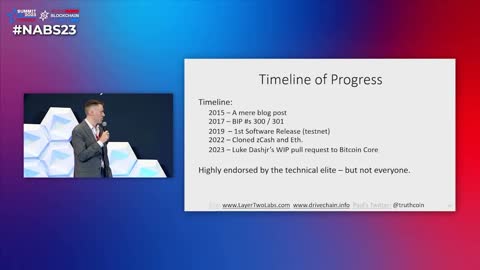
0:00 3, 2, 1, Paul! How's it? Here we go! 0:25 Hey, good to see you again. 0:27 Good to see you again, too. Third time on the podcast. 0:30 Yeah, happy to be here. 0:32 I wanted to get a hold of you because I just followed up on that debate with Peter Todd. 0:38 Yeah, with Peter. What did you think? 0:41 I thought it was shambles. Okay, we can start off with the lowest hanging fruit. 0:50 Peter was rude. He was rather obnoxious. 0:54 The content of his speech was just, he kept avoiding, dodging you. 1:04 And I don't know how you accepted paying that money to him. 1:15 The way I see it is, I'm very interested if there actually objectively is anything wrong with Drivechain. 1:24 So I think, okay, this is the best that the universe has got. This is the best microscope that the universe has. 1:29 And it's not a very good one. But I thought I will leave no stone unturned. 1:36 I was really surprised. He put almost no effort into looking into the idea. 1:43 And it's obvious that he has never really visited drivechain.info, the site. 1:48 As he said in Baltic Honey Badger, that there is no code. 1:53 But even though we have software that has a GUI, we've had that for years. 1:57 So I don't know. I think he just has this idea in his head of what it is. 2:02 And he's unwilling to, some people just don't take anything in. 2:06 They have no inputs. And they just think. 2:09 So yeah, I don't know. But I thought that maybe we'd get something out of that. 2:13 I was surprised he didn't even say any of these. 2:15 Sometimes people come up with, I think it's all concern trolling and it's all fake. 2:18 And it's all just people shilling their, they have some kind of alternative investments. 2:23 So many of these people are actually altcoiners. 2:25 Or they just have some big LN, lightning narrative. 2:29 Or they have some kind of like, you know, Peter is RGB and whatever. 2:33 Paul, are you familiar with the CIA handbook on how to sabotage organizations? 2:39 Yeah, that came to mind about the just constantly referring things to committees. 2:45 And how like nothing gets done in Bitcoin anymore. 2:48 And we don't really have a process, which is another way of saying we have a process. 2:54 But it's extremely defective. 2:56 And you don't know to whom, you don't know who to address your grievance to. 3:00 Like who are you complaining to? 3:02 So it's just Kafkaesque. 3:04 I think that that is, it's definitely like we seem to be following the CIA playbook. 3:13 Even, I don't know if anyone is trying to make that happen on purpose. 3:16 But maybe you pay enough money to Peter Todd and it'll make it happen. 3:21 I mean, I suppose. 3:23 I just don't. 3:25 I mean, it's definitely possible. 3:28 I don't think so. 3:29 But I just think he's actually, I mean, it's very easy to explain. 3:32 It's just sort of selfishness and ego. 3:35 Because, of course, he, think about what it would mean. 3:37 Like he has been against this idea for so many years. 3:41 He would have to really admit that he was wrong in a big way. 3:44 And his point of view is very clear. 3:46 Back in 2014, he had a point of view that it was very close to the truth, but was wrong. 3:53 The true part is that Bitcoin Core should care about the cost of running an L1 full node. 4:00 This is the con up factor. 4:03 Is that correct? 4:04 Exactly, yes. 4:06 So we should care about that. 4:08 What you should do is you should factor that out and not care about anything else. 4:11 Everything else is a distraction. 4:13 And especially you should not care about miners' costs. 4:16 Because that is just the same thing. 4:19 Like that's saying that we should get rid of proof-of-work in Bitcoin, basically. 4:23 No, it sounds like he's getting rather communist about this thing. 4:26 As if he's got this wand that taps over everybody's business. 4:32 And he says, OK, this is how we're going to organize things. 4:37 I don't fully understand. 4:41 Because if I decide to sink as much of the process down into an ASIC for whatever it might be. 4:49 Or lay fiber-optic cables between my neighbors and whatnot. 4:54 That's my expense. 4:56 Do you see what I mean? 4:57 That's what we want for our miners. 5:00 Stuff like that. 5:03 And he has this view that he's very interested in how much it costs to start up a new mining operation. 5:11 Why should he care? 5:12 Is he paying for them? 5:13 Is he paying for it? 5:15 I think that if we could steel man it, we would say something like we all share the same miners. 5:21 But at the same time, it doesn't really make sense. 5:23 Because proof of work is actually saying that we have a lot of conditional love for the miners. 5:34 We fire the bottom half of performers every two weeks. 5:37 The bottom half of the designs are cut. 5:40 So, yeah. 5:43 Mining must operate at the most profitable configurations. 5:49 So, if those are at different scales, then too bad for the scales that are not profitable. 5:55 I mean, he has a view that if you have costs, they must co-vary perfectly with the number of hashes each person performs. 6:05 It doesn't really make any sense, but we can try to figure it out anyway. 6:07 I would actually quite like to do that. 6:09 It seems like you both had differing opinions. 6:12 It's a combination of laziness and concern trolling, I think. 6:17 He thinks if you do a trillion hashes versus a thousand hashes, the costs have to scale perfectly. 6:25 And so, I'm not exactly sure what he thinks would happen if two people merged their operation. 6:31 Or if they were in a different room and then you removed a cardboard divider between the rooms. 6:39 But I guess what he's saying is it has to be equally. 6:41 So, even down to if you're doing 12 hashes a day, that should be exactly one millionth the economic profile of someone that's doing 12 million hashes a day. 6:54 And I don't know. 6:55 It doesn't make any sense. 6:56 But, yeah. 6:57 Okay. 6:58 I mean, we have to try to understand. 6:59 But even from another perspective, I can still run a Bitcoin miner node literally without any sidechain software. 7:09 None of it. 7:10 Nothing. 7:11 Nada. 7:13 And where is the added cost coming from? 7:16 Sorry. 7:17 You noticed that I asked him those 10 questions at the beginning. 7:20 By the way, I think you overloaded him. 7:22 And like a rat, he chose the easiest one. 7:26 He did, yeah. 7:27 And then dodged everything. 7:28 Yeah, I made a mistake by doing that. 7:29 I should have certainly just used the 10 minutes to just, like, give propaganda about, say, how great Drivechain is. 7:36 And then at the end, ask him the first question. 7:39 So that was probably my mistake. 7:40 But, I mean, I would just think if someone, you know, I just think that's it. 7:46 I gave him the 10 questions. 7:48 He could have, like, I think a very, someone who's really, really confident that their position is correct, they would have wanted to go through. 7:56 Like, they would have made sure to. 7:58 And we tried to stay on that one of this contradiction of whether or not you need, whether or not it's some kind of requirement that every miner, in order to start, must run a node, which is not true. 8:07 So the node is another thing where it's kind of like if you have two miners in a room and they each run their own node and then they're in the same room. 8:17 So they look at each other and they say, well, we can only, we can only use one of these. 8:21 I mean, I guess he says that that just doesn't work or something. 8:25 But the reason why that's important is because if two people can share one node, then 50 people can share one. 8:33 And then if I'm right about the sidechain nodes can live in their own universe, the miners just need to open a connection between one for this Blind Merged Mining thing to work. 8:44 And then none of them, everyone can defer to the pools node. 8:48 Obviously, but of course, he contradicts himself because he's also saying that the pool gives an advantage to a big pool who defrays the cost. 8:55 So we'll never get an answer out of him because his argument requires it to be both ways. 9:00 It requires it to be the case that you can divide the cost of running a node among multiple people, which is the correct way. 9:07 And it also requires that he has a whole section where it's do miners need to run a node? 9:13 Yes. And it's like it goes on and on and on about that, even though that's not correct. 9:17 So they contradict each other. So I just think I don't know if I don't. 9:24 The reason why that's so important to him is because he understands that I have correctly. 9:30 Moved all the costs, the like the large block costs, the full node costs. 9:37 I have moved them off of L1 and he knows that. So he needs he needs to find them somewhere. 9:42 He's going to have to rummage around and say, oh, here they are. 9:46 They're the mining costs. And then he also knows that miners pay all kinds of costs, especially for electricity and for ASICs and for everything else. 9:55 So he knows he's got to find something different about these costs. 9:59 So, sure, you have labor, you have whatever physical security to stop people from stealing the ASIC chips, you know. 10:07 ASICs, electricity, whatever labor. To set up some of these things like to set up like the ERCOT demand management credits, you need like, you know, I don't know. 10:17 I'm not exactly sure, but you need some kind of administrative legal apparatus. 10:21 So miners have all these costs, cooling. And he's got to find something different about costs that are in the form of software. 10:29 And what he's hit on, he has kind of flipped the good thing about them, which is that everyone can share the same node that's run by someone who's not even a miner or someone who is the mining pool or, you know, two miners in the same room can use the same. 10:44 So he's taken that, which is actually a very useful and helpful thing. 10:47 And he's trying to flip it around and say it's a bad thing, which it's not. 10:51 But I mean, this is he's it's not I don't think it's a very honest argument. 10:56 He's just trying to find he's trying to find somewhere where this full node cost is paid by. 11:02 And, you know, he admits that it is not he tacitly admits. 11:07 That it does not affect any actual Bitcoin user, anyone who's running a Bitcoin full node even. 11:13 So. So, I mean, in a way, he admits that I'm right, but he's got this circuitous path through Minertown. 11:21 I noticed he also has another argument, which which was rather disingenuous. 11:26 And I also think groping like like groping in the dark for for some sort of legal ramifications. 11:33 And it goes like this. Oh, if you run the a miner without the sidechain software. 11:40 Aha. So it seems like he already understands that. Right. 11:44 If there is another bad actor. Yeah, I know he understands that. 11:49 Right. This guy's jumping around. He's he's anyway. 11:53 He he understands that. But then his argument is that. 11:57 But if there is somebody else and they happen to to to retarget the hash or change the hash, then you are complicit. 12:06 You are participating in the theft of of this of this of this Bitcoin. 12:13 So therefore, the miner will go to prison. 12:17 Like this, the arrogance of this fellow to to sort of like look at these systems and generalize them, these complicated systems and generalize them to to to to. 12:30 It's it's it's the height of Justin Trudeau communist arrogance. 12:35 I mean, it's like if we all know that, like if it's the case that the court order is providing consensus. 12:44 Then the whole proof of work thing just doesn't exist anyway. 12:48 And in the same paragraph where he complains about that, he has to, of course, he's got to make it about himself. 12:54 So he complains about Craig S. Wright suing him. 12:58 But that just proves that lawsuits are, you know, not necessarily connected with reality or something that we should respect. 13:07 So I don't understand. He almost every sentence in the thing piece of writing he produced is wrong. 13:14 And many of them contradict themselves, like with the sentence right next to it or a paragraph that is just a little bit later. 13:23 So so I think that, you know, he's just thinking like. 13:27 It's it's like a performance and he will look good among some people who are already they're already worried about, I think, what Drivechain will do, because what Drivechain will do is it will fix all the problems in Bitcoin. 13:39 We won't need the toxic toxic cultural enforcers. 13:43 We won't need to worry about scale. 13:45 So we won't need all these weird engineers doing these like overcomplicated things that that are doomed. 13:51 So, like, you know, lightning has turned into basically like a make work scheme where it's just a never ending. 13:57 It's like you hire contractors to work on your house and they just work forever. 14:01 You know, they don't just get the job done in one day. 14:03 They you know, it just takes two weeks and it just goes on and on and on and on. 14:07 And that is what lightning has become, where it's great if you want a salary as a technical person. 14:14 But the the the ethical thing in Bitcoin is to make yourself unnecessary as unnecessary as possible to purge all human interaction from the software because you can't have this thing where you need support. 14:31 But then now we have these LSPs. So anyway, Drivechain will do that. 14:35 Drivechain will also like a lot of these people that I just disagreed with in the past because they are they're weak and they're not, you know, they're not strong and they're not good for Bitcoin. 14:45 So I just make fun of them on Twitter. 14:47 They don't want drive to the drive. 14:49 She won't give me a lot of credit. 14:52 So I think that that is just what it is. 14:54 And he I mean, I don't know, like I, I struggle to to like drill a hole into his mind and figure out like what is really there. 15:07 And does he really care about minor fixed costs? 15:10 And does he even know what those words mean? 15:12 Because that's I don't think so necessarily, because I think in economics, those are tied to a single decision making context. 15:21 As I write in a reply to him, my written reply is that you don't like if you hire an electrician to come out for the day and they're hired for eight hours. 15:34 Then there are fixed costs, and if they finish their work early now that you can reuse them for free, you can say, well, can you do this other thing also and then just leave early now they have to have economies of scale and there are fixed costs. 15:46 But if you zoom out over the year and you say, well, for every single day, we need the electrician. 15:51 We have to pay this. 15:52 Then they're a variable cost. 15:54 So and also the is for being a fixed cost versus economy of scale. 15:59 It depends on the scale. 16:00 So like if you build a hydroelectric dam, that's a huge upfront fixed cost. 16:05 Of course, if you zoom out and you take the point of view of the emperor of the continent who will rule for 200 years, then even the hydroelectric dam is a variable cost because you say, how many hydroelectric dams do I need? 16:15 How much power do I need? 16:16 How much is it going to cost per thing? 16:18 And if you have if you zoom out, then everything is a variable cost. 16:22 This is well known. 16:23 But even it depends on the scale. 16:26 So you have enormous the marginal demand of the electricity demand of the town could be it could need like 70 percent of the dams, the water that can flow through the generators of the dam. 16:42 And then the other 30 percent just flows over the waterfall kind of as normal. 16:48 In that scenario, the town has, you know, the they can easily scale up. 16:55 They have scale economies. 16:57 They have they have already paid the fixed cost of the dam and then now have a very, very low marginal cost for the next unit of electricity until they're putting 100 percent of the water through the dam. 17:10 And then they don't then they then it all flips around again. 17:12 And now it's impossible for them to get more electricity out of the dam no matter what they do as far as dam and dam related costs. 17:20 And so it's it depends on the scale. 17:24 So every everything will eventually hit some kind of diminishing returns to scale. 17:29 Well, you cannot have eventually have so many full nodes that, you know, the planet becomes a black hole and collapses or something or runs out of usable energy and be available like computing resources of the planet. 17:43 So, I mean, that's that's irrelevant. 17:44 But I'm just trying to say is that it's pretty to pray. 17:48 It's the predator prey cycle. 17:50 What you just mentioned that things don't just have economies of scale like like in the piece of writing I used and I replied to him. 17:57 I said, this is like saying that the chemistries of lithium have both heat and pressure. 18:03 You know what I mean? 18:04 Like lithium doesn't like have heat. 18:07 Like that's not that's not what that word means. 18:09 You know, like so things economies of scale are when you're trying to decide, does the town build a hydroelectric dam or do they build a bunch of wind turbines? 18:17 Do they build a coal plant or do it? 18:19 You're trying to say, OK, we we forecast this amount and some of this will have to pay no matter how much you know what I mean? 18:27 When you no matter how much electricity you get out of the dam, you must pay the upfront cost. 18:33 So you see, this is just this is human nature. 18:36 This is 101 stuff that you would do to figure out, like, OK, how do I get the cheapest amount for the what I expected the actual demand will be. 18:45 And demand is something else that will always have diminishing returns. 18:48 And anybody who's run the most basic of businesses understand these very basic concepts. 18:53 OK, so he doesn't understand them. 18:56 So this means. 18:57 Yeah, I don't think that he does. 18:59 He uses them in a very weird way. 19:01 He'll just say like he said, the economies of Bitcoin mining have economies of scale or something. 19:06 It's just like saying, you know, like the the economies of whatever copper wire manufacturer have. 19:13 I mean, it kind of depends. 19:15 Like it's not there's not supposed to be used that way. 19:17 It's supposed to be like we have two or three choices. 19:20 This is the expected scale. 19:22 I mean, you need the expected scale in there because nothing on a desert island like manufacturing cars certainly doesn't have economies of scale because there's no roads and there's no people and there's only you. 19:33 So it's like it depends completely on the context. 19:36 So I don't know. But but but that's the best that that's the best that the anti Drivechain people have got. 19:41 So you have to weirdly, weirdly engage with this, this very I don't know, this very like juvenile application of terminology. 19:53 Yeah. And also the other one is, oh, miners can steal. 19:56 And this is also a very, very idiotic way of looking at things. 20:00 So I've taken a stance of of of anybody who's running business and owns a business and invests in businesses will understand what I'm trying to say. 20:10 If you're like Peter Todd and you you basically sit in your your your your bedroom and just go to conferences and whatnot, you probably have no idea how this works. 20:20 But the way I see it is this. As soon as you get Drivechains into Bitcoin, what happens is miners, they might have started out as entrepreneurs setting up a business, the equivalent of setting up a business. 20:33 But it's almost like when Drivechains comes along, it becomes like a rather large company where where you actually need a board. 20:43 Do you see what I mean? A board of that actually are adult supervision over this corporation, which is Bitcoin and the community. 20:53 Now, what happens now is that these these these board members, they're going to select execution, the C-class people, you know, the CEO, the CTO, the CMO. 21:05 And those guys are going to be paid pretty well. 21:08 Basically, they're just going to manage the workers. Right. And their job is to turn a profit, turn a dime, hopefully do useful things to society so that they can aggregate wealth and solve problems. 21:24 So then the board members will select who's a good set of X executors. Right. 21:31 The sidechains are such things. 21:34 So it's kind of like they each have their own difficulty, I mean, in a way, because it's like the sidechains have to compete also against each other. 21:42 But it's right. But yeah, this is exactly right where the miners gain the ability to. 21:50 Like they they they can bring the sidechain forth and dismiss it at will. 21:54 And even if like some sidechain is like interfering with other sidechains, they can just they can take a zoomed out view. 22:01 Right. What will actually maximize our fees and the market price of the coin? 22:06 And they they delete anything that shouldn't be there. 22:10 And they call forth anything. Miners could even like sponsor a hackathon or hire someone to create. 22:17 They could create the power to create and destroy. 22:20 OK, I have a question for you now. 22:23 So assume for a second you are a serious miner. 22:27 You've invested multiple, multiple millions of dollars in setting up your your thing. 22:32 You have a series of other miners. 22:35 And you guys have been whittled away of over a decade of, you know, refining your business, optimizing it to get to this point. 22:42 And, you know, when then there's a when there's a when there's a halvening. 22:46 Everybody like the bad performers get removed. 22:52 Now you have sidechains and Paul Peter Todd comes along and he says, I want to create a sidechain. 22:58 And he manages the sidechain the way that basically Bitcoin is currently being managed. 23:05 I ask you, how long is he going to last in this board? 23:09 Well, of course, remember, we shouldn't be. It should be up to this. 23:13 The good what I think the good thing about sidechains is it's it's about the relationship between the software developers and maintainers and the software itself. 23:24 Since the developers may leave as Satoshi did. 23:27 Right. So it's a relationship between the design, which is basically the the business, as you put it. 23:33 It's like a dry cleaning place or a food place or something. 23:36 And it's a relationship between them and their customers. 23:39 So if the fees are there, then and if they think that this overall thing is like helping the exchange rate by having this option, you know, it's like these are rides at Disneyland. 23:48 We're doing too many metaphors. I mean, I'm doing too many metaphors. 23:51 It's like, you know, if they think it adds something, because, you know what I mean? 23:54 You can't not everyone wants to do like, you know, if you go to have a big mix, always because it comes to mind, because if you go to like a theme park, not everyone wants like the really crazy fall ride. 24:05 That's like really, really thrilling. They also have like some of the simple rides and have like simple games for like people, you know, it's like so they have they have like a mix. 24:14 So you'd have a cash sidechain. You'd say maybe it doesn't generate that much in fees, but it allows everyone to obtain privacy if they need it. 24:23 So you see what I mean? They would be maybe motivated to keep that one around because it helps the whole portfolio. 24:29 But we wouldn't necessarily need to inject our own opinion. 24:34 We could just see, hey, is it is it getting the and I think that's that's where the whole thing would improve, because right now we do have this communist USSR style. 24:42 Like, what do we want in Bitcoin? How should we support the code? 24:49 Our. 24:50 Yeah, we had roadmaps at one point we had. So so I think that actually we have gone in the wrong direction with that. And so the good the good news is he see this is a great I want to there's many great things about this, but one is in that scenario, the miners can just kind of completely ignore this whole thing until there's actual like code and then they can like run it in like the traditional way. 25:16 They can actually run it in like the test environment. So someone says, oh, I'm working on the sidechain. I mean, you always if you're a miner, you always say, great, you know, you don't keep me updated, you know, because I don't care until the software is done. You can't do anything anyway. So so you just say, great. You just hope that they work on it. 25:36 Then when it's when it's ready, you can kind of test it out yourself. And you can see like, is this any good? Is this vaporware? Or is this real? Can I actually see people using this? You have a very clear criterion, which is generate the transaction fees. And, you know, it's a great criterion, because you can generate fee revenues. You know, one of two ways, you can either have a lot of happy customers that you take a tiny bit from, which that's great. Or you can somehow you could have this new software you've written. 26:05 Be so amazing that you can charge higher per fee per transaction. I don't know exactly how that would work in the world of open source, but it's theoretically possible with network effects or something. So so if whatever that is, you have, as you say, it's like the board has outsourced part of the job of boosting their own revenue and growing Bitcoin. 26:32 See, whenever you get more transactions, it's a it's a two for a two for one, you get more actual users, you get all this and all the all the goodness that that entails, which is a real feedback to the software people, real feedback in the world. But you also necessarily you get more adoption, because you have, it's not only a use, but it's more attention to the coin, you know what I mean? 26:56 Like, everyone's trying really hard in the crypto world to like, get on different podcasts. It's whole, we've created this weird media landscape where it's like, you want to do marketing, you want to shill, you want to like, you know, you just want to get your name out there, like EOS just did the Times Square ad in 2017. And it was just EOS didn't say anything about what it was, it was just the name, you know, and it's like, that's. 27:22 But if you've got actual users, and spreading by word of mouth, I mean, that's far superior. So you get you get more actual, you get more transaction fee revenue, but you clearly you also be increasing the price as you grow the community. 27:35 Yes. Talking about getting your word, getting your name out. I thought of a bit of a conference thing. Assume for a second that Bitcoin has adopted BIP300. Now, once a year, you have a conference, but it's almost like a commodity. It's like a fight, basically, you know, currently, we only have we can only have 256 sidechains, right? 28:00 Now, assume that we already had saturation, right? And the miners are looking at this, and they're saying, yes, our portfolio is coming along quite nicely. But we have space enough for maybe 10, maybe 10 of those portfolio people are a little bit, you know, on the dodgy side, let's have a commodity. 28:18 And then what happens is, you get a whole bunch of young bright, bright sparks with with great proposals, they sort of get up on stage. And some of them might be in a financial position to be able to fund the development of this, some might not. But then, you know, they do their presentation, they do their pitch. And it might be like, you know, Britain's Got Talent type thing, whereby, you know, you get all your miners that yay or nay it on the spot, right? 28:45 And then some might say, Look, I need funding, I need a couple million to develop this. And of course, the miners are looking at this and thinking, I'm interested in funding this sort of thing, because it's going to drive, we believe it's got potential. And then on the other side, to make space for those 10 people that got selected, well, you're going to have to vote off the people that that, that, you know, are are the Peter Todd sidechains, basically. Yeah. 29:10 Yes, I think competition is always the way to go. And, but an unfortunate thing is, I think that the miners, both when miners support or are against something, including my own project, it's pretty clear to me that they don't have the most amazing understanding of it. I mean, they live in their own world where they're very specialized in finding like cheap power, and etc. So they, they don't, I think they should take, 29:40 I really think that they should make the decision to take more responsibility for what happens, because actually, they are the ones who will, in the long run, suffer the most if they screw this up, which I think meant a lot is being left on the table, like a huge amount. 29:57 So I think they don't really at this point, because ever since it was probably like SegWit2x, they have been like very hands off. But even before, something I often recommend is the scaling to minor panel that had like 95% of the hash rate on stage. But they clearly just don't know what to do. And this leaves them vulnerable to, you know, just people coming up to them and telling them, you should do this, or you shouldn't do this. 30:23 So just without editorializing too much, you know, just what happened was the miners had no idea what to do during the block size dispute. And so they did nothing for a while. And then the large blockers persuaded them to do, persuaded enough of them to block SegWit, and then persuaded enough of them to hold it hostage for SegWit2x. 30:53 And then persuaded them, and then somehow they changed their mind to to not do that. But it was because SegWit2x was a losing idea. But the point is, they are kind of like easily just batted around by, they don't, they don't seem to have like a very deep understanding where it's like they know every inch of the issues, and they say they have, they know exactly why they're doing things. 31:17 So I think that they, they're not very technical people, as we in the Bitcoin technical community would use that term. But even though they're, they're, of course, extremely technical in their own way, they have their own, and it's clear one, you know, things like Ocean, and Luke Dashjr.'s new pool, I think they show very clearly that, that how specialized mining has become and to the point where other Bitcoiners don't even understand. 31:42 I mean, I didn't really even know that there was, I didn't even know that there were firmware discounts. And I mean, I guess it was kind of obvious at one point that because of the way AntPool and Bitmain were organized, that there was like, vertical integration, and there's always been vertical integration. 31:58 But, like, Luke is a super expert, and he ran a pool that found thousands of blocks for years. But now he started his new pool. And with the exception of two blocks that he found, like on December 1st and 3rd, which I think were either just with rented hash power or, you know what I mean, something like help kick it off with some momentum. 32:25 With the exception of that, they have not found a single pool, and their pool design does not achieve any of the objectives that they say that it does. And other miners have correctly realized that it does not. So this is a scenario where people can have enormous prestige and expertise and fail completely to participate even, even participate, even join the network of miners. 32:52 Yeah, there's another direction that that's rather worrying to me. Anybody who hasn't got their head shoved up their asses knows that lightning's falling apart. There's too many moving pieces. It's it's a convoluted mess that was designed and created in Silly Valley. A bunch of VCs put stack loads of money behind that this is supposed to be the greatest thing since sliced bread. And guess what, it doesn't work very well. It's pathetic. 33:23 Well, yes, I mean, we don't want it to like, we don't want to impugn the people with the bad motives, unfortunately, I think are the marketing people who they they just picked up on this meme of okay. 33:35 There's like a bunch of people who they don't even use lightning themselves, but they like Bitcoin, and they want Bitcoin, they want to pump the Bitcoin bag, which we kind of we all want to some extent. But what they have concluded is Bitcoin is good lightning helps Bitcoin. So we don't want anyone to make fun of lightning or criticize lightning. 33:57 I mean, but I had the Anthony Riard on our Twitter space two weeks ago, I think. And he, you know, he is a leading expert, you know, and he has decided to just quit. He says it's not there's no future for a tech person to do that after investing all the time, you know, and learning the code and the design is he's decided that he's just going to look for something else to do because it's so hopeless. 34:21 And even we asked, I thought, asked him some, some pretty normal questions, tame questions. And I was very surprised. I mean, he would even he went as far as to say, he said very casually, he was just very friendly, very kind of jovial, even, but he was saying like, you know, you know, there's a lot of the VCs don't want anyone to invalidate their investment thesis. 34:42 So he's like explaining, like, why is it that why is it that there's such a difference between, like, the opinion of the technical people who work on lightning every day? I mean, this is like, kind of like, this is going to become like a Theranos style, like Enron situation where there's like people working on the blood machine every day, or know that it doesn't work. And then in yet, then there's like, you know, great woman CEO, revenge story that everyone is a feel good story. 35:12 We all love a feel good story, right? She quit Stanford, and no one believed in her. And now she's rags to riches. Whatever, you know, so and, you know, that's the but that's the issue is. So this is the issue is the cultural thing is it's not any problem with any code or anything. It is because you can just change the code. If once once everyone knows what to do. 35:35 You can easily you could just change, you could activate the 300. You could do some other thing, you know, you can do plenty of things. The problem is the culture has actually become, you know, complacent and overconfident. But also, it's just diluted in other ways like that are these parasites have installed themselves, which include the lightning VCs. And but it's also just includes like, whatever, like anyone selling a book or even a conference. 36:05 Not these people are not necessarily symbiotic relationship with Bitcoin. And especially when you see people who are like the cultural enforcers who are saying like no true Bitcoin or this are people who are just being rude and obnoxious and not not growing the church, getting more people in. If you're not doing that, then you aren't. 36:26 You are a parasite. Yeah, that's how it is. 36:30 Well, a friend of mine went to one of these lightning conferences, and he was like, it's one of the most stale, boring places he's ever been to. 36:39 You know, it is. I don't understand how, like, more people don't see it. I mean, I went to Tab. I think Tab Conf is the best technical conference. But for the last two years, like, you know, it's more than half of the content is lightning. But it's like when it's lightning, everyone's just sitting there and the things like at the computer, the person gives up and they always give a talk like this. They always say. 37:02 Here's an incredibly difficult problem. It's very arcane that I've discovered with lightning, but we can solve it with this or this or this. And then it goes to their solution and it's very complicated. 37:14 And but they have some kind of solution to this weird edge case. You've never even heard of this yet. Another lightning problem, as if the inability to onboard people to it wasn't enough, like just right out of the gate or as if the fact that it doesn't work when the fee rates are unstable. 37:30 Like you just think like, OK, these these two things alone would just kill the idea. But they have like this thing. They've discovered their own weird channel jamming thing. And they OK, we can do it with this. We'll add these fees. 37:43 And then the end and then everyone claps and they sit down and then it kind of repeats. And it's it reminded me a lot of academia where it's like the goal is to find like a weird problem, impress everyone with how you were able to solve it somehow. 37:58 And then it's kind of quite listed down and it doesn't matter that none of this is in the real world. You would just pull the plug on this idea because the likelihood that it will translate to satisfying the needs of the end user is very low. 38:14 Although there may be there's probably some niche, you know, where like the ability to sign and rapidly iterate will have some niche, but certainly not scaling Messiah. 38:26 And it's but one thing that I want to stress is that at TabConf two conferences ago, which I believe is September. 38:37 There was a macro, a big talk that was like lightning is is is broken. That was the title. And then the content was, you know, matched the title. It was very persuasive. 38:50 And this is on the main stage and everyone claps and then everyone just goes about what they're doing. And then someone who's very senior in the community, like a couple of months later, I was talking with this person and they were like, you know, everyone just, you know, the lightning is broken, but we all just we all just keep doing it or something like that. 39:12 And then the next TabConf is still there's like all this lightning content, lightning, lightning, lightning, everything's lightning. Lightning our sponsors. And someone said that, you know, we had more people slowly coming, speaking in person, like not at the event, but like when we're having dinner and stuff, people would say lightning is broken. 39:37 And then, you know, Barack, who is to the last two TabConfs ago, he was breaking lightning with his funny little hacks. And then he invented Arc. So he's talking about Arc. This one in his Arc or whiteboard masterclass video. 39:53 I mean, he practically starts it off like the first four sentences or something like. I mean, he starts it off in the intro and then he's like, you know, so we all know that lightning is broken and this this project is about trying to fix some of the bigger problems in lightning and just like with the different. 40:07 So. So there has been disillusionment, but many people on Twitter still haven't caught up. And I think Peter, Peter Todd is an example of someone who I don't think has actually caught up. He doesn't realize that the people are leaving the sinking ship, which is weird because normally when people are kind of smooth operators like that, they're very aware of where everyone else is. 40:31 But so it's very bizarre that he but I think he's got a lot of writing on with RGB and I don't know exactly what the status of everyone's. 40:40 Like, I don't know what everyone's projects are, but I think that what the project people are working on obviously biases them. Anyway, lightning. I think I think it'll be interesting to track how it actually goes away culturally, like, will it like slowly fade out? Will it be like coven where everyone just kind of prevent pretends like we try to pretend like that never happened or something? 41:03 Or will it be like, which is kind of my suspicion. I think the coven model is a good, it's a good guess. But it's also possible there will be like something like Theranos will go just be like some, there'll be like huge ruptures like the article just saying that it's a fraud and then they're failing to reply to it and then like they get like the whistleblower investigated and then it just like explodes. 41:28 So I don't know. But, you know, the fact that it's not it's currently not incentive compatible even on its own terms with respect to like the need for op expire now, even HTLCs don't work. 41:44 HTLCs don't work when the fees are high anyway. So if fees stay high, then they then just no one will really be using the lightning network, they will just be passing funds, you know, custodially, they will be like fronting someone the money without any guarantee that they will get reimbursed, which is why it's all more than half of it goes to LSPs. 42:05 So the whole thing is going to collapse and eventually. And the only question is, I guess if I think that probably a lot of LNVCs are just going to try to like dump their shares and they want to keep the narrative going. And now this whole thing has become a disastrous cultural problem for Bitcoin, unfortunately. 42:26 Yeah, and also, um, one thing that's happening is that folks like Peter Todd with with their heads in the ground, like ostriches, you know, even though they don't do that. But what's happening is, is, you know, I think in 2014, 15, he was one of the bigger naysayers of sidechains. And that's caused irreparable damage to, to 42:49 has, like, it's impossible to overstate, I think. I mean, like, it would be like, we've had scalability, privacy, we would have had there probably the exchanges would not have even had as much influence, because Oh, sure. There'd be a situation where we would already have, we were sprinted directly to a situation where you could like buy Bitcoin at like a CVS or something, or like a little card, like there would have been like bit instant, like redo or something. And 43:19 I argue, I argue, we might, we might be in a situation where we actually making transactions with each other in Bitcoin had had there been something like the 300. You see, what I'm trying to say is that Bitcoin is impossible to scale to everyone in the world. And lightning is also demonstrated that this was supposed to be the panacea, the, the, the solution to it all the final, you know, the great solution. But that's not happening. And instead, what is happening is that people are making transactions with each other. 43:49 Over centralized custodian solutions like like with exchanges, and lightning is going to evolve. The only way lightning can actually work is if it works with become a massive custodial type scenario. And I believe there was one of these apps I thought was I don't know was a Phoenix I think was a Phoenix that was that was that was a centralized and everyone was like all fapping on about how great it was, but it's all it's all centralized. 44:15 Have we not learned our lesson from FDX? 44:45 You would like buy one of the non custodial would buy like moon or something. And you just vertically integrated because it's all custodial. Anyway, just say, okay, this is great for this is a great deal for Coinbase and just spend whatever it is, you know, $2 billion, who cares, and just acquire the brand and the the app. And they're all you know, but that does remind me of a great tweet that I saw about 45:12 I don't it was the tweet when something like this quote, I don't know who needs to hear this, but scanning a custodial QR app is not an innovation or something. It's like, so that's the 45:27 But that's where we are, you know, we are, we will regress to Venmo. So really, the lightning people have taken us into a place that is basically what the worst case scenario of large blockers was, which is that people don't have, they can't run a node, and they don't, they don't know the status of their own money without talking to like an API. 45:45 So we have already achieved this, the worst case scenario of, of large blockers and via lightning. So that's, I don't know why. And more people are starting to realize that because, you know, there's a lot of people out there who are, of course, it's very easy to just be a bullshitter, right? So you get up there and you just you say a bunch of vague stuff, you know, this week, we could name something. I mean, like, you know, like a Michael Saylor, Max, Max, Max, Max, Max, Max. 46:15 Kaiser, like they, they're not exactly, you know, Michael Saylor isn't exactly going up there and saying, Okay, I'm in this file on this line of code should be a three instead of a two, you know, it's not exactly like a pinpoint, laser guided missile precision, he's just saying, you know, a Bitcoin is encrypted energy, you know, and the crowd goes wild. So, you know, that's great. I mean, we need people like that. One of the best things I ever heard in my entire life, the cleverest things, I think, was a Milton Friedman 46:45 saying that there's idea manufacturers, and then there's idea, you know, distributors and wholesalers, and there's idea retailers. And that's a profound truth, which is that the guy people who come up with ideas, they're often not the best to like, you need like, there's like, there's like a Satoshi, and then there's like an Andreas Antonopoulos, you know, so then then there's, you know, people like people like you and me, you fall on the continuum somewhere. And even the people who listen, like someone who listens to a podcast, but never goes on a podcast, 47:15 that person is probably like a relatively like intellectual type of person, you know, and they're gonna they have to tell it to their friends that like the bar or, you know, the house party or something. So even maybe they are even the retailers, you know, so but the point is, there's no reason to say that one person is sort of better than the other. These are all different jobs that everyone has that must be done in order for an idea to make it from not existing at all to being pervasively adopted by everyone around the world. 47:43 So, so yeah, like, you know, my, you know, Michael Saylor is he's sort of near the retailer end, and he's pumping the these ideas and but you know, it's very easy to be vague. And what we, you know, that's, that's good in some ways, but it's it has the negative property that it's the Theranos problem. 48:07 So lightning, this is the lightning Theranos metaphor where you a lot of people have all these beliefs about lightning, lightning will fix everything we'll just do I'll just do that we'll do the Zcash sidechain on top of lightning or people say stuff like that when it's like, okay, you know, they don't, they don't really know what the word lightning means, but they know that something will happen. And so that's just something that everyone should be aware of, I suppose. 48:34 Yeah, I want to ask you, right, maybe a more controversial thing. 48:43 I think it's quite conclusive now that at the end of the debate on the very end, I believe was where he was asking for his money. There's a Peter was asking for his money, which I thought was quite telling, quite telling indeed. And another thing, 48:59 I mean, hey, we hired him to do a job, he did the job bit kind of marginally. But, you know, you know, I mean, like, okay, I get it, I get it. But But, you know, if it's more about me showing to the world that like, listen, I really, you know, I tried with this guy, I feel like I, you know, Oh, is that what it's about? Okay, I think, I mean, like, I mean, I think I will at least get something, I'll get something out of it. Like, so either I'll be able to show the world I tried with this guy, or he'll identify something important. 49:27 Or, like, I don't know, he will show the world that he there's like an opportunity to, because he like, he's complained about this idea for years and years. And I, he's got enough ever been specific. And honestly, he's still not specific, because he did what he produced self contradicted itself in, in. 49:48 Unbelievably important ways. There's no, the whole argument hinges on minors being required to run sidechain nodes, even though that's not true at all. And he even admits that it's not true in the other parts. And then he the whole argument also hinges on minor centralization. And he has eight, eight different definitions and measurements of it that all contradict each other completely. And most of which have nothing to do with BIP300. So, so it's true that I still we still don't get anything out of it. But I think we can now be 50:15 confident, you know, that his opposition to the idea is just based on some kind of like, you know, it's like he's, he's, he's, he's working on RGB, or he can be disregarded that he was wrong or something like that. 50:28 He can be disregarded from the equation. He's a he's a he's insubstantial. He should be asked to leave the stage. Thank you very much. Stop wasting everybody's time and and causing more damage. Now on to the more controversial question. 50:44 Right. You know, when you're going to say, okay, when the steam engine, okay, what did you think I was going to say, I thought you were going to ask, because at the very end, I asked him, which is like the normal science question, I asked him, well, you know, is there anything that would, you know, he's like, I don't like this idea. And I was like, Is there anything that would make you like to change your mind? And it was like, Well, no, I don't think so. And he didn't even say he didn't even really own the know, he tried to like waffle for a little bit. And then he was like, 51:11 Yes, yes. Actually, that's, that is what I wanted to say. Thank you very much for catching. Oh, good. Yeah. Because that's, that's always telling to I mean, that question is, that's a very important question, of course, because it would call popper falsifiability science type. Yes. But it's a difficult in practice, when that question is sprung on people, they usually are. It usually is difficult to answer on the spot. But I get my guess is that Peter will never be able to answer it on the spot or after hours of reflection, either. 51:38 And I think it's telling that, for the large, large block or small block dispute, I really know what both sides would have said, they would have said something like, I mean, I think some of them are deluded and crazy people. And they were just in it for fun. And they had no idea what was going on. But you could have gone back into the scaling war and said, to the large blockers, like what, is there anything that would make you not want the block size increase? 52:02 And they would say, yes, because all we want is for everyone to be able to use Bitcoin at a reasonable experience and a reasonable fee rate. So if something is built that does that, that doesn't involve large block L1, we'll go for that. And similarly, you could have flipped it and I would have known immediately like the right answer on the small block size. 52:21 Is there anything that would persuade you that you should that that we should have large block size increase or an unlimited block size or whatever that would be? Will it still be cheap to run the node? Or, you know, do we actually know what the final block size is? You know, are we going to have to keep changing it? Because that was another very reasonable thing to say. So we can't keep changing it. We have to change it. We're going to change it once or we're going to just change it every two years. And how's that going to look? 52:49 So I would have been able to answer it kind of on the spot for both sides of the block size debate in back in 2015, 2016, I think. So, you know, he couldn't he didn't answer it. So, you know, you know what that means, though. It means that it's driven by something other than the content of the idea just as he doesn't like it for some other reason. 53:09 Yeah, no, whatever that reason is made him he's now irrelevant. The man is irrelevant. He's he's representing some sort of decaying, old, out of date, decrepit thing. 53:26 He should certainly try to answer the first two or three of the 10 questions if he wants to rejoin the conversation. 53:46 All stones have been left. All stones have been turned. And where to from here, Paul? This is the question. Because when you have because when when when the when it's the time for the steam engine to be created, once that invention is in it, there's no stopping it. There is no stopping it. And right now we've got a scenario whereby, you know, basically the competitors, the SWIFT network. 54:10 This this board that I spoke about, whereby the miners need to man up and become board members and oversee execution, you know, the C class, that what happens is the whole network is is essentially taking on. 54:24 And here's the key point. Central banks are recognizing the power of this technology. They're starting to look at these exchanges and saying, well, we could do what FTX did and Binance did. 54:51 We just have to put the population of the earth into or the country onto this particular website and we will manage the toing and froing of the currency. This means that banks are cut out. This means that they, the central banks, become the enemies of the banks, the retail banks. 55:15 Now, how about this for a scenario? Excuse me. How about this for a scenario? Assume for a second you have BIP300 merged into Bitcoin and you have a sidechain for each of the banks. 55:37 This way, now the banks are starting to use. OK, I say this because a large majority of the people have no idea how to use Bitcoin. So this puts in a familiar interface with the population of the country and the typical SWIFT type network. 56:00 And instead what happens is these banks, who they're looking at their central banks and they're realizing that now all of a sudden they're in the crosshairs, you see, and they start to think, we can fight back. We can fight back if we all agree to. 56:14 Oh, yeah, that would be neat. I think what I would like to stress is that, again, the sidechain, I take no idea. I mean, I personally have all kinds of thoughts on what I think is a good idea versus not. But the point of BIP300 is to say this is not a good idea. 56:34 Just to say that it shouldn't be up to me is that try anything on any spectrum of decentralization. Have Luke Dashjr. sized tiny blocks. Have Roger Ver sized blocks. Have unlimited sized blocks or have something that is – 56:51 I get it. I get it. But your mind operates in a different way, you see. Normal human beings need some sort of a narrative. Like the Bitcoin price is going to shoot up next year sometime. Maybe it is. But the media are going to fabricate some sort of a narrative. It might be completely and utterly inaccurate. 57:21 But it doesn't stop because any bank or any individual can participate in that network just like it's permissionless. So, but what happens there? 57:48 Yes, of course. Well, I would just like to say that I have done some of the math. It doesn't actually take that much. You only need like 10 or so sidechains that are only 10 or a little bit bigger than the Bitcoin core that we already have. 58:04 And, you know, you even have things like Solana. They're the actual total cost for the running the software in terms of like the server, etc. RAM and everything. There's only a few thousand dollars a year. 58:18 So all the data that I've seen suggests that it actually it will be very, very cheap even to run nodes that can actually have everything be an on blockchain transaction for the entire world's transaction throughput. 58:37 So I think that that so we won't really need but but for the user in terms of a we will not hit the scale ceiling technologically. But in terms of as you're not factoring in Metcalfe's law. 58:51 Yeah, the. Well, what do you mean? 58:54 Well, Metcalfe's law is a network becomes more and more useful, the more nodes that get participate in it. 59:01 So like the telephone network, or in the case of the Bitcoin network, assume for a second that you get you on board a bank per sidechain, and then they bring all their customers onto that sidechain. 59:18 So it becomes more and more and more and more valuable. Because if, for example, I wanted to use HSBC, I could I could take my money out of HSBC, sink it down into them into BTC, and then move it into, you know, standard charted bank, for example. 59:34 And then I can, and and, you know, and also as a result of this, each of the countries are more likely to adopt this because they can control their own monetary policy realities that we are in a world where where countries and we elect these people because most of the people are stupid and they are unable to operate on these different levels. 59:58 So they can't, I don't know, anyway, I suppose. 1:00:01 Yeah, maybe. 1:00:02 But it's going to be monetary policy. 1:00:05 What BIP300 does is it says it doesn't matter if something is a fiat project or an altcoin project, you know, or Ethereum, whatever it is, you can turn it into a Bitcoin project and have it use 21 million BTC and have it pay fees to the miners. 1:00:20 So I think that we should have, we should have like a Solana type thing, like we should have something like something where you you push the envelope on decentralization down. 1:00:31 So like you become more centralized, you go in the bad direction. 1:00:35 But you see, like, how far can we get and still, you know, and still have the enough of the good properties of decentralization that we like, and then we should have things should go in all the different directions and including various levels of integration with, you know, corporations or even the government or whatever, you know. 1:00:54 So like El Salvador, people, people love that. 1:00:57 The Chivo wallet is centralized, you know, it is, you must, they must use their equivalent of the social security number. 1:01:06 It's tied to their identity. 1:01:08 It is fully custodial. 1:01:09 It is, you know, fully KYC. 1:01:11 And so it's in many ways, it is a CBDC nightmare outcome. 1:01:16 But it's got the, it's got the word Bitcoin slapped onto it. 1:01:19 And I would just like to say about that, that even though that that's a very, it's a very disappointing outcome so far. 1:01:24 But I do think, you know, Rome wasn't built in a day. 1:01:27 And that guy should be given enough rope to hang himself. 1:01:32 If he, maybe he can make, I think it's possible that he will be, it's possible that he will turn into another Latin American dictator and just steal all the money and leave. 1:01:40 And, but it's also possible that he will, he will make it work. 1:01:45 And he has not had enough time to make it work. 1:01:48 It's very hard. 1:01:49 Those people are obviously very, they're not the most educated or technologically sophisticated population that he, you know, you've got to play the cards you're dealt. 1:01:59 And he does seem to be, he seems, he has an unbelievably high approval rating. 1:02:04 I mean, it's always, whenever you throw a lot of people in prison, you've got to watch that approval rating though, because you never know if that's, are they doing a great job of cleaning it up? 1:02:13 Or are they just going to throw everyone in jail if they don't, if they don't vote yes. 1:02:17 But he's great. 1:02:19 I think that, right, exactly. 1:02:21 It's like, what's the approval rating in North Korea. 1:02:25 If they don't clap hard enough when he walks in the room, well, you know, that's it. 1:02:33 You're done. 1:02:34 I know quite a few people who have, yeah, I know quite a few people who visited the country and usually they come back with like kind of like a mixed review, which is what you would expect, which is to say, sometimes I could use Bitcoin. 1:02:48 It was great. 1:02:49 And other times they had no idea what I was talking about, or they said that I could use Bitcoin, but then they didn't, I didn't actually pay with cash half the time. 1:02:58 So I think that, but I would definitely say this, even though it has been years, it is not enough to do what he, what they want to do is that would take a while for even the most, like even the most organized person, Napoleon. 1:03:14 Maybe Napoleon could do it because apparently there's all these funny stories about like when he was exiled to that one island, the first island, he like will completely revolutionize the culture and legal system and economy and like open to like mines and like open like harbors and stuff. 1:03:31 So apparently some people are just good at that kind of thing. 1:03:34 But, but that's a big project. 1:03:37 So we'll see. 1:03:39 I'll learn from that experiment, hopefully. 1:03:41 Okay. All stones are left are overturned. 1:03:45 They were all investigated. 1:03:46 How to get this into BIP3, how to get BIP300 into Bitcoin or does one fork? 1:03:54 Now, keep in mind that there is a perverted incentive. 1:03:57 You can see a lot of the Bitcoiners, what they do, what they do is they, you know, they don't really care about the community. 1:04:03 I mean, even though, even though on one hand they're busy shilling that, yes, Bitcoin to the moon. 1:04:08 And the only way for Bitcoin to get to the moon is by the global, the whole world adopting Bitcoin. 1:04:14 But then on the other hand, don't fucking change anything about it. 1:04:17 And if you do change it, fork Bitcoin, because we want to double our Bitcoin. 1:04:21 We want to have. And then what happens is you divide the community. 1:04:25 And then all of a sudden now you have. 1:04:28 And in a networking, I don't want to get too technical that way. 1:04:31 Yeah. It's called the end to end principle. 1:04:33 And basically you don't want to have complexity in the middle. 1:04:36 In other words, you don't want to have multiple different currencies. 1:04:39 It would be good to have a single currency. 1:04:41 My view is that one currency will ultimately win, even if even if cryptocurrency had never been invented. 1:04:48 But now that you have an Internet currency, it's just too difficult to have the smallest currency. 1:04:53 You know, you're in such a precarious spot. 1:04:56 Yeah. And you really want to use the money that most other people are using. 1:05:00 And just like you want to speak the language that most other people are speaking. 1:05:03 It's just too much of a risk of of a malinvestment. 1:05:06 You lose if you you put money into something, into a form of money that you lose. 1:05:13 That's just a big risk. And people, you know, like when you go to Japan, we all use yen. 1:05:21 And when you go to Europe, we all use the euro. 1:05:25 You could go. It would be an interesting experiment. 1:05:28 If you could take like a briefcase full of yen, like a ton of yen to like. 1:05:33 Something that's not like not a hotel or an airport, but just but that's. 1:05:39 Like sophisticated enough, like you go in and like a nice restaurant or something in in Rome, maybe. 1:05:47 And say, will you take yen? This is like this is like eight thousand dollars worth of yen. 1:05:52 Can you take and you see like if they would do it or not? 1:05:55 That would be a neat thing. This would be a neat experiment for someone to run. 1:05:59 Like how how how is much is the cultural lock in? 1:06:04 You know, like if you like I assume you've been to Japan. 1:06:08 I've been to Japan. I'm actually going to. I'm going. Yeah. 1:06:11 Excellent. Yeah. So so when I was in Japan, I was thinking like. 1:06:16 Like even if I had hundreds of dollars, U.S., just like it's so culturally like it is very, very. 1:06:24 The culture is very nice. First of all, it's a great culture, but it's also and I don't want to say insular, even though it is. 1:06:31 Oh, it's very insular. No, it's very insular. But what I'm trying to say is like they've got they're very happy where they are. 1:06:36 You know, they like their thing and they should be very proud because they have a great culture. 1:06:40 But but it's like they're dialed in, you know. 1:06:43 And I was thinking like even like, you know, the allies occupied this country and like the U.S. was like ruling the country sort of. 1:06:53 And to some extent, you know, there's like all this geopolitical history that we're all familiar with. 1:07:00 But still, I was thinking like I if I took out cash, I don't think I would be able to like pay. 1:07:04 Like they would just be like, what? What is it? But maybe I'm wrong about that. 1:07:08 I don't know. But because even the U.S. dollar is kind of its own special position, because the U.S. dollar is everything settles in the U.S. dollar. 1:07:15 And by volume, much more than 80 percent of all forex trading has the U.S. dollar as one of the two pairs. 1:07:24 So the U.S. dollar is utterly dominant. But even then, I think like. 1:07:29 Well, probably not, you know, you'd probably need a steep premium of like 200 percent, you know, on the official exchange. 1:07:34 You have to take out your phone and say this is something and then maybe at a certain point, 200 percent or two or three X or four X, the value, they would say, OK, whatever. 1:07:44 This person is clearly lost. I'm doing someone a favor. I'll take their this look. 1:07:49 They'd have to like look up pictures like it would be. That's the question. 1:07:52 This would be an interesting empirical question is all I'm saying is like how how how much how much loyalty do people have to their their one, the currency that they mostly use? 1:08:03 I think it's a lot, but I would love to know. I'd love to see someone figure that out somehow. 1:08:10 Yeah, I mean, OK, so that's the problem with the fork, though. 1:08:13 You see that you see it's all metaphor for your question, which which is basically, I mean, if if if if if the stalwarts are not moving, they're not budging. 1:08:24 And the people are are incapable of understanding this. 1:08:29 And there's not enough and not enough of a groundswell for this to come about. 1:08:35 Yes. 1:08:37 Here's the other thing I wanted to go into this, the B cash fork was initiated by a I don't know Roger very, very well. 1:08:48 I've never met him. I know that he's he's recently got his black belt in jujitsu. 1:08:53 And and I was very good at that. 1:08:55 He's been making he was on YouTube when I first looked him up. 1:08:59 He has all these like Brazilian jujitsu videos that were like before Bitcoin or something. 1:09:03 So he's oh, yeah, I wouldn't want to get into a fight with him. 1:09:06 He can probably. No, I can't wait. I can't wait to roll with the guy. 1:09:09 Because, I mean, I love doing jujitsu and I think he's going to be a great, great opponent. 1:09:14 I love it when there's a foreigner who walks into our gym, you know, like a sizable strapping person. 1:09:19 You're really good at it. Also, yeah, I mean, the chess of most martial arts. 1:09:24 It's like exactly. Exactly. 1:09:26 Well, also, it's it's it's it's like solving problems under pressure. 1:09:31 So, you know, you don't put yourself in a compromising position and you don't like you have to really tap quickly. 1:09:37 Otherwise, you're going to get your arm broken or something. 1:09:39 But the person has total control over whether or not they will, like, choke you out or break your arm off. 1:09:44 Exactly. Exactly. 1:09:47 What can I say? It's fantastic. It's so much fun. 1:09:51 But also also from another perspective, it's, you know, I think we we grew. 1:09:55 We evolved on the plains of the Savannah Plains of Africa. 1:09:58 And, you know, we've always been in scenarios where we'd like fight or flight type situations. 1:10:03 And in this modern world, you know, when are you going to get like a fight or flight situation? 1:10:07 So I get that on the mat. I get that all the time. 1:10:10 You know, I know a lot of people love it. Yeah. 1:10:13 Well, from another perspective, it's like, you know, going to the office is quite so much stressful. 1:10:19 No, fuck off. It's not stressful. 1:10:21 What's stressful is being strangled and having your arm broken three times a week. 1:10:25 You know, Sam Harris made like an essay or something because he also does. 1:10:30 And I think it was called like the joy of drowning or something like that, like of like being choked or like you like you die over and over again when you do Brazilian. 1:10:38 It was all about Brazilian Jiu Jitsu and like you just you die and then you like come back and you something I'm probably butchering it. 1:10:45 But, you know, I think I think I know what you mean. 1:10:47 But but like that's what thoughts are, thoughts and conversation and free speech is so that we're able to communicate these problems and these issues before we come to blows. 1:10:57 Yeah, we don't we don't take up arms. 1:11:00 Yes, we want to talk about it. And in Jiu Jitsu, it's basically it's like, you know, you just wrote you doing a combat. 1:11:07 But then you just tap and it's over. 1:11:10 And you just you just redo it and you keep on doing it. 1:11:13 It's fantastic. Anyway, you're talking about Roger. 1:11:16 Yeah, Roger. OK, so Roger Ver, Roger Ver. 1:11:19 And and yeah, I think that's I can see why he's got the power to sort of like drive through because, you know, you need to be a stubborn bastard when you do like things like Jiu Jitsu. 1:11:30 I tell you. But maybe there wasn't the greatest of technical arguments behind the cash, the value offering was not significantly higher than that of Bitcoin. 1:11:41 But it's funny. Sorry. 1:11:43 But in the case of, for example, a fork of Bitcoin whereby you've got BIP300 in it, I honestly think that the value offering is significant, significant. 1:11:58 There's a lot to say there. I mean, first of all, we have not actually left every single stone unturned. 1:12:03 So I still have to actually because we're still our test network is old and we have to update it. 1:12:09 And we need this is one of the problems with Bitcoin cash that it did not. 1:12:15 It's very funny. There's so many directions I'd like to go from here. 1:12:18 But it's like I'm often people often think of me as like a large blocker, Roger Ver aligned, which is true that I I was hoping that everyone would get what they wanted out of the scaling war, including Roger. 1:12:32 Even though I was always a small blocker and I was against signed that thing against SegWit to X and I wrote this blog post against the hard fork. 1:12:40 And so the so it's just kind of interesting that I don't know. 1:12:46 I'm perceived in kind of a everyone perceives me and kind of like a very gray, suspicious way sometimes, which I think is exactly where I want to be. 1:12:55 So perfect. But the what I was going to try to say is that I've been so I was so critical of Bitcoin cash, I thought. 1:13:05 I mean, I constantly was telling them to do things differently. 1:13:09 And I had this table of mistakes that they had made that I published at the time, like when it was happening and since also. 1:13:17 And I go on their podcast and I tell them that they have they have no hope, really, and they give up. 1:13:22 And but still people think that I am, I don't know, a large blocker or something like that. 1:13:28 And, yes, they did make many mistakes and. 1:13:32 Well, we could go into them because any fork that would be successful must avoid those mistakes. 1:13:40 The stones that still haven't been unturned is like we have to have the actual software where I have to actually have an actual proposal of what Bitcoin miners should run and users, of course. 1:13:53 Which right now we don't because the test network is old. 1:13:57 So actually, it's the last stone is my own kind of in part, I did it for a very virtuous reason. 1:14:03 I didn't actually I wanted the community to understand the idea and. 1:14:08 Get excited about it first and then maybe help build it also, but I still have to do this last step. 1:14:16 This would be the last stone, which is that, you know, I have to give people something to that their actual Bitcoiners, BTC people would run. 1:14:26 Which I think I will actually be able to do very soon, you know, probably by the end of January. 1:14:31 I mean, I hope maybe I just totally jinxed myself there. 1:14:34 I'm not sure. Maybe I shouldn't have said that, but the I mean, just that that will be the final stone. 1:14:39 So I'll let you know you'll be there. Is this a surprise thing? 1:14:43 Is it a surprise for you? No, this is just going to be like the deliverable. 1:14:47 I'm saying that that's exactly what I'm saying is I will be it will be software that the miners can actually run to to activate BIP300, which. 1:14:57 So currently doesn't exist in a reasonable form, it has to exist, it has to exist, not only does it have to exist and be free of bugs and everything, but it also has to be something that does not interfere or interact with whatever the people doing in Bitcoin Core, you know, like the Bitcoin Core, it has to be, it has to either go through the Bitcoin Core process, which now I think will take too long, or it has to just interface with it, you know, to be able to run it and to be able to, you know, 1:15:24 so so I'll release that. And we can talk about that also. But now we're now we've have four or five different threads now, about what is not the most Bitcoin cash do that we should avoid? 1:15:36 What are the four different ones? Let's let's give them a high level names. We've got the the the the sister software, the side software, or the software? 1:15:45 Oh, you're talking about the deliverable? Yeah. 1:15:47 Deliverable. Okay, the deliverable. We've got the the the the 1:15:51 I think, yeah, one of the points of the mistake, you're trying to do something we talked about this. Yeah. So this is what is actually going to happen is there will be Bitcoin Core will be unmodified. And that will be piloted by like this kind of like, you can call it whatever you like fork activator or like driver or like an executive type of a thing. 1:16:14 Rules engine. 1:16:16 Apex rules engine. That's like that. That's good. 1:16:19 Okay. 1:16:19 The so this thing will be a very simple thing that only its job is to scan a block this is on it'll be on the block this men pool side. So there's mining side and then there's a block validation side block construction block validation. 1:16:36 But what it will do is it will just it's job is to like load a little like a little maybe we should explain the other thing for us because it's much easier to have Bitcoin Core and they have this thing that will just check to see if any BIP300 301 rules are being violated. 1:16:56 So this is the right? 1:16:58 Yeah, this would be like the Drivechain auditor thing. 1:17:02 Okay, let's give them names. Let's give these things names. 1:17:05 Okay, I'm gonna Drivechain Drivechain auditor then. 1:17:07 Okay, so but okay, now. So the Drivechain or now now we're going to give a definition for the Drivechain auditor. Yes, this Drivechain. Okay, I say it and then you correct me or not. Sure. The Drivechain auditor is a small piece of software. It's an executable that operates that executes on a separate process from the mining software. 1:17:26 It is deliberately small and tight, and written in maybe even literal literal style code. So you have the English and well documented and and and it's very, very clear about what it does. Is that the Drivechain? 1:17:44 This is the this the the top thing you're flip flip them. 1:17:48 Okay. Okay, so so what are you giving names? This is the reason why we giving names. 1:17:54 So I called it this 300 auditor because it's in tied intimately to this 300. So you could have remember, you could have a 119 auditor, like a CTV auditor, that's, you have multiple ones. So they would these would be like, these are things that it's like Jeremy Rubin would just make the 119 thing. 1:18:13 It's between him and that. And and then the small thing is the apex thing. 1:18:19 Okay, so let's let's let's not not bring in Jeremy, all of these things. Let's just keep it down to. So we've got the basic flow, we've got blocks, we come in, they come in, we're going to check a set of rules to see whether a block accords with BIP300 rules or not. 1:18:37 Now, we need to check to see what so these blocks are going to come in, they're going to be filtered off into another process, I'm assuming, which is going to be this rules engine. And then the output of this rules engine is to say yay or nay to a block. If it passes, then it goes if it if yes, the if the block passes the BIP300 rules, then it will be merged. 1:19:03 Well, you know, it will be merged on to the the blockchain, the rest of the blockchain, correct? 1:19:09 Yeah, you can think of it as a bunch of filters. So it's like the whole thing is this one thing within your Bitcoin core would be like the first filter, and then there'd be like the, the BIP300 auditor thing that's going to scan for the BIP300 rules. And then if you wanted to, you could install more filters, but we're going to forget about those right now. 1:19:27 Let's not, let's keep it simple. 1:19:29 You could have 119, you could have other filters. 1:19:31 No, no, no, keep it simple. Keep it simple. Okay, continue. 1:19:33 Then the whole, the fact that it must be threaded through the wall. 1:19:35 Okay, so the block will go through this, it checks the rules, and if it's a yay, then it continues through to the next phase. What is the next phase? 1:19:43 Well, first, it has to do all the Bitcoin core rules. 1:19:45 Got it. 1:19:47 The whole point of this is so that I no longer have to touch Bitcoin core. And if they release a new version, I don't have to rebase or anything, I just plug it back in, you know, the, if they update to Bitcoin core 27, you just put that one back in, you know, you upgrade. So you just, you can upgrade that without touching either the BIP300 part or the apparatus that holds the whole thing. 1:20:07 Okay, got it. 1:20:09 So the three are the apparatus that holds the whole thing, Bitcoin core that's not modified, and then the BIP300 part. 1:20:15 So this process is essentially a way of reintroducing the concept of soft forking back into Bitcoin. 1:20:21 Yeah. 1:20:23 Dude, you are solving a really, really important problem. 1:20:27 Yeah, I know. 1:20:29 Screw BIP300. This in and of itself is absolutely a great innovation. You're bringing value to the table. Thank you. 1:20:37 Well, thanks. But you know, what I think is kind of ironic is I really thought that the prediction markets idea was like a great idea. It was a huge risk, huge reward. And then I had to move to Drivechain because I was like, this is way, way simpler. 1:20:49 And this solves all Bitcoin's like governance, scalability, privacy problems. And now, yeah, this will be the simplest thing ever. And it will solve kind of a not quite as big, but the point is, my career has taken me into like the very, the most simplest direction. 1:21:05 But yeah, I think that this will be good. If people like this, you know, if miners like this, then what it will do basically is allow the Bitcoin core to kind of go their own way. And they don't need to even worry about software, which they have demonstrated numerous times that they do not want to have anything to do with the soft forks because they find soft fork activation to be like stressful and annoying. 1:21:33 So this is the kind of way of just sort of like taking it out of their hands. And I think it's a good idea. We'll have to see if they go for it, because while they are, they're all in on Bitcoin and they want Bitcoin to succeed. 1:21:51 Like I said, they are usually, I found them to be baffled often by even the simplest technical commentary. And sometimes even people who support me, I get a little nervous because I was like, do they really know like what they're supporting? Like, I don't know. So we'll have to have this all laid out. But this is why the thing that holds all the filters, that is the very small thing. 1:22:15 Each individual filter can be of unlimited complexity and it can have terrible code really, because you can pull them out and replace them. So that's why it's better because now the miner only needs to understand why it is they have the filter box. That thing should be like 200 lines of code. 1:22:31 And then the, that's why you didn't want to talk about this, but I have to keep bringing it up. That's why you can have 119, you could have another filter where it's like some other thing, Jeremy Rubin's thing that now you see the benefit is Jeremy doesn't have to make it through Bitcoin core process, which is hell. 1:22:50 And no one has to change the filter apparatus. So it's just doing what it does. It's only invalidating blocks. It's not like stealing anyone's money or anything. And Jeremy doesn't have to interact with the 300 at all. He just has to make sure that when he tests it, the right stuff goes to all the filters. 1:23:05 So that is, so that is why it's, that's, that's kind of, you know, that's kind of like the new thing I've come up with. So we'll do that. And then if that still doesn't work, then I don't know, I guess we'll probably, I think that would just show that the culture in Bitcoin is like literally suicidal and it's probably trapped in like a complete death spiral, which is would really be something. 1:23:30 But we already know how to fix that also, which is to just release, release a hard, we'll just, it will be like a demo, but it will be a demo that has the looming threat of taking over if, if Bitcoin is really determined not to like, like what is the actual plan? 1:23:47 Like all the lightning people have, have quit. Darknet markets are moving to Monero. Bitcoin has done very well, but we need to, we can't, you know, we've gotten to where we are. 1:24:00 No, we're getting off track. No. Okay. So let's just focus a little bit on the, on the, on this filtering thing. I, you see, like you're saying stuff and I'm getting explosions in my brain, the good sort. Okay. Once we've gone through all the filters, what is at the end? 1:24:18 This is a block that is accepted by the network of miners. Okay. So, so basically the miners must enforce the soft fork. I don't know if people disagree with that, but I disagree with them. 1:24:29 So the block that makes it through all the different filters gets appended to the blockchain. 1:24:34 Yeah. And the idea is if 51% is running the same configuration of filters, then no other block will, you know, maybe you get one or two orphan blocks, which something that happens naturally anyway. 1:24:47 Yes. So you really, the only blockchain that anyone will see. 1:24:53 Yes. 1:24:55 Is a blockchain that enforces all of these rules. 1:24:58 Yes. 1:24:59 Now you don't need to run, you could run Bitcoin Core 26. 1:25:03 Got it. 1:25:04 Forever. Or you could run, you know, as people did, as you probably remember that Merchant Pup SQ character, they would run the very old Bitcoin 5, 0.5.3 or something. 1:25:15 And they would just run that and they ignored the new versions. And they had some pretty good reasons for doing that, even though they were crazy people, of course. 1:25:24 But, you know, rightly, people said the more the code changes, the more, what do we have to do? Are we obligated to continue to look into each change? 1:25:35 You know, because when you upgrade the software, this is like a consensual, you don't really know that it, there could be something in there where it's like a soft fork for like five years and then it triggers something, you know, it could be something hidden in the code. 1:25:47 So we kind of want to discourage the code from changing. 1:25:50 So actually this filters thing is better. It's kind of like layers, like layer one, layer two, layer three. 1:25:55 Got it. I'm already, I got that. I got that. Okay. Okay. I think, okay. So now that's on, that's for the verification side. Now, okay, you, we're going to have a side, which is also the block side, right? 1:26:04 I suppose. Yeah, no. Even, even the miner would run exactly the same software. So once you, once the miner discovers. 1:26:11 The filters, because they must construct the mempool. They need the mempool to only have valid transactions that will pass all the filters. 1:26:18 So when they, when they want to fee optimize, they cannot include something that pays a high fee, but that is invalid. 1:26:24 So when all the miners do, if all the miners do this, then the network just upgrades, even if individual people are running only a subset of the filters. 1:26:32 So they only have some filters, but not others. It doesn't matter. So. 1:26:36 Good God, man. Have you, have you broken the hedge of money, the, the Bitcoin core? 1:26:42 I don't know. I mean, it's a lot, you know, it's a lot, it's much, it's much more irrational. And I think that this is, I think may have discovered like a profound truth about like how everything regresses into a cult, unless it has constant. 1:26:57 Like external feedback, like challenge from the external world without like constant dynamism and creativity and like interacting. 1:27:05 So like each business doesn't have this problem because business, they could lose a sale every day. 1:27:10 So they're worried every single day you walk in and you're, you know, they're going to buy Crest versus Colgate, you know, toothpaste. 1:27:16 And they're, so they're, they have constant feedback. And this is, I think why so many people prefer the, you know, the free market to other. 1:27:24 Well, I mean, I mean, they are competing against other businesses, other toothpaste companies. Right. So. 1:27:30 Yes. And the CVS is competing against the Walgreens and even supermarkets. So the supermarkets compete and stuff like a Walmart. 1:27:38 There's already an enormous amount of competition just to get on the shelf at Walmart. Walmart will argue on people's behalf. And of course, Walmart will do all that, like the safety testing for like children and stuff, because they know that it will come back and hit their brand. 1:27:51 So the sheer scale of competition just to make it onto Amazon is like, I think the average person can't even really even imagine it. It's, it's immense. 1:28:06 And, and that's a good thing for us as consumers. We love that. And so that's great. 1:28:13 And I think if you don't live in a world where that happens, I think stuff configures around like into like a weird political cult, academic in the worst sense of, you know, not in the sense of like a professor looking into like prime numbers for like 40 years and then cracking something one day. 1:28:31 It's called a sense of just like, blah, blah, blah, like what is happening here. 1:28:36 And so, yeah, I think that this is part of human nature, unfortunately, we have to, but as you see that you see that the cult evolves and becomes more fragile. 1:28:48 It also then becomes like it becomes more evolved and becomes tighter and it becomes like incestuous, it becomes more efficient, but then it also becomes more for what was the word is incestuous. 1:29:02 Yes, it's very like these cults, they must be self referential. So this is also happens with like woke and like this other stuff like they eat their own. 1:29:12 These weird academic theories, they all just like they just cite each other in a big circle and it never can never connects with outside reality, which is exactly what I'm saying is like, but this is another perfect example where when it does. 1:29:25 It's like it's like this, you have stuff that's good at error correction, but it's like making a lot of errors. So it's getting feedback and it's changing its configuration around a lot. 1:29:35 And then you have stuff that is bad at error correction. It ignores the errors. It looks more stable, very superficially, but then it has like some kind of like explode black swan thing. 1:29:46 So like we saw that earlier in America, you must have seen about this, like the university president, including the president of MIT, which you would really think like utterly MIT would be unbelievable, unbelievable thing when you don't have an internal error correction. 1:30:02 Yeah, eventually you collide with the outside world. And this is also has happened in Bitcoin kind of with the ordinals thing where ordinals was just like a version of like counterparty or something that we would have. 1:30:12 We would have just kind of like we would not have made a big deal about we just would have tolerated it or would have been like kind of shrug or whatever. 1:30:21 But because you can just see how different it is like 2014, 2015 versus today where it becomes this thing and it becomes even a scapegoat for the fees. 1:30:32 Like no one even cares. Very few people even look up the extent to which the ordinals are related to the fees. 1:30:37 But that doesn't even matter because the point is, is you get this huge reaction and then you have like so you see it's people dancing and wizard costumes that's considered. 1:30:48 We can't have that kind of, you know, do these people realize what the Bitcoin community was like? 1:30:53 Like it was full of the craziest people you could ever find. Like having a weird outfit was like nothing. 1:30:59 These people were all crazy. And we can't afford, people would say like we can't afford to have Udi and Eric up there because. 1:31:09 Oh, fuck off. 1:31:10 Think of how it'll make Bitcoin look bad. It'll make Bitcoin look unserious. 1:31:14 And this is going to like all of our children will grow up in a dystopia because you're just like, oh my gosh, like I had no idea it was so fragile. 1:31:23 But that's what is, but it's not Bitcoin, it's just the cult. The cult evolves and it becomes more insular. 1:31:28 And then it becomes when it collides with reality, the collision. 1:31:32 So if you're right that I will with the filter thing, the sideways layers, if you're right about that, then it will probably be like a really crazy moment. 1:31:47 It'll be like this huge, you know, it'll be really something. 1:31:51 Because, you know, just think about it. It's similar to the MIT thing where imagine telling the story to random lay people on the street. 1:31:59 Some guy who works a nine to five job and they have to drive to their, they work a sales job or they are a roofer or something. 1:32:07 And you're like, you, they're like, you have no idea, you know, how bad it is that. 1:32:13 Now people can run whatever software they want to run and they don't have to go through the, they don't have to, they don't have to go through a five year. 1:32:22 Bitcoin core review rebase and get and go and go and personally go to every single person on Twitter, including every bot and get that. 1:32:37 Like, I don't know, like a regular person. 1:32:40 They'd be like, do you have any real problems in your life or is it all just like this, this internet BS? 1:32:46 You know, I have to go. 1:32:48 But, but, but it goes further than that. 1:32:50 For example, if you were to try to get like 95% of the votes for some, for something, you're not going to get that because. 1:33:00 Yes, this is a big mistake of the process, but continue please. 1:33:04 Well, what wouldn't, I mean, I think, where did I hear this before? 1:33:07 It goes something along the lines of like, like, for example, the 5% that are left over, they're more incentivized to. 1:33:14 Yeah, they can. 1:33:16 You're familiar with it. 1:33:17 Tell me about it. 1:33:18 How did it work? 1:33:19 There's the, well, okay. 1:33:21 What happened in Bitcoin's history was that we used to have this 95% hashrate threshold. 1:33:29 And what had happened, a defining moment in Bitcoin's history was that we had the scaling conferences in 2015. 1:33:36 And then scaling three was like kind of a long ways later. 1:33:39 And it was deeply unsatisfying to one particular miner who left. 1:33:43 And I don't remember which one, but it had 9% and they signaled for Bitcoin Unlimited. 1:33:48 And maybe, I don't know, I don't want to say the wrong person because it was a dramatic moment, but anyone can look it up. 1:33:53 It's pretty easy to find. 1:33:55 So they went back and they, they left scaling three and they started signaling with 9% against. 1:34:00 And SegWit as a soft fork, the code, it wasn't finished until the hackathon after scaling three. 1:34:07 And we had previously to just give people, try to give people a picture of what had happened. 1:34:12 The old soft forks used to be activated by 90% threshold signal, but no one had ever intended this as a governance mechanism, really. 1:34:22 And that's because you didn't need a governance mechanism because everyone agreed with everything. 1:34:27 Everyone wanted Bitcoin to succeed. 1:34:29 And no one would have thrown like a, no one would have like complained about whatever, like having, there's the soft forks of the past were very simple. 1:34:39 And they were like, you must have a block height in the Coinbase transaction or something. 1:34:45 They were not, there were nothing, there was, there was no controversy until the block size war. 1:34:50 And then even then the controversy was not about SegWit itself because SegWit as it was coded, 1:34:57 it actually was a compromised block size increase. 1:35:00 And it increased block size to four megabytes or created this block weight thing. 1:35:08 So even that was not controversial. 1:35:11 What happened instead was that there was controversy over what to do. 1:35:15 Like there was the block size war. 1:35:17 And then these nine people decided to give it a thumbs down when they left. 1:35:23 They decided to just say, we don't like the process. 1:35:25 Now, I don't, I would love to know if anyone could interview them in a way that guarantees they tell the truth or something. 1:35:33 I've always thought that they just meant that as a kind of like an angry lashing out. 1:35:38 And I thought that they never really, I think it's possible they didn't even realize that when they did that, that it would block SegWit. 1:35:46 But I'm not, I'm not sure. 1:35:48 Maybe they realized the whole time and they said that. 1:35:49 It doesn't really make any sense because what we're talking about now is why is the 95% threshold bad? 1:35:56 And it only worked in the time when there was no controversy. 1:36:01 And it was really very much a courtesy where they said, we don't want any miners to accidentally lose money because the miners are our friends. 1:36:09 Everyone, happy friendship, you know, hearts and rainbows were everywhere. 1:36:15 So it was like, but everyone, but every single person knew that 100% threshold. 1:36:22 Well, that's, that's a terrible idea because you have someone just troll the process and that's, we have no real way to get rid of that person. 1:36:31 But people did not generalize. 1:36:33 They failed to generalize that logic all the way up to 49.9%, which is what they probably should have done. 1:36:40 But no one really realized how bad things had gotten, I think. 1:36:42 Scaling three was like just kind of people are at wit's end. 1:36:46 And it had already been, the precedent had already been set. 1:36:49 And you know how precedents are. 1:36:51 So this, this was how it had been done with a bunch of really funny exceptions that were, they would only underscore how much the precedent. 1:37:00 People would prefer the precedent because of those wacky situations where like there was, it was supposed to, this is a funny one. 1:37:07 A particularly funny instance was when one soft fork was supposed to activate by a certain date, but not enough miners had upgraded by that date. 1:37:17 So they just pushed the date back. 1:37:19 And it was like, you know, it's kind of like the tail wagging the dog or maybe vice versa, depending on how you look at it. 1:37:26 But anyway, the point is we needed 95 and we only had, there was no way to get to 95 because people were running a completely different client. 1:37:34 They ran the Peter Ryzen large block Bitcoin limited client, which did not behave differently, but it certainly wasn't a signal for SegWit because they're just, I don't know. 1:37:44 Now, what that does is it means when you have a threshold that is not 50%, it creates a strategic problem, this sort of limbo where the, no one is getting what they want. 1:37:59 So when it's 51%, you have a clear, you have closure, you have a clear outcome. 1:38:06 And some people got what they want, others did not, but you at least tried something and you know what to do again. 1:38:14 And in particular, so a useful experiment might be to imagine what would have happened had the threshold been 51% back in the day. 1:38:23 For this event, this is the moment, one of the most important events in Bitcoin's history. 1:38:29 Because one of the many things it did is it took, it escalated the hate of the large and small blockers into different levels and it put the miners on the large blocker team eventually and the small blockers, devs. 1:38:42 And then there was this minor developer hatred and mistrust that persists to this very day and which is what created all this soft fork drama, which is de facto irrational, which you can see. 1:38:54 You can basically prove that it is because you can see how people's opinion flip-flops on something like CTV 119, where they hate it at one point, they love it. 1:39:02 Now they hate it again. 1:39:04 And then it's like the whole, none of it has anything to do with, none of it is guided by any kind of rational process. 1:39:09 Or even most of the people who campaigned for or against SegWit or Taproot clearly had no idea what it was. 1:39:18 So many of the pro-SegWit people didn't realize it was a block size increase for years after and still years after people think that it makes transactions more efficient or something. 1:39:28 None of that's true. 1:39:30 The Taproot people, they don't know what they, they thought it was a smart contract upgrade. 1:39:33 You could, from what recorded comments that people made on stage on Bitcoin conferences, you could see that they had no idea what it was doing. 1:39:42 So the whole thing, the whole process has basically reached a Kafkaesque proportion. 1:39:48 But we can nonetheless say, what would have been different if it was 51%? 1:39:54 Well, 9% would not have been enough to block SegWit. 1:39:57 So it would have just gone through. 1:39:59 There would have been an angry miner, but that would have been no different than the situation when already had some angry miners, some angry people, some happy people. 1:40:04 So, so nothing would have happened. 1:40:06 And you might say, well, Paul, you're just kind of dodging the question there because you're evading the issue because what if it, the, the dissenting miner had had enough, what if they had 52%? 1:40:17 But my claim is that even if they had 52%, what would have happened would have been by far superior to what actually did happen in our reality, which, which I think is one of the worst things that could have happened. 1:40:31 But so what would have happened was either one of two things. 1:40:34 Either, on one hand, they would have said, we're blocking this one. See, when you're 9%, you're blocking SegWit, but you don't take full responsibility because you're only 9%. 1:40:44 But if you block with 52%, you are taking responsibility. You say, I have 52%. This is my mining network, and I'm not activating SegWit. 1:40:54 Now, then you deal with, since you are taking responsibility, you can be criticized, and people can do things to you, like they can, if you're a mining pool, and you don't personally own all this hardware, they could point their hardware somewhere else, or they could go on Twitter and criticize you, or they could mount a campaign to persuade you to change what you're doing. 1:41:14 They could say, this person changed, and now you know, since you're 22, you're 52%, you understand that it's now rational for you to pay attention when people make like a video, and they say, here's why such and such should change what they're doing. And here's why it's in their interest, because you say, I really am the one making the decision. 1:41:32 So whether they get their way or not, it's either they get their way, and then people criticize them, which is exactly how it should be. And they either ignore the criticism or reply to it, you know, they change what they're doing. They learn, and they have to think, am I doing the right thing? Am I not doing the right thing? Should I change my mind? Should I change what I'm doing? 1:41:54 Or another thing that could happen would be that the people pushing for SegWit could say, they could also learn something. They could say, well, you know, we really thought that this was a slam dunk, and this is this is going to increase the block size, you know, also, in addition to helping lightning work. And yet, an entire 52% of the people who are pushing for SegWit are not doing the right thing. 1:42:22 An entire 52% is against us. And so they're like, wow, we really misjudged how seriously people are taking this problem. They're really, really upset about this. And I think, you know, what could we could we do something differently? Or what should we do instead? 1:42:40 So this is all this is far superior to this 9%, 95% situation, which has the toxic limbo, because the 9% person can say, I'm not getting what I want, which is clearly they wanted some kind of different scaling roadmap, so that I'm not getting what I want. So you're not getting what you want, either. But no one takes responsibility for this. 1:43:03 The 9% person, they have a very limited incentive to even listen to anything that anyone is saying at this point, because the well, I'll get to that in a second, which is that the, the people who want their want to get up to 95%, they have a very limited incentive to reach out to the 9% person and give them a concession. 1:43:30 Because they give that person a concession, then what if someone some next guy, he's got 12% hash rate, but right now they were cooperating, they were in the 95 group, but they weren't getting any special, you know, attention or any kind of special consideration or concession. 1:43:46 So they might think, well, wait a minute, I want, I want something too. And then so you're now you're playing whack a mole with 9%, 12%. All these people can pop up. And with as long as they've got more than 5%, they can veto. And this veto is makes it very hard to get anything done. And it also makes it impossible to know to whom you should reach out to, to change the problem. 1:44:11 Whereas if they have 52%, no one has that problem. It's crystal clear exactly who to reach out to and what to do and what they want, what they want to know. And so the whole process can continue to evolve and have a healthier growth of knowledge and growth of persuasive knowledge and stuff. 1:44:28 But now not only is because of this fact, as if it weren't weren't bad enough, the 9% person, they think they're going to be thinking now I've opened this can of worms. I've opened Pandora's box. Anyone can now block with more than five, you know, if you have 6% or more, you can block. 1:44:50 So now we're in a situation where nothing is going to happen. So they don't even have any incentive to really listen to anyone or participate in anything, they can just throw this temper tantrum. And then they so this is why that 1:45:15 Yeah, each, each of the six, every 6% is going to want 100, like 99% of the benefit. 1:45:21 Right. 1:45:22 And that doesn't work. 1:45:24 And then more people will be like, well, George over there is starting to get some good benefits. I mean, what happens if I also start to, you know, switch over? So yeah, okay, so it becomes difficult. 1:45:38 If it's more than 51%, it just it won't it just just mathematically it game theoretically will not work. And people don't like that because they think, oh, the poor 49%, whatever. It's like, yeah, that's not the point. They don't. It's, that's not the point. The 49% are going to have to get their rights some other way if they're relying on a pure democracy for that, but that's not but that's not how people use this type of thing. 1:46:01 People don't say 51% of the hash rate can just rewrite the ledger do whatever they want. It's always this very narrow thing when there's a dispute between different options, and you have to disqualify all of them except for one. 1:46:14 Yes. 1:46:15 And that is where you must do 50% 51% or it will just it will just be you will never get anywhere so that yeah. 1:46:23 I'd like to bring the conversation back into this, this filter mechanism this this this process. 1:46:29 Because it's running through my mind a little bit on how to design such as such a piece of software. 1:46:38 Hear me out for a second. 1:46:39 One needs to be careful, I would, I would go as far as to say that the language that is used to implement the rules, the rule check rule checking, it should be a completely deterministic language. 1:46:53 The reason is because you want to avoid non determinism. So for example, if you have a very expressive language, that language might be able to, you know, whoever writes a rule or is maybe not such a good programmer or something like that, you can actually force the, the, the, the, the, the filtration mechanism to actually allow stuff through which should shouldn't go through or stuff that which should go through but actually doesn't. 1:47:22 So, so it's important that one would have to implement the rules in a specific deterministic language. 1:47:32 That would be one thing I'd also be looking at. Actually, it's a really interesting. It's a really interesting piece of software because there's a lot of potential that can be weaved into that you see, you can you. 1:47:44 I recall my first endeavor I had with you, you mentioned you solve the problem of oracles. It's also a point where you can actually weave oracles into, into this. Am I correct? 1:47:59 The Oracle thing must be on its own sidechain because my design and you know, I may not have solved it. We'll have to see if I actually have or not, but I think I have gotten it as theoretically close as it can possibly get in practice. 1:48:11 But I think, but yeah, that thing, that's its own very complicated matter. But I think that we have my project Bitcoin Hivemind, which is originally was originally called Truthcoin before there were all coins before there was like a coin name for everything. 1:48:28 But that I think that will be its own sidechain. So that will be 300 rules will support the 256 sidechains. And then I think that will be because that requires a little bit of it requires a lot of control over like state and like people's participate. People have to like basically stake coins. It's not exactly how it works, but that's okay. 1:48:51 Okay, so now what I'm doing is I'm fleshing out this idea a little bit more. There's another thing that could be that that I find very interesting. So there's a something that that scares me about this is, for example, is Nostra in China? No. 1:49:21 And the reason is because relayers are behind an IP address. And if you want to, if you want to see your your internet go down very, very quickly, you have a war. And very, very quickly, those nodes, your IP address, if you're a suspect, your your node, your IP address goes down very quickly. 1:49:41 So, so the problem I have is, how does one create, because I don't think Bitcoin is robust against the state at all. And the reason is because we use IP everywhere. For Bitcoin to become robust against the state, you need to be able to disseminate blocks, not by IP. 1:50:12 And the backup strategy is disseminating blocks, not by IP. So here we are, we've got this little piece of software that's also doing filtration stuff. And if you design it correctly, this thing can become the mechanism for distributing or disseminating blocks other than IP. This is anyway, this is this is one of the major problems that I am solving. And I see that little entry point there. 1:50:38 That's great. I mean, you know, you may know this, it's kind of obscure, but it's fascinating, like the older versions of Bitcoin, this has since been removed, which is probably a mistake. But they would like, there's like the seed nodes that are like, whatever, like, they may be even DNS resolved, as far as I know. 1:50:58 They are DNS resolved. And Luke Dashjr. is one of them. 1:51:02 Right, he is one of them. And so it's like, this is like a famous list of like, super cool. But it's like, if the software cannot use the seeds, it has like multiple backup, it used to have multiple backup strategies, including that the network would like connect to like, random IRC channels that were like, 1:51:19 that was the early days. Yeah, correct. So I find this fascinating. So no, this is this is this is good. This is good engineering. I mean, from that perspective, because IRC is actually very distributed protocol. And it's it's a way of disseminating a separate protocol disseminating information, you could you could download the blocks from from IRC from that mechanism. 1:51:42 The people who are running Bitcoin now are not, they don't seem to have the state as a threat model anymore. 1:51:50 Yeah, there should be a war games thing where we do like little simulations where we say, okay, this is day one, the whatever, we've lost, we've completely lost all DNS, we've lost, we just see like, what, you know, what will happen, you know, yeah, that'd be something that I think we should do. 1:52:06 I mean, I think that we should have wargamed the Canadian truckers thing was that was that kind of a big eye opener for me where I was like, Oh, no, the project is actually dying. Because that, you know, that should have been like, because what actually let me refresh people's memory of what happened. 1:52:25 We had widespread COVID lockdowns, which differed enormously in terms of like, we have different, you know, there's different countries that have different tolerance for, and you know, some countries are more urban than others. 1:52:40 And so, you know, it's like, it's very different. Like Tokyo is very different than, you know, a huge, a huge city where people are crammed together, New York City and Tokyo are different than whatever, Huntsville, Alabama, I don't know. 1:52:53 So, and Florida is different. Also, Florida gets more, more sunlight has more beaches, you can go people are outside in the fresh air. 1:53:01 So we had, we had different, many different countries, and we had many different policies. But what some people decided to do in the democracy of Canada was protest. 1:53:12 They had a very peaceful protest. And what the government decided to do was try to track down everyone who was protesting and, and freeze their all their bank accounts and like, basically depriving them, exiling them from economic life in Canada, and probably, you know, basically forcing them to do whatever they want, you know, like, very much holding a gun to their head, like you can't get food, you can't, what are you going to do? 1:53:38 So then the Bitcoin community tried to, like, onboard these people and send them money. And this would amounted to this amounted to basically, like, at some point, people had gotten like paper wallets. 1:53:53 And fast forward, nothing useful happened. And the Canadian government confiscated all of the it was a big, it was confused mess. No one really knew how the where the money was going or who had it. 1:54:04 And the Canadian government ended up confiscating most of the money, most of the Bitcoin. So then I was like, Oh, man, this is like directly in our wheelhouse, you know, this is like as good as it gets. 1:54:17 And we failed to we gave we gave money to the, the, the anti protest, the government of Canada. And I was like, Well, this is terrible. Like, so that was when I was like, okay, too many people are neglecting the UX. It is it is like VC parasites or whatever. So. 1:54:37 So that was when I was kind of a wake up call for me. So and I also I didn't understand when they removed that stuff about the IRC. And maybe I'm mistaken, but I'm very confident that I remember that they removed a lot of that, that interesting stuff about how to bootstrap the network and find peers and stuff. 1:54:53 And I was kind of like, Why? Because it's like, almost never triggered. You know what I mean? It's like, you have like a backup pacemaker. It's like, Oh, we'll just remove the battery from that. And it's like, Well, wait a minute, like, why don't we just leave it the way it is. And so there's people, the process of vacation, the process of vacation, people are so no offense to them, but they are just so dumb. 1:55:17 They don't know what they're doing. Because even though they're right, that they don't even know what they're talking about. Because it's like, I it's a shame. We live in a situation where so many people are either correct or incorrect for the wrong reason. And they don't. So the code is being changed. Like, what I'm trying to say is this. A lot of people are against soft forks, because they don't want to change the protocol. 1:55:41 No, sorry, just just press pause. Just press pause. Do you have you have you seen how many changes are going into Bitcoin core at the moment? 1:56:11 Because it might add maybe one, someone would have to ask the miners to do something and that we should all just kill ourselves instead of doing that. 1:56:41 So now you're obligated to like, I don't know, one, just about like, one out of all the 8 billion people on earth, there's only a few who can really run the node, according to these bizarre criteria and actually understand, have any idea of what it's doing. 1:57:08 And so we and then you have all these people who just refactor they want to they want to be a Bitcoin core developer. So they will refactor lines of code are moved. No one is going to really review that very carefully. I mean, they will look but it's possible that you could sneak something by because no one because you don't get a lot of kudos for reviewing a refactor, you know, I mean, you get some I'm sure but 1:57:31 they like to buy shit. They will buy lots of lines of code around but not actually doing anything. So people people the soft fork is great because they're usually small number of line of code and they're great. And that's the one that people don't like because they can get attention on Twitter for being no one is going to get attention for fighting against the frivolous refactor where someone sneaks in a key logger or some kind of other kind of like horrendous thing, or even, you know, just removing these things. 1:57:58 So I'm fascinated by this whole bootstrap, this whole how the network would work on something other than IP. I think that's, that's absolutely fascinating. And there should be, of course, it should have, like, we should be adding as many backup things that we think will never it should that list should be like 150 things long. 1:58:16 Correct. I mean, like, you should be able to like load a USB stick in there and down. Sneak in it. Sneak in it. Exactly. It that should be it. We should be working towards this. And anyway, anyway, so gosh, okay, so we nailed a couple of those points. One of the points with what were the what was the do's and don'ts? One should adhere to 1:58:41 Yeah, we didn't really do we didn't do that. 1:58:43 We didn't really go into that. 1:58:44 I had a table that I tweet sometimes I feel bad tweeting it because I think it's so accurate. It must be very demoralizing for the poor people who have, but you know, we're all adults here, but no one would have, they made a ton of money, you know, we're all responsible for our decisions. So, but Bitcoin Cash, the numerous flaws. 1:59:07 One is the the whole circumstances of the timing of the launch this move to call splitting the vote. So, Bitcoin Cash was launched by Omri Sashay. While, so SegWit2x was like May or something of 2017. 1:59:21 And so SegWit2x was, it's already a terrible plan. SegWit2x was basically SegWit will activate on August 1. And three months later, three months later, there will be a 2x hard fork block size increase. 1:59:42 So like many compromises, everyone was unhappy about it. But, but what happened was, so this first of all, I just like to take a moment to say that this plan is already terrible, because it's basically a hostage swap where you one side gives up the hostages first, and then three months later, they expect to get their hostages back, which why would they do that? 2:00:03 And but it's also terrible, because one could, one could happen at any time, SegWit activation, but the other requires everyone to coordinate on a date. So that one should have been first, just as a matter of organizational principle, but no one really wanted to do it. There was no momentum for a hard fork anyway, because SegWit was already going to increase the block size by, by more than a factor of two anyway. 2:00:27 So, so this whole thing was absurd from the beginning, unfortunately, but that's where it was. Now, while this plan, this is the plan that the large blockers have bought into. 2:00:36 While this plan is going, and in fact, at the moment where it would have the highest goodwill, which is when SegWit activated on August 1, and it did not activate because of the UASF, although the UASF was waiting. 2:00:48 It, miners folded right before and activated it the normal way, and it just happened to activate around August 1. Kind of a weird coincidence that that's the day that Omri Sashay launched Bitcoin Cash, which is the worst day, I think, of all days ever, because again, everyone is thinking in the large blocker camp that SegWit2x is the way to go. 2:01:11 And I even clearly remember tweets where I think Jameson Lopp asked, so is, now that Bitcoin Cash exists, is SegWit2x off? 2:01:21 Perfectly reasonable question, because we all understand network effects, I thought, but apparently not. 2:01:27 And then someone like, so like Eric Voorhees replied, and Eric Voorhees is a very smart guy. 2:01:32 He replied and he said, of course not, Bitcoin Cash is some other thing. 2:01:37 SegWit2x is still on, or whatever. 2:01:40 This is what I mean by splitting the vote. 2:01:42 So then later, SegWit2x, the timing is extra worse, because at the exact moment, SegWit2x is totally humiliated when they abandoned it, because it's a terrible plan. 2:01:51 Because as I've already said, you've already given your hostages away. 2:01:54 So, of course, they were going to say, well, we're not giving you 2x hard fork now for nothing. 2:02:00 That's just too much. 2:02:02 You're just giving too much. 2:02:04 It's just unreasonable. 2:02:06 The plan was terrible. 2:02:08 So this is the exact moment that this was sort of humiliated. 2:02:11 Large blocker group was humiliated. 2:02:13 Then Roger just kind of has some kind of tweet where he says, OK, this thing that has been around for months, that Eric said is not the official thing. 2:02:22 That's now the Bitcoin.com will be supporting Bitcoin Cash. 2:02:27 And then they got into a big fight over the ticker. 2:02:30 They said, we want the BTC ticker. 2:02:32 We are the real Bitcoin. 2:02:34 We want the Bitcoin name. 2:02:36 Bitcoin Cash is the real Bitcoin. 2:02:38 So this is another issue, is the name was always not great. 2:02:43 So the small blockers had the opportunity to obtain like the Bcash, like social media accounts, like Bcash.com and whatever. 2:02:55 Then they tried to get the name Bcash. 2:02:58 But implicit, that was itself kind of a little bit of a dirty move. 2:03:02 But fair game, I suppose. 2:03:05 But kind of still dirty. 2:03:06 But it underlies a kind of deep truth, which is that Bcash was actually a better name than Bitcoin Cash because people prefer words to mean the same thing on Tuesday that they meant on Monday. 2:03:20 And they already have the Bitcoin word is already locked into something. 2:03:24 So people are then like Bitcoin Cash, you have to wonder, am I being misunderstood when you talk about it? 2:03:31 So the name was tough and fighting for it after the fact was not good. 2:03:37 And then when you lose, then you are humiliated again. 2:03:39 So I don't know. 2:03:42 That's another one of the problems. 2:03:44 So the timing was horrendous. 2:03:46 Fighting over the name was not good. 2:03:48 A bigger problem, though, even in that is that Bitcoin Cash did not actually solve the problem, either of block size or of governance, which is exactly what the block size war was about. 2:03:58 In contrast to where BIP300 actually does. 2:04:02 Because everyone knew that, you know, one megabyte versus eight megabytes is what they wanted, I think. 2:04:10 Eight is not really. 2:04:12 Eight is not enough to scale to the entire globe. 2:04:15 It's only eight times bigger than one. 2:04:18 So it's like, well, we're going to are we just going to wait till that one fills up and then do it again? 2:04:24 And then are we just going to keep doing this over and over again? 2:04:27 This is going to be a big process. 2:04:29 And so even for anyone who thought that the block size should be something else, no one could clearly articulate like what that was or why it should be now that it moved to eight and then what the schedule should be. 2:04:42 So even there were some people, I think BIP101, it was called a BIP that I think a Peter Wiles co-author on or something that had like the block size increase to two and then grow by like 11 percent a year or something. 2:04:55 So that was at least that would at least. 2:04:57 Purport to solve the problem of block size and of governance, which is to say, this is what it is permanently, but instead, you know, everyone, you know, it's kind of baffling because this the idea does not actually represent it can't represent it doesn't it just kicks the can down the road and so all the reasons for why it's not permanent, it's not going to be permanent, it's not going to 2:05:25 ignoring the. 2:05:29 Let me put it this way, like there will be a new there will be a new time when people disagree over the block size, even if it was eight megabytes, some will say eight is we've come far enough, but now no further. 2:05:42 And then some people will say, we wonder, so will we split again and then we'll just split again and again and again and again. 2:05:49 And so I think everyone kind of had this intuitive understanding that this this this this didn't really even make any sense. 2:05:55 And so that it was like, what what is the actual alternative? 2:05:59 You know, in politics, you can't beat something with nothing. 2:06:02 So so it didn't actually solve the problem at all. 2:06:05 You would you just kicks the can down the road and moves the problem over a little bit. 2:06:09 You some kind of final solution. 2:06:12 There's another problem with Bitcoin cash is that the idea of large one block ism is not good. 2:06:20 It's probably better with hindsight. 2:06:22 It's probably better than going all in on lightning. 2:06:25 But you see, this is the thing is a Bitcoin. 2:06:28 It's only an illusion that Bitcoin BTC has gone all in on lightning. 2:06:32 It's a very convincing illusion and it has the danger of becoming reality. 2:06:36 But you see, it's really not because you're still a way out. 2:06:40 You're still a way out this way. 2:06:41 There's other ways out. 2:06:42 ARK, Covenants, BIP300, et cetera. 2:06:46 So we can kind of see with hindsight that. 2:06:49 The lightning idea looks a lot worse, however. 2:06:54 The large block on L1 idea still has the same problem that it's always had, which is that you can put a large block, you can put a more expensive layer on top of a cheap L1. 2:07:04 You do small L1, large L2, but you really can't do the reverse because they're mandatory in one direction. 2:07:12 So it's like saying you must join this rich country club and then you can optionally, you know, for an extra five dollars, you know, the country club membership is like twelve thousand dollars a month or something. 2:07:24 But for an extra five dollars, you can get a candy cane or something, you know, it's like, but that doesn't make sense. 2:07:30 But the reverse makes a lot of sense where everyone has to pay five dollars and then a couple of people, if they want, can pay twelve thousand dollars a month and go golfing or whatever. 2:07:39 So. 2:07:41 That that's not yet another problem. 2:07:45 You know, I made a really long list at one point, I want to know just some details, so like the replay protection was a mistake, they should have done full transaction replay. 2:07:55 Instead, they did full transaction replay protection, the replay protection, I don't know. 2:08:02 It's a it's a misnomer because who's being protected from what nothing as far as I know, the replay protection is just a concession to the preexisting chain that you will that you will stigmatize yourself by. 2:08:18 Forcing you to become a different chain, so I don't. 2:08:22 I don't know, no one is being protected in that scenario that anyone the end user can always broadcast on only one network or the other. 2:08:32 Using very innumerable wallet tricks or other kinds of things that make it opt in so. 2:08:38 So that's another mistake they also got they kind of got into a quagmire where they are one one huge issue was that they this is part of what I mean about them not solving the problem of governance is that it's solving the problem of block size they go from one to eight, but then they quickly get outflanked by Bitcoin SV, which just goes to whatever, infinite. 2:09:00 So now they're stuck in a position where they have to say, well. 2:09:04 We fucked up. 2:09:05 Yeah, it's they have to say something like the problem with Bitcoin SV is the blocks are too large and now it's like, oh, no, like now what now you're it's just it's a very so it's it's it's unfortunate, but I think that they but it's intriguing that despite all of that after after in November. 2:09:24 Roger announced his support for Bitcoin Cash it did make it to number two for a day it flip into theory and you remember that tweet and the congrats on this seriously so it was the most successful altcoin sort of despite all these numerous flaws. 2:09:42 But I think it failed so badly that it unfortunately discredited the hard fork institution there was one or two more more things it's kind of minor but they were they were relevant I think which were that they they got well first of all, there's not too much time talking Greg Maxwell would show up and start talking to them on on our R slash BTC which I don't know why they allowed themselves to just be distracted by that. 2:10:07 But then one thing was that, like, Omri wanted some money for development, which is kind of reasonable, and then he wanted to put in this tax and then people wanted to say, is that volunteerism or not and they got into a big fight over that this is the point is you live by the fork die by the fork, you split off, then you have to worry about other people splitting off again, which is exactly what happened. 2:10:31 And so, so I think they did just about everything wrong I think it's baffling to the split the vote thing is the most important thing you, you need everyone to understand why they're joining the coalition and why and you need sovereignty over your name, you don't want to be fighting over the name. 2:10:47 So that's some of my some of my list I have a piece of writing somewhere I'm sure I forgot things. I mean, you know, but there's that was a lot of that is more than enough to keep people. 2:11:05 I'm chugging along. What were the any other. 2:11:34 I mean, how are you going to stop BTC from just now hard forking like sure a lot of the existing people would be like, you know, fired or discredited, but it all takes is one person in the BTC community to who doesn't want to lose their money to Bitcoin cash to just say, take a leadership role, release large block hard fork at a later date. 2:11:55 So this is all this stuff was very difficult for, they made their job almost impossible to succeed. But despite that they made it to, but yeah I don't know I see the threads we managed to talk about something about next step so yeah I think maybe the only way I still have a last stone to unearth, I mean really to because I have to release a good S net network so that everyone can see. 2:12:23 Even normal people can just experience for themselves like what the 300 would do if it were brought to Bitcoin. 2:12:30 But I'm already doing that but I have to do a better job of that. We're improving that as we speak, and then have to do this, this thing that miners could run that is very respectful. 2:12:43 I mean people will, I imagine the critics who you and I would agree we should just ignore at this point, these type of critics but they will say that this is skirting around the Bitcoin core process but it's really it's really actually respecting the process by not saying we won't, they don't, they have made it very clear both in person and in other communications that they get very uncomfortable dealing with soft forks even ones that they personally think are necessary. 2:13:10 So another example of this is that everyone should at least hear about is 1.18, BIP 1.18, any privouts that catch no input. 2:13:20 That's in lightning white paper. That's necessary for L2 for it would improve lightning by preventing this state of I mean lightning is kind of unfixable but lightning currently has this endlessly growing thing in RAM of all the states that you have to react to like old western style. 2:13:39 But they will do away with that is already been coded by reputable people and it has been active on Cygnet for a while. 2:13:49 So it jumps all the normal hoops and yet no one wants to touch activation. 2:13:53 So it's not BIP300. It's not me. It's not Drivechain. 2:14:00 It's just that people the process has faltered as a kind of collateral damage from the scaling war. 2:14:08 The process is defective and they don't they don't want to participate and you can see why because look Jeremy participate and I participate we get all kinds of like harassment and abuse, all of which is totally unfair. 2:14:19 And, you know, but I mean it's I'm not complaining about that but I'm just stating a pure fact that it's all in Jeremy's case it's obvious that he everyone liked the idea. 2:14:30 And then even when he proposed activating it, they all like no one would ever criticize the idea. 2:14:35 They would say we just don't like it being activated this way. 2:14:37 And now they and now the talk of the town is how to activate 119. 2:14:41 So that's the process is someone comes up with a good idea and then he was so vilified that he quit. 2:14:52 Not only Bitcoin development be basically quit Bitcoin over this and now it's only sort of recently it's like half return. 2:14:59 So that's really the relationship people want to have with people come up with like great Bitcoin technology like now as of now his idea and mine are the only that would could even theoretically allow ever more than a small number small percentage of the earth's population to use. 2:15:21 To actually own Bitcoin in a sense of like a technical way of owning it like noncustodially. 2:15:29 So the whole thing's a nonsensical but but yeah it's really they don't want to the software processes they don't want to have anything to do with it. 2:15:39 And they want to instead go back to just coming up with new address formats and cutting out the IRC chat bootstrapping machine. 2:15:48 So I don't know I think that's just about everything I can remember. 2:15:52 Okay. 2:15:53 Okay. 2:15:54 Well good. 2:15:55 Okay. 2:15:56 Do we have anything more to sort of cover. 2:15:58 Shall we. 2:15:59 Because a lot. 2:16:00 This is going to be I mean I don't know if other people feel this way but I don't know every Bitcoin podcast for the last years and years has been so so predictable and boring. 2:16:08 And this is like I mean I hope people get something out of this. 2:16:12 If you don't get something out of this then I don't know. 2:16:16 There's plenty of there's plenty of other stuff out there. 2:16:19 You know you can always go to which we do like a fake a bit where we like pretend to be like one of the. 2:16:25 I spent so long since I've seen many of the mainstream ones that I don't even know how to. 2:16:29 Yeah. 2:16:30 How to ridicule them. 2:16:31 But many of them are just really something. 2:16:34 Yeah. 2:16:35 And yeah. 2:16:36 What's your price prediction for the next week or so. 2:16:41 Should we wrap it up then. 2:16:43 I think probably we should. 2:16:45 Yeah. 2:16:46 All right. 2:16:47 And then I'll stop recording. 2:17:10 Oh.