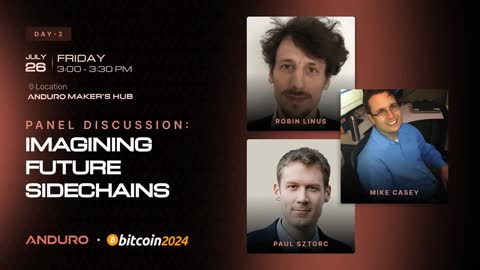
0:00 We're going to continue to move right through today's programming into the 0:03 development side of the world and talking about building in terms of 0:07 responsibility. That said, ladies and gentlemen, a big round of applause for our 0:12 next panel and their moderator, Natalie of Coin Story Podcast and Bitcoin 0:17 Educator. Ladies and gentlemen, round of applause for our panel. 0:20 I'm so excited to be back at the Bitcoin Builders Conference. I'm one of the 0:39 least techie people ever, so excited to have you guys explain it all to me. 0:43 First of all, I want to introduce our panelists. We have Jamison Lopp from 0:47 Casa, Charles Manke from Wolf Financial, Alex Miller from Hero Systems, and Paul 0:53 Sztorc, LayerTwo Labs. They're not necessarily sitting in that order, but I 0:57 want to first just really focus in on the title of this talk, Building on 1:03 Bitcoin Responsibly. What does that mean to all of you? It's tricky. I mean, 1:09 there's a number of ways you could look at it, but I think for me, the first 1:13 thing that comes to mind is just the fact that what we have here is a 1:16 shared resource. You could call it a platform, if you will, and of 1:23 course, there's the permissionless aspect of it, is that anyone who is 1:26 following the protocol can do whatever they want, even if it pisses other people 1:31 off or maybe even prices them out of doing what they want. It's 1:38 something you could even call coopetition in a way. It's like a lot of 1:43 us are all working together in the sense that we're building on these 1:47 ecosystems and making them more useful and more valuable, but we're 1:52 also competing for the scarce resource that is the system. 1:57 Coopetition. I like that. Okay. Yeah, I don't know. I guess I'll zoom out like a 2:03 little bit. When it comes to building responsibly, one thing that's interesting, 2:07 we host spaces all day and the conversations are various myriad of 2:11 different topics across people who have failed, succeeded, rugged, and all these 2:16 things. What's interesting is in Web 2, you get regulators that protect 2:20 ignorance for the users, but Web 3 doesn't have that. You end up in this 2:24 space where the moral compass is more important on the builder in Web 3 than 2:29 it is in Web 2, because in Web 2, the moral is protected by the regulators. 2:34 That's why I think if you're looking at a leader in Web 3, who they 2:38 are is way more important than in Web 2. For me, I think the nature of 2:42 the person is actually more important than necessarily how they're building, 2:46 because there's a lot of ways to cut corners in crypto. You see it 2:51 everywhere where people are rugging, hurting other people, starting 2:54 new things. I think it goes down to the character of the person, not 2:58 to make it a very deep thing, but it kind of ends up being that way. 3:02 One thing people love about Bitcoin is it sort of returns accountability 3:07 and personal responsibility. Maybe we'll dig into some of that, 3:12 because anyone, like you said, can build on Bitcoin. In our current system, we 3:18 do have this framework of regulators and gatekeepers, but if you're a freedom 3:22 maximalist, you believe in free markets, then the free market is the best referee. 3:25 Why do you think it's important to build on Bitcoin? 3:30 I think it comes down to a combination of a couple of things of 3:33 what do we owe to each other and what do we owe to our users. Obviously, 3:38 crypto world in general has had plenty of scams and active scams. 3:42 We can all agree that that is bad and you shouldn't be doing that, 3:47 but we've also had plenty of people who just obfuscate things in an effort to 3:52 grow. They don't necessarily intend to be 3:55 stealing, but they do end up harming a lot of people intentionally or 3:58 unintentionally. I think that's happened, to Jameson's point, 4:01 sometimes it can happen between builders, depending on how resources are 4:04 being used, or it can be happening to end-users. I think that's really 4:08 the question. How do we take people who do have, let's say, pure 4:13 intentions, they're not looking to scam or anything, but maybe not realizing what 4:17 their larger responsibilities are to be building in an ethical way? 4:23 In general, people want the Bitcoin protocol to resist change to some 4:29 degree and they don't want to be beholden to a team of 4:34 developers who have to decide something. This is a very interesting and 4:38 nuanced conversation where you could talk about CVEs and to 4:42 what extent are you unable to... If you wanted to just run an old 4:48 version forever, would you actually be able to do that? Jameson has some 4:50 great research on his blog where he tries to run old versions and things 4:54 like that, which is fascinating. I think the overall picture is 4:59 something like we don't want people to come and destroy Bitcoin. Gavin 5:04 Andreessen had that metaphor about you're flying in an airplane and you 5:08 want to swap out the engine while it's still in the air or something. I do 5:12 think it's a conservative technical community and a conservative user 5:18 base and it does want property rights over something. It wants to actually 5:21 own something. So I think that would be part of it. Can you talk to me a 5:27 little bit about the challenges of just building on Bitcoin in a way that 5:33 provides the most opportunity but doesn't anger the people that are 5:38 really passionate about the blockchain being what it was originally in 2009? 5:43 I feel like you have to weave a little bit. You have to 5:48 carefully manage expectations and there are probably some challenges 5:52 technically that come up as well. Yeah, certainly. I think the soft fork was 5:57 originally invented in 2012 because it was unable... You can look at 6:02 comments that Gavin Andreessen made back then where it was like, we cannot 6:07 reach every user and not everyone will upgrade, but if we do this other thing it 6:11 won't matter that not everyone... We won't need everyone to upgrade the 6:15 software, basically. This is a disputed point by some people, but you 6:19 can talk... That was back in 2012, the idea of we will not force everyone to 6:24 upgrade. We will allow people to just not upgrade and they'll still be on the same 6:27 network. And then since then, the standards have been raised 6:32 even higher of just not touching anything. Now we've gotten to 6:38 the point... I mean, I think the soft fork is an ingenious way of actually 6:41 protecting people's... Defending the users against developers, but even now the 6:49 big phrase for most of last year was like, this is being built on Bitcoin 6:55 without a soft fork or something. A BitVM where people are like zeroing out 6:58 bytes. This is like how far we've come to not touch this. I think that's 7:04 kind of an interesting point. It's almost an intractable problem though. I think it really goes back 7:08 to what Paul said about property rights. One of the fundamental, I 7:14 think, values held by Bitcoiners, and of course this is very hand-wavy because 7:20 we're not a homogenous group, but it is not disenfranchising people. But I 7:26 think that if you look at it over a long period of time of history, you can 7:32 realize that even if the protocol doesn't change, the rest of the world 7:37 changes and how people use the protocol may change. And the free 7:42 market, if you want to call it that, may disenfranchise people because certain 7:45 attributes of these networks and how you can use them will change because new 7:50 use cases come up. They may price out other use cases. And so now we're 7:55 stuck in this really weird place where the narrative, of course, has gone to, 8:00 okay, we build in layers. But even what Paul was talking about with soft forks 8:06 of like, okay, we can change the protocol and do it without breaking people's 8:10 money and disenfranchising them. Even the concept of soft forking has become 8:15 somewhat controversial. We haven't had a soft fork in several years and even 8:20 though there are a number of really good proposals out there, the developers have 8:25 become very reticent to actually run the gauntlet of being a champion for a 8:32 consensus change, even if it's a backwards compatible consensus change. 8:36 And part of it, I think, is a lot of the vitriol that comes from certain 8:40 segments of the user base that says, it's too dangerous to change anything, 8:45 and then they'll point at different examples. And the main thing that I've 8:48 been trying to get across is that if you look at how scaling is done with layers, 8:55 even historically, we had to make changes to the base layer in order to make 9:02 second layers possible. At least like with lightning, if you want to be able to 9:07 have unilateral exit from some new set of game theory that requires some new 9:13 rules to it, then you're probably going to need some new rules that you can 9:16 enforce on the base layer. And I think that that's still true today. And I think 9:21 a lot of people would agree that in some sense, lightning is one of the only pure 9:28 unilateral exit layers that we have. And a lot of them, you can't necessarily get 9:34 out of that layer without asking permission from someone. But there's a 9:39 lot of possibility for us to build other layers with unilateral exit if we make 9:46 the right changes to the base layer. 9:47 Oh, really? So it's dependent on that? Can you help me, as a non-techie person, a 9:52 non-developer, better understand this debate? Because I see it more frequently 9:56 online now, the idea of whether Bitcoin's base layer should ossify or not. And what 10:01 are the two sides, thoughtfully? The straw man, the steel man. Can you guys talk about it? 10:06 You're the ossification guy, James. 10:10 Yeah, but actually, I was going to say that. I always think of James as that, but you don't. 10:13 But see, it's a very nuanced thing. I definitely don't think of you as the 10:17 completely pro-ossification guy, because of course, it is kind of a 10:23 bizarre thing. I mean, some things we should definitely mention are something 10:26 like, maybe like, even something as extreme as software dependencies or 10:30 something, where it's like, if you're going to build a house from scratch, you 10:34 don't build the plywood from scratch or the screws from scratch. So 10:37 there's all these people who have built how to multiply a matrix or 10:41 something, these tiny sub-libraries that Bitcoin Core is using. And those 10:46 people update those all the time. Those like Heartbleed, there was that famous 10:49 thing where there was a cryptographic library that everyone was using, but it 10:55 had a terrible bug in it, so it didn't work at all, actually. So that 11:00 would be like, a bunch of people are building houses with these screws, and it 11:03 turns out the screws didn't work. They're made out of glass or 11:06 something. My favorite was the left trim on the node libraries, where 11:12 someone just basically deletes a dependency that's at the top that has a 11:16 thousand dependencies, which all have a thousand dependencies. And one 11:19 deletion of one repo basically wipes out thousands of software programs. And I 11:24 think what that kind of comes back to is like, we can get into the debates over 11:27 ossification, what should, shouldn't happen. I think, again, when we come back 11:31 to the idea of responsibility, it's about being transparent and honest in 11:34 what you're doing. You're never going to get everyone to agree on a change. 11:39 You're never going to be able to do anything or even not do anything without 11:44 some people both disliking it and even potentially being harmed by it, or 11:49 harmed in the sense of like ending up in a worse off place. The status quo is also 11:53 not acceptable to everyone. And people get harmed by the status quo. So I 11:58 think that's where it comes back to, like, are you being honest about what 12:02 you're doing and transparent? I think there was a lot of, let's call it 12:07 drama, around the Bitcoin testnet 3 earlier this year and with its 12:12 performance based on, but like, since Jameson, you were involved in some of that, but you said 12:16 very clearly what you were doing and why and why it needed to happen. It caused a 12:21 lot of pain for a lot of people, like myself included, my company, and like 12:24 because of just stuff we were running on top of it. But like, if nobody does 12:30 anything, you're never gonna get any progress. And so that's why I think it 12:33 comes back to the, are you being honest and upfront about what you're doing and 12:36 why, so that other people can make their choices and adapt to engage in it. And 12:40 that's fundamentally kind of comes back to that core idea of property rights. So 12:43 I also see it as a 10-year history now. Ten years ago we were given the 12:51 promise of sidechains, of, you know, permissionless two-way peg sidechains. 12:56 And the idea there was to have basically infinitely scalable and growable 13:02 ecosystem where we don't have to do everything on the Bitcoin base chain 13:07 because anyone who wants to can go create their own other network that you 13:11 can send your Bitcoin over to, unilaterally permissionless, yada yada, 13:15 like upholding all of the ideals of Bitcoin. And we never got that, and as a 13:21 result we've had, call it, you know, shifts in narratives and sort of coping with the 13:29 fact that we don't have it. And so, you know, there are protocol 13:35 changes that we can make that I think would enable us to finally start to 13:40 achieve a future where the builders who want to go do crazy stuff can do that in 13:46 a way that is actually, you know, cryptographically tied to the Bitcoin 13:50 base chain without having to create like a multi-sig Federation that, of course, 13:54 could potentially be corrupted and failed. Charles, did you want to weigh in? Yeah, I mean 14:00 this topic is so nuanced because, like, when we'll host a space of just Bitcoin 14:06 OGs, Layer 2 companies will come in and market to those companies, but the 14:09 tribalism that happens around those companies is so stark it's hard to 14:14 change their minds on something they believe in past because Bitcoin 14:18 represents more than just a technology, it represents like a freedom or an 14:22 altruism. And when people stand for that it's really hard for you to start 14:25 messing with it because you're not messing with a tech, you're messing 14:29 with an ideology and people get weird about that. So I think like ultimately 14:33 like going into runes, you know, runes with stuffing transactions and then what 14:37 was happening is regular transaction would get stuck in the mempool for six 14:40 and seven and eight blocks and they wouldn't come down for long periods of 14:44 time. Now the miners get rewarded but what ends up happening is peer-to-peer 14:47 regular transfer gets pushed out. So, and I'm not making a stark contrast that I 14:51 believe in either way because I believe if something can be manipulated it 14:55 should because just because you have a door to your house and it's unlocked 14:59 doesn't mean that that's safety. And if there's opportunity for Bitcoin to be 15:03 manipulated, safety only comes by manipulating it because people always 15:07 change on the precipice of difficulty. Like ossification is the idea of like 15:12 what could happen, but I think the ossification becomes way more at play 15:17 when they break it. And unfortunately a Bitcoin is such a big beast at this 15:20 point like if we break it it's like will something come out and replace it? If we 15:25 end up in a position where there's no more peer-to-peer transfers, runes is 15:29 absolutely taken over, regular transaction fees are no longer getting 15:32 into the block, they're stuck in the mempool forever. I mean it's a stark 15:36 thing but and I don't necessarily you know believe either way is like the 15:40 right way. I just I think inherently you either have to ossify it or manipulate 15:45 it until it breaks and then have another Bitcoin. Well yeah I think this is a good 15:50 point of like similar to what I think Jameson you were saying earlier which is 15:54 like how like the end-user has expectations and needs and like how 16:00 ossified will Bitcoin be if it is ultimately replaced by something else? 16:03 That's a that's very that's like negative 100% ossification you know I 16:08 mean because you changed it out of existence by just the user not demanding 16:13 it anymore. And we have seen quite a few you know changes over just a short 16:19 amount of time you know I like I've been alive only so long but like there was a 16:23 time before widespread internet access there was time before people had it was 16:27 a time when there was only one computer in every house right there was a time 16:30 when before a smartphone so I don't know it's the ossification strategy does seem 16:37 like a big risk and I think this is part of the sidechains vision was that 16:41 you could ossify L1 it's very safely and in a very sustainable way be precisely 16:47 because it's kind of a paradox but really it's more of an inevitability 16:51 which is like because you need to cater to different people and they won't 16:54 always agree and some of them are early adopters and some of them are late 16:57 adopters and so you would have the L1 should be the same and then you'd have 17:02 all this other new these new L2 things that would all be blockchain so you'd 17:06 explore the blockchain space. You know Bitcoin has made me think more 17:11 profoundly about incentives and Alex you brought up the idea that has to be the 17:16 ethics and the morals of the person but we've also seen controversy over even 17:21 funding developers and have any of you ever worked at a corporation where 17:26 you've had a mid-year review anybody yeah you remember those the thing that 17:31 frustrated me about that is they have to tell you something they have to find 17:37 something wrong for you to improve on you will never you could be the best 17:41 employee in the world you'll never have a mid-year review that tells you there's 17:45 nothing you can work on is there a component of that like if you're funded 17:50 don't you have to start tinkering and almost find something wrong and then 17:54 that is its own kind of corrupted incentive yeah I mean I think that is 17:58 the reason that you know some folks who are for I'll just call it pro complete 18:03 ossification let's say don't like it and you know yes if you have people looking 18:07 at a problem they're gonna find something to work on at the same time I 18:11 don't think reasonable people for the most part gonna say there's nothing 18:14 about Bitcoin that needs attention paid to it even if you don't want substantial 18:17 changes but going back to that idea of incentives which I think is exactly 18:23 right people are not gonna stop trying to do more on top of Bitcoin I'd 18:27 actually go so far as to say it's immoral not to because of how 18:31 unbelievably tiny and concentrated the user base of Bitcoin is today like you 18:38 cannot say that you believe in like the freedom and optionality and power that 18:42 Bitcoin provide and say you're happy with where it's scaled out to oh yeah we 18:48 have like a couple million wallet we have a million wallets that one Bitcoin 18:51 on there are eight billion people on this world right and most of the people 18:56 who hold a full Bitcoin live in the US which like again we can argue about the 19:00 current state of our government and whatnot here but it's a hell of a lot 19:03 better than a lot of other authoritarian regime and like the reason that I work 19:07 on layer twos is because I really believe in scaling Bitcoin out to as 19:12 many people as we possibly can and we just leave it locked up with a small 19:16 group like that group has a lot of incentive to not break the chain and I'm 19:20 to be clear do not want to break the L once but if you've already got ten 19:24 million dollars in asset worth let's say on Bitcoin today yes you are gonna be a 19:30 lot less interested in anything that potentially risks that but what about 19:35 the person who only has ten dollars on Bitcoin and can't do anymore because the 19:38 transaction fees are too high and that's not gonna change because people 19:42 do want to do new and innovative things on it like if we don't do something to 19:46 scale it and I think sidechains and is absolutely the way we need to go because 19:49 it's the only thing that's viable on it we're just trapping it as a toy you know 19:53 go back to the pet rock analogy and not actually bringing like that promise and 19:58 the freedom that it provides to the people who actually need it that's that's 20:01 why I think it's somewhat of an intractable problem and also because 20:05 both of you have talked about you know breaking Bitcoin and that is subjective 20:10 and and of itself dependent on what your use case is and your desired properties 20:15 of Bitcoin are but I think if we're talking about responsibly building then 20:23 we have to understand that we're still exploring the possibilities and so to 20:29 say that we should stop exploring possibilities because we might do 20:33 something wrong I believe that that is that is projecting from a position of 20:39 fear and it's a loser mentality and in my view and and this may sound like 20:45 overly bullish or optimistic but I don't think it's possible to break Bitcoin by 20:51 which I mean I think it's possible to maybe temporarily screw with Bitcoin so 20:56 that it doesn't work as people expect for a while but I believe that the 21:00 reason Bitcoin works is the anti-fragility and why is it anti-fragile 21:06 it's not because of any one particular aspect of the protocol or the way that 21:11 the network works it's because of us it's because there are innumerable 21:16 people out there who are either you know morally or ideologically or financially 21:24 incentivized to make sure that this thing keeps running and so yeah I mean 21:30 it's been a decade since we have broken the network in the sense that it wasn't 21:34 working for a few hours but what happened everyone came together they 21:40 said oh shit we broke it let's fix it so yes maybe we'll have another one of 21:45 those things happen if we continue experimenting but the funny thing is 21:48 that thing not to interrupt but that thing that was not like a soft fork 21:51 that's the other thing is these are like unexpected emergency things that 21:55 was like an optimization refactor type of switching the database or whatever so 21:59 and the other thing the Mac Corrales thing that was also a refactor to shave 22:03 off like 600 microseconds or something so the bugs are not the soft forks that 22:09 people the ossified people want to like ossify now they want to like do like a 22:13 campaign and stop the soft fork is definitely not the enemy of you know 22:18 ossification I think but it's the those these weird outages were because of 22:24 unexpected things so that that's a do you guys forecast potentially having 22:30 another block war over something yeah eventually I think yes over what and why 22:37 well I do think in general there is a complacency right now that is taking hold 22:43 and so people think that it's Bitcoin it's for it's a foregone conclusion that 22:48 Bitcoin will succeed and so these people just think it's inevitable and I think 22:55 that's actually the kiss of death and see the normally when awesome people 22:58 there are other people who talk about ossification long before Bitcoin and they 23:02 talk about like there's this famous book the innovators dilemma and there's this 23:06 other book exit voice and loyalty these are like famous books 23:10 Balaji has brought these up at Bitcoin conferences so maybe people have heard 23:13 of them but usually the story is like the organization ossifies and then it 23:18 eventually has to be replaced like there's no there's really not that many 23:21 stories where it's like it ossified and then it lived happily ever after that is 23:24 actually very rare so the status quo is not going to be I mean you said 23:32 something very good I thought about like so it reminded me of Satoshi you're 23:35 talking about eight billion people we like we have to go eight billion people 23:38 or or zero I think actually and Satoshi Nakamoto has this quote where he says 23:43 he's talking on the forum and he says I'm sure that in 20 years there will 23:47 either be a very large transaction volume or no transaction so that was 23:52 obviously you can interpret it in various ways I don't want to get like 23:58 into like anything about the block size because I think it's completely 24:01 irrelevant because that we can have a small ossified l1 block size and still 24:04 have a large transaction volume on the L2s but I think he was definitely right 24:08 like either this idea will succeed and you're either growing or dying I think 24:12 you know so it's like it's either gonna be like the intranet where it just takes 24:16 over and becomes this thing or it will something else will do that and then 24:21 this will just fade it and it will be nothing it would be Esperanto yeah so I 24:24 mean there's going to be conflict and there's there's conflict because the 24:29 developers who know what they're doing they know what all of the technical 24:34 problems with Bitcoin are and for example Rusty Russell has his great 24:38 consensus cleanup like there are known ways that adversarial entities could 24:44 attack the network now and break it from pretty much everyone's perspective and 24:48 we know how to fix those things and to throw up our hands and say no we 24:53 shouldn't fix them because doing anything as dangerous as you know once 24:57 again I think a very silly position to take you know from a really fear 25:02 projection perspective you know you made me think of a Bitcoin core 25:05 developer Gloria said it on stage that basically a military attack could bring 25:11 down the Bitcoin network and we're not prepared yet and people think that we're 25:14 in this very safe place and it did it terrifies people who are non-technical 25:18 and don't understand the things you do so we're wrapping up now so give us 25:22 something to look forward to with some hope here you guys obviously are working 25:26 on Bitcoin because you think it will succeed right well yeah I mean my my 25:29 optimistic take is that you know builders gonna build and you know you 25:34 can you can hate the idea of changing Bitcoin as much as you want but you 25:39 can't stop the builders from proposing changes the only tricky thing now is as 25:45 I said it's kind of builders finding themselves stuck between a rock and a 25:51 hard place of knowing that there are improvements that are you know highly 25:57 desirable and knowing that there are factions of people who are gonna fight 26:01 against those it's a really weird position to be in but I'll do whatever I 26:06 can to support people and you know if I have to be a dick about it I'm happy to 26:09 do so well you got to make your case right and then the free market should 26:13 should decide right yeah yeah no I I think I'm relatively neutral you know I 26:20 think without veto power in any central position you always end up with 26:24 progression no matter what and I think that like what I mean is that if there's 26:28 two people and they can manipulate a thing the one person that can't or won't 26:32 is always gonna sit by the wayside and the other guy will if there's no central 26:36 entity to stop it always ends up manipulated so I think it's a matter of 26:40 time I think we end up manipulated and it'll get to that position where we're 26:44 you know kind of figuring out what we want to do with it after the fact so 26:47 yeah yeah I think as Paul kind of pointed out that Satoshi said even 12 26:53 13 years ago like it bitcoins in an evolve or die place and and that doesn't 26:59 necessarily mean you need drastic changes you need to try and you're never 27:02 again you're never gonna do everything you need on the L1 and it's gonna be 27:06 just as much of a fight to double capacity on the L1 as it is to introduce 27:10 things that allow 10,000 X scaling on the L2s and so I think it's focusing on 27:16 the if that end goal again is really and for me it's how do we provide an 27:20 alternative like financial system globally it's we've got to focus on that 27:25 that 10,000 X increased view all the way out there and just figure out cool how 27:30 do we protect the L1 as best as we can we don't want to wreck it but we got to 27:34 give the things that do that actually make it possible to scale it out that 27:37 much it's who a billion yes I do have my own L2 proposal just VIP 300 and you can 27:45 down there's test software you can download and play with for yourselves 27:50 LayerTwoLabs.com slash downloads and have stuff there we have a Zcash level 27:56 privacy and planetary scale I have a bunch of articles that I've also written 28:00 about that so so you want a little bit of hope you could go and try this off 28:03 for yourself a lot of people have like PowerPoint slides or whatever which is 28:06 great I actually think the industry is is already moved past that and there are 28:11 a lot of people who if you can code something it will exist and it has the 28:16 software we've written is for all three operating systems and it has buttons you 28:20 can click it as a GUI so so I would I would try that out and look at the 28:25 point the proposal is the only thing it does on L1 is use the unused 28:30 op-nop 5 to count to 13,000 over and over again it's a little bit more than 28:36 that but that's basically all it does and it's a completely opt-in and also 28:41 reversible really if you think about it I think the soft fork is a very we saw a 28:45 little bit of time and so I'm gonna ramble about the soft fork in general 28:48 which is that this whole reason the soft fork was invented in 2012 as I alluded 28:52 to earlier is that before everything was like we changed to a new version but the 28:57 soft fork was people did not need not everyone needed to only the people who 29:01 wanted to use the new feature had to upgrade this included 51% of the miners 29:06 so you could say maybe that's not true but it's the the miners want to collect 29:11 the transaction fee so they're also using so the whole point of the soft 29:14 fork is it was a change and not a change at the same time so even though it is a 29:17 creative act of a change it's not really as much of a change as people might 29:21 think and it's very underappreciated for that reason well thank you guys so much 29:25 I think we've learned a lot and really appreciate being on stage with you Paul 29:28 Alex Charles Jameson give it up for them thank you