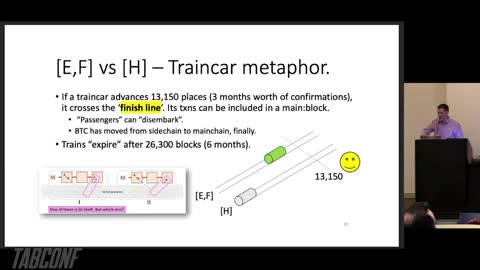
0:00 What up, freaks? It's your boy Marty Ben here to introduce this week's episode. 0:09 I had the immense pleasure of sitting down with somebody whose blog posts I've been reading for quite some time, 0:15 somebody I've been conversing with on Twitter for quite some time, 0:17 somebody who is a unique thinker in the Bitcoin space. He definitely ruffles some feathers from time to time. 0:22 He's ruffled my feathers before, including last week which was the impetus for me reaching out and hopping on the mic with him. 0:30 This week's episode of Tales from the Crypt, I sit down with Paul Sztorc, the creator of Truthcoin.info, 0:36 which is a wealth of knowledge, a bunch of hours-long blog posts that I highly recommend you read. 0:43 They've been around for a while. Paul and I dive into some of them in this conversation. 0:48 We talk about the fee market, the concept of Drivechains, which is his idea for applying merged mining sidechain 0:55 that he believes would help a fee market develop. 0:58 That's a controversial topic because of the way miners could steal the coins, 1:02 but we talk about all the scenarios and the disincentives for miners to do such a thing and the ways in which that could be prevented. 1:10 On top of that, we talk about his HiveMine project, which is the reason for the idea behind drivechains. 1:16 He started with HiveMine and worked backwards from there. 1:20 We didn't go at it. We had a conversation for two and a half hours, most of which Paul was speaking, 1:28 which is fine by me because, again, this is somebody I've been following for quite some time 1:34 and am very fascinated by his ideas, particularly around the cost of proof-of-stake versus proof-of-work 1:42 and why proof-of-stake is probably not that advantageous in the long run or less costly than proof-of-work. 1:50 I hope you guys enjoy this episode. A lot of topics covered. 1:54 This episode of Tales from the Crypt is brought to you by the Cash App. 1:57 You freaks already know all about them, and if you don't, let me tell you about them. 2:00 They're letting you do a bunch of things. You sign up. You can get their boost card. 2:04 You get their boost card. You put your signature on there, a little Bitcoin sign on there. 2:08 You get the boost card delivered to you, and then you have it. 2:11 You have money on your account, and then you can activate their boost. 2:14 I just saved $5 at the grocery store the other day activating my $5 grocery store boost. 2:20 On top of that, they have partners like Chick-fil-A, DoorDash, Nike from time to time, 2:26 Whole Foods from time to time, a bunch of partner merchants that you can save money at when you're shopping at them with your cash card. 2:35 On top of that, they're letting you stack sats. You can stack sats, sell sats, receive sats, send sats. 2:41 I sent some sats to Wasabi to mix the other day. 2:45 You can send it off in Wasabi if you want to. 2:50 On top of that, they have Cash App Investing, which is new. 2:54 We know you like to stack sats. If you want to stack stonks, Cash App Investing is letting you do that. 3:01 If your favorite stonk is a little too expensive, you can stack as little as $1. 3:06 You can stack a sliver of a stonk. 3:09 On top of that, there's no 4-5 day waiting periods to start investing. 3:13 Since Cash App is connected directly to your bank account, you can start investing today. 3:17 Cash App Investing is a subsidiary of Square and member SIPC. 3:23 Use the code stackingsats when you download the Cash App if you haven't already. 3:27 That's one word, S-T-A-C-K-I-N-G-S-A-T-S. 3:31 You're going to get $10 and Cash App is going to be so kind to send $10 to our great friends at Owl's Lacrosse. 3:38 Oooooooooooooooh! 3:41 Oooooooooooooooh! 3:43 Owl's Lacrosse! 3:45 Don't listen to that dirtbag, Owl. 3:47 He's a scummy dude. Enjoy this episode. Take care! 3:58 You've had a dynamic where money's become freer than free. 4:02 You talk about a Fed just gone nuts. 4:04 All the central banks going nuts. 4:07 So it's all acting like safe haven. 4:09 I believe that in a world where central bankers are tripping over themselves to devalue their currency, Bitcoin wins. 4:16 In the world of fiat currencies, Bitcoin is the victor. 4:20 I mean, that's part of the bull case for Bitcoin. 4:23 If you're not paying attention, you probably should be. 4:29 What is up, phreaks? Welcome back to Tales from the Crypt. It's your boy, Marty Bent, here on a Friday afternoon. 4:34 Very excited for this conversation. I think this is going to be a long one. 4:38 If the pre-interview conversation is any indication, it is going to be a long and very interesting podcast. 4:44 I'd like to introduce you, phreaks, to Paul Sztorc, making his second appearance on the podcast. 4:50 Yes, I remember that now. 4:52 Yeah, second appearance. Yeah, I remember my line from the first one. 4:55 Things that you didn't even know you did. 4:57 About Ethereum. 4:59 For you phreaks that don't remember, the first appearance was the rabbit hole recap on the roof of the Bitcoin 2019 conference. 5:07 Paul made a guest appearance to talk about proof of stake. 5:13 And we have a lot to talk about. 5:15 It's three months away. It's three months away. 5:17 Ethereum, three months from now, they'll have it all worked out. 5:21 And everything will work perfectly. 5:24 You just have to keep in mind that it's right around the corner. 5:27 It's coming. It's coming. 5:29 2020. That's what they say. 5:32 Yeah, it's going to be quarter three of 2020, quarter two of 2020. 5:38 I heard January 3rd at one point a few months ago, but they keep pushing it back. 5:43 It is sad that we have no real way of communicating to people just how often they have said that it is right around the corner. 5:52 They literally said that before Ethereum had even released in 2015 or something. 5:58 They were like, oh, we'll do proof of stake. 6:00 Yeah, I believe their first goal pre-launch for proof of stake was 18 months after launch, if I recall correctly. 6:10 I've actually been keeping a thread since August 2017. 6:15 Yeah, the Twitter thread. 6:17 The Twitter thread of like the Steam's 11 quote about that's the most beautiful. 6:24 It will just keep paying forever. 6:26 I mean, that is the best way. 6:28 That is the best way of convincing of just not convincing people. 6:32 It's not so much because they could eventually theoretically do it. 6:35 But it's hard to imagine a point of view having any less credibility than that one at this particular point. 6:41 Yeah, that is my magnum opus of a thread. 6:44 And actually, it's a good segue. 6:46 Yeah, that's a wonderful thread. 6:48 It is really great. 6:50 One of the best threads on crypto Twitter ever, I think. 6:54 Well, you have one of the best blogs in all of crypto. 6:59 I know, it's very weird. 7:01 It's a very weird blog. 7:02 As I was telling you before, it's like a kind of art therapy or something where I have to just read about what people are talking about. 7:11 And then I'm like I don't really agree that I take notes. 7:14 And then I edit them into a blog, and the blog posts will reach hundreds of pages of notes. 7:21 Some of the posts are more than 100 pages long, and they broke into sections or something. 7:26 The one about fraud proofs is like 48 pages long. 7:29 And it's just like me dumping stuff out of my head because it's driving me crazy. 7:34 But people end up appreciating it, which I like. 7:37 People like different parts of it. 7:40 It's very interesting. 7:42 Different people have quoted it at points. 7:45 Adam Beck quoted it a long time ago, and also Gavin Andreessen and Roger Ver. 7:51 Like all these different people, they can find something in it they like. 7:55 So I don't know. 7:56 I must be doing something right or wrong depending on how you think about any of that. 8:01 No, I was telling you. 8:03 And then other posts are like completely – I never hear anyone talk about some of them. 8:09 Some of them have like a controversial element. 8:11 It's proof of work, proof of stake. 8:13 People love nothing is cheaper than proof of work. 8:18 I wrote one about ASIC boost that was like controversial. 8:23 And then some like no one really ever talks about. 8:26 Let's touch on like proof of stake isn't cheaper and isn't better than proof of work 8:30 since we were talking about Ethereum. 8:34 Yeah, I think it's important. 8:36 Yes, continue. 8:37 Yeah, I think it's funny that Ethereum has been trying so hard to transition to proof of stake 8:44 when it seems to me to not be a valid consensus mechanism or a worthwhile consensus mechanism. 8:51 And they are sort of digging this hole trying to make this transition to this new consensus mechanism. 8:57 And it may not even be worthwhile when they finally get there. 9:00 So let's dissect that blog post in particular. 9:03 Sure. 9:04 Yeah, I think the deepest critique of Ethereum that one can make is that the community – 9:10 it doesn't really have – the culture rewards like kind of these Hail Mary paths, 9:16 kind of very optimistic sort of way of doing things that someone somewhere will invent something to fix this, 9:31 which I admire the optimism, and I mean that sincerely. 9:35 But it's also like you can't just say someone will invent something to solve this problem. 9:39 Someone actually has to invent it at some point. 9:41 And proof of stake, there's a very long – it came out in like 2010. 9:45 You can read about this on bitcointalk.org if you go into the ancient archives of bitcointalk.org 9:51 where every crypto idea was once posted at some point before being rediscovered. 9:57 You can find it. 9:59 And people are very enthusiastic about it at first, but then problems started to emerge. 10:05 And then eventually Andrew Polster wrote I think in 2012 something on proof of stake 10:13 where he argued that in practice because of stake grinding, it just became proof of work, 10:20 and so it was ultimately pointless. 10:22 But people tried to get around that by then – they didn't really understand the substance of what Andrew Polster was saying, 10:31 and they said, oh, stake grinding is the problem. 10:33 So now we'll solve stake grinding, and we'll do this slashing, and we'll do these other things. 10:38 And they were still like trying to solve proof of stake, even though it had a lot of conceptual holes in it. 10:47 And so what I set out to do is I set out to just say that since it's peer-to-peer, 10:54 and anyone can join or leave the network at any time, 10:56 and there's no privileged person in like a monopolized position, 10:59 no matter what you do, these new blocks need to be found or produced by someone. 11:04 And so whatever that is, it will involve people doing effort to gain their chances. 11:13 And so I tried to set out and say, look, even if you fix all these problems, 11:17 you would still have this Andrew Polster-like regression thing. 11:22 And then I laid out all these examples about how it was not only would it happen, 11:27 but it had already happened with Dan Larimer's delegated proof of stake 11:34 and then the idea of locking up the bonds in this so you could slash them later. 11:41 Is that BitShares? 11:42 I wrote this big essay. 11:44 Yeah, yes, that was the era of BitShares. 11:47 This was like late 2014, early 2015. 11:53 But then again, it doesn't really work. 11:59 People get very optimistic and they have wishful thinking, 12:05 especially when money is concerned. 12:08 This happens to Bitcoiners as well. 12:11 It happens to everyone. 12:12 I think definitely the biggest critique of Bitcoin ever is if you watch the Flat Earth documentary 12:18 and you just see these people and they're just so optimistic 12:21 and then they say things like, how long do you think it will be until the Flat Earth theory is taught in schools? 12:30 And then they'll be like, yeah, anytime. 12:32 It's just around the corner. 12:33 We just need to just keep – everyone just keep hodling the Flat Earth theory. 12:39 And you're like, oh, no, this is what people can do. 12:44 But yeah, Ethereum has this optimism and they're willing to try these weird ideas. 12:52 It's extremely complex and it ultimately achieves basically nothing because ultimately, 12:58 you'll just waste a different resource. 13:00 It was proof of work waste, you know, a lot of quotation marks around the word waste, 13:06 silicon and electrical energy. 13:10 Even if proof of stake worked and there was no way of gaming it, which is something that I think no one believes, 13:17 but even if it did, you would have situations where lots of working capital was locked up. 13:24 And we can talk about that. 13:26 It's ironic that Ethereum has now evolved to the point where it's gone from having absolutely nothing at all 13:34 to having nothing plus the Dow, which was a disaster. 13:39 And now it has this weird, very thin – it has like kind of a money market. 13:44 But the money market actually proves in a weird way that I was right all along about. 13:48 Because now if you have ETH, you can kind of lend it out using these weird loans. 13:53 I mean at least you can for now. 13:54 Maybe they will decide to pull the plug on all this because it's just like having a rough couple of weeks. 14:02 Yeah, they had one of their dApps. 14:07 Somebody executed a trade and basically stole a bunch of ETH from the decentralized financial app, right? 14:15 Yes, they have this – I don't fully understand it. 14:18 I have to warn everyone, but probably no one does. 14:22 But it's something like they have these areas where you can for very short periods of time 14:29 loan ETH or loan other assets and trade them. 14:32 And those assets have market prices, and some people are using those market prices as inputs for collateral. 14:38 So they're like mark to market type situation. 14:42 And so as I understand it, it's possible to borrow a lot of stuff, anything, ETH or whatever, for a very short while. 14:51 You put up some collateral. 14:53 You can borrow – you say I only need to borrow this for like a day. 14:57 And so I only need small amounts worth of interest. 15:01 You borrow all this stuff, and then you sell it or you buy it or you do something to manipulate a price, 15:08 and that causes this cascade of basically margin calls on other people. 15:14 And you can then bet on those and use that to your advantage. 15:18 And again, I have to stress that I don't really understand it. 15:21 But the point is that they have an area where you can – it's now possible to loan ETH and earn a return on your money, 15:29 which is a lot like how the U.S. money markets work, and we have many of them. 15:35 And if you have a checking account or a savings account and you want to earn higher interest rate, 15:40 you can put your money in a money market mutual account. 15:45 And notwithstanding 2008 financial crisis in which something very bizarre happened that I could explain, 15:55 and there was a weird kind of run on money market mutual funds because they were not FDIC insured, 15:59 but there was no reason to think that. 16:01 It's a very long story, but basically you can get a higher interest rate if you just want to say, 16:05 look, I really don't need this cash, but why don't you use it for something. 16:11 But you see what I mean? This is like a checking savings. It's like the next thing. 16:16 And then with the proof of stake on Ethereum, you're supposed to be able to lock up money, 16:23 huge amounts of money, much more than is spent on entire mining infrastructure. 16:28 And then you would – this money would be deleted if you didn't do the stake things properly. 16:37 So much money would be locked up that it would end up wasting just as much of society's resources 16:42 as would if you just spent that money building a power plant that produced all the power used by all the proof of work miners. 16:50 And in practice, I don't even think that any of this would work because proof of stake gives you an incentive 16:57 to try various schemes like denial of service attacking people to make it look like they aren't holding up their end. 17:06 Really just – it's possible that they will eventually figure it out, 17:10 but it's also possible that all the serious people who would have reviewed it have stopped paying attention a long time ago 17:16 and insist that it's another problem that BitShares had, which is that the design would keep changing. 17:25 And so you'd just be like – come back when it stops changing. 17:32 Yeah, that's the thing that perplexes me the most is how people can still be confident that it's right around the corner 17:40 when the specs have changed and the timelines changed and there was Casper, the constant – 17:47 there's a bunch of different implementations that they're trying to go after at the same time. 17:52 It's all very confusing. I don't know if that's on purpose, but that's what I really liked about your blog post in particular. 17:58 You point out the whole virtue signal of moving to proof of stake is because it's more energy efficient, 18:03 less capital intensive, and better for the environment. 18:06 And you make a very compelling point that actually at the end of the day, 18:10 when you're locking up all the stake, like you just said, 18:13 you'll be expending more energy than is needed in a proof of work system. 18:18 Yeah, it's not – it is – right, it's not necessarily energy, but it's something. 18:23 You have less capital available for funding projects, so it means that economic growth will be slower. 18:31 And what's really better for the environment, you know, if we invent something like cold fusion or just hot fusion. 18:39 Now, someone is building something in Europe where it's like regular hot fusion, 18:44 but in some kind of chamber where it's – but the point is, you know, with fusion energy, 18:51 you can use – there's like some isotope in seawater that could power the Earth for like 3,000 times longer 18:58 than the expected life of the universe or something. 19:00 Holy shit. 19:01 So more than enough energy for all of mankind until the sun explodes in 5 billion years or so, 19:10 and that would be unbelievably cheap. 19:13 And then you could have all these things coming from cheap energy, whatever the cheap energy source is. 19:17 If it's this fusion idea or something else, you could have, you know, vertical indoor farming and all this other stuff. 19:24 So what's really better for the environment? 19:26 To invent that technology like one year earlier than you otherwise would or, you know, and not – 19:35 don't do the proof of work mining, but have this technology be delayed a year 19:41 or do proof of work mining, but have this technology be invented a year earlier or two years earlier or whatever. 19:48 So even on the criterion of environmentalism, it's not clear that proof of stake is any better. 19:56 But even if you just say – if you just count up the waste in pure dollar terms, 20:02 then it really can't be the same because the waste is equal to the block reward. 20:07 So the block reward should probably have led with this for anyone who has no idea what we're even talking about 20:13 and where this is even going. 20:15 But that original – yeah, I was like a total nobody, and then I wrote this post and Adam Back quoted in a Bitcoin talk, 20:21 and then people started to read my blog where I write about how the block reward, 20:28 every Bitcoin block has a certain amount, right now 12.5 Bitcoin plus the fees. 20:34 And those new blocks, you know, they're worth a certain amount of money even in U.S. dollar terms. 20:42 You just multiply by the exchange rate and they're worth whatever it is. 20:45 So right now you take $10,000 and 12.5 plus one, and for fees you have 13.5 BTC, 20:52 and then you have $135,000. 20:55 So it's like $135,000 – it's like a briefcase full of cash that has $135,000 of cash in it, 21:02 and you're auctioning it off. 21:04 That's really what the blockchain is like. 21:07 It's saying whoever finds the next block gets this cash, 21:12 and then you have all these people fighting over how to get it, and they're basically bidding it up. 21:17 And what do you think the final bid price is going to be? 21:19 Of course it's going to be like, you know, $134.99. 21:24 It's going to be like bid up right up to what that number is. 21:32 And that is why it doesn't make any difference if you swap it from proof of work or proof of stake 21:40 or really proof of anything else. 21:42 Bram Cohen came very close. 21:48 Excuse me. 21:49 He said if we had a proof of space and time because you had this – 21:56 he had this idea where you would use all this unused hard drive space. 22:00 So he built this way of tapping hard drive space that wasn't used to try to do blockchain consensus, 22:09 which is extremely interesting. 22:11 But the way it works is by making unused hard drive space valuable 22:15 and then immediately wasting all of that value. 22:19 So if that were successful, all it would mean is something like David Vorek's project, 22:25 the SIA project, which is like a very interesting project where you can sell your unused hard drive space. 22:34 All that would mean is that his project would probably be successful and would probably create value, 22:39 and then that value would be the value that proof of space and time would destroy. 22:46 So it would still be equally wasteful because you are just auctioning off this briefcase full of cash. 22:56 So you're referring to Chia particularly, Bram Cohen's? 23:01 Yes. 23:02 So, yeah, so you're basically getting at the fact that the cost of production is very close to the value of this briefcase. 23:12 Yeah, this ended up being summarized as this MC equals MR argument, marginal cost equals marginal revenue, 23:18 which is something that is taught to like economics undergraduates or high school students like very early on, 23:28 which is just that the blocks have this worth. 23:30 And so it wouldn't make any sense if you could earn a ton of money by making these blocks and it was cheap to do so. 23:42 That situation doesn't make sense. 23:44 You sell the blocks for $10,000 each, and they cost $100 to produce. 23:48 Why more people would want to get in on that scheme? 23:53 You just easily make a lot of money. 23:56 So those people will come in and they will do whatever it is you are doing and then some, 24:04 and that is where all the waste will start to leak out. 24:08 Yes, that's another thing that Posty gets. 24:11 It will be like an equal – if there is a moment of disequilibrium, that waste will get spread out and filled in some places somewhere. 24:23 It's like with proof of work where you don't know if it's – some of it is electricity, but that's actually not all of it. 24:34 Of course, you have to make the chips. 24:36 People have to run – there is labor involved. 24:38 There is the air circulation and all this other stuff. 24:43 You have to maintain the chips. 24:46 You have to cool the chips. 24:48 So mining is not just electricity. 24:51 It's a lot of things. 24:52 So all these things, there is no guarantee that they will take just one form. 24:58 As I mentioned, proof of stake. 25:00 If you have to – there is kind of a theory where you put up working capital, but you would also need to follow the rules of the blockchain system and you need to produce blocks when you are told, otherwise you lose your stake. 25:19 So who is to say that people won't build elaborate systems for denial of service attacking you and stopping you from doing that. Because remember, it's a huge amount of money at stake, no pun intended. 25:34 But you have a lot of money that's being earned, because it's 13.5 every 10 minutes. Bitcoin, if you say 12.5 plus one in fees and you say that Ethereum would be comparable. So then it's $10,000 for Bitcoin and it's $135,000. We're talking like $100,000, $200,000 per 10 minutes. 25:54 So it's 144 blocks a day, so now we're two orders of magnitude higher already. So we're talking like $20, $30 million a day is what you can earn if you're the only miner. So in proof of work you want to mine really efficiently and put everyone else out of business, you get the $20, $30 million for yourself. 26:17 In proof of stake, if you can find a way to shove people off, it's $20, $30 million a day in revenue for you. So what is it per year, 365 days a year, two more orders of magnitude if not more. So we're talking unbelievable amounts of money. 26:36 Yeah, there would be professional people figuring out exactly how to take other people off the network or exactly how to manipulate the randomness used to assign who finds blocks. This is what I think people don't understand. 26:51 Similar thing with, I mean I don't know the status of Emman Goodsire's Avalanche thing, but he said something like it would be a proof of work competitor. And some people, he was in a conversation I was in and we were talking about it. 27:07 And I was like, what about simple attacks or whatever. And he said that at the time, and this was six or eight months ago, he was like, well we have this part closed source because we don't want people stealing it. And I kind of laughed too, that was my reaction. 27:26 It's a non-starter. 27:29 So right, it is kind of a non-starter. And maybe he'll publish it or has published it and I didn't notice and we can look at it more. But what I was trying to give everyone in that conversation the impression is that this is a huge amount of money. 27:45 Theoretically, let's give it the benefit of the doubt and we'll say Avalanche replaces Ethereum and Bitcoin and everything, and the US dollar and it's in this position where you have just the rewards that come in to distribute the coins or to process the fees. 28:05 We'll just give everything the benefit of the doubt and we'll just say that all that's outrageously successful. Well now you have the situation where even with today's numbers, it's millions of dollars per day, 10, 20 million dollars, 30 million dollars per day. 28:21 And if the price of Bitcoin goes up by 20 or 30 percent, then it's 20 or 30 percent more than that. Obviously, if it goes down, it's less, but a lot of people in mining believe in Bitcoin and they are sort of half speculating that it has potential and that if they do a good job mining, it will continue to go up. 28:41 They can get more of a return. So this is a huge amount of money, billions of dollars per year. And the proof of stake is that it's a kind of theory that people will just volunteer, run software on their computer and then it will just be this happy equilibrium where no one will try to seize more of this gigantic pie for themselves. 29:09 Some people will be easier to attack than others. It will be like mining where some people go out of business first. The least efficient miners will go out of business first. There will be some new thing that will evolve around proof of stake that will involve people spending basically the two billion dollars that they earn. 29:32 It will be just like auctioning the briefcase. So this is the point I tried to convey and I'm sorry, we did actually go on quite a bit of a tangent, but you mentioned earlier that it's funny and I don't remember if this was before you hit record, but people come in on the blog and I actually – Vitalik and Jay Kwan on the nothing is cheaper than proof of work. 29:54 I thought that I had convinced them. It seemed if you read the comments that they ended up agreeing or they even said something like, well of course we've always believed that kind of line. I think Vitalik may have said something like that. 30:05 Jay Kwan eventually was like, oh, do you think you can help us solve this problem, which is like a different response. But those are the big people pushing proof of stake and then that was like 2015 and then I saw them in – I remember I saw them in consensus May 2016 and I was like in New York City. 30:24 And I was like, why are you guys doing proof of stake because I thought that you were convinced by what I had to say. And then they were like, well we – I think actually Vlad Zamfir said something like, yeah, but you know we're going to just like keep working on it because we think we can improve it. 30:41 Yeah, dude, it's insufferable. 30:43 I kind of shrugged and was like shrugging and kind of saying like, okay. And I was like, oh. 30:48 Well, how much – 30:50 I was like, okay, well that's kind of funny. All right, great, well good luck with that. 30:55 So how much is the probabilistic nature of SHA-256 proof of work mining? Is that sort of the differentiator there, the probabilistic nature of that? 31:04 Yeah, well, yeah. What's nice about SHA-256 and mining is that, yeah, it's very hard to inject randomness into something, but the hash function is already random on its interval. 31:18 So that takes care of that. But the really cool thing about proof of work is that all of the work done by everyone, all the waste is actually measurable in the form of the low hashes. 31:32 And it's very imperfect. It is not perfect at all, but you have some measurement of it. 31:39 And since the hashes are in the linked list, this Haber-Starnetta thing where each block has the hash of the previous block, the work accumulates. 31:49 So it's quite ingenious. Satoshi obviously was quite a genius, and he worked this out. 31:56 And so even though they're all equally wasteful, oftentimes – see, here's the thing. 32:02 If you prove a mistake and then people denial of service attack someone, and then someone says, look, I was denial of service attacked, you have no way of knowing if they really were or not. 32:12 You just have their evidence, which you don't know how to interpret. 32:16 You don't know the context. Maybe they denial of service attack themselves. Maybe they unplug their router. 32:21 I don't know. Maybe they have no idea what they're talking about, and they're just crazy. 32:26 They could be schizophrenic. You have no idea. So you have no idea what's going on. 32:31 But with proof of work, you really do know all the headers and their hashes, and they are all very low. 32:39 So all the work is piled into one easily measurable thing, which is ingenious, and it's great. 32:49 And it's a really clever thing about the way it's all set up is that all the work is done on the headers, which are these very short little 80-byte things that – I think it's like 4.7 megabytes per year to get an entire year of Bitcoin headers. 33:09 So it's like a photograph or something. You can easily get all the headers and check the work on them. 33:17 So all the – like 99% of the effort of constructing the block can be checked with 0.01% of the effort. 33:31 So it's very ingeniously all set up. 33:34 With proof of stake, again, it's not clear if that's the case because, again, the design keeps changing, but you have to have these – you know, it's funny that talking about this, I almost wanted to have – who is it that – I think Eric Wall was – he posted something, but it's terrible if it was someone else. 33:54 But someone posted a thing where they said they actually thought it was – there was still a difference in the type of waste, and we were going to debate it on some podcast, but I forgot about it. 34:05 I wouldn't be surprised if it was Eric Wall. 34:07 But that would have been nice. I could have had my notes for that, and we could have come on here and done it. 34:15 This is such an old issue though. I think for most people are just like so tired of hearing about it. 34:18 I was almost tired of talking about it because it's going on for so long. 34:22 I think it is an insult to people's intelligence that they keep saying that. 34:31 I mean I know that software is like this. I feel the exact same way. 34:35 Whenever anyone produces a piece of software, they're always like, well, it's almost done. It's almost done. 34:41 And then it takes 37 years later. It's the first release. 34:47 There's even that joke about if you wait until the first release is perfect, then you waited too long, things like that. 34:56 So I realize, I understand that it takes a long time, but there does seem to be a total, like, it does seem to be like an insulting character. 35:05 Yeah, I agree. 35:06 People in Ethereum like this. 35:08 The other thing, Ethereum is, it's doing like some kind of clever mind games where it's like pretending that it's not a Bitcoin competitor until it is. 35:16 And then, you know, there's no way that that stuff would get up on, like dress up in cotton. 35:22 I lost you at, we're still recording. I lost you at, they do funny stuff like dancing on stage. 35:28 Oh, there you go. Yeah, they do. 35:31 Like, so why do they do that? You know, like, is it because they're crazy? I don't know. I don't think so. 35:37 You know, I think they know that they have to appear like unthreatening to Bitcoin until like the opportune moment. 35:45 I think it's like a trick. 35:47 Yeah, it's. 35:48 I think they do it on purpose. 35:49 A lot of the things they do have, they're like, it's almost like so dumb that you can't, you have to be worried that, oh, what's going on? 35:57 There's some scheme, some scheme. 36:00 I mean, it's always seemed very schemey to me, at least. 36:04 I remember going to a consensus meet up here in New York in the summer of 2017. 36:11 And they were like basically begging people, companies, startups that are well-established already to launch ICOs and just felt like, 36:18 ah, you're really going to tell people to launch blockchains for their companies? 36:22 And obviously a lot of people went down that path. 36:24 We had the ICO boom and bust and that's no longer a narrative. 36:28 They're no longer convincing people to launch ICOs on Ethereum. 36:32 Now it's DeFi. 36:35 I know. 36:36 But one thing you said, like the thing that really irks me is, and what I'm really happy you said about Bitcoin and Proof-of-Work, 36:42 particularly is that Proof-of-Work's imperfect. 36:45 SHA-256 is imperfect and that's something that Bitcoiners and Bitcoin as a project is upfront with. 36:50 It's like, hey, it's not perfect, but it works. 36:53 And it seems like what they're trying to do with Proof-of-Stake is create a perfect system, which I just heuristically think is impossible. 37:05 Yeah, I think that's true. 37:07 Well, yeah, this is something that's been said a lot about Bitcoin, that a lot of people had really – 37:14 almost everyone had a hard time understanding it because it's just this crazy scheme. 37:20 And previous stuff was kind of – it was like where you needed to break a hash function or a signature or something in order to break it. 37:34 So it had like perfect privacy and perfect everything, but it had a server to mitigate double spends. 37:44 But other than that, it was perfect. 37:46 And then Bitcoin came along and it's this really weird other thing, and it is very different. 37:54 And it's this weird kind of Hayekian thing where it's kind of like trial and error. 38:04 And yeah, it's kind of like – yeah, it is very sly, but yeah, I know what you're referring to. 38:12 Yeah, I think Hayek was right about that. 38:15 He was very good. 38:18 He knew culture, I think. 38:20 He knew that culture evolved slowly due to all these little decisions that people made. 38:28 And if people's opinions reach like an equilibrium, you can't get out of it. 38:36 He knew you needed a new subversive thing that the minority could use as it slowly became more popular. 38:46 But see, that's the same slyness that I'm talking about when you see people in costumes on the Ethereum stage. 38:52 And you're just like, what is – are we being like – who is scamming who here? 38:57 Because this is just so absurd that it almost can't be. 39:01 Right. 39:03 It almost can't be legit. 39:06 So that's the only thing that has me worried about Ethereum is how crazy it is. 39:09 Are you that worried about it? 39:13 Well, I think that money has very strong network effects. 39:17 And I think that the differences between – I think if you had to group like the yen, the U.S. dollar, Ethereum, and Bitcoin into groups, 39:28 you would have Ethereum and Bitcoin in one group and then all the fiat currencies in another group. 39:33 So I think the differences between crypto and fiat are much more profound than even the differences between Bitcoin and Ethereum. 39:42 So I do think that if Ethereum became more popular, it would be on a sort of a path to success. 39:51 But fortunately for anyone who dislikes Ethereum, it doesn't really seem to actually be. 39:59 If you look at like Google Trends and things, almost everyone who's – everyone who's heard of Ethereum has heard of Bitcoin. 40:06 But it doesn't go the other way around and stuff like that. 40:10 But I do think it's theoretically possible. 40:13 I mean, think about this. 40:14 One way of putting it is to say – is to reformulate the question and say, 40:20 is it the case that no matter what mistakes the BTC community makes, it will inevitably triumph? 40:29 And I think the answer to that question is that it is possible to make a mistake that causes BTC to fail. 40:36 I don't think that its success is completely inevitable. 40:41 Even though it's BTC's game to lose. 40:43 But I've been saying this for a while now. 40:48 Wouldn't the failure of Bitcoin erode confidence in the whole idea of a cryptocurrency, right? 40:55 I do think it would. 40:56 Yes, I've said similar things. 40:57 But I think those – someone clever could come up with a way. 41:02 I mean, one thing is a hard fork of Bitcoin. 41:06 If the Victor project, the project that triumphed over BTC, if it was a hard fork and shared the UTXO set, 41:16 most of the people – it takes a long time for most people to split their coins. 41:21 It was very interesting. 41:23 I liked watching. 41:24 You could watch – I think it was Forks.network maybe. 41:27 Forks.monitor? 41:29 Was that Jameson? 41:30 Yeah, I think Jameson Lapp or someone. 41:33 I should really not say because I can't remember whose name is associated with what. 41:36 I'm terrible. 41:37 I was forgetting that and giving credit to the wrong people. 41:39 But you could watch the extent to which the UTXOs were the same 41:46 because BCH split off from BTC in August 2017. 41:51 And then at that moment, the UTXO set was 100% identical. 41:56 Because they didn't add replay protection, right? 41:59 Yeah, they intentionally did add replay protection, I think. 42:04 So the transaction – this is what makes it even more interesting, 42:09 which is that the transaction replay protection was on by default. 42:13 So if you made any transaction at all, even if you just sent BTC to yourself, 42:23 it would split. 42:24 It would count the chains as split. 42:25 So if you had 10 BTC, you had a UTXO that had 10 coins in it at the time of the fork. 42:31 You'd end up with one that had 10 BTC and one that had 10 BCH. 42:35 And then if you just spent one of the – if you spent like 0.01 BTC, 42:42 you spend that somewhere, and then you have 0.01 going to that destination 42:47 and then 0.99 going back to you as change. 42:50 It looked as though you split the full 10. 42:53 Interesting. 42:57 And so it greatly overestimated the amount of splitting just looking at this UTXO divergence. 43:02 So the UTXO divergence was just one way of looking at how much could – 43:11 in the most extreme case, how separated have the communities gotten? 43:16 And for a very long time, it was much less than 50%. 43:21 Mostly, it was the same. 43:23 It was just the same owners and the same people, 43:25 even though there was very loud disagreement online, of course. 43:29 It was mostly the same people who were BTC people and BCH people, 43:35 judging by that criterion of did you own any. 43:39 And that also misestimated various other things. 43:42 So some people were on record. 43:45 I believe Eric Voorhees, although again, I'm getting all my names mixed up, 43:48 so I can't remember who has said whatever. 43:50 Eric Voorhees said that he sold and then re-bought and then sold or something. 43:54 At various times, he said that he owned different amounts of BCH or something publicly. 43:59 And the point is not to critique or appraise or whatever any of those decisions, 44:06 but the point is just that that makes it look as though it's more split than it really is 44:10 because if he intentionally moves the coins around and then unmoves them 44:14 so that his accounting position is that he's back to owning similar portions of BTC and BCH, 44:22 now he's back to being equal. 44:24 But in the meantime, he's split a bunch of UTXOs, 44:26 so it looks as though they diverged even though they did not. 44:28 So the real communities, the bottom line is the real communities were more similar 44:32 than even that metric suggested, which it suggested that they were very similar. 44:37 And so to your point about what does failure of BTC like make in peril all the other projects, 44:48 you could have one way of getting – you could have different ways of getting around that. 44:52 One of them would be to have this hard fork succeed, and then you could say, 44:56 well, almost everyone, almost every single person who was in BTC is in this project. 45:03 It's only a few people who intentionally split their coins in a speculative sense 45:09 or who didn't hear about it in time or something. 45:11 So I think that's one way, but I think there are other ways. 45:15 There are other ways. 45:16 You could just say – you could have some pretext or an excuse. 45:18 You could say this new project has something that BTC could not have because of some reason. 45:25 It could be a false reason or a true reason, 45:27 but you could just – you just need a story that says, well, I took what was great from Bitcoin, 45:33 and then I changed X. 45:36 So I think it's still possible to get around that story where you just say that – 45:41 you just have to attribute BTC's failure to something else, 45:44 or you have to say that this new thing, while it's not Bitcoin, 45:52 it was so overwhelmingly overlapped with Bitcoin that 95% of the coins and 99% of the users came along, 46:02 and then you can call it Bitcoin 2.0 or whatever, 46:05 and you can just say that it was a rough transition, but it was basically the same. 46:10 So I think it's possible to get around that, although I do think that that is an element of it. 46:14 I think it's not the case that BTC is totally immune to errors, like completely. 46:23 If there's no error that BTC can make, that will lead to its death. 46:29 I think that – 46:30 That's naive. 46:31 Definitely, it's possible. 46:33 I think it's definitely possible to commit suicide with BTC. 46:37 Well, it's important to be upfront with that too, right? 46:41 Actually, that's sort of the reason why we're talking right now, 46:44 is the thread I wrote about Jevin's paradox and UTXOs and potential development of the fee market. 46:50 That could be one of the ways Bitcoin dies. 46:52 If people are ardent about having a hard $21 million supply cap and a fee market doesn't develop, 47:00 maybe that's the case where you have a hard fork that adds tail emissions, 47:07 and that is the successor. 47:10 Yes. 47:11 I'm quite proud of the fact that it never even occurred to me when I wrote that piece to write about adding inflation. 47:18 That's the thing that people always run to, and it didn't even occur to me, 47:25 and it doesn't appear anywhere in the piece. 47:27 So if you want a piece complaining about long-run security that does not have anything in it 47:32 about violating the 21 million coin limit, even though probably people should at least talk about it. 47:39 I mean, every idea you should talk about because every idea could be a good idea. 47:42 But yes, I wrote this piece, Security Budget in the Long Run, and that is what we were talking about on Twitter. 47:49 And it's a very interesting piece. 47:56 It had a lot of interesting – people interpreted it in very different ways. 48:04 I mean, one way is that – I think it was misinterpreted in a lot of ways. 48:09 One was that you have these people who think that proof of work is very wasteful still, 48:13 and they complain about how much energy proof of work wastes. 48:17 This piece goes right up to those people and just kind of slaps them in the face. 48:20 It says that we need to waste way more than we currently are, and there's nowhere near enough. 48:29 And so those people are just, I think, just completely stunned. 48:33 Most Bitcoiners are not in that group, but anyone who was would just have no idea what to say. 48:38 They'd be like speechless. 48:40 But another thing is that people have been trained to respond to any complaint about fees in a certain way. 48:48 They're trained to say that lightning will bring them down, or that channel factories will bring the fees down. 48:55 And that is the opposite of what the piece is saying. 48:59 The piece is saying that fees will be too low, and so this puts people who have been jumping into that line of response. 49:08 It throws them into a kind of – they're like the opposite of the point there. 49:14 Can I push back on the lightning thing a bit? 49:16 Yes, you can. 49:17 So lightning, when I think of lower – like I think we do need higher fees at the base level if we do want to keep the $21 million supply cap 49:26 and entice miners to keep mining the chain. 49:33 But when people say lightning will bring lower fees, is it lower fees on lightning? 49:37 Because when they're transacting on the lightning network on the second layer, fees will be lower, 49:41 but not necessarily saying the creation of the HTLC would be the fee creating that. 49:52 Yes, you're completely right. 49:54 I say that in the piece. 49:55 I say like the immediate effect is to reduce demand through the block space. 50:01 But the long-term effect is to make it easier for people to tolerate high LayerOne fees because they would do most of their transacting on the lightning network and so then they would be able to – so yes, you're completely 100% right about that. 50:17 But it's just a lot of the people responding to the post on Twitter or whatever, people are just kind of used to thinking about the fee conversation that way, and this is the opposite of how the fee conversation normally goes. I'm saying that the fees are too low. 50:32 And there's another issue is of course that the word fee is used in two completely different senses, which is annoying. It's used as a price and as a revenue. 50:42 That's a very interesting point. 50:45 Yeah, Walmart has low prices, but it has high revenue because it makes a lot of sales. But Steinway and Sons, you buy $175,000 piano, the price is very high. But I don't know if their revenue – I would guess their revenue is much lower than Walmart's by quite a bit. 51:04 So fees are one sense used as a price, and I try to only use fee rate in the piece when I talk about that, but I mentioned this explicitly. 51:14 But yeah, what I'm talking about in the piece is revenues being too low. The amount of money we pay miners is too low, and not necessarily making any comment about the price, although of course price times quantity sold equals revenue. 51:31 But they are totally different units. So there's one is the Satoshi per byte fee rate, whereas I prefer to price it in dollars because it makes a lot more sense that way. But it's like dollars per transaction is really a better way to think about it. 51:48 Is that viable in the long term though? What if we go to a closed loop Bitcoin economy? 51:53 I think it still is because you just say that in the economics profession there are ways to deal with that because of all these problems. How do you compare money supply with different countries that have different currencies? 52:09 So there's this idea of purchasing power parity, and you can say something like it's possible to construct a statement that goes something like the euro's money supply increased from 10 trillion to 20 trillion, and then you just say US dollar purchasing power parity or you say some other thing. 52:32 So you can convert them all into comparable units so that people can understand what's going on, even though of course the euro money supply isn't in US dollars, it's in euros. 52:43 But it's still possible to compare them all, and what's important to keep in mind is that there's a difference between the block subsidy and the fees. They're very different. 52:54 The block subsidy pays you 12.5 or whatever it is right now, no matter what the exchange rate is, no matter how high it climbs. So if the exchange rate climbs to, I don't know, it doesn't matter anything, $100,000 per Bitcoin, then it's 10 times higher than $10,000 per Bitcoin, but the block subsidy does not change, still 12.5. 53:20 So you see then the security budget went up by 10, because now mining is way more profitable than it was before. You can buy more stuff, you have a greater claim, you have a greater purchasing power. 53:32 You can get more stuff, you can get more houses, you can get more shoes, you can get more whatever, lumber, restaurant food, you can get more stuff. 53:42 But with fees, it's really not like that. When miners are on fees, it's because someone else paid, and so you cannot just say the exchange rate goes up and then people willingly at the exact same time become, you know, the price of Bitcoin goes up by 10. 53:58 It doesn't mean that you become 10 times more willing to process a payment in Bitcoin relative to Visa or cash or something else. It doesn't change any of the relative factors of the payment world. 54:17 So actually I think the fact that it is priced in satoshis per byte is actually misleading. It's one of the things that I try to fight against in the post, because it has to be in satoshis per byte, because of course the software doesn't know the exchange rate without getting it from somewhere, some exchange. 54:40 Who's to say that exchanges run well, or who's to say anything else. So the software doesn't know how to price it in dollars per transaction, because the transactions can take any number of bytes and it doesn't know what the exchange rate is anyway. 54:55 It doesn't even know if you're American, you know, and you download Bitcoin Core, you could be living in Europe or you could be living in Japan. Obviously, you know, you could build user-friendly software that tries to do these things, but fundamentally the fees change as a result of people's willingness to use the payment network, the layer one payment network. 55:17 And so they're driven by that and if the exchange rate goes up by 10x, then people won't suddenly want to pay 10x more for that. They'll reprice it so that it's always the same dollar amount that they were paying before. 55:31 So if there's a hyper-Bitcoinization world, it's true that there wouldn't literally be any dollars in that hypothetical scenario, but there would still be some unit of purchasing power that's comparable. You could price it in hamburgers or something instead. 55:47 You just find something that costs about as much as what a Bitcoin transaction is now. And that would be what it would really be. It would be something like, do I want to give up one hamburger to use the layer one Bitcoin at the current fees, you know, or at some rate. 56:06 So I think it really is priced in dollars per transaction and I think the security budget really is in dollars. And again, that's not to say that it's literally in dollars. In fact, it's a way of trying to get around the fact that all these exchange rates exist and they keep changing. So just put it in one unit for people to understand because those exchange rate fluctuations confuse what's really going on. 56:34 So there's a difference. The block subsidy, the 12.5, does, we do get, that hits for full force no matter how high the exchange rate climbs, but the fees do not. 56:45 So how does this problem alleviate in the long run, do you think? 56:50 Well, I, you know, I post about how layer twos need to absorb more transactions and then they settled layer one. 56:58 And one of the things that is problematic about the piece is that it does touch on this block size limit question, because at the end I say, well, hypothetically, what if you had the huge block chain? 57:12 And it was like a Visa chain and it processes as many transactions as Visa processes and it charges a similar amount. Then you would actually have much, much more. 57:28 And this inevitably causes it to intersect with the block size debate, which people already have made up their minds about one way or another. 57:37 And so it's very difficult for me because I have a third, I have a very different point of view that's very different from both the mainstream small blocker point of view and large blocker point of view. 57:48 But I bring up that you can have merge mine sidechain, which is a large block sidechain that where it does not require anyone's full node to do any more work, which I think is the major complaint that small blockers have about large blocks, that it requires a hard fork and that it increased the cost of running a node. 58:08 So you can avoid both of those, this optional sidechain extension block. And at the same time, it would have to settle the way Blind Merged Mining, which is something that I developed, the way that works, the miners, the main chain, Bitcoin charged to 56 miners end up getting all the revenues from all the sidechains. 58:33 There's like a two-step thing, but they end up with all of the money. So that is – but I don't – I'm not trying to say that's the only way. I mean I point out – I list Lightning Network and merge mine sidechains as two ways, but I do say that Lightning will probably be – I'm not sure exactly how Lightning will be used in the real world. 59:00 I'm certain that it will have a lot of uses, but I'm not sure that really the whole scaling Bitcoin to worldwide adoption is the Lightning use case. 59:14 The people who invented the Lightning Network never claimed that it would be like that. They said that it would allow a lot of transactions, but they know of course that to onboard people you need a layer one transaction. 59:25 And whenever you need to edit your Lightning channel, you need another layer one transaction. Even if you want to do these loop out submarine swaps things, you still need some layer one transaction somewhere else. 59:38 And even like Jack Mallers, who has done probably the most for like the user-friendly Lightning experience, he kind of transformed it into this thing where people are paying – if I understood him correctly and perhaps I did not, but I tried to. 59:57 I think his scheme is something like the merchant wants Bitcoin, and so he's really the payment processor. He's like the point of sale terminal. People pay him in fiat through his app like a debit card, and then he pays the merchant with Lightning. 1:00:17 So even in that case, that is very user-friendly, but it isn't like using Lightning for the full circuit of the economic transaction. It's still like half fiat. That's no critique really. 1:00:38 I also worry like is Bitcoin really hard to use for people already. Lightning, you need to be online to receive money. You need to interact to receive money. Whenever you either spend or receive money, you have to sign a new message with your private key. 1:00:58 So you have to do a lot of work. It's possible that all these things will be… 1:01:06 Abstracted. 1:01:07 Fixed, but the sidechain doesn't have a lot of those properties. You can onboard people without layer one, and you do not have to be online to receive money. 1:01:19 So it's obviously a big song and dance whether or not people believe that sidechains are viable. I'm kind of kicking that conversation out, which is perhaps a little unfair, but I did want to end it on an optimistic note because I do not believe, contrary to what a lot of people did think, that I was saying the end is near and we should all give up. 1:01:39 First of all, we have a very long time to figure it out because the block subsidy doesn't have for a long time. 1:01:47 In the beginning I talked about how big it is right now, even if you include the block subsidy, the 12.5 and what did I do, I printed it out last year. 2.6 billion. 1:02:04 Yeah, 2018. So in 2018, 2.6 billion per year. That's for the entire year. That's all the money that we pay to miners. That's all the money that miners spend by that long conversation we had before that marginal cost equals marginal revenue. 1:02:22 It's all the money that we pay to miners and it's all the money that the miners spend fighting amongst themselves to see who will produce the blocks and spend on SHA-256. 1:02:31 So it's also the amount that any attacker has to spend to buy theoretically 100% of the hash rate or do something very similar to that. 1:02:43 So only 2.6 billion per year is an awful lot of money, but it's not that much. I mean, I don't know what Calvin Ayer's net worth is, but I think it's more than that. 1:02:54 So if you wanted to spend more, I think he has more than three or so billion dollars. I don't know, I have no idea what I'm talking about people. 1:03:03 Yeah, I'm not paying. 1:03:04 I don't know how much money Roger Ver has. I don't know how much money, I mean we know that what is it, Michael Bloomberg running for president. Now everyone knows that he has whatever, 60 something billion dollars. 1:03:16 So that's for the entire year and that's with the security budget included. So I think this is another problem with the piece, a problem with how effective it is that a lot of people have this mindset that finally I have Bitcoin. 1:03:30 This is this immovable object, this anchor of absolute truth in my life and I can build my whole life on this foundation and no one can mess with your stuff. 1:03:41 The Bitcoin user not affected meme, that's one of my favorite memes of all time. Now we can't even do it anymore because it seems like after SegWit2x and stuff, people seem like people are constantly being affected by things and constantly needing to do various things. 1:03:56 But I think this challenges that, this says well it just tangibly costs some amount of dollars to mess with Bitcoin and potentially shut it off. 1:04:10 But I wanted to say, so when I ended the piece with this whole, what if we had Visa transaction fees, I wanted to kind of end it in a way that said we could amp this number way up if we could do something like that. 1:04:26 And there are many other things as well. There are a lot of other layer twos, I like Ruben Somsen's state chains. I'm not sure that they, I don't actually quite remember. I think with those, see some of these have the property that they do not pay the fees to miners. 1:04:45 So LM, you can tolerate a higher layer one fee and with state chains. If you need a layer one, you don't need it as often. So you can pay more, you can pay a higher layer one fee. But the fees that are paid when you do your lightning fees which are lower, those go to the lightning node operators who front working capital. 1:05:07 So they don't go to miners. So that's fine. But it's good for them, but it's not good for the miners or the security budget on which the foundation depends. So yeah, there's kind of a lot of stuff in this little piece. 1:05:21 But it was very fun to write. And I think, yeah, I think it was a mistake. And then you were saying online like, you know, you're like, oh, this is like just all those people are complaining at it. That's just fun. And those people don't know what they're talking about. But there are a lot of people do take this point of view that I expressed, including people like Rusty Russell in particular, who's like a big, huge lightning guy, huge Blockstream guy. 1:05:47 I think he's got quite a resume, in fact, and the reputation is super nice guy. And then he wrote, he wrote that thing about like, people should worry about it. So it was that in particular, when I was like reading your tweet, and I was like, I have to push back on this a little bit because there are a lot of people who do worry about this, who do think about it. 1:06:09 And I think it is a case where, you know, if I had to guess, I would say that probably, even though I put a lot of this stuff out in writing a lot, and people have taken it however they like, but I wrote some things I write about, you know, one of the things I wrote about is that how Satoshi was the one who put the one megabyte block size limit in place, because people write about how Satoshi's vision was, 1:06:39 unlimited block size, but in July 2010, he was the one who put the limit. 1:06:43 And noticing the potential for spam attacks. 1:06:47 So, well, yes, then you can read and talk about which justifications he felt comfortable writing on the forum post and, and to what extent you believe any of them, which is, those are very difficult questions to answer. 1:07:06 But yeah, it seems as though his original vision really was for it to be processing lots of payments. 1:07:14 And he really didn't, he really was not concerned about the block size getting very large. 1:07:20 And then at some point, he sort of had a crisis of confidence about that. 1:07:27 He put this limit in, and even though he could have coded it to expire, or he could have coded it to, he could have put it in permanently and then coded it to expire later, like right before leaving, he didn't. 1:07:41 And that's not to say that either of those, you know, either the large blocker or small blocker point of view is right or justified by Satoshi or that Satoshi was right or that Satoshi never makes any mistakes or any of that. 1:07:57 But it seems as though that's kind of what he thought. 1:08:04 And so when the one megabyte limit was put in place, it was thought that other things is a point that Hal Finney makes other people make that. 1:08:15 And Peter Todd made this in a funny video he made in 2013 to keep Bitcoin free video. 1:08:21 I think it's great. It's a really charming little video, but it's also a cool piece of like Bitcoin history. 1:08:27 And so you can look it up on, it's like two minutes long and it's like a funny little xylophone and like cartoons and stuff. It's great. 1:08:37 And so they're saying like we could have other stuff on top and people would only use this to settle and there would be layers. 1:08:47 And this is related to the point that I was trying to make earlier, which is that BTC could make an error and destroy itself. 1:08:59 And one error would just be if no suitable payment scheme ever materializes. 1:09:07 But again, probably at that point someone would just hard fork again and run with the block size strategy at that point. 1:09:17 And so it's still then you'd have the BTC UTXOs, they would have to compete with these BCH BSV UTXOs, 1:09:26 but they'd probably still do very well because I think that the network effects are so important to the viability of money, 1:09:36 that even if you hard forked BTC to a large block size today would probably still do better. 1:09:46 I feel bad saying this. I feel bad for the BCH BSV people often. 1:09:52 But if BTC hard forked to a larger block size it would probably do better than BCH. 1:10:01 Just as a network effect. 1:10:02 Just as like if you did it a slightly different way where you announced it months in advance and there was a lot of discussion 1:10:09 and it was like there really is no other way, we tried all these other things. 1:10:13 But of course we have barely scratched the surface of trying a lot of other things. 1:10:19 Obviously one thing that I think is kind of silly is that Lightning gets ridiculous amounts of praise and attention. 1:10:28 I think a lot of it is deserved, but I think people are really just thinking Lightning equals good 1:10:36 and then they have decided not to think much more past that. 1:10:41 And so as a result we never hear about what happened to Ruben Somsen's state chains idea. 1:10:48 We don't hear about it. I think it's really good. 1:10:50 I like that idea too. 1:10:51 It's really weird because you need fixed size UTXOs. That's a really weird quirk. 1:10:58 But other than that it's better than a federated chain in literally like every possible way. 1:11:03 It's exactly what that is except much better. 1:11:07 State chains are just trading private keys really at the end of the day, right? 1:11:11 His blind state chains, the servers have no idea what they're signing at all. 1:11:17 They have no idea if it's even a Bitcoin message or anything. 1:11:20 It's very difficult. They have to collude with – it's very difficult for them to steal your money. 1:11:29 They almost never end up with it. They just have to – they can like reset it to the very first state. 1:11:35 So it's much more secure, much more private. 1:11:41 They don't know – they don't necessarily know how much money is even in this system. 1:11:49 It does require – my understanding is it requires hard requirement for Schnorr and some other things. 1:11:58 So you can't currently do it. 1:12:00 But yeah, I think that's a good idea. 1:12:03 Why do you think people are apprehensive to try things like blind merge sidechains? 1:12:09 Oh yeah, blind merge mined sidechains. 1:12:13 Well, there are – I do keep like an FAQ and there are one – I have a peer review. 1:12:24 On drivechain.info, I have a peer review section. 1:12:28 But I replaced it with a new one because I feel like you could boil it down to these two objections. 1:12:35 The big one is that with merge mined sidechains, there's this complaint about miners being able to steal the sidechain funds, 1:12:46 which is technically true, but very misleading. 1:12:50 Because it's like – one analogy I give is that it's like someone asking, 1:12:57 does the free market allow entrepreneurs to go bankrupt? 1:13:00 Because it does, but that's kind of the whole point. 1:13:04 The whole point is that the threat of bankruptcy is what enforces quality. 1:13:11 And so you have to induce some way of keeping the junk software out of the system. 1:13:25 It's kind of frustrating because when I wrote the post in November 2015, 1:13:32 I knew that people would have this misunderstanding about it, 1:13:35 and so I wrote a large section about it back then. 1:13:39 And if I read it now, it really holds up very well because it's just – it is all the stuff that everyone – 1:13:45 this line that the miners can steal line that people complain. 1:13:50 A lot of people think that, oh, if miners can steal, then that means there's 100 bitcoin in it. 1:13:55 And then the very next block, why wouldn't the miners just take that money and give it to themselves immediately? 1:14:03 And am I assuming that the miners are altruistic? 1:14:08 The answer is absolutely not. 1:14:09 I'm assuming – in fact, relying on the miners to be as self-interested as possible. 1:14:16 So in their self-interest, they wouldn't steal because it would – 1:14:21 Well, first of all, it's much more difficult to steal than I think people really appreciate. 1:14:25 They have to – the miners have to work together on a given withdrawal. 1:14:29 They converge on a withdrawal over three to six months. 1:14:33 So they can't just like withdraw the next block. 1:14:39 They have to announce this thing and then wait a very long time with it hanging in the air the whole time, 1:14:46 like very visibly to everyone that the withdrawal that they are trying to ram through 1:14:53 does not match what is reported by a sidechain full nodes, the full nodes of a given sidechain. 1:14:59 So that's – 1:15:01 you know, that's kind of one of the points. I think a more important point to make though 1:15:05 is that if we wanted to change Drivechain, which is my sidechain's idea that we're 1:15:12 talking about, is if we wanted to change it so that it would be impossible for miners 1:15:18 to steal funds, that would be extremely easy. That would be like one line of code or something, 1:15:24 or even zero lines of code, because it could be just redrawing the definition of Bitcoin 1:15:29 to include all the sidechains, and then your full node would be responsible for every sidechain, 1:15:39 all the sidechain code. And it would be more like Ethereum, where people could run all 1:15:44 this code and you'd be responsible for all of it, and the validation costs would just 1:15:48 grow and grow and grow forever. And that's why it's bad, and we need a way for your 1:15:55 full node to ignore what other people are doing on other sidechains. So that's really 1:16:01 the heart and soul of sidechains is your sovereignty as a user. It's really trying to prevent 1:16:08 funds from being stolen in a sense of creeping this other code in, or stuff like these hard 1:16:16 fork campaigns like SegWit2x. See, if you had sidechains, there wouldn't be any need 1:16:20 for SegWit2x. People would just make a sidechain that had large blocks, they'd go off on their 1:16:27 own system in this ideal world of pitching, they'd just go off and be opt-in. And then 1:16:35 they would never need to hard fork the entire network. So people could stay in their small 1:16:40 block world, but the people who wanted to go to large block world, they would go over 1:16:45 there and then you'd just have two separate worlds that interacted and they share 21 1:16:50 million coins, but otherwise they don't care as much about what each other do. 1:16:57 Now you know, how is the case – with altcoins we already have that situation, but with sidechains 1:17:05 you need to have it be the case that they share 21 million coins. So if some people 1:17:09 acquire the sidechain coins, and they want mainchain coins, they need to be able to get 1:17:15 them back. If Brian Armstrong gives them 20 BTC, or it would really be something like 1:17:22 if Brian Armstrong gives them 20 Drive2-BTC or something, you know, a sidechain in the 1:17:31 second Drivechain slot or something. It would be slightly different, the same way that Liquid 1:17:34 has LBTC. But it would be very much like BTC, because like LBTC it has to trade at 1:17:44 par with mainchain Bitcoin. You have to be able to redeem these 20 BTC that you got from 1:17:51 Brian Armstrong, because he loves large blocks so much, or Roger Veer. They give you 40 BTC, 1:17:59 you want to be able to say, okay, you know, thanks but no thanks. I want 40 on you know, 1:18:07 the Luke Junior, the tiniest blockchain in the world, 350k whatever blockchain. So you 1:18:15 have to be able to exchange them at a one-to-one rate. And how can you do that is the big question 1:18:22 of sidechains. And one easy way is just to make it so that you actually check every 1:18:30 sidechain's rules in all their software, but that just cheats and just staples. You basically 1:18:37 got a hard fork, you know, that's basically just hard forking to a larger block size, 1:18:42 just in a sneaky way. So you can't have that. So what you need is some way of – what would 1:18:50 Bitcoin Core, the mainchain full nodes need, is some way of figuring out whether or not 1:18:54 withdrawals are real. That doesn't involve caring about anything else that the sidechain might do, 1:19:01 because you don't care. Yeah, and well, yeah, the way it works is this SPV proof that this is like 1:19:09 a much older thing, Satoshi invented it, and then Blockstream wrote a paper about it in October 1:19:15 2014, which is that it's easy to only check the work as we were explaining earlier. The headers 1:19:21 have all the work, the headers are just 80 bytes, that's 4 megabytes per year. Very, very easy to 1:19:29 check, and that was where all the effort was placed. So it's very, very unlikely that someone 1:19:35 would go through all that effort to create blocks that were invalid, although it's certainly 1:19:40 possible. Nothing stops it from being possible, and it has occasionally happened by accident. 1:19:46 It happened in July 2015, I think, around the 4th of July, there was something funny happened where 1:19:54 someone actually, a miner, created an invalid block that had the same proof of work, that had 1:20:00 valid proof of work by accident on mainchain BTC. So it does occasionally happen, and it could 1:20:07 happen, and that is why running full nodes is important, because you need some negative feedback 1:20:11 loop to prevent that from taking everything off the rails. 1:20:18 So the point is that the way to check the withdrawals is with some SPV proof, and the SPV proof that I 1:20:24 use is I just say every time a mainchain block is found, that counts as an SPV proof. So this is a 1:20:31 little complicated, because what I had to do when I invented Drivechain was acknowledge a lot of the 1:20:38 previous work, but also undo parts of it that I didn't like. So if someone is coming at it fresh, they 1:20:44 will not be able to really understand what I'm talking about, because I would introduce things, and 1:20:49 then I would say why I don't do them, and that would be confusing for people. But I guess the best way 1:20:55 of explaining it, I had this funny little train metaphor, but there's like a train going from New York 1:21:00 to Los Angeles, and the train, everyone's withdrawals, individual withdrawals in the sidechain, they're 1:21:08 like passengers on this train, and the train leaves once every three months. Passengers get on the train, 1:21:14 and then everyone can watch as it very slowly, in full view of everyone, this one little 32-byte hash 1:21:22 withdrawal moves slowly from New York to LA. And there's many other details about it as well. But 1:21:33 basically, what I'm suggesting is that the miners would not want to allow, and there's a big difference 1:21:41 between just miners not thinking about it and miners thinking about it, because they don't think about it, 1:21:47 they have pretext to say it was a mistake or that someone snuck something by. But if it's very slow, and 1:21:53 they can only do one at a time, then they are endorsing it, they're in fact endorsing it. There's no way it 1:21:59 can go three months on this long journey without all the miners consciously saying that they have no 1:22:07 problem with this hash. So this hash is conjectured, and then if miners have a problem with it, they could 1:22:14 stop the train or even send it backwards. And after six months, the train just, you know, 1:22:19 So how would they do that? Would they just reorg? 1:22:22 No, that would not work at all. If they reorg, then it would be affecting the main chain, which is the 1:22:29 whole design criterion is that someone should, in fact, as a soft fork, you should be able to not even 1:22:35 upgrade your software to any code that had Drivechain in it at all. And everything should still work 1:22:43 for you. Right? So you shouldn't even have to notice this. So reorgs would be people noticing it, and 1:22:52 that's not good. So but there is a inside that I have this little game where each with these withdrawals 1:22:58 show up sidechains have there's, you know, it's kind of hard to explain to a wide audience, because I 1:23:05 don't know what background knowledge they already have. But Drivechain kind of makes 256 slots, it 1:23:09 says that you could have 256 sidechains if you wanted them. And then you turn one on. There's some 1:23:16 hash commitments to the software, so that people can at least know. If someone says, if Brian 1:23:24 Armstrong says, this is funny, because this is happening now, this is the live by the fork, die by 1:23:28 the fork problem. If Roger Ver says, this is BCH, but then Amri Shisei says, this other thing is BCH. 1:23:36 How do you know which piece of software really was the sidechain? So they kind of have that at the very 1:23:42 beginning, you get to hash the tarball and the GitHub latest commit. And you can those are all 1:23:49 optional, but highly, highly recommended. Because there's no real way to enforce software as Bitcoin 1:23:57 Core has no idea what you, you know, are doing with your sidechain, but highly recommended that you do 1:24:04 those things. And then people deposit money into it, it all rolls into this output. This Bitcoin, 1:24:11 because money goes into this box. And then if you want to withdraw, the sidechain will assemble a 1:24:19 transaction that pays out all these people. So if you have 17 different people that want to withdraw, 1:24:24 the sidechain software that we wrote, it will automatically figure out what to do. They'll say 1:24:28 select this, select this box, and pay out the 17 people. Here's the transaction that does that. And 1:24:36 here's the hash of that. Or a hash 32 bytes that correspond to that. Those 32 bytes can then be 1:24:46 proposed, anyone can do this at any time, they propose these 32 bytes, and they still 32 bytes 1:24:52 will stick around for six months. And then they expire and go away. But when they're proposed, 1:24:59 miners can, there's a little score. And there's a score. And if the score goes up, they can move the 1:25:05 score up by one, each block, or keep it the same if they do nothing or even move it down. They can 1:25:12 upvote it or downvote it once per block. And if the score climbs up to 13,150, which is three months, 1:25:19 then you can include blocks. Three months worth of mainchain BTC blocks. You can then if that once 1:25:28 it's in that state, you can include that withdrawal transaction that pays the 17 people. 1:25:34 Okay. So there's delayed gratification built into it. 1:25:39 It's extremely delayed. Yes. And this is yeah, this is why Adam Beck often calls it the slow return. 1:25:46 He's the basically the first person even before me to identify that that was even though I designed it, 1:25:52 he was like, this is what really makes it different. Makes it sort of what makes it work, which I think 1:25:57 is, is correct. Now, if you can only within each sidechain group, there's 256 slots. So if you propose 1:26:06 two withdrawals from from a given sidechain at the same time, only one of them can get can move up and 1:26:13 score. The others automatically move down. So it's extremely rate limited. Not only can it doesn't take 1:26:21 three months, but you can only do one withdrawal per three months. So it's very, very slow. And so this is 1:26:29 to address this question of, well, how do I know the miners won't steal the money? Well, it's very difficult 1:26:35 for anyone to get any money out, let alone the miners. And, but the other angle is that it's very difficult. 1:26:43 It's kind of you have a prison metaphor and some slides that I use where there's like these gates, you know, 1:26:47 these transparent gates with chains, and you have to go through 13,000 gates to get out of the prison, you know, 1:26:53 because some people have to get out the employees, the lawyers, they have to let people in and out of the 1:26:58 prison. But you know, they have buzzers and things, you know, when the door opens, there's a buzzer and you 1:27:03 walk through the next gate and you can't just waltz out. But nonetheless, it's possible to leave. So people have 1:27:09 to be able to leave the prison. Eventually, unless there's something to life, you know, time is up and you get 1:27:15 out. But the prisons are the sidechains. And they generate money for they generate money for the miners, 1:27:22 they have transaction fees. And they should amp the exchange rate. Because a token that can do anything, could do 1:27:33 anything. It's more useful, should be worth more. Yeah, it should be worth more. So by attacking a popular side 1:27:40 chain, it should decrease actually miners revenues, maybe not by enough. But perhaps it's you see, this is what 1:27:52 actually depends. I have a meme on drivechain.info. I have memes. I think some of them are made by other people. 1:27:58 Some of them are made by me. I made one of them. One of them I call skimming the vital few. 1:28:03 I'm looking at them right now. 1:28:05 Yeah, do you see this one with this one with like a little bell curve, and it's called skimming the vital few. And most 1:28:11 sidechain designs will be terrible. And so the design criterion of Drivechain is that only a few will actually be 1:28:20 viable enough. It's like most businesses of all the theoretically possible businesses in the world. Most would fail, you 1:28:27 know, but we in the real world, we interact with only the ones. So certainly, it's important for people to understand that 1:28:34 they're taking a big risk at first. But if the sidechain does become popular, or if it just has some theoretical 1:28:40 justification for existing, like for example, a Zcash sidechain that people just use to like launder their toxic sludge 1:28:47 coins that they know already, that someone knows that they own these UTXOs. So they're doomed. They can't, their privacy is 1:28:56 already lost. What can they do? They can't, you know, they can try to send them to themselves, you know, you may see like 1:29:02 blacklisted coins, you send them to Zcash sidechain. And then now what is people going to do when they come back, no one 1:29:10 will know what happened where they were going, you know, what happened to them, it's while they were in the Zcash 1:29:15 sidechain. So if a sidechain has some theoretical reason for existing, you see, there's a problem with Zcash, there's a 1:29:22 problem with a lot of the crypto is that it allows inflation, but Drivechain does the accounting for the 21 million coins. 1:29:30 That's one of the few things that is checked across all the all the chains. In fact, it must because there is no way it 1:29:39 could be valid Bitcoin transactions if you could pay 10 Bitcoin into some mysterious script and then get 15 back out. Every 1:29:48 other node would reject that. So there is no possibility of inflation in the broader system. Someone could easily make a 1:29:58 mistake on a sidechain where they accidentally created inflation, that would lead immediately to the death of that 1:30:04 sidechain because everyone would run, there would basically be a bank run, and people would withdraw their money. But you 1:30:09 see, then what would happen, the developers or whoever, and the promoters, they would be blamed for that, which is very 1:30:18 healthy, because then someone would make a new sidechain or all the existing sidechains that did a better job would get more 1:30:24 credit for doing it the right way. So it's a very healthy antifragile thing. 1:30:30 Well, so that's the idea. And many of these, you know, I don't think, I think it's, you know, the Ethereum concept that 1:30:38 whatever, however bad your code is, will support it 100%. That has, that definitely has pros. That is, you know, that has 1:30:47 advantages. But of course, then you have something like the DAO. And then they did have to hard fork the whole thing or reorg the 1:30:54 whole thing. 1:30:54 State transition. 1:30:55 So it has its pretty big disadvantages as well. 1:30:58 State transition. 1:31:01 Yeah, right. State transition, yeah, yeah, yeah. Some euphemism. So with Drivechain, what you want is the miners can 1:31:08 steal, because what that means is that it's not your problem. That's, it's like, you know, sorry for your loss. That's what 1:31:17 Bitcoin kind of means to me, really, is that some other people tried some weird thing. It didn't work out. 1:31:23 Tied off. 1:31:24 They lost their money. But miners can't steal any money that's not deposited into a Drivechain. It's completely unchanged 1:31:33 for every, so the way it is now, it's, if you're just, if you just like using layer one, you have really no basis for 1:31:41 complaining about what other people do. Other people are allowed, this, I asked this question to a lot of smart people, 1:31:47 including Peter Weil and Andrew Polstra. And I, because we're, we talk about these types of things from time to time. And I 1:31:57 remember I asked him in Amsterdam, I was like, well, you know, you think that people should be allowed to sell their BTC 1:32:03 for US dollar, right? You know, yes. And you think that people should be allowed to sell their BTC for, you know, Litecoin 1:32:14 or Ethereum or some other dumb project. And of course, the answer is yes, because it's your money. It's your sovereign money. 1:32:21 If you want to sell it and buy something else with it, you know, that must be allowed. But all I'm saying with Drivechain is you 1:32:30 should be allowed to spend it to a weird script. And so, but apparently that is, that is people just, that is the main sticking 1:32:40 point for people. They really think, because miners can steal, it's just three words. And so there's actually a pact with 1:32:47 nuance. It's easy, you could easily change it so that miners couldn't steal, but that would be a mistake. It would be a much more 1:32:55 horrific mistake. 1:32:56 Sacrificing latency and the ability to download a full node. 1:33:00 You would, yeah, it would turn everyone's weird pet project into a mandatory hard fork of Bitcoin. That's a nightmare. And 1:33:11 especially if you don't like large blocks, we're way past that. Now you not only have to download everyone's block data, but you have to 1:33:18 perform whatever weird computations they think you should perform. And the other angle is that it's not actually very easy for anyone 1:33:27 to get money out of the system, because you can only do it four times a year. It takes forever. At most, if they fight and they 1:33:37 start moving this train forward and back, it could take six months or never, because it expires after six months. So you could 1:33:44 never, you could have multiple attempts to get a train from New York to LA that all fail. And at which point no one's money is, 1:33:51 everyone's money is still safe. It's all protected by the respective full nodes. So if there's dissent, it's just maintains the status 1:33:58 quo, which I think is great. Usually this leads people to believe that, isn't that such a dumb idea? Money will never come back from the 1:34:06 sidechain. Who would ever deposit the sidechain? And how would I ever get my money back? So why would I do any of this? This is a dumb 1:34:12 idea. But that's very easy to fix. In fact, we already did it. It was the origin of Andreas Brecken's project, SideShift.ai, which now is 1:34:22 like a shapeshift competitor. But he just, you know, it was originally I was sort of explaining this little idea to him, and he kind of 1:34:29 coded it up in like a weekend or something. But then the idea is that you'd have someone like, you don't need a shapeshift or 1:34:37 whatever. But for user friendliness reasons, people would probably do something like that. You could do it completely with crypto and 1:34:44 with atomic swaps and things. But you'd have on the sidechain, people would basically sell, they go to something like shapeshift and 1:34:52 instead of selling at a complete one to one ratio, they'd sell for like 99 cents on the dollar or something. They'd say, I don't want to 1:34:59 wait three months. I have Brian Armstrong gave me 20 large block BTC, but I want original main chain BTC. I don't believe in 1:35:13 Drivechain and I don't believe in large blocks and I don't believe in whatever, blah, blah, blah. So you'd say, okay, so I tell you, 1:35:21 okay, well, look, here's what you can do. You can put your money on this train and hope for the best. It might get there in three 1:35:27 months. Or you can go to, you know, sideship.ai or whatever, or shapeshift.io or whatever. And someone will buy them for you, you 1:35:39 know, basically immediately. They'd be earning time value of money because they're taking that risk. You see, anyone can do this. 1:35:49 Anyone, right, exactly. Anyone with main chain BTC could do this. They assemble everyone's transactions in a big pile. And they may own 1:35:58 many UTXOs. They may own like 20,000 UTXOs of various shapes and sizes on the sidechain. But when they withdraw, they're just going to 1:36:10 withdraw the sum, presumably, to themselves. So when it comes back in the main chain, it's actually already shrunk all the entire activity of 1:36:20 the three months from all these people into just one transaction. It's kind of crazy. They say, this Andreas Brecken or whoever it is, they 1:36:30 have all these things, they paid 99 cents on the dollar, then they watch. They care very much that this train thing works as advertised. But 1:36:40 most people would not really need to care. 1:36:41 No, well, and I think this actually really highlights the thread that I wrote that we that brought us here is like, we want these UTXOs to 1:36:50 have more utility. Because then we'll drive fees up on the main chain. It seems like, at least the way you're explaining it, these side 1:36:57 chains would do that. 1:36:59 Yes, the sidechains all pay. I mean, it's possible, it's theoretically possible to have. This is like the goal of sidechains is to let 1:37:07 people try all of their crazy ideas, because it's like a Friedrich Hayek thing. Try whatever idea you want, something will work, right. 1:37:15 People were skeptical of Bitcoin when it first came out, blah, blah, blah. But it would be terrible if you weren't allowed to try this or 1:37:23 that. Who knows, you know, society is built on crazy people trying crazy things. So you could, there's a lot of flexibility, you could 1:37:33 make a sidechain that has proof of stake, you could make a sidechain that has a different proof of work. All of it would be very 1:37:39 weird. And possibly a waste of time, because the main chain miners, 51% of main chain miners can always, in all circumstances, filter out 1:37:51 any message that they don't like. They just have to not mine on any block that has that message, and that's all they need to do. So that's 1:37:59 already given. So I don't know why you would involve more people. It's like more people, because ultimately, when you try to move back to 1:38:08 the main chain, you have to get through this first group. So I find that, so you know, the many designs are possible. I tweaked, there 1:38:17 was originally, of course, merge mining, which was invented by Satoshi for Namecoin. And I tweaked it a little bit to take advantage of the 1:38:26 fact that in sidechains, and we're in Drivechain at any rate, in order to run a full node of any sidechain, you must run a full node of all 1:38:38 the parent, any parent chain. So if you have BTC as the ultimate parent, and then if you have a sidechain of that, you need to run its full 1:38:47 node and the Bitcoin full node. And then you could have a sidechain of a sidechain, in which case you would need to run three full nodes to 1:38:55 really understand what's going on. So it goes in one direction, it's, you can ignore everything. But in another direction, everything is 1:39:04 mandatory. So in the downstream, and that's exactly how lightning works as well, you know, you need to run your lightning node, but lightning 1:39:11 node doesn't work unless you have the Bitcoin full node. 1:39:13 So did Satoshi bring up merge mining, because Namecoin was shot 256 too, and he just didn't want them stealing hash power? 1:39:21 He, yes, that was in the original Bitcoin talk thread, as I remember it, that was a major consideration that people complained about the hash 1:39:30 power being split. He said, actually, we don't need to split the hash power, we can pile it all, they can all share hash power. It's funny, in 1:39:40 that thread, he also said that piling everything into one chain won't scale, which is one of his big, see, you can line up all these 1:39:47 different quotes about was Satoshi a large block or a small block, which is very fun pastime. But yeah, Satoshi actually invented the 1:39:56 phrase sidechain with a space. 1:39:59 Invented the phrase sidechain with a space in that thread also, so there's a lot of weird trivia going on in that Namecoin thread, which is very interesting, because it shows just how open, and people are very excited about Namecoin, and I'm also excited by it. 1:40:14 I think it has potential for, especially Bitcoin has a kind of affinity with the dark net, and it's annoying to type these onion addresses, and I think somehow it could work, you know, the way DNS works, it costs a lot of money to buy domains, you have to renew them. 1:40:33 Yeah, that's a really good read for anyone who wants to read about it, because you can read about people's attempts to redesign a second chain that's not Bitcoin, and they invent all this cool stuff, including merge mining collectively in the thread, and then they debate it, and it's a very interesting debate if you're interested in that. 1:40:53 If you're interested in stuff like proof of work versus proof of stake, I think this is much better than that, you know, it's much higher quality discussion, you know, because a lot of that stuff ended up being very quickly turned into a real project, Namecoin. 1:41:09 It was successfully merge mined, I mean it still is, and it occasionally has the hilarious property that it's happening again. I had a tweet about this, one of my favorite tweets ever, where from Jeremy Rand, who is basically the chief Namecoin guy, he's an awesome guy, he's a super nice guy and very smart. 1:41:31 And he found out that he watches Namecoin very carefully, and after the split, the BCH, BTC August 2017 split, because of the way Namecoin's merge mining works, pools were configured to do it. 1:41:51 This is fascinating. 1:41:53 And the pools were also configured to switch between BTC and BCH, based on the fact that the profitability changed, because the difficulty resets, as we have talked to death a lot about already. 1:42:07 Difficulty resets to erase all the profits, so even though BTC had a much higher price, BCH came out with a low difficulty and a low price, but then its price currently quickly went up. 1:42:19 And then, so it became relatively more profitable, and so it was switching back and forth. The pools kept merge mining, and because it didn't matter if they were mining on BTC or BCH, it ended up being the case that the hash rate on Namecoin was higher than both BTC and BCH. 1:42:44 Which had the hilarious property, because you had all those people who were saying that, that was also around the time when the meme of the most hash rate determines which Bitcoin is the real Bitcoin or whatever, that meme, and the most hash rate in a kind of who cares how it was calculated way, like the hash rate of what? 1:43:09 The Bitcoin headers? How do you know that it's a Bitcoin header? So this view was always wrong, it didn't make any sense, but it became temporarily absurd completely, because it would have claimed that Namecoin was actually the real Bitcoin. 1:43:20 Because it was being merge mined on both. 1:43:22 Something that literally no one believes, that it had the highest hash rate. 1:43:26 And this has been happening again actually, because of, I think this just happened, Jeremy just pinged me on Reddit to tell me that this is happening again. 1:43:37 Because this happens when, so it's very funny because even though Namecoin, the block rewards were only ever worth like $5 or something, some microscopic amount of money. 1:43:48 And there was a time when Bitcoin's block rewards were worth like $5,000 total, because it was like 25 Bitcoin, it was like 25.1 Bitcoin times some small number, and it was like $5,000 per block. 1:44:04 Whereas today of course it's like $135,000 per block or something. 1:44:10 But there was a time when it was like $5,000 for BTC, and then plus $5 for Namecoin. 1:44:17 There was this tiniest amount of money possible, and yet it was still like 56% of the network participated in this merge mining. 1:44:32 Anyway, that was a bit of a tangent. All I'm saying is that I tweaked it a little bit to try and take advantage of the setup. 1:44:39 And what I took advantage of enables the miners to be paid, see because when you get Blind Merged Mining you get paid in Namecoin. 1:44:48 You get $5 worth of Namecoin that you have to sell. 1:44:51 But with Blind Merged Mining you get paid on layer one actually. 1:44:55 So you don't have to worry about, you have to worry even less about what the sidechain is doing. 1:44:58 And in fact, believe it or not, it's possible to blind merge mine. 1:45:03 With regular merge mining you had to run a Namecoin node so that you would know how to assemble the blocks and collect the transaction fees and make sure the blocks were valid. 1:45:13 With Blind Merged Mining, hence the name, you do not actually need to look at sidechain blocks at all. 1:45:19 You can sell that risk to someone else who is running a sidechain full node, which is all the people who are using it already. 1:45:24 So the Blind Merged Mining is kind of clever because everyone who is using the sidechain is already running a full node for free just to use it. 1:45:34 So I exploit that fact and I say, okay, everyone running a sidechain node who wants to participate in this weird scheme. 1:45:43 If you have main chain BTC, so you have to be a sidechain user and you have to have main chain BTC. 1:45:51 But remember, everyone who is using my scheme, unlike Namecoin, everyone who uses a sidechain is also a user of the main chain. 1:45:59 So everyone has to have main chain BTC to even deposit it to the sidechain in the first place. 1:46:03 So yes, it's possible they deposit 100% of their BTC to the sidechain, but many people will have most of their BTC on the main chain and just some in the sidechain. 1:46:13 The same way you have some in your checking account and some in your lightning. 1:46:16 You don't put all of the BTC in. 1:46:18 And when you say on the sidechain, is that locked up? 1:46:23 Correct. I mean that is in the box. 1:46:27 Just like you deposit it to this special script. 1:46:30 So of course, it's basically still in the main chain, sort of, but it's in this state where it can only be removed very slowly. 1:46:40 And so it's basically frozen in place and then once it's frozen in place, the sidechain credits you. 1:46:48 Over there. 1:46:50 And the sidechain starts with 0 BTC and it ends with 0 BTC, so it doesn't have its own block reward, which is a little scary. 1:47:00 But ultimately Bitcoin will have that fate, so we should try to learn about it sooner rather than later. 1:47:06 And so anyway, with Blind Merged Mining, what you do is you have someone, Alice, has sidechain node and they have some main chain BTC. 1:47:14 They assemble a sidechain block that pays themselves the 7 Bitcoin and fees and then they pay 6.99 over on the main chain separately. 1:47:25 They say to the miner, they say, I'll pay you 6.99 if you include this exact hash giving me this block, this sidechain block over here. 1:47:35 And the miners just say, okay, because they get 6.99 for one transaction. 1:47:40 But of course, to stop various gaming, there's all these rules, so they can only take it. 1:47:46 Remember there's 256 sidechain slots in Drivechain, so they can only take one of those per block per slot. 1:47:57 So of course they can only find one sidechain block per main chain block. 1:48:03 Hopefully that's not too confusing, but you see the point is you can't have someone bid 6.99 and someone else bid 6.8 and then have the miners take both of them. 1:48:11 So the sidechain and Drivechain setup would have to compete to get their transactions in a block. 1:48:18 Yeah, everyone who's running, exactly, all the people who want to do this on the sidechain, if they want, they will start bidding it up. 1:48:26 So they start collecting the transactions into blocks, if there are many. 1:48:31 And they pay themselves, now they're paying themselves half of Bitcoin, 0.6 Bitcoin, 0.7 Bitcoin, 0.8. 1:48:37 And then they keep increasing their bid as well, because they know the miner is only going to take one. 1:48:41 And they'll only take the highest one. 1:48:43 And then the other ones become discarded. 1:48:45 They're like fill or kill. 1:48:47 Yeah, they could try again next block. 1:48:50 Yeah, so this is actually a good thing. 1:48:53 I think this is another thing that's misunderstood. 1:48:56 If the sidechain node is very difficult to run, it actually compensates people for running it actually, because they can make the delta a little bigger. 1:49:07 So it's no cost to the main chain miners, but it's a shift of who pays. 1:49:16 So it's quite a neat idea, because let's say that the sidechain blocks always pay 7 Bitcoin in fees, even though that doesn't make any sense, but we'll just say hypothetically they do. 1:49:28 And we'll say that the sidechain node is so difficult to run, it's like this ESPN 4K broadcast sports thing, and it costs millions and billions of dollars to run a year. 1:49:39 So it costs basically 1 Bitcoin or half a Bitcoin every 10 minutes to run. 1:49:46 It has a lot of operating costs. 1:49:49 So instead of bidding up when you're earning 7, instead of bidding up to 6.99, you can just bid up to 6.49. 1:49:59 And then you can just say I'm breaking even. 1:50:02 And then the miner can say, well hey, wait a minute, I'm getting less than I got before, but they really aren't, because what they could do is run the node themselves, and then they'd have to pay the 0.5. 1:50:16 And so they would earn 7, but they'd have to pay 0.5, and they'd be back where they were starting. 1:50:19 They can, of course, also run the node in SPV mode, sidechain node and SPV node, and be truly blind and depraved, not caring at all about what goes in these blocks, if they're valid or not. 1:50:33 At that point, they're likely to find invalid sidechain blocks, which means that they will not get paid the sidechain fees. 1:50:42 So there's actually kind of a lot of cool little equilibrium feedback stuff that's kind of neat. 1:50:48 So how do we get this stuff live? 1:50:54 Well, I've been focused on just making it all, and basically CryptX does all the work. 1:51:01 He's a developer friend who has contributed to several Bitcoin Core releases. 1:51:08 He really does all the C++. 1:51:10 And so I've just been focusing on making it better, and I get invited to talk about it from time to time if I'd like to talk about it with other people. 1:51:18 But I think the important thing, we have a couple testnets. 1:51:22 So if you go to drivechain.info, you can find the GitHub, and you can find those releases, and there's like a little guide on how to create, turn it on, and create a sidechain and send money to it, and then get it back. 1:51:37 And then in test mode, I've changed it. It's not three months. That would be impossible to test. 1:51:42 We make it like 140 blocks, and then the difficulty is faster, so it's only like a few hours. 1:51:50 Otherwise, it would be completely impossible to ever test. 1:51:54 But yeah, I think we've basically finished. I hate to say that because it's a cursed thing to say. 1:52:01 It's right around the corner. 1:52:03 Yeah, exactly. We've been debugging. 1:52:05 But I'm instead going to say that instead of being right around the corner, it sort of is kind of done. 1:52:11 We have to put out this release because our version does not, obviously. 1:52:15 We've only put out the releases after we've buried all the bodies far away, and no one can see all the mistakes. 1:52:26 But yeah, we have to put out a new release, and it looks pretty good. 1:52:29 And of course, the thing is consensus is very important in the BTC community. 1:52:35 So one thing that many people have complimented me on is that they're like, 1:52:41 especially Adam Beck brings this up from time to time. 1:52:44 He's like, well, Paul never tried to ram this through like SegWit2x style or whatever. 1:52:50 He's just slowly working on it. 1:52:52 So is a soft fork necessary to make this happen? 1:52:55 Yeah, there is a soft fork that is required to enforce the rules about the three-month withdrawal, 1:53:01 and to enforce the rules, the fill or kill rules for the blind bridge mining. 1:53:05 I have a BIP, and you know, it took a while to get the BIP numbers, 1:53:09 but it's actually a good thing because when I reread earlier drafts of the BIP, 1:53:12 they're terrible and they're horribly long, and eventually I made them much shorter. 1:53:16 So finally earlier, a few months ago, we got BIP numbers 300 and 301. 1:53:24 So 300 is called for hash rate escrows, which is like the Drivechain, the 256 slots, 1:53:30 and then blind bridge mining is 301. 1:53:32 So that took a little while, but that was a good thing because we, you know, 1:53:39 just made a couple tweaks to the design that all things considered were pretty minor, 1:53:45 but they did change the way the BIPs had to be written. 1:53:47 And my writing of the BIPs, I think was atrocious on the first two or three drafts. 1:53:52 You know, I made a mistake in the BIPs where I tried to explain and justify everything. 1:53:56 Yeah, were you writing five-hour BIPs? 1:53:58 Yeah, I was. It was terrible. 1:54:01 And I was like, that's not what people want out of the BIP. 1:54:03 They just want, this is what the bytes are, and this is what they do, 1:54:07 and here's a list of the functions and the BIP. 1:54:12 So they're much shorter. They're actually very readable now. 1:54:16 You can find them if you go to drivechain.info. 1:54:18 I packed everything onto the front page so you can find the BIPs. 1:54:22 And the front page on drivechain.info is packed with links. 1:54:26 And memes. 1:54:28 I don't think it's that long. Yeah, there are some memes. 1:54:30 There are some great memes. 1:54:32 I like the one that is like the piano versus the synthesizer. 1:54:36 It's like it can do a piano sound or it can do other sounds. 1:54:40 And I was like, oh, there you go. It's a meme. 1:54:43 Someone else had that idea. 1:54:45 Then I have what, I think, some of them I've edited over the years. 1:54:48 Some of them are Mike in space weirdo memes. 1:54:52 I like the galaxy brain meme. 1:54:54 Yeah, I like that one too. 1:54:57 Yeah, that's the miners can steal reaction meme. 1:55:00 I try valiantly to get people to avoid thinking about that. 1:55:06 I want to end it on a couple of things. 1:55:09 One of the applications of Drivechain that you're working on too, the Hivemind. 1:55:15 Yes, that's interesting. I hate to interrupt, but it's just such a weird, 1:55:19 I have a very weird story in Bitcoin. 1:55:22 And my interest in Drivechain really has nothing to do with Drivechain at all. 1:55:26 I want to use it for the specific other thing, 1:55:30 which I kind of think is a good sign because we have an overabundance of projects 1:55:36 that are like solutions looking for a problem, I think, in the wider crypto world. 1:55:41 You know, people like over blockchain healthcare. 1:55:44 And I've even been invited many times over the years in various contexts. 1:55:50 You would go and someone would want to meet with you and they'd say, 1:55:53 how can we use blockchain to improve whatever? 1:55:56 I had somebody ask me how they could improve a paper company today. 1:55:59 I was like, don't do it. 1:56:01 Yeah, but you see, this is a style of solving problems that is very strange, isn't it? 1:56:06 Normally, and I think most people don't notice it. 1:56:09 And I think it's really worth pointing out because I think it will improve your life a lot. 1:56:13 If you get on the right track with this, which is that knowledge is about problems. 1:56:19 It doesn't go the other way. 1:56:21 You start with the problem first and then you say, what will solve this? 1:56:24 Then you invent some new thing or you take an old thing, 1:56:28 a new application of an old thing. 1:56:31 You say, oh, my garage door doesn't work. 1:56:34 Okay, maybe I need a screwdriver. 1:56:36 Maybe I need, I don't know, a multimeter. 1:56:39 I don't know. You don't know what you need. 1:56:41 Maybe you need to check the breakers. 1:56:43 You start with the problem first and then you look for the solution. 1:56:47 But you don't say like, how do we use screwdrivers to fix garage doors? 1:56:51 Like, you don't know that you need a screwdriver yet. 1:56:55 Maybe it won't help at all, you know. 1:56:57 Maybe it will, but the point is it's a weird way of – 1:57:00 but this is a thing that people are determined to do. 1:57:02 And it's one of the things that kind of keeps me motivated for Drivechain 1:57:07 is that I have this other project which is extremely – 1:57:09 it's very high risk and very high reward and it has very ambitious and insane. 1:57:16 And it's weird because I've drawn on lots of different experts 1:57:19 in various completely different areas 1:57:22 and I've combined it into this very weird thing. 1:57:25 But I believe in it a lot and I have – 1:57:29 this is the BitcoinHiveMind idea. 1:57:32 This is at BitcoinHiveMind.com and I have that 20-minute video 1:57:35 which I hope you were able to watch 1:57:38 because I was able to sort of pack the point of the project. 1:57:42 Yeah, it was your presentation at Archipoco last summer. 1:57:45 Yeah, at Archipoco. 1:57:47 That was really good. 1:57:49 And so, yeah, let's just focus on that. 1:57:51 You explain Hivemind in the context of US elections. 1:57:55 Yeah. 1:57:57 It's funny because Hivemind is yet another thing 1:58:01 where it creates this general purpose thing. 1:58:03 But again, I intend to only use it or mainly use it 1:58:08 in service of exploring this concept of futarchy. 1:58:13 It's not limited to elections, 1:58:15 but I thought that would be wonderful for an Archipoco. 1:58:19 And I think that's probably the biggest value extraction. 1:58:23 But there's many situations where we face these problems. 1:58:30 You see, elections is one, 1:58:32 but we also elect board members for corporations. 1:58:36 So it's the same process of just shareholders vote, 1:58:40 but the shareholders have no idea who any of these people are. 1:58:43 If you've ever owned a company, 1:58:46 I used to own U.S. Steel 1:58:48 because after the financial crisis, 1:58:51 it was like $1 a share or something insane. 1:58:54 And its price-to-earnings multiple was like one 1:58:56 or some absurdly low amount. 1:58:57 So I bought some U.S. Steel. 1:58:59 And even if you own one millionth of a percent, 1:59:03 they send you the stuff in the mail. 1:59:05 You're asked to vote for the board of directors 1:59:09 with your microscopic vote amount, 1:59:12 and you have no idea who these people are. 1:59:14 And almost everyone just throws this straight into the trash 1:59:17 because it's a waste of time to figure out. 1:59:19 Voting on elections is a similar thing. 1:59:22 So anyway, to get back to your question, 1:59:24 there was this website called InTrade a long time ago, 1:59:29 and it closed down in 2012. 1:59:31 But InTrade was a place where you could bet on election results. 1:59:35 And elections are one of those things 1:59:37 where people's IQ points collapse 1:59:40 because it's partially by design. 1:59:45 The politicians are pros at manipulating people 1:59:49 and getting people to think that they are trustworthy 1:59:52 and that their rivals are the devil incarnate 1:59:56 and that everyone is conspiring against them 2:00:00 and have to move quickly to protect their freedoms 2:00:04 or their family or their rights or whatever it is. 2:00:07 It's always very lofty. 2:00:09 It's never anything specific. 2:00:11 It's always vague. 2:00:13 Save the Children. 2:00:15 Yeah, right. 2:00:17 The Children with a capital T and a capital C. 2:00:21 Or the people or the corporations, right? 2:00:26 They'll never say like this corporation 2:00:29 underpaid their taxes by exactly whatever, 2:00:33 $13.8 million. 2:00:35 It's never anything like that. 2:00:37 It's vague. 2:00:39 But the point is these people are pros 2:00:41 at manipulating everyone's brain 2:00:43 and you have a very small ability 2:00:45 to affect the outcome when you vote. 2:00:47 And you have no incentive to do research as a result. 2:00:50 And so we end up with the situation 2:00:55 where no one is happy with what happens. 2:00:58 Everyone hates the congressional approval ratings are low 2:01:01 and then you have, I brought up the Simpsons characters 2:01:04 that the Mayor Quimby and the Police Chief Wiggum 2:01:08 who are, those are like usually elected musicians. 2:01:12 But everyone's just like, 2:01:15 the reason that those jokes are funny 2:01:17 is because everyone kind of knows 2:01:20 that actually Mayor Quimby is not too far off 2:01:23 of what they kind of suspect their own mayor is doing. 2:01:27 But they just kind of like, whatever, 2:01:29 look the other way. 2:01:31 And so the future, 2:01:33 I'm not sure like in what order is best. 2:01:35 I think the video is a good way 2:01:37 because I like wrote this sort of script 2:01:39 for a target audience of people. 2:01:42 But maybe it's easier if I just answer any questions 2:01:46 or you should frame it 2:01:48 because you just watched it or something. 2:01:50 That's what people would be interested in. 2:01:53 Hivemind is a project for peer-to-peer Oracle. 2:01:56 So it's just, 2:01:58 it's itself this weird econ statistics project 2:02:01 for figuring out what happened in the real world. 2:02:04 And that has, you know, 2:02:07 I don't want to say endorsements, 2:02:09 but I have some quotes on the front page 2:02:12 from people like Andrew Paulstra 2:02:15 and even Peter Todd 2:02:17 about whether or not it's sort of viable. 2:02:20 They sort of think it is. 2:02:22 And that's the best I can do in a short podcast. 2:02:25 Otherwise, I mean the white paper for Truthcoin, 2:02:28 that was the origin of the name Truthcoin. 2:02:31 And that is a very long paper 2:02:34 that involves a lot of explaining 2:02:36 as to why I think that that will work. 2:02:38 But in addition to the Oracle, 2:02:40 the Oracle is deciding whether or not certain events happen. 2:02:43 There's markets for betting on 2:02:46 whether or not those things happen 2:02:48 in various combinations with each other. 2:02:50 So it's peer-to-peer Oracle 2:02:52 and event derivative marketplace 2:02:56 is like the whole thing. 2:02:59 And then some of the derivatives you can make 2:03:02 are about election betting, 2:03:05 which are like, 2:03:09 we have these already 2:03:11 and I post to electionbettingodds.com. 2:03:13 I tweet about it a lot because I find it so interesting. 2:03:15 You can bet on who you think will win various things. 2:03:17 But what I want to do is go beyond winning 2:03:20 and say, if someone wins, 2:03:22 what outcomes are likely to take place. 2:03:26 And so then we just vote for whoever has the better numbers. 2:03:29 And that's like the whole thing in a very brief nutshell. 2:03:32 But probably you can frame it probably a lot better 2:03:34 than your poor audience. 2:03:38 I think a good idea would be to hone in on the one slide 2:03:41 where what you just described, 2:03:43 where post-election you had the results, 2:03:45 where the country would be more profitable, 2:03:48 less people would die. 2:03:51 Yes, I think that is a good slide. 2:03:53 You're right. 2:03:55 Before that I had the menu. 2:03:57 I was trying to make a joke. 2:03:59 It's like you're buying breakfast 2:04:01 and you have a menu 2:04:03 and you can buy an omelet or whatever. 2:04:05 You have some idea of what you're going to get 2:04:07 and how much it's going to cost. 2:04:09 But then you walk into the voting booth. 2:04:12 I've had many people admit to me 2:04:15 because I've been talking about this for a long time. 2:04:16 And I said, yes, some people do. 2:04:18 They vote for president 2:04:20 but then they didn't really remember. 2:04:22 They forgot about it. 2:04:24 They have to vote on all these other positions, 2:04:26 aldermen and all this other nonsense. 2:04:28 So people have admitted to me 2:04:30 that they do like zigzags 2:04:32 or they do whose name they like. 2:04:34 They don't have any idea. 2:04:36 They vote completely on party lines 2:04:38 or they just leave it blank. 2:04:40 The real sad things are 2:04:42 that Congress is actually much more important. 2:04:44 Most people can't name their representative 2:04:47 or their senator 2:04:49 and those are the people who make the rules 2:04:51 and they're very important 2:04:53 and the turnout for those are low. 2:04:55 You have a situation where people walk in to vote 2:04:57 and they don't really know what they're doing. 2:04:59 They remember some vague images and things. 2:05:01 And so, the core idea is that they can look up and find very reliable information that's very, very difficult to manipulate. I would say almost impossible, which is a tall order, but the information is of the following form, as you say, you basically have a two-party system you can just subtract, but if you had more than two parties, you'd have columns, Republican, Democrat, Libertarian, 2:05:28 whatever, Green, Labor, blah, blah, blah. But in a two-party system, what you'd probably 2:05:33 want to do is just subtract and just see the net, but you'd have these columns and the 2:05:37 rows would be various metrics. And they'd say, if you vote for the Republican candidate, 2:05:44 this is how much money the government is going to spend per person. So whatever, $26,000 2:05:52 per year or whatever it is. And this is how much, this is what GDP will be. This is how 2:05:59 much money everyone will earn in the entire United States over the next few years or over 2:06:07 the next four years or the next six years if it's a Senator or the next whatever. And 2:06:12 then this is how much the value of the land will appreciate. This is what the unemployment 2:06:17 rate will be. This is how many people will die in all various ways, you know, plague, 2:06:24 war, whatever, mental health. So you can just look at the numbers and you can just say, 2:06:29 well, this group has a better number than another group. And if enough people start 2:06:33 to do that, then the politicians will have to compete on those numbers. And there's a 2:06:39 long precedent for this. The medium is the message, so to speak. The United States was 2:06:45 built in a world where everything was done by the newspaper, and I can get into that. There's 2:06:50 a lot of interesting history with that. But then eventually you had radio and FDR, and then it's 2:06:57 well known that the invention of television changed a lot with the election of Richard 2:07:03 Nixon and Ronald Reagan. And then it's well known that Ron Paul and Barack Obama were getting out 2:07:11 the vote via internet in 2008. And now it's unavoidably known that Donald Trump with his 2:07:17 use of Twitter, like, like changed the game yet again. So the game, there's a long precedent of 2:07:23 changing the game with a different medium of getting your message out to voters. And so this 2:07:31 is a kind of, it's kind of aiming at that. And so yeah, and these rows can be anything, anything 2:07:37 that's measurable post hoc. And they don't settle. The cool thing is they don't settle until after 2:07:42 the presidency is over. 2:07:43 This is where my question is, how are those numbers determined? Are people putting skin in 2:07:47 the game? 2:07:48 Of course, yes, absolutely. So yeah, so I opened, I kind of put that at the beginning of the slide 2:07:52 and I say, well, here's the end result. And this will all be, these numbers will all be accurate, 2:07:59 and they won't be able, won't be able to manipulate them. And then of course, the question 2:08:02 is, well, that just kind of passes the buck to the explanation of where those numbers come from. 2:08:10 Where they come from are these conditional bets. So someone is making a bet that you have to 2:08:16 understand a little bit about conditional probability and about how asset prices work just a 2:08:24 little bit. But basically, if you bet on a coin flip, then you should be at most willing, for the 2:08:32 head's share, you should be willing to pay about 50 cents on the dollar. And for the tail share, 2:08:38 you should pay 50 cents on the dollar. And if you bet on a dice roll, you should pay about one 2:08:45 sixth of a dollar on the dollar and so forth. So the prices co-vary with the likelihood. But what I 2:08:54 do is you build this kind of grid, and you have these joint events, which is very easy to do. It's 2:09:02 annoying, because this project tries to move the needle forward in a lot of different ways at once. 2:09:07 But ignoring other questions of liquidity and how the oracle handles all this, which is actually 2:09:13 very easy to do. But I'm going to avoid explaining it, because we haven't even gotten there yet, if 2:09:20 we ever get there. But this is all written down. And you can check all this stuff out on the site if 2:09:24 you are interested, and I hope you are. But the grid is, you make these different events. And then 2:09:30 you say the asset only pays if they both happen. So you have what's called in statistics, the joint 2:09:35 probability. And from the joint probability, you say this pays if it's heads and you roll a two on the 2:09:42 dice. So make a grid that's like six units in one direction and heads and tails, two units in another 2:09:48 direction, you have 12 squares. And then each have something like a 12th. And if you take from this 2:09:56 grid, you can get everything you had before and more. You can get what you had before by just 2:10:00 summing up along a dimension. So you add up six 12ths, you get the halves for heads and tails. And 2:10:08 if you add column wise, or however the other way is, you can get one sixth for the dice. And so you 2:10:17 have everything you had before. But in a dice and coin are independent. So they're just diffused, 2:10:25 there's just these numbers that are just the same in every cell. But if the events are related, the 2:10:30 numbers will clump up on a line in the, in the, and some kind of diagonal line through this grid, 2:10:38 because it'll be saying that, although some, you know, maybe something's not likely, maybe a good 2:10:45 economy isn't likely, and electing whoever it is, take your pick, you know, Andrew Yang is, is 2:10:51 unlikely, they could both be unlikely, but maybe there's only a 5% chance that the economy will be 2:10:56 good. Maybe every single one of those five percentage points out of the total hundred that 2:11:02 occupy the grid, maybe all of those are in the Andrew Yang gets elected grid. And that takes them 2:11:09 out of the other grids. And so then this forces this line to appear. And if you know, maybe, you 2:11:15 know, if people just Google joint probability, and marginal probability, and conditional 2:11:21 probability, you'll see that it's extremely simple math to just get these numbers out of this grid. 2:11:29 Yes. 2:11:30 Now, of course, where are these numbers coming from? People are trading, they're betting, someone is 2:11:34 betting, I think that because this is infinitely regressing even further, because it's like, sure, I 2:11:40 have to say this is clumping on a line. But where's the clumping? Where's the line coming from? Well, 2:11:45 people will be able to bet, they'd be able to say, I want to pay 5 cents for this contract. It pays me 2:11:54 money if Andrew Yang is not elected. Or if Andrew Yang is elected and the economy does well. In fact, 2:12:05 the only way I lose money is if Andrew Yang is elected and the economy does poorly. That's the 2:12:12 only way you lose. So you can buy that and then people are buying and selling all these things. So 2:12:17 it's a contract that pays you no matter what before the election or before the primary or before 2:12:22 anything, you're betting on these things. They won't settle until long after the election is over and the 2:12:28 presidency is over, because you need to check. There's a very complicated timeline here. They don't 2:12:34 settle until the far future, but you can buy and sell them today. And so they should have different 2:12:40 prices. And so you can pay something that pays you more money in every scenario, except the one where 2:12:51 your guy is elected and does a bad job. 2:12:54 And so the theory here is that because people are putting money down, putting skin in the game, if 2:13:01 you will, you're going to get better information. 2:13:06 Yeah, you should get the best information, because if anyone has any information at all, they should be 2:13:10 willing to trade in this or partner with some rich person who will invest on their behalf. So you and 2:13:16 again, out of this grid, you can get everything you had before you get the likelihood that the economy 2:13:20 does well, and you get the likelihood of everyone getting elected. Those would be the heads and tails 2:13:26 and the dice in this. So a lot of people already only want to bet on one of those two things. So this is 2:13:32 actually kind of combining three completely different things into one thing, which is clever. 2:13:39 There's this other thing I could say about market scoring rules and liquidity, where it's actually much, 2:13:44 much better than you could ever imagine being possible. Still not great, but the whole interesting 2:13:51 conversation in itself. But yeah, you think about it, these assets will have different price. So this is 2:13:58 the Andrew Yang does well for the economy asset, and then you have the Bernie Sanders does well for the 2:14:04 economy. Donald Trump does well for the economy asset. They all have prices, and they can't all be a tie 2:14:12 for 100%. You know, someone's got to have the best price. Yeah. And that's only if you have this one 2:14:21 criterion, that's only on one criterion. Really, some people would be different. Some people would be 2:14:26 better than on different things than others. Some people might have, you know, I don't know, some 2:14:33 people might be more likely to get us into a war. So they might be more likely to spend a lot of the 2:14:39 government's money and have more deaths or something, but they might be better for, I don't know, income or 2:14:46 whatever, unemployment, who knows, there could be all these different dimensions. So it still would be when 2:14:51 you go into vote, you'd still have a little thinking to do, but you wouldn't need to understand this 2:14:57 complicated world that we live in to a great extent. This idea is that what happens is that my sort of 2:15:04 political theory is that it actually does mostly work the way it's designed, which is that the democracy represents 2:15:10 the consent of the governed. But it's that the governed are just too busy to look into this economy is so 2:15:17 complicated these days. And people know that they don't have, they have no rational reason to put in a lot of 2:15:23 research effort. And the politicians are professional liars who are confusing them at every turn, and turning 2:15:30 them against their family and whatever. So they are building these weird cults, because they're professionals, you 2:15:38 know, you can't win unless you're like a cult leader. So it's impossible for people to, so the governed, the population 2:15:47 is, you know, they're doing their best to decide what they want. But what they want is poorly thought out. So what 2:15:53 I'm just trying to say is bring them super high quality, the best quality information. There's, if anyone disagrees 2:16:01 with any of these prices, and they're right, they can make money. You see, you only, this thing, you still make money 2:16:08 if you're in the counterfactual case, where you say, you say that Andrew Yang will be great, and he isn't chosen by 2:16:15 either the primary or the general election, you're still making money. So now you're hoping, you're kind of 2:16:22 hoping, you're like, whatever, whatever, you know, whatever happens, to lose the money. Right. 2:16:32 Let's not even focus in on like the granular, any more granular details, how does this work? Like, how do you 2:16:36 envision this changing the world? Obviously, we just focused on elections there. But beyond elections, 2:16:41 of course, the yeah, it's not limited to elections. And you know, it's not really limited to us. It's really any policy 2:16:50 where you'd want, it's, it works best when you have really measurable criteria for success. So really, the best 2:16:59 place is actually the stock market. Because you have the best criterion is the market cap of the corporation. 2:17:08 Yeah, with this, with the stock market, act like it would today. 2:17:11 You basically say, yeah, I think, well, I think everything, we have a lot of, I think we have actually a lot of 2:17:18 corruption with CEOs. And I think most CEOs are great, and they do a good job. But I think this is a game that every CEO 2:17:25 plays. Firms are not really as efficient as economics textbook would imply. They do lots of clever little things to 2:17:34 avoid blame and entrench themselves, which is, which I think is partially makes some sense, because you want the CEO 2:17:45 to be in there for the long haul. You want someone like Elon Musk, maybe who really believes in the vision. But many times, 2:17:53 you know, the CEOs are paid a ton of money, and they elect their friends and the board is their friend. And they not only pay 2:18:01 themselves tons of money wasting that money, but they don't run the company very well. And with this, you could just say, you 2:18:10 could have one single market, should we fire the CEO against the stock price, and then people would be able to bet, well, if you 2:18:19 fired the CEO and replaced him with the number two person, then the stock price would go up. And then you make money if they 2:18:27 ignore you or if they follow your advice, and you're right. And if they follow your advice and fire the CEO and the stock price 2:18:33 goes down, then you lose a ton of money. But you only lose money if you're wrong, which is desirable. I mean, that's the way it 2:18:40 should work. And, you know, I think corporations, just think about how innovative a corporation can be when it has a good 2:18:51 leader, which good is obviously with a lot of, you know, quotation marks and qualifiers and things around. But if you have 2:19:00 basically someone who has united people around a vision, and people are no longer infighting, and they're committed to one 2:19:07 vision, that I think is a good place to start. You have like Steve Jobs, and you have like Elon Musk, something like that. And 2:19:17 that makes a big difference. Think about how big the iPhone changed. There was no app store. There were no apps. There was no 2:19:23 like touchscreen phone before the iPhone. There were no tablets before the iPad. And, you know, Elon Musk, when he lands those 2:19:35 rockets, you know, like, like landing a pencil on an eraser. It's so cool to me. It's so cool. And then you're just like electric 2:19:45 cars. America will never do it. And then he just, he just did it. You know, he just like, somehow you just do these things. And I 2:19:52 think every company can be so contentious, though. I know. Yeah, it's crazy. No, that's, that's fascinating. Like, 2:20:00 But yeah, I think there's obviously so much, some people have done estimates. I have this link somewhere, because I like this so 2:20:08 much. I have like the prediction market propaganda folder, but I don't remember where I put it. But it's, but there's someone did a 2:20:17 study, you can look this up, of like various projects the government could do, and their hypothetical return on investment. So it 2:20:24 was kind of tongue in cheek, because it was done by, it was done by like Brookings or something, some like econ style place, but 2:20:31 relatively mainstream. But in framing it as return on investment, they were being kind of clever about it. They're like, because 2:20:37 they're like, they know that's not the real stated goal of the government is to like make all this money or whatever. But they were, 2:20:43 there were some things on there, like global free trade, unrestricted movement of labor and capital, like open borders and stuff, 2:20:52 where like, the return on investment is like 15 million percent, or like some absurd number. And there's all these other, these other, 2:20:59 like, there's tons of stuff that the government could do, policies that would be a little different. Changing, why is our tax system so 2:21:08 bad? It's like the worst tax system in the universe. It's why, you know, Adam Smith had land value taxes, and 2:21:14 it's so stressful. 2:21:16 Hundreds of years ago, and we still don't do, still don't do them. 2:21:22 That's 2:21:23 this weird bureaucracy instead. 2:21:24 Weird bureaucracy that makes it very hard to do your taxes. 2:21:31 Yeah, a lot of, one major function of the tax system is to punish and reward certain groups of people. It's not really even, this is not the 2:21:39 most efficient way of raising money. Some of it's just absurd. The payroll tax makes no sense. It's a tax on employing people. It's a tax on 2:21:46 being poor. It's a tax on, it doesn't, it's just like nothing about it makes any sense. It's like universal agreement that it should be 2:21:55 just deleted. And the corporate, the idea of the corporate income tax is also a lie. There's no evidence that most corporations don't even 2:22:04 pay it, even if when they do, they just take their money away from either the customers through higher prices or through their employees. It's like, 2:22:12 there's many tax things where there's wide agreement across all, 2:22:18 many experts across the political spectrum that certain things should just, you should just delete them and just not even replace them with anything 2:22:26 because they, they do such a bad job. 2:22:30 But yeah, we, we have all these weird things. So 2:22:34 yeah, it would be nice to make the tax structure more efficient. 2:22:41 Interesting. It's been a fascinating conversation. I have one last question to ask you because I've 2:22:47 always been fascinated because you have the economics background and it seems like the computer science design background, at least engineering 2:22:54 design with Drivechain and stuff like that. Like what interests you about Bitcoin more, like the economic side of it or the technical side of it? 2:23:03 Oh, that's a good question. 2:23:06 Yeah, it's funny. There's, it should, there kind of could be a, it's weird. I have a lot of mainstream economics training, and yet I'm like in the Bitcoin world, which is very funny. 2:23:20 Ultimately, I do think that 2:23:23 a lot of the disputes in economics and all these, these schools, 2:23:29 you know, whether or not 2:23:31 whatever Austrian economics or neoclassical economics or whatever is right about any, I think most of that doesn't really even matter because we have a kind of 2:23:41 scheme where 2:23:44 your cash is being inflation taxed away. And so there's no reason not to look for an alternative. And you have a payment system where, I mean, Silk Road is a big eye opener where it's like you can't use 2:24:00 credit cards for that. So the payment system actually is a subset of what is politically feasible. 2:24:08 And election betting is banned in the United States, it's heavily restricted by the CFTC. So this is my favorite website Intrade. But you could, you had to go, you had to wire money to this company in Ireland to use Intrade. 2:24:23 And even though it was not a, it was a company in Ireland, it still, you would get harassed if you did anything with it. Even CNBC would do stories about it in the United States. It's not even a US company, and it would still get harassed. So I'm kind of interested in 2:24:38 just by being interested in election betting, I kind of became sort of more interested in Bitcoin. But yeah, I don't know the, I think definitely the, for me, I'm more interested in the economics 2:24:50 of Bitcoin than the computer science. A lot of it, a lot of, even though I knew some computer science, a lot of the cryptography and stuff I did not know at all. I had to learn when I was learning Bitcoin. I was like amazed that 2:25:06 I kind of always knew like that there were hash functions, because if you'd ever used BitTorrent or something, you would kind of, but I kind of didn't really realize what they could do before. And now they seem like, or post-Bitcoin, they seem way more impressive. So a lot of that stuff I didn't know when I was still getting into Bitcoin. Really what did it for me was the Silk Road article as someone who never really used Silk Road ever. 2:25:27 But just seeing that you could have people, you know, you had people who are like drug addicts, and they could somehow get all of this stuff to work, you know, and they were like the early adopters on the cutting edge. And then I was like, holy crap, there must be something really interesting going on here. And there was, and it was more interesting than I could have ever imagined at the time. 2:25:57 Well, thank you for getting interested in this and sharing your crazy thoughts on your blog on drivechain.info, bitcoinhivemind.info, or .com? 2:26:09 .com. But they all link to each other. I have like a lot of different, and then you can see on the sidebar, I have them all linked. So if you go astray, you can find your way back pretty easily. 2:26:19 This has been, Paul, it's always a pleasure conversing with you on Twitter and in person. Is there any like parting notes that you want to get out there? 2:26:30 I don't know. I don't know. I don't think so. I mean, I have all the stuff on drivechain.info and on bitcoinhivemind.com. 2:26:38 Can people help you review? 2:26:39 You can get the video. 2:26:41 Can people help you review the BIPs or anything like that? 2:26:44 Definitely, yes. I think, well, I think if you want to know exactly what's going on and you don't like, you like some weird podcast explanation, you're like, I just want to know exactly what is going on. 2:26:54 The BIPs, I think they actually do a decent job of telling you what is technically exactly happening. And then we have releases, so you can download them and play with them. 2:27:04 And we have, we even have, we have GUIs because Cryptex is great with QT, so we have, everything has buttons that you can click and stuff. It's kind of a, I dare say it's possible for someone to use. 2:27:16 You don't have to do all this from the terminal? 2:27:18 Yeah, you don't need to. There's RPC commands for, I think, everything at this point, so you can do either. 2:27:29 Well, Phreaks, if you haven't gone and checked out Paul's blog yet, go read it. It's going to take you some time to get through, but it's really helped me understand a lot of these concepts, particularly pertaining to consensus networks, proof of stake versus proof of work. 2:27:45 Those are, that's one of my favorite blog posts on any subject in Bitcoin. 2:27:52 Thank you so much. Yeah, again, it is, be warned that it is writing therapy for Paul when you open it. It's me dumping these thoughts out of my head, so I don't have to think about them anymore. Pushing them into your head, so be aware of that. 2:28:09 On the actual post, go into the comments of the post, too, because there's some… 2:28:14 Some of them are great. Yeah, some of them are really funny. The proof of work versus proof of stake one is funny, where Vitalik and Vlad and Jaquan are in there, and then I thought they, well, we talked about it already, but sometimes the comments are really something. 2:28:31 Paul, thank you for all that you do. I'm very interested to see Drivechain and, hopefully in the future, the Hivemind progress. 2:28:42 Yeah, I mean, they're both pretty polished off. I mean, even Hivemind, if you go on the site, you can see we have charts and things. We have screenshots, you know. So, it's kind of not, I'm kind of proud of the fact that I don't, I try not to talk about things while they're still vaporware. 2:29:01 So, you can actually go and just take a look. Just look at some screenshots, at least. Some beautiful screenshots. 2:29:07 Big fan of screenshots. That's what half the bet is usually, screenshots. 2:29:12 Yeah. 2:29:13 Paul. 2:29:14 Thank you so much for having me. 2:29:16 That's all we got this week, freaks. Peace and love.