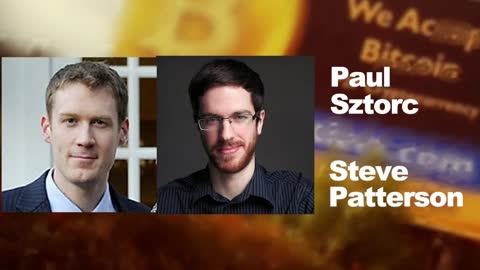
0:00 I'm out too. 0:01 Those guys. 0:03 Yeah, those guys are great. 0:04 They're really funny. 0:06 I don't know what else they are. 0:10 We are live. 0:12 It's just like, it's great. 0:13 It's just like guys, it's just live streaming. 0:16 It's like, it's like Twitch or something. 0:18 Yeah, they're just broing out. 0:19 They're just broing out. 0:20 They're just playing video games, drinking, talking about whatever. 0:25 We're live with another Bitcoin Bloodsport. 0:29 As you can see, these two are just dying to just kill each other. 0:34 It's a lot of acrimony. 0:37 I don't know how to hold these guys back. 0:40 A lot of animosity here. 0:43 But I have two very special guys in the community. 0:47 It's been a lot of turmoil and chaos this week about how we got these two together. 0:52 I apologize to the brother that we X'd out. 0:57 We had another guy, Steve Patterson. 1:00 Steve, I'm sorry. 1:02 I'm going to make it up to you. 1:03 We get you back on this platform another time. 1:05 Maybe we do a personal interview or something. 1:07 But he got vetoed. 1:09 The community said, nah, this ain't the guy. 1:13 And at first I didn't I wasn't paying too much attention to the guys. 1:16 You know, I just assumed they were trolls. 1:18 But when somebody well known in that in that community spoke up and DM me and showed me some tweets, I was like, yeah, this doesn't make sense for today. 1:32 Maybe another time. So I apologize to him and anybody who's expecting that. 1:36 As you already know, I'm shilling Coinbase at Coinbase app dot com. 1:39 It's a dollar on all transactions. 1:41 If you know the network fees to purchase Bitcoin, it's kind of crazy sometimes. 1:47 So no matter what amount you want to buy, it's only a dollar. 1:52 And it does it automatically for you, too, based upon the roundup scheme. 1:56 So you guys go ahead, sign up. 1:57 That link is in the description in the box below. 2:00 Now that we got all the bureaucracy out the way. 2:04 We got my homie Paul Sztorc is to my left or my right, your left. 2:11 And we got Vin Armani. 2:13 Paul, go ahead and introduce yourself to the people who you are and then go directly afterwards. 2:20 All right. I'm this guy from Connecticut. 2:24 I work. I went to have a pretty mainstream background. 2:27 So I went to public school, high school for a while, and then I went to college and then I went to graduate school. 2:33 And then I ended up working in the Yale Economics Department for a guy named Bill Nordhaus, who just won the Nobel Prize, actually. 2:41 So that was pretty neat. 2:44 But while I was there, I invented this thing, Truthcoin, which is like a prediction markets, blockchain technology. 2:53 And both Blockstream and Roger Ver tried to hire me away from Yale. 2:58 And and Roger was the one who succeeded. 3:01 And now I'm against the BCH side. 3:04 So, wow. 3:06 I mean, what's going to happen? 3:07 What what's going to happen next in this conversation? 3:09 You're just on the edge of your seat. 3:12 I hope. And I have a Truthcoin.info I turned into my blog. 3:17 So I have Truthcoin.info as my blog. 3:21 Bitcoinhivemind.com is where the prediction markets project is now. 3:26 And then along the way, in November 2015, I invented this sidechain technology called Drivechain. 3:31 And the site for that is at drivechain.info. 3:35 And now I consider myself to just be an independent Bitcoin researcher, commentator. 3:41 But I work on those three projects still. 3:45 Nice, awesome. 3:46 Vin, tell us about yourself, man. 3:47 Where are you from and all that? 3:49 So first off, Hotep Jesus, I want to just say to you that I really appreciate you giving us this platform. 3:56 But also something, you know, I feel that you have I'm really impressed by you that I was initially very skeptical sort of of your appearance within the sort of community of people, 4:09 especially with the shut up and code, meaning that it seemed like you were trying to get to take off. 4:15 But I got to hand it to you going from shut up and code to actually putting on two coders here to be able to speak is I think it speaks volumes about the character that you have. 4:27 So thank you for that. Thank you for that. 4:29 So my name is Vin Armani. 4:30 I'm the chief technology officer of Cointext. 4:33 And as of late, besides my own businesses, which all accept cryptocurrency and have been for years, and I earn my income in mostly BCH at the moment, but have been earning income in cryptocurrency for years. 4:48 Besides my own businesses, I'm now building out a lot of infrastructure for for Bitcoin cash as it takes sort of its next step. 4:57 So, so, yeah, I'm and, you know, crazy enough, like, as you say, there's not a lot of acrimony between Paul and I am. 5:04 And particularly, I think Paul is a brilliant guy, and he's been way far out ahead of things. 5:10 And, you know, honestly, it's kind of crazy because the stuff that I'm working on in BCH right now are a lot of the things that he has been pushing for for years for people to pay attention to. 5:24 And that BTC hasn't really done a good job of that. 5:26 So I kind of find it interesting. 5:27 And it's going to be fun to debate with him and say why BCH is actually a better platform for his own ideas. 5:34 So I feel pretty confident about this, about this debate. 5:38 Oh, I said, introduce yourself, I say, throw no blows there. 5:45 Paul, I'm going to let you go ahead and go into your two minute opening introduction. 5:49 I think that's a good segue. 5:51 All right. I have no idea how many minutes it is, but I had some things that I wrote down and then it went on for a couple of 5:56 pages. But OK, here's the deal. 5:59 So to dethrone BTC, BCH needs to jump two hurdles. 6:05 First, it has to actually be better. 6:08 But that's not enough. 6:11 It's sort of the elephant in the room is that it's not only does it have to be better, but there's this collective action problem. 6:16 So you need to have enough other people agree that it's better at the same time. 6:22 Or it won't, it won't, you won't succeed in dethroning BTC. 6:28 So if everyone watching this gets nothing out of this debate at all, I really hope that you just open a new browser tab, type in the collective action problem and hit enter. 6:39 And then at least you have something to latch on to after all this is done. 6:43 And I just it's it's discouraging to endure so much ignorance of an important thing. 6:49 But you see, the thing is, like Esperanto is a better language than English, sort of much more logically coherent. 6:56 It's easier to learn. 6:57 It's easier to spell. 6:58 And even Spanish is better than English. 7:00 But English is taking over when international people, if someone from Germany and someone from France do a business deal, it's written down in English. 7:10 And it's like English is just taking over, you know, people in India learn English, even though there's no real reason for them to do that culturally. 7:19 But they want to be able to speak English with all the other people who are speaking it. 7:21 So you have this big problem with BCH is not whether or not it's better or worse than BTC. 7:29 The big, the really big problem, the technical issues with BCH are just the tip of the iceberg. 7:33 The big problem is the network effects. 7:35 So people want to go to the party that their friends are going to, they want to speak the language that the people around them are speaking. 7:43 And that's when people are introduced to Bitcoin. 7:45 The first question they ask is who's accepting it, who values this, who I am going to toil for this thing and who will pay me back in exchange for doing that. 7:58 So what it all boils down to is who can host a more popular party, BTC or BCH, because everyone wants to go to the party where the popular people are. 8:06 And it's a circular, self-fulfilling prophecy. 8:09 So the market cap of BCH, it's never, ever been as high as 25% of BTCs. 8:16 It hovered around 10 for a while, and it is slowly crashing away from where it needs to be, which is 100. 8:24 And it's going down to 3. 8:26 Now it can sort of barely do 3%. 8:29 Transaction data, anyone can look up at bitinfocharts.com or whatever. 8:34 It's like 10%, 20% of BTC, despite the fact that the BTC fees are lower. 8:41 So the BCH block space just isn't as popular. 8:45 Even when you put it on sale or on clearance, you still sell fewer units. 8:50 So for any of the optimists for BCH, it cries out for some explanation, I think. 8:55 It's not that the price is zero, but the prices are cheaper than BTC. 8:59 So it points to the fact that people don't value it as much. 9:03 And of course, people could change their mind, but I think it still cries out for some explanation, 9:08 especially when there's this looming network effect threatening to destroy everything. 9:12 Now, I don't know how far I'm going to roll over this two minutes, but this next point, 9:15 point number three, is pretty important. 9:17 I call it this cheap talk point. 9:19 It is a very popular debate, medium of exchange for a store of value that I find to be misguided for several reasons. 9:26 But I'm just going to skip to the big one, which is that I think we can put it back on the right track 9:33 of being a logical thing to talk about by saying that the merchant acceptance, 9:37 which is the medium of exchange theme, and market capitalization, which is the store of value theme, 9:44 those are both metrics of how popular the party is. 9:48 If ever all the merchants are accepting it, it seems like it's popular. 9:51 If the market cap is very high, it seems like it's very popular with investors. 9:56 The problem, though, is that the merchant adoption metric is cheap talk 10:00 because it takes very little effort for a merchant to start accepting cryptocurrency. 10:05 And that's a very good thing for cryptocurrency and for the world, 10:09 but it's a bad thing for anyone who wants to use that metric as their measurement of cryptocurrency health. 10:14 So the people who bid up the market cap to a very high number, they have to pay a cost to do that. 10:20 They're buying the coin with their money, their wages, with their stuff, their purchasing power. 10:27 And the signal they send is more reliable. 10:31 But the merchant who sets up BitPay or whatever it is, BTC PayServer, whatever you want to say it is, 10:36 Coinbase has a thing, if they set up BitPay, they risk very little. 10:40 But to add insult to injury, they almost always onboarded to BTC at the exact same time. 10:46 They onboarded to BTC and BCH at the same time. 10:49 And this is just a specific instance of a more general problem, 10:54 which is that a lot of the criteria upon which these two projects compete, 10:58 they're not specific to one project or another. 11:02 They could just be copied, all the technology can be copied, it's open source. 11:06 The efforts to onboard more merchants, the marginal effort to onboard them to BTC is high, but to BCH is... 11:16 Once you're on one, you kind of onboard it to all the cryptos at once. 11:20 The same goes for bad things, like developer capture, which I know is a critique of BTC with justification. 11:28 But there's no reason to say that a bad thing happening in BTC won't also happen. 11:32 There's no reason to say, like, how are you going to say that Omri Sashay is not also sort of capturing the project for himself, 11:39 which is a critique that people make of BCH. 11:44 So I've got some more, but I don't know how badly I blew over the two minutes. 11:47 Yeah, you blew over that two minutes, man. 11:49 So we'll go ahead. 11:50 Great, great introduction, though. 11:52 We kind of know where your mind is. 11:53 Vin, you're on the clock, man. 11:56 So I figured that this conversation would wind up being a sort of the difference in perspective and perception between a trained economist and an entrepreneur. 12:12 So my background, and the reason why I'm even a software developer is because I come from a family of entrepreneurs, small business people, 12:21 and on one side who now have family businesses that are huge in the area that I'm from, 12:27 ended up going from a little taco stand to owning a huge percentage of land in the city. 12:33 And my father on the other side, a tech entrepreneur, and I got a chance to come up in those early days. 12:38 I'm 41 years old. 12:39 So in the early days of Silicon Valley, to be able to come up there, he moved the family up there to do his thing. 12:45 The reason I became a software developer and learned how to code was because there were businesses that I wanted to do that as a young man, young 20-something-year-old man, 12:55 I didn't have the funds to be able to hire a developer. 12:59 And the amount of time that it would either be for me to raise those funds or to go out and hire somebody, I also didn't know who the hell to hire because I didn't have the skill to know who would be good or not. 13:09 It was enough to just teach myself how to code. 13:11 And so at every step of the way, including learning Bitcoin front to back, it's all been self-taught. 13:17 And I think that this is true, actually, for a lot of tech entrepreneurs, that that was their entree. 13:23 And so I always approached Bitcoin from the beginning with an entrepreneur's mindset. 13:28 The reason I had heard about it, but the reason why I even decided to go out and get any was, and people can know about my background, 13:34 that in 2012, I had spent several years in an all-cash business, all paper fiat, and earning a lot of money. 13:44 So they're talking about stack and sats. 13:46 This was the first time where I was stacking bills and having to tie them up and put them in a safe and having to have a good safe and then moving to anonymous private vaults in Las Vegas and the whole nine. 14:00 And I ran across Bitcoin, and here was this idea that solved the problem that I obviously had. 14:06 I was living in Vegas, so I could pay for a lot of things with paper fiat, but I couldn't do all the things that I needed to do online. 14:13 I was like, oh, what is this thing and went and got it and said, OK, if this ever takes off, this solves a big problem. 14:23 It solves a problem that I had, and I loved being in an all-cash business. 14:29 As people who make their money in cash and spend it in cash know, you end up making a lot more money when there's not a paper trail of how much you've earned. 14:38 I'm sure a lot of people in your audience are nodding their heads like, OK, yeah, I feel you on that one. 14:44 So this was an opportunity to be like, whoa, there's an electronic version of this outside of the banks. 14:51 And then and I was like, OK, in 2012, there wasn't much. 14:54 In 2014, when I started developing, the reason that I started developing to go back, take this full circle was I was working. 15:01 I was like, oh, I want to do this little gaming app. 15:04 I wonder if I could do some accounting on this this blockchain. 15:06 I wonder I wonder how this would work to do it outside of the banking system. 15:11 And from then, it's been about. 15:15 Which. What do I want to do entrepreneurially on Bitcoin? 15:22 And for me, in terms of choosing between Bitcoin, BTC and BCH, it's very, very simple. 15:28 And I think that you as like I hear you shilling your business and you're talking about, you know, you're going to charge a fee for what you do, but there's already fees that are happening on the blockchain. 15:41 Right. So if and this is so very simple to understand why there will be a flip, anybody who's an entrepreneur will understand this and even people who aren't will understand why there's a flip. 15:52 You've got a business. You make a dollar a pop. 15:55 But these people are paying a total, let's say, of two dollars because they got to pay a dollar fee to put it on, meaning they're willing to pay two dollars. 16:05 If the fee on BCH is zero cents, that means you can just double your profit margin, just double by using the same technology. 16:16 Right. Because like you say, you don't care how much they they spend. 16:19 You don't care what the transaction is. 16:22 You make a dollar a pop, but they're willing to pay two. 16:26 And so for me, what I've built in my business context, we take a fee on every transaction and we we do support BTC. 16:34 We absolutely do. 16:35 And we support Litecoin. 16:36 We support Dash. 16:37 We support Ravencoin. 16:38 We support Decred. 16:40 Two things about BCH. 16:41 One, fees are incredibly low, so our profit margins stay solid. 16:45 And two, and this is the most important thing, the community is supporting. 16:51 When we launched, boom, tons of community support that we didn't ask for. 16:55 And I got a chance to A, B it on to see BTC. 16:58 They were asking for all B cash. 17:00 You should support BTC with it and everything. 17:03 So we dropped the BTC version. 17:04 Guess what? Nobody cared. 17:06 Dash. Oh, you should do it on Dash. 17:08 So we dropped the Dash version. 17:09 Guess what? Nobody cared. 17:11 LTC version. 17:12 Nobody cared. 17:13 Ravencoin version. 17:14 And they're trying to build their coin. 17:16 Nobody cared. 17:17 And so when I look out at the landscape, what we're doing here is we're making a bet on the future. 17:23 And so I'm betting as an entrepreneur. 17:25 I'm betting as an entrepreneur the same way that I would and have done many times, the same way that I did when I was driving around the arts district. 17:32 In downtown Vegas in 2016. 17:36 And I was like, saw a few little bars, saw things starting to pick up. 17:40 And I was like, oh, look at this amazing space over here that I could get for cheap. 17:45 And got it, put an art gallery, event space, the whole nine, six months later, the area blew up. 17:50 Right. So, yeah, the arts district was nothing then. 17:55 But that's not I'm in this. 17:56 This is I view this as a multi-generational project. 17:59 And I'm not interested in investing in what's hot now. 18:02 I'm interested in looking and finding the value in finding the underpriced real estate and finding the area that's about to gentrify and seeing here are the metrics. 18:12 And the metrics are actually really, really strong. 18:15 One, it can scale on chain. 18:17 It doesn't need the additional complexity. 18:19 Simplicity is always preferable in business. 18:23 Always preferable. 18:24 Two, it's got op codes that have been re-enabled. 18:28 In other words, you can do more powerful transactions. 18:31 The types of transactions that Paul has been writing and talking about for a very, very long time and the types of things that enable Drivechains and all of this to be much simpler. 18:42 Those have been added in. 18:44 Things that BTC has been trying to add in, like Schnorr signatures, that's been added in. 18:49 And that is all due to the culture that's there. 18:52 Just the same way that it's due to the culture of Williamsburg, Brooklyn gentrifying or Echo Park in L.A. gentrifying. 19:00 And you see that cultural change. 19:02 And so for me, that's where my mind is at. 19:05 We could talk about the theoretical economics of it all, but I've got skin in the game in terms of my business and my business is what feeds my family. 19:15 And so the bets that I make are about where are we going to be 20 years from now? 19:20 And it's not BTC. 19:23 Awesome. 19:24 Another great two minute introduction. 19:28 Hey, man, I'm just trying to I'm trying to even it out. 19:30 You know what I'm saying? 19:33 I love it. 19:33 I love it. 19:34 Paul, I know you got some thoughts. 19:36 You over there making notes. 19:38 What's on that brain of yours? 19:39 Yeah, I got it. 19:40 I got a lot of notes. 19:41 Well, I mean, one thing I'm curious about is you mentioned a lot of things. 19:43 You mentioned low fees. 19:45 Community is very friendly. 19:47 The culture, you know, this specifically is kind of you have this metaphor, the gentrifying metaphor, which is clever. 19:55 I like that. 19:57 But then you say it can scale on chain and the opcodes. 20:00 So that's like five things. 20:01 But it's really about the fees for you, I would guess. 20:06 I mean, the community support that is, I think, just the result of the novelty, right? 20:11 When people are new, they want, you know, if BCH is the underdog or it's new, you want to try and foster the growth of the economy. 20:23 So you would be much more generous there than you would be. 20:27 You're making a very skeptical face, but I think you've made. 20:31 Well, because one of the things is. 20:33 My support of BCH, I just went I just went in and said I was developing on BTC when there was no BCH, right, and I had given up on building businesses on Bitcoin. 20:47 I mean, I literally had it was my business, but I was like exploring Ethereum and other things. 20:52 And it was my business partner. 20:53 And the reason why was fees, because I said, look, that's what I'm trying to say is the big thing for you is the fees. 20:59 Well, I think it's it's the big thing for for what Bitcoin in my perception is supposed to be, which is a peer to peer cash system, which is cash. 21:11 So like when I when I first encountered when I first started developing on BTC, there were there were zero fees like I could get transactions on with literally no fee, like zero mining fee. 21:24 I could get transactions on the chain. 21:26 And that was then I felt like, oh, that's like cash. 21:29 When I hand over a hundred dollar bill, I don't have to hand over a hundred dollars and another dollar or a hundred dollars and 10 cents. 21:36 So it was the analog to me. 21:38 That's what I'm saying is that cash is the cash analog is dependent upon those low fees. 21:45 So so the novelty idea, I don't buy it. 21:49 I mean, obviously, I'm not it's not novel to me. 21:52 But when you say that you posted that you're starting a thing and there was a lot of interest from people, people were happy to read your Reddit post. 22:01 That kind of thing isn't possible when six billion people are using. 22:06 And you can't just post you can't just post something in new business, you'd be there for like one billionth of a second and get buried by new posts. 22:15 But but what we're talking about the fundamental reasons I'm saying to go back to the gentrifying neighborhood. 22:20 I mean, right now, a billion people are not using any of these chains, period. 22:24 So right now, all of the businesses, right, all of the businesses now. 22:29 I mean, we know the names and we know the actual people. 22:33 If you mention like the big businesses, you and I both know them personally. 22:37 We're at the level now of like Echo Park when I first moved there in 2005, where I would go down to the one little independent coffee shop, Chongo. 22:47 Right. And the people in these areas of Brooklyn are right now probably nodding their heads like, oh, yeah, I remember when I first moved into that neighborhood in Brooklyn, when it was first starting up, there was the one sneaker store and there was the one coffee shop. 22:58 And you go in there and it's the same people every day. 23:01 Now, those places have blown up. 23:02 But you don't blow up unless you first have that strong community that's supporting the business. 23:10 Fair enough. But can I hop in here really fast? 23:13 Just ask a question. 23:15 So we're talking about fees here and BCH has a low fee network. 23:20 Does that mean when or if BCH reaches the adoption level as BTC is right now, that the fees will stay the same? 23:29 That's right. That's right. 23:30 So I can test most of these points just for the record, but I'm just trying to figure out, because you said a lot of things, but I think that really the one thing that you care about, Vin, is really the fees. 23:43 But your explanation did help about you need that initial cohesive sort of incubator group. 23:51 But don't you think that we did have that in BTC in earlier years? 23:56 Yeah. And where did that go? 23:58 And where did that go? 23:59 You just explained yourself that that is a temporary, fundamentally, that is a temporary transient state of affairs. 24:07 Well, it is not that it is a temporary transient state of affairs, because, for instance, dance hall reggae, right? 24:14 It's all over the world. 24:15 The dance hall queen is Japanese, right? 24:19 So like the best dance hall female dancer in the world is Japanese. 24:24 I'm having trouble following this. 24:25 Well, hold on. What I'm saying is this. 24:27 You don't get a Japanese dance hall queen. 24:30 You don't get dance hall music traveling to every corner of the globe and morphing into all different things when it hits England, when it hits Latin America, when it hits Africa, when it hits Japan. 24:40 You don't get that unless you've got this core group making music for each other. 24:46 No, I understand that. 24:48 But the thing is, Paul, they're still listening to the music. 24:51 They're still making the music. 24:54 They're still the core of it. 24:55 And so what I'm saying is that even when it reaches a billion people, it's not like Roger Ver is going to be gone. 25:00 It's not like the people who are making moves now are going to be gone. 25:03 They're just going to be that much more powerful, just like the same way Russell 25:06 Simmons isn't gone from out of the hip hop game. 25:09 So it's but yet it's not just, you know, they're not doing it out of their 25:13 apartment anymore, but he's now he's flying around in a helicopter. 25:17 So so my point is that you have to have that initial incubator. 25:21 BTC, just there's no business in that. 25:25 BTC, just there's no business, not on BTC, on Lightning, they're trying to do 25:31 things, but there's just no opportunity for entrepreneurial spirit that's easy 25:37 and simple within BTC. 25:39 And part of that is due to the fees. 25:44 Right, well, the technology to support lower fees is obviously something in the 25:52 works, but that's a separate issue. 25:54 I'm just trying to is you said a lot of things. 25:56 I'm just saying like fees is the main thing for you. 26:00 I don't it's difficult for me to understand. 26:03 I mean, it's not it's not the main thing for me. 26:05 Let me let me tell you what the main thing for me is. 26:07 The main thing for me is the ability for entrepreneurs to profit. 26:11 If we're talking about an economy that it fees is fees is a means to an end. 26:16 So if we're talking about any economy, if you want to see an economy grow, you 26:22 have to remove the friction for entrepreneurs to profit. 26:25 And how you do that is you take the cost out and you increase their profit margins. 26:29 Now, jurisdictions, governmental jurisdictions will do that by doing things like 26:34 lowering fees that that entrepreneurs have to pay, like business license fees, 26:38 lowering taxes, free parking in certain areas, all of these things to lower the 26:45 cost so entrepreneurs will think it's a good move to move in there and that their 26:50 profit margins will be high for for a business like Jotep Jesus is when he looks, 26:55 if he really is looking and he sees, well, there's there's this amount of money on 27:01 the table here with this number of people. 27:03 But I make half the profits or over here. 27:06 I could make double the profits, but there's only half the people. 27:10 But this could grow over here. 27:13 Then it becomes for an entrepreneur. 27:14 That's a real choice. 27:16 That's a real that's the reason why people will go into a depressed area and say, 27:22 oh, well, you know what? 27:23 I can't open my art gallery on the Las Vegas Strip, but I can open it in this little 27:29 district here that the city had decided, oh, we got a depressed district. 27:33 We'll name it the Arts District. 27:35 We'll make it real easy for people to move in and start a business. 27:38 That's what that's what BCH is doing culturally that BTC is not doing culturally. 27:44 And so when I look at the future, I'm always going to bet on the people who are 27:49 wanting to see entrepreneurs profit. 27:52 Well, you know, that's a very interesting point that you're making about culture, 27:58 even though I think it's a little vague. 28:00 But don't you think like people will come in and they'll say one has higher fees than 28:04 the other. 28:08 People will think like, you know, people know that like where there's smoke, there's 28:11 fire. 28:12 They'll be like, you know, there's no free lunch. 28:14 Why are the fees lower? 28:16 And when they investigate, they'll discover that the network is responsible for processing 28:21 all this information. 28:23 And when the block size is higher, the network has to do more work. 28:27 And so people will think, you know, I don't know. 28:31 One has easier nodes to maintain, but higher layer one fees, which are not necessarily 28:38 at all the fee paid by the end user. 28:42 But another one has lower layer one fees, but more difficult to run node. 28:48 And they're going to look at the items that I mentioned earlier, the market capitalization 28:52 and the transaction rate. 28:53 And they're going to say, well, you know, I'm new and I don't really know what's going 28:57 on. 28:57 But it seems like, you know, BTC is where the party is at and they all sign up for BTC. 29:04 I mean, we don't see it's been it's been a very long time and we have not seen, you 29:10 know, there's fewer transactions. 29:13 It's not even equal. 29:14 There's fewer transactions on BCH than BTC. 29:17 So you have a theory that people will be drawn towards the lower fees and the more welcoming 29:25 environment. 29:27 But yeah, it doesn't seem like that is the case. 29:31 I do have the theory that the average individual, the average consumer, which is what we're 29:37 talking about if we're talking about global scale, right? 29:41 At global scale, like ask people what the fee is for the Visa network. 29:46 Like, how much does Visa itself actually get? 29:50 Not like, shit, ask them how much the merchant gets or the merchant is being charged. 29:55 Most people don't know. 29:56 If you ask them, what's the fee for Square? 29:59 People don't know. 30:00 They don't care. 30:01 But yes, if it's essentially the same product, like I want to send $100 from here to there 30:11 and it's $100 US worth of value and it's either going to move the same speed because it's 30:18 still 10 minute blocks, it's going to be just as secure as it is. 30:22 We could argue about is it theoretically as secure, but not a single Satoshi has been 30:27 lost on the BCH network or on BTC. 30:30 And one of them is going to cost me a dollar to send and one of them is going to cost me 30:36 nothing. 30:37 I think just simple economics says that the average consumer, that the trend for the average 30:42 consumer, the same product for less that's just as accessible, that what you're going 30:47 to see is people move there. 30:48 What the problem is, and I want to address exactly what you said about the lack of transactions 30:54 because I will concede that point. 30:56 But it's not a lack of transactions that are using Bitcoin in the way that I believe Bitcoin 31:04 should be used, in the way that I've always believed that it should be used. 31:07 And in the way that Satoshi meant it to be used, which it was as peer to peer electronic 31:12 cash, a means of a buyer and a seller paying to one another without the need of a trusted 31:19 third party. 31:20 That's the first, it's the first sentences of the white paper, right? 31:24 That's the problem that this technology is solving. 31:27 I don't believe that we have reached that at all. 31:30 I don't believe that we have even begun to explore it. 31:33 BTC has transactions, but so much of that, if not all of that, is exchanges, people stacking 31:40 sats, all of this. 31:42 That's not without a trusted third party. 31:44 That's not peer to peer cash. 31:47 So in my mind, if we were to talk about the number of transactions that are actual peer 31:52 to peer cash, I would say it's probably even or more on BCH. 31:57 And the fact that BTC is getting full without being peer to peer cash, I think says a lot. 32:05 Well, you know, I don't know, you're putting a lot in this peer to peer cash theme. 32:11 And then before that, you draw this big equivalence. 32:14 You say they're exactly the same, but one has cheaper fees, so therefore it's better. 32:19 And obviously, that type of argument is very intuitive. 32:21 But as I've been trying to explain, they're not the same, and people don't want the cheaper 32:27 one. 32:27 Just empirically, they're paying more for the more expensive one. 32:31 So it's got to be something. 32:34 I think that, as I mentioned in the opening remarks, that that cries out for some kind 32:38 of explanation from the people who are optimists about BCH. 32:41 There's another thing I have to say, which is that this argument, I think, opens itself 32:45 up to a big infinite regress. 32:47 And without complexifying that, a funny way to think about it is BSV is sort of trolling 32:55 you guys. 32:56 It's a turnabout is fair play kind of thing. 32:58 You say we made these blocks bigger, the fees are lower, and they made the blocks even bigger, 33:04 and now the fees are even lower. 33:05 And now by your own logic, everyone should desert BCH and go to BSV. 33:10 And it goes on forever, because someone should make a BSV squared that has still more gargantuan 33:18 blocks. 33:18 And then, according to the logic that you've outlined, that fees are the single factor, 33:24 and there's absolute complete neutrality and all these other factors, such as the popularity 33:28 of the party, which is what I think is the dominant factor. 33:31 Well, I'm sorry. 33:32 But then people should just keep deserting the network for a still larger one forever. 33:39 That's the logic that you've outlined, which is why I was so interested in it before. 33:44 No, see, I don't think that's the case. 33:47 First off, it's just factually incorrect that the BSV fees are not lower than the BCH fees 33:54 in terms of minimum fee. 33:55 And the minimum BCH fee is not lower than the minimum BTC fee. 33:59 All three of them have the same minimum fee, which is one Satoshi per byte. 34:05 I don't think that necessarily needs to be the case. 34:07 It could be lower. 34:08 No, sure. 34:08 But what I'm saying is, at this very moment, right now... 34:12 But one Satoshi per 250 byte transaction, theoretically. 34:16 No, I'm saying, theoretically, you could. 34:18 But what I'm saying is that on all three of those networks, the fact of the matter is 34:23 that right now, if I broadcast a transaction, the minimum miner fee that I need to broadcast 34:29 to all three, BTC, BCH, and BSV, is one Satoshi per byte. 34:35 Now, if I broadcast... 34:36 The difference is, if I broadcast... 34:38 That's why that's not important, as you're about to explain. 34:41 If I broadcast... 34:42 Well, but it goes to why the fees are high. 34:46 It's not a rationalization of like, oh, well, it gives more security and all of that. 34:50 That's after the fact. 34:51 The reason why the fees are high, like the objective reason why the fees are high, is 34:57 if I broadcast a one Satoshi per byte transaction to the BTC network right now, I don't know 35:03 what the mempool is like right now, but chances are, it's not getting confirmed for hours. 35:08 Many, many blocks are going to go by before I get it confirmed, if ever. 35:13 And that's because the blocks are full. 35:16 And so it's just... 35:18 And this is not for you, Paul. 35:19 This is obviously... 35:20 But just for the people watching, because we're talking about these fees. 35:24 An analogy that I like to use, and you can refute this if you think that this is not 35:27 a good analogy, but I like to use the idea of people waiting in line for a bus, right? 35:33 And everybody needs to go to work. 35:35 And it's a 20-seat bus. 35:37 And so long as there's not more than 20 people, as the bus shows up, everybody gets on. 35:43 They pay their fare, no problem. 35:45 That's one Satoshi per byte. 35:48 Now, 10 more people get in line. 35:50 Everybody needs to get to work. 35:52 Everybody needs to get on the next bus, or else they're going to be late. 35:55 Maybe they get fired, whatever it is. 35:56 There's only 20 seats. 35:58 So what you very well might have is you might have somebody who's number 25 go up to the 36:03 person at number one and be like, hey, look, I will give you $50. 36:07 Yeah, it'd be bid up to the reservation price. 36:09 I agree. 36:10 It'd be a motto of this explanation. 36:12 I understand what you're saying. 36:14 Right. 36:14 So that's what I'm saying. 36:16 This is for people out there to try to take it down a notch, the people watching, right? 36:23 To take it to something that they know that's not some sort of economic theory or jargon, 36:29 but something that they might have experienced, right? 36:33 So you have two choices, really. 36:35 The choices that you have, and the choice that BCH has taken, is BCH looks at that situation. 36:41 And BCH says, OK, we're going to increase the maximum size of the bus. 36:47 And we're going to increase that maximum seatage to 50. 36:51 Now, if there's 10 people waiting in line, they all get on. 36:55 If there's 20 people waiting in line, they all get on. 36:57 If there's 50 people waiting in line, they all get on. 37:00 And that's where it's at. 37:01 What BTC has decided to do is to say, oh, no, no. 37:06 It's actually much better to have a market of people having to pay more for that because 37:14 it's basically a little different situation where they actually have to pay more to get on the bus. 37:19 They're bribing the bus driver, which is the minors. 37:23 And so they're like, no, no, no. 37:24 It's much better for the bus driver if there's this situation going on where people are trying 37:29 to bribe him to get on, and he doesn't just get the bare minimum. 37:33 It's much better for him, which it is. 37:35 That's true. 37:37 But we are developing an autonomous multi-hop drone system that is going to be free and allow 37:47 everybody who you will... 37:50 Here's what you'll do. 37:51 You'll simply just throw your bag onto the bus, and it will sit there. 37:57 And then you will be able to, as long as your bag is on the bus, you will be able to take 38:01 the multi-hop Uber drone system that we are building, and you'll be ready in a few months. 38:08 I was wondering where this was going. 38:08 But in a few months, Paul, it'll be ready to go in eight months. 38:12 Oh, no, I agree with you about the software deadlines. 38:16 I once said something about... 38:17 I said, if we got someone competent, then we could co-drive Chin up in like four months 38:22 or something. 38:22 And then it's like, yeah, never... 38:26 Forget about software deadlines. 38:27 They're a total waste of time. 38:31 But you snuck a lot of things in there. 38:33 I mean, for starters, you tried to make this description for the layperson, but don't you 38:38 think that... 38:39 I don't really think it would really... 38:40 I don't think that strategy is going to work, because don't you think the layperson is going 38:43 to be thinking to themselves, you can't just keep making a bus longer and longer. 38:49 Eventually, it won't fit in a tunnel or whatever. 38:51 They're going to be like... 38:52 The average layperson is going to be already seeing the flaw in this infinitely growing 38:57 bus plan. 38:57 You need more steel. 38:59 You need like... 39:00 Oh, Paul, you are not... 39:03 You so can't be the average layperson. 39:07 You're going to scale to global levels. 39:09 You just did a thing saying that 30... 39:11 You made a lot of points, but I'm just wondering if... 39:14 30% of Americans think that the US dollar is backed by gold. 39:18 And you really think that those same people are going to be concerned about what's going 39:23 on with the block size? 39:24 No. 39:25 What they care about is from here to there. 39:28 That's it. 39:29 Very good point that they will not... 39:31 And nor should they care about... 39:34 I believe in Friedrich Hayek and in his Nobel winning speech, he said, we should all be 39:39 thinking about less about what we're doing, and we should have more specialization. 39:43 I totally am on board. 39:44 So laypersons will not... 39:45 But layperson is choosing to support by recognizing it as money or investing it, BTC or BCH. 39:54 They're going to be thinking, what's the catch? 39:57 You know, they're going to be thinking what BCH figured all this out, and they have a 40:01 magically growing bus forever. 40:02 And they're going to be like, I don't know, something about that sounds kind of fishy. 40:06 And I don't think... 40:07 I think that layperson, when their own money is at stake, they suddenly gain many IQ points. 40:12 And the other thing is you have this weird... 40:13 Because you said a lot... 40:14 You're trying to make a lot of points. 40:15 The thing about layers is you can buy the seat on the bus, but it's kind of a little 40:19 bit more like... 40:21 It's like maybe real estate in the town or something, or like fitting many people, or 40:26 like the bus seat has like a little tower in it. 40:28 You could fit lots and lots of people in this tower somehow. 40:32 This analogy starts to break down at a certain point, as all analogies do. 40:36 But layer one, there are many ways of getting the fee to zero. 40:43 One is with just adding in trust in the custodial wallet or a website, which of course is anathema 40:52 to everything. 40:53 And everyone will hate that, but there's... 40:55 Like coinbitcap.com. 40:58 Yeah, but see, you're the one who's saying that fees are this big thing. 41:01 You can drive the fees to zero. 41:04 You can also do lots of things. 41:05 There are many other technologies in the work, including Lightning Network and state chains 41:11 are too, but I really don't want to share all too much of my own stuff. 41:15 But with Drivechain, you can have basically an optional extension block that simulates 41:19 BCH, and I can just steal all the BCH ideas, and it will be with BTC, and that kind of 41:26 takes the conversation in a strange direction because you're sort of almost... 41:29 At that point, I'm kind of endorsing the BCH ideas by stealing them. 41:33 But nonetheless, the layer twos can be in numerous forms, and anything that has been 41:46 invented can be a layer two on top of Bitcoin. 41:51 And so I'm just trying to figure out what your objective sort of is. 41:56 It's just the lowest fees, then custodial wallet will be zero fees. 42:01 Can I hop in? 42:03 The example you gave with the bus, people getting on, and- 42:05 I just want to say one more thing. 42:07 You said low fees, and you said you didn't care at all about any of these other factors 42:11 about security or whatever. 42:13 No, that's right. 42:14 That's exactly where I wanted to go. 42:16 That's exactly where I'm going. 42:18 You have this bus, you have all these people on the bus, but the more people you put on 42:21 the bus, the less secure we are, right? 42:24 The bus- 42:25 That depends on a lot of things. 42:27 It's not going to maneuver the same as a smaller bus. 42:30 The bigger the bus, the faster you go, the harder it is to maneuver, which means- 42:33 Yeah, no, absolutely. 42:35 See, this is what I'm talking about, Vin. 42:37 They're going to be thinking like, what's the deal with this bus? 42:39 Do we really just keep doing that forever? 42:41 Well, right. 42:41 So that's my question, right? 42:45 Cannot keep doing that. 42:46 If the cock size is bigger, is it more susceptible to disease? 42:54 Is it more susceptible to being compromised? 42:57 Well, let me answer this because I'm going to concede to the idea that Bitcoin cannot 43:06 scale as it currently is, unless we discover some amazing new technology. 43:12 It's certainly contrary to what the BSV people say. 43:17 I do not believe, and I don't think that anybody reasonable in BCH believes that BCH 43:22 can scale or any Bitcoin network can scale to global transactions of everybody, that 43:30 we could move the whole financial system onto a blockchain like the crazies in BSV think. 43:36 That's unreasonable. 43:38 But the question is not, can it scale to global levels? 43:42 The question is, can it scale to the level that it can effectively handle the traffic 43:46 that is here now and that it can move forward 10 years from now? 43:54 And again, I think that we are still so early that people thinking we're going to get hyper 43:59 Bitcoinization and everybody's going to be using Bitcoin in even 20 years, I think is 44:04 naive. 44:05 I think it's silly. 44:06 I think even people who think that there's going to be hyper Bitcoinization who are our 44:11 age and who think that they're going to see it in their lifetime, I think that's a utopian 44:16 vision, right? 44:17 Because this is a brand new form of things. 44:19 I look at this as a multi-generational project. 44:22 And so I want to bring up to you, to both of you, the words of Adam Back in 2015, who 44:29 said to Gavin Andreessen, this is Adam Back, CEO of Blockstream, probably the top thought 44:37 leader in BTC right now, cited in the Bitcoin white paper. 44:42 The only person who's still active in BTC, his name is in the Bitcoin white paper, Adam 44:47 Back. 44:48 And he says, cited by Satoshi. 44:50 And he says- 44:51 He's actually not. 44:52 Well, yeah, he's in the body. 44:54 He's not in the citations. 44:56 But yeah, you're right. 44:57 He's mentioned by name in the- 44:59 I've got it in front of me. 45:00 I'm pretty sure he's in the citations. 45:01 Yeah, he's in the citations. 45:02 You're right. 45:02 Yeah. 45:03 Oh, thank you, Paul. 45:04 Yeah. 45:05 So I'm pretty sure I looked at it. 45:08 All right. 45:08 All right. 45:08 So what are you quoting him saying? 45:10 What he says to Gavin is, in 2015, when the scaling debate is going on, he says, Gavin, 45:14 what about this idea? 45:16 We increase the block size to two megs now. 45:19 We increase it to four megs two years from now. 45:22 And then in another two years, we increase it to eight megs. 45:26 Now, if that had been done, right now, BTC would have eight megs. 45:30 The other thing that would be true, Paul- 45:32 I know it would, but this is a tautology. 45:34 Like, if it's- 45:35 Hold on. 45:35 The other thing that would be true is we wouldn't be having this debate because all 45:39 of us who are in BCH would still be on BTC because it only takes about four megs of total 45:47 traffic to encompass, even at the height, to encompass BTC, BCH, and BSV, all of the 45:53 traffic right now. 45:54 If BTC was at four megs, there would be no BCH, and there would be no BSV. 46:00 So the thing is, at four megs, security is not reduced. 46:03 At eight megs, security is not reduced. 46:06 Oh, well, OK. 46:07 Well, I don't agree with that last part. 46:09 But all of what you said was very straightforward and tautological, right? 46:14 If we moved to eight megabytes, we'd have eight megabytes. 46:16 That's fine. 46:17 Sure. 46:19 Probably, if BTC had been more accommodating of counterparty, we would never have even 46:24 had Ethereum because the only thing that Ethereum was really used for was the ERC-20 tokens, 46:29 which Bitcoin had long before in various forms. 46:34 MasterCoin, whatever, colored coins, and numerous forms of... 46:39 So I agree with a lot of that, but I don't see the relevance because... 46:44 I'll tell you. 46:44 Because I think you linked it to that last conclusion part. 46:47 No, the relevance goes back to what I'm talking about, about culture and the decisions that 46:52 are being made, right? 46:53 Because you just brought up a very good point. 46:55 You know, you said, had the leadership, and there is leadership, had the leadership... 47:01 Let's get this out. 47:02 The people who say that there are no leaders, that's... 47:04 They're crazy, right? 47:05 So silly. 47:09 So as you just said, and I agree with you, had the leadership been more accommodating 47:13 to counterparty, there would be no Ethereum. 47:16 And I just said, and I think that we can both... 47:19 But I think, I suspect, yes. 47:20 You suspect, right? 47:22 You suspect. 47:23 I think there was a market for like a Bitcoin competitor. 47:25 That was like a power vacuum. 47:28 But there's a chance that they wouldn't be... 47:32 That Ethereum wouldn't be threatening BTC. 47:35 It could have been something even crazier, like whatever, I don't know. 47:40 But there was a decision not to accommodate counterparty. 47:43 There was a decision not to just poo-poo Vitalik. 47:47 There was a decision to just immediately deny, even though Adam Back said that it was probably 47:52 a good idea to raise the block size, to deny raising the block size. 47:56 And he just says, how about this idea? 47:58 He doesn't say necessarily it's a wonderful idea. 48:02 Well, he's made his position very clear in writing and interviews that, you know. 48:08 I mean, I think that there's a level of self-interest at this point for him to not... 48:12 I think that for him to say that now... 48:14 But I'm not going to judge Adam Back's... 48:18 We're maneuvering a little bit away, though. 48:20 I thought I had your logic kind of nailed down and now it's sort of slipping out. 48:25 No, I'm not maneuvering away at all, because I said that initially what we're doing here 48:29 is we're making a bet on the future. 48:32 And that part of the way that I bet on the future of a community, of an industry, of an economy, 48:39 is that when it's early, of a music scene, is I look at the culture and I look at the 48:45 decisions that are being made by the people who are the thought leaders in that culture. 48:49 And the decision to just poo-poo Vitalik gives you a competitor. 48:55 The decision to not nominate a counterparty gives you a competitor. 48:59 The decision to just simply ignore raising the block size, 49:02 which you could do safely, gives you a competitor in BCH. 49:05 So, any group... 49:08 They're not very healthy competitors, despite the immense luck that they've had. 49:14 They enjoyed some success, but they really are not... 49:19 I don't see them as being very healthy competitors. 49:23 What is the proof behind what you said, Vin? 49:28 You said at four, eight megs, there's no security compromise. 49:32 Why? 49:33 Right. 49:33 Before you said it made no difference. 49:35 There was no downside at all. 49:36 It was just merely cheaper and they were absolutely identical. 49:42 A hundred dollars being sent over the network, 49:45 and you said one is just cheaper and so it would be better. 49:47 But now you're saying that... 49:50 You're acknowledging that when the block size increases, 49:52 there's some mysterious security downside. 49:56 No, I didn't. 49:57 Oh, yeah, at a certain level, certainly, but we've seen that already in BCH, that with the current research, the implementations as they stand, it really peaks out at the network not being able to propagate blocks at about 22 megs, at about 22 megs. 50:19 You don't have a fundamental disagreement. You just think someone picked the wrong number. Satoshi, who put the... 50:24 No, no, no. 50:25 You just think he just picked the wrong number. But you fundamentally agree that there should be some limit. 50:32 No, no. There's going to be a limit. There's going to be a technical limit. There's going to be a limit at which the network becomes unstable. 50:40 What I'm saying is we are so far from that limit organically that it's almost a moot point, number one. 50:48 And number two, that getting to that limit will necessarily... If we had 20 megs of traffic continuously on any Bitcoin network, the scope, the breadth of the amount of people in the Bitcoin economy and the amount of capital that would be available to solve the problem of taking the next step would be there. 51:14 It's almost like saying it's got a town of a thousand people. We need to worry about putting a freeway in here and that it's going to be a problem for the roads if we have a million people moving through here. But we don't. 51:29 Right now, the blocks on BCH are less than... Like I said, if you took BTC, BCH and BSV all together and slammed them all together, you still couldn't generate four megs of traffic. 51:41 And we know that at four megs, at eight megs, there is not a significant security issue. The mining infrastructure can handle that just fine right now. 51:52 So we've got a long way to go. We need to double the total number of transactions on Bitcoin in order to get to even eight megs at this point. 52:02 Okay, you like to say a lot of things there. So I'm happy that I wrote at least some of them down. I mean, first of all, I just want to say something about cities. Historically, they have grown to a size and then they have had a horrible disaster like a plague run through or a giant fire that has killed everyone. 52:20 So your assertion that who cares about the city being too big, that has historically been a problem sometimes. 52:31 That's not my assertion. And just to clarify, so that you don't go forward and say that's my assertion. I am not saying that unlimited block size and that slamming the network with transactions to try to do like stress tests is a good idea. 52:47 In fact, I was one of the main people when the BSV proponents were doing that on BCH. I was one of the main people saying that's a very, very bad idea. And you shouldn't be trying to stress test how big of blocks you should get on your network, that we should be relying on organic traffic. 53:04 And so it's not that I'm for a limit. It's that I'm saying organically, we don't need a limit because we can't even get over four megs. Right? So it's like, why would we cap something that we can't even reach? 53:16 Okay, I'm going to try to weave a lot of the things you're saying into a little thread here. So you have this view that involves a lot of, it's sort of like an open loop. It involves a lot of feedback with the world, like all the transactions on an arbitrary subset of cryptocurrencies, BTC, BCH, BSV, you could include everything on, you know, coin market cap, and then probably presumably it would be more than eight megs. 53:44 Every Bitcoin fork we'll include and it will be arbitrarily created Bitcoin Diamond 3 and add a trillion transactions to it and make it any sizable. But those transactions do not exist on Bitcoin Diamond 3. 53:58 No, but you could, someone could, in principle, make them and then your premise wouldn't be true. It would be trivial for anyone to do that. 54:05 I'm trying to weave this thread here. You have this, you have this view that involves lots of feedback with people, you telling other people that you don't think what they're doing is reasonable, the stress test. There's a lot of kind of open loop, it goes out of your brain into the world into other people. And there's this big interaction. 54:27 But don't you see why a lot of people push in the opposite direction, and they want something that's very independent of manipulation from humans, because humans are not very reliable. Humans are very, you know, imperfect. 54:45 We're very fallible creatures. And a lot of people want something that is minimally affected by opinions of other humans and can't, I believe that you can understand why they would embrace that type of position. 55:02 And you can see, I think, the logic how that leads very quickly to one megabyte, like forever type position. I'm not saying, you know, that's the best thing to do or that I agree with all of it, but I'm just trying to sketch out this logic here. 55:17 Don't you see that there's this big difference in philosophies. You have this view that we need to take into account all the market demand from the world. But a lot of people would say, hey, we don't have any reliable way for me or my computer to measure that. It could easily be faked or I could measure it differently from someone else. 55:39 So I can't rely on that. I have to work out with what I've been given. So don't you see how a lot of people find that to be valuable. And again, I return to my point that people prefer, they prefer BTC to BCH. It's been a long time. It's been like two years. 55:56 A long time. 55:57 It cries out. I think that is a long time. 56:00 You've been making money two years, a long time. 56:04 I'll tell you why. Because when you hard fork, you have like this big opportunity. It's like some chorus throwing the same New Year's party every year. And you say, we want to throw a different one this New Year's and every other New Year's afterwards. 56:20 We want to throw the big one. The first New Year's is your big shot. That's when you've got to get all of your A-list celebs and you've got to make sure that there's enough food and drink for everyone because if it's flaky, people won't want to go. They won't want to skip over to their two years from now or three years from now. It'll be the lamer party forever. 56:42 I know it sounds kind of crazy, but I think that is an accurate description of how a lot of people think that money is very social and language is very social, as I was talking before about English. 56:53 We can't just sweep aside the fact that we type on a QWERTY keyboard. The layout is ridiculous. It has a semicolon on the home row. Some people switch it over to DwarfJack, but when you buy the keyboard in the store, it's always laid out the same way by default. 57:10 This is the collective action problem I wanted people to open in their browser tab. It's hard to get people to switch. It's very difficult. I think it has been a long time. 57:27 I guess it's really a difference in perception of what the length of this project is and where along the way this project is. 57:40 For me, what I understand is that Bitcoin is upsetting a financial system that's fundamentally 1,000 years old that goes back to the Knights Templar. 57:51 They're basically the ones who, in the West, developed the first international money transfer network. Although there have been changes and it grew out from there, we're talking about something that the white paper version of it, the first version, was about 1,000 years old. 58:12 What I look at is I see Satoshi Nakamoto releasing a white paper 11 years ago. When I got into it in late 2012, there was one wallet that was worth a damn, the blockchain.info wallet, and one explorer. 58:28 Just now, we're getting to a point where we're getting even people in the public to start looking at it. Still, nobody's using it in terms of merchant adoption and all of this. 58:40 I look at that we're talking about the next step in the global financial networks. I don't think that two years, if we're talking about that span of time, is really anything. 58:55 Yeah, but it doesn't concern you at all that it's 100% of the time the market capitalization has been lower, and if you smooth the transaction rates, the transactions have been lower? 59:07 No, and the reason why it doesn't… 59:09 100% of the time. 59:11 Yeah, the reason why that doesn't concern me is because, again, the reason why the price is where it is is based on speculation. 59:19 But is there anything that would concern you? I mean, this is like as bad as it gets, almost. 59:24 What is as bad as it gets? 59:27 The relative adoption, I would say, something like that. 59:32 Well, the relative adoption of BCH has increased certainly since the fork, but if we're talking about price, I bought my first Bitcoin at $15, and right now BCH is around $300. 59:50 If you bought them a long time ago, anyone, I think you would add BCH together. 59:57 At $15 for me, it was worth it when I bought it as peer-to-peer cash, and it's worth it to me today as peer-to-peer cash. 1:00:06 I don't dispute that. I'm just saying, is there anything that would concern you? You would say, well, maybe this idea just isn't… 1:00:12 Of course there are. Of course there are, and it's the reason why I'm in BCH. The things that concern me is fees getting high and entrepreneurs not being able to take profits. 1:00:22 There's a reason. Fees could be low. All you have to do is make certain trade-offs. 1:00:29 Yes. 1:00:31 It's very logical to make the lowest one that's mandatory for everyone, have the least social cost for everyone, this externality cost imposed on everyone. 1:00:44 All you have to do from there is just opt in to custodial wallet, and then the fees are zero. 1:00:47 You can't do that if it's reversed. If it's layer one has the expensive fees. 1:00:52 Can I read something, Paul? 1:00:56 You would like to just shotgun out these points. They just go everywhere. 1:01:02 Well, this is not a shotgun. What I wanted to read was I wanted to read the first three sentences of the white paper. Could I do that? 1:01:09 I think it's commerce on the internet. 1:01:12 I'm going to get it wrong. 1:01:14 Oh, yeah. Here's the first three sentences. 1:01:18 A purely peer-to-peer version of electronic cash would allow online payments to be sent directly from one party to another without going through a financial institution. 1:01:29 That's the abstract, though. 1:01:31 Yeah, but it's the first three sentences. It's in the abstract. 1:01:33 Digital signatures provide part of the solution. 1:01:36 But the main benefits are lost. 1:01:37 Hold on. This is the important part here when we're talking about custodial wallets. 1:01:41 Digital signatures provide part of the solution, but the main benefits are lost if a trusted third party is still required to prevent double spending. 1:01:50 We propose a solution to the double spending problem using a peer-to-peer network. 1:01:55 So, yes, I could use a custodial wallet, but the main benefits of Bitcoin are lost. 1:02:02 It's the second sentence of the white paper. 1:02:04 If a trusted third party is required… 1:02:07 You're the one choosing to make a trade-off of additional trust for lower fees. 1:02:14 If I want a custodian, I'll just use a bank. 1:02:17 Yeah, but you dispute the fact that there will be… 1:02:21 I mean, it's true that a blockchain network with huge blocks will not be as trust-intensive as a custodial wallet. 1:02:30 But people who run a full node… I don't even run a full node. 1:02:34 I'm a heretic and an evildoer, so I don't run my own full Bitcoin node. 1:02:41 But because it requires a lot of space, when someone looks at running a node, you think… 1:02:48 When I look at a Bitcoin node, I think in my head, I think, oh, this block size is too big. 1:02:55 This is horrible. 1:02:56 I mean, hundreds of gigabytes of space, bandwidth requirements. 1:03:02 What would happen if there was intense surveillance of the internet to find people who are running Bitcoin nodes? 1:03:10 You had to try and hide the bandwidth transactions, the bandwidth, the usage of your… 1:03:18 The way, the sort of pulse of information flowing in and out of your house. 1:03:23 Because when a Bitcoin network block is found, it would be possible to find. 1:03:29 If you wanted to try and hide all this stuff behind Tor, behind VPN… 1:03:33 Why would I hide it? 1:03:35 If there was an attempt to… 1:03:38 But I mean, what would be the benefit of me hiding this? 1:03:44 What would I be trying to… 1:03:45 If you're living in a place like North Korea or Russia or at an unlucky time in the United States, anywhere, anything… 1:03:57 So if this surveillance was going on that they were spending this time to do this intensive looking for Bitcoin blocks moving around in nodes, 1:04:07 well, there already is intensive scrutiny of bank accounts. 1:04:11 There already is all of this happening on bank wires, all of it. 1:04:16 So that's the point that Satoshi is trying to make. 1:04:19 That's the solution. 1:04:21 That's what he's trying to solve is to take away the trusted third party. 1:04:25 You're asking me, you're saying, I could have low fees, but I'd have to have a custodian. 1:04:29 Well, all they have to do is go to the custodian. 1:04:31 And not only that, Paul, we just saw this with Coinbase. 1:04:35 They went to Coinbase with the John Doe summons, the IRS. 1:04:39 They went to Coinbase with the John Doe summons. 1:04:42 They didn't know. 1:04:44 Coinbase, the custodian, they did not know who had traded. 1:04:47 They made Coinbase hand over the information and then they went ahead and sent off letters and a whole bunch of our friends have gotten these letters, Paul. 1:04:55 Of course, I know. 1:04:57 But you're making my point though. 1:04:59 This is the point I'm making. 1:05:01 It's a bad move and why we need to scale on chain. 1:05:03 No, it's predictable. 1:05:05 I don't know how you would run an exchange without depositing money to the site. 1:05:11 I mean, it is possible, but I think user experience isn't very good. 1:05:14 I mean, you have things like local Bitcoins. 1:05:16 You still need someone to arbitrate disputes. 1:05:18 The liquidity is severely impacted. 1:05:21 So I think actually putting Bitcoin into a website, if you want to exchange for fiat, I don't really see that changing in the foreseeable future. 1:05:29 Maybe you disagree. 1:05:31 I don't think large blocks are going to solve the fact that there will be large exchanges that have a lot of liquidity. 1:05:38 Liquidity begets liquidity, as they say. 1:05:41 And then governments will serve those exchanges with just a request for an Excel spreadsheet to help the government with their tax collection. 1:05:52 I think all that is foreseeable and that is why it's also foreseeable. 1:05:55 You have no idea if someone in the Chinese government or the Indian government or the Russian government is going to want to figure out who's using Bitcoin in their country anyway and show up at the house with some questions. 1:06:11 That is foreseeable. 1:06:14 So you're trying to draw this. 1:06:17 There can be a huge spectrum. 1:06:19 This is why I asked you about this earlier. 1:06:21 You said fees are very important. 1:06:23 And I said, look, you can make the fees zero if you want. 1:06:27 And now you say, well, that's a trusted third party. 1:06:29 So what I really want is fees as low as possible but no trusted third party. 1:06:35 But your ability to evade the trusted third party is your ability to run the network node. 1:06:46 And that is what becomes more expensive when the blocks increase, when the bus is magically growing in size. 1:06:53 Wait, no. 1:06:55 You're moving away from the trusted third party situation and towards the trusted third party situation. 1:07:04 Why do I have to run a node to avoid a trusted third party? 1:07:09 I just have to have access to be able to broadcast to a node in order to avoid it. 1:07:13 Well, I mean, you can be one of these people who don't. 1:07:16 You don't run a node? 1:07:18 That's true, I don't. 1:07:20 But I receive money from people that I know and then I pay people that I don't know. 1:07:24 So I don't need to run one. 1:07:27 Anecdotally, do you know of anybody who has been using a traditional SPV wallet and has lost it? 1:07:34 No, I think many people don't run a node and I think that's fine. 1:07:38 Do you know anyone who has lost money? 1:07:40 No, but you understand that it must be possible to run a node. 1:07:45 Otherwise, the network won't exist. 1:07:47 Well, it must be possible for some people to run a node, which gets to my point. 1:07:50 The more difficult it is to run a node. 1:07:53 Well, no. 1:07:55 It has to be worth it to run a node. 1:07:57 So, for instance, with my businesses, we run nodes. 1:08:00 The reason we run nodes is because we make our revenue. 1:08:04 It is incumbent upon our business to be able to quickly be able to broadcast to and query the blockchain. 1:08:14 Businesses will always run nodes if it's profitable for them to do so. 1:08:19 And so it goes back to my initial point. 1:08:21 I don't think that's true. 1:08:23 They could be made illegal to run a node. 1:08:25 Then you wouldn't. 1:08:27 Outside of that, what I'm saying is if it is legal to run a node, 1:08:31 businesses will run a node if it is profitable for them to do so. 1:08:36 But then doesn't that just put the whole protocol underneath the umbrella of the US Congress or something? 1:08:44 It's game over immediately. 1:08:46 Well, if it's made illegal to run a Bitcoin node, we're in a completely different situation. 1:08:53 Right now what I'm talking about is the assumption that we're going to be in a similar situation as we are now. 1:09:00 I don't think it's important. 1:09:02 It's like someone installing a pacemaker and you're like, well, you know, this one's a little bit cheaper. 1:09:08 It has lower fees. 1:09:10 But a normal person is going to be thinking, I want the most reliable pacemaker. 1:09:14 If this thing doesn't work, I'm going to... 1:09:16 How is BTC more reliable than BCH at this point? 1:09:19 I don't know. 1:09:21 It makes the nodes easier to run. 1:09:23 We need to have the nodes. 1:09:25 That's not what I asked you. 1:09:27 Sorry, I misunderstood then. 1:09:28 My question to you was, how is BTC at this moment more reliable than BCH? 1:09:34 And let me define reliable. 1:09:36 For the average person, I believe reliable is I make a transaction. 1:09:41 My transaction gets to its destination. 1:09:43 My money is not lost. 1:09:45 Somebody sends me money. 1:09:47 It gets to me. 1:09:49 How is BTC in that context more reliable at this moment than BCH? 1:09:53 I would say it's very negligible. 1:09:55 I understand what you're saying. 1:09:56 I agree with you. 1:09:58 It doesn't matter. 1:10:00 You don't just want to take a snapshot. 1:10:02 This is a movie. 1:10:04 This is one block. 1:10:06 One megabyte blocks. 1:10:08 There's a thousand blocks a week. 1:10:10 One megabyte blocks, sure, but it's one gigabyte every week forever. 1:10:13 How many blocks have been... 1:10:15 Accumulate. 1:10:17 How many people have lost money on BCH because of the changes that have been made to BCH? 1:10:24 I don't know. 1:10:26 I'm not familiar with that, but that doesn't... 1:10:29 Zero. 1:10:31 Yeah, but you understand the pacemaker could just work fine and then you can say, 1:10:35 this is the turkey problem. 1:10:37 Right before Thanksgiving, the turkey is being fed and massaged or whatever. 1:10:43 It gets all the food it wants and it doesn't have to do any work. 1:10:46 And then right before Thanksgiving, the turkey thinks, 1:10:48 hey, life's not so bad. 1:10:50 So when... 1:10:52 More and more confident that life is perfect and just everything's getting better. 1:10:54 So when will BCH fail because it supports more than a one megabyte block? 1:10:59 What if BCH will fail because of this? 1:11:02 This derivation. 1:11:04 Well, don't you think that there would be some... 1:11:07 There will be some point at which... 1:11:11 Well, I don't... 1:11:13 Again, this goes back to this fundamental idea of, 1:11:15 you and I don't really disagree on this. 1:11:18 You just think the line is sort of in the wrong spot 1:11:20 and that people should be free to move the line if they... 1:11:24 Feel like it's okay. 1:11:26 No, no, no, no. 1:11:28 It's not about feeling like it's okay. 1:11:30 It's about a decision about what you value. 1:11:32 Because low fees... 1:11:34 Again, I'll go back, dude. 1:11:36 And again, I knew that it was going to be difficult with this 1:11:38 because I think for someone who... 1:11:40 I don't know if you've started a business and ran a business. 1:11:43 I don't know if you have or not. 1:11:45 But I do. 1:11:47 I have academics in my family who teach economics. 1:11:50 And so sometimes it does get into this situation where I'm saying, 1:11:52 the low fees are an incentive for entrepreneurs to build on the network. 1:11:59 It's an opportunity for them to have higher profit margins. 1:12:04 I think that's great. 1:12:06 And the more entrepreneurs you have in a given economy 1:12:10 and the more profit you allow them to seek in that economy, 1:12:14 the faster an economy grows, 1:12:16 the more solutions you have in that economy, 1:12:18 and over time, the more successful it is. 1:12:20 It doesn't matter where it's at now. 1:12:22 Because I've already said, I'm betting decades ahead. 1:12:26 I'm building my business for where it's going to be when I retire. 1:12:30 That's what I'm building for. 1:12:32 And when I look at the decisions being made by BTC's thought leaders 1:12:36 and the decisions being made by BCH's thought leaders, 1:12:38 to me, what I'm betting on as an entrepreneur 1:12:41 is that BCH is going to be much more successful. 1:12:44 Okay. 1:12:46 I mean, that's a very inspiring story and everything. 1:12:48 I mean that sincerely. 1:12:50 But you're just saying that fees are lower, 1:12:56 entrepreneurs will have more profits. 1:12:58 But we're kind of cycling now. 1:13:01 Because I said, you can make the fees as low as you want. 1:13:03 You can opt in with Layer 1. 1:13:05 You can send Layer 1 to other things. 1:13:08 Some of them, with Drivechain, 1:13:11 some of them could resemble BCH almost perfectly. 1:13:14 Although, again, I don't want to... 1:13:15 But those solutions... 1:13:20 And if Drivechain existed right now and was up and running 1:13:24 and I could create and build the type of things 1:13:27 that I'm building on top of BCH, 1:13:29 on top of a Drivechain instance that was out there 1:13:32 that was working and had that level of reach, 1:13:34 I would do it. 1:13:36 I'm happy to do it. 1:13:38 That's very encouraging. 1:13:40 The argument from Drivechain is kind of cheating in several ways 1:13:41 because it is just cops straight up copying everything about BCH. 1:13:48 But it is similar to a related point, 1:13:50 which is that if a different blockchain model 1:13:55 were shown to be successful, 1:13:57 I think it's likely that someone 1:13:59 or a large number of people in the BTC community 1:14:02 would hard fork at that point and say, 1:14:04 okay, look, it's been shown that actually the right answer 1:14:07 was 17.2 megabytes. 1:14:11 Now that we know that, 1:14:13 take the BTC UTXO set and install that in. 1:14:17 But I still think this is kind of like... 1:14:19 This really is like evading. 1:14:21 You're saying you want lower fees, 1:14:23 but I'm saying you can do that with Custodial Wallet 1:14:25 or you can do it with BSV. 1:14:27 There's always going to be someone leapfrogging 1:14:29 the blockchain technology to just go further 1:14:31 in your desired change direction with infinite regrets 1:14:34 that I mentioned before. 1:14:36 And I can say, well, I like... 1:14:38 BSV's fees are not lower, Paul. 1:14:40 Well, you're saying because they're both so close to zero 1:14:43 that it doesn't make a difference. 1:14:45 No, they're both one Satoshi per byte. 1:14:47 Yeah, but you don't understand. 1:14:49 That's actually... 1:14:50 That's actually, you know, it could be... Theoretically, you could make one... 1:14:51 I'm not saying theoretically, I'm saying what they... See, as a business owner, I don't really have the luxury of dealing in theory. 1:14:59 I have to deal with the facts on the ground. I have to deal with what my actual costs are, what my actual infrastructure needs to be, the actual work that I have to do, the actual planning that I have to do. 1:15:11 I understand that theoretically, a lot of things could happen. Theoretically, Lightning Network could be gangbusters and in 18 months, everybody will be using Lightning. That's not now, right? If that's the case, I'll re-evaluate. 1:15:24 Well, I mean, you do make use of theory. Tonight, you've made use of theory a lot in many of the things that you've said. 1:15:33 Prediction. Prediction is different than theory, right? I'm predicting and betting on a particular outcome, and it's based on things that I know, but it's not theoretical. We don't know what it is. 1:15:46 I think your strongest point is the culture point, which is that ultimately... Here's a point that Giacomo made in the third one, which is that in order to be consistent with this message, BCH is going to have to hard fork again to increase the block size further as the demand for the seats on the bus increases, 1:16:13 which means that this is in a state of flux. Similarly, the Layer 2s on BTC are also in the state of being worked on by humans. There is a question in which there's a sense in which both projects are... You're betting on a team of people. 1:16:31 Is that true? A hard fork is necessary then? 1:16:34 Well, to be honest, BCH has already hard forked multiple times to increase the block size. 1:16:39 Every six months, which I think is a big problem. 1:16:42 Well, you may think it's a problem, but the fact of the matter is we forked from 8 megs to 32 megs, and the network stayed and the community stayed together. 1:16:52 Hold on. I think you're going to regret saying that. 1:16:56 Yes, I will concede. 1:16:58 Because right now, there's in the process of an Omri Sashay and Roger Veer fork. So you live by the fork, die by the fork. It's happening. 1:17:05 I have said publicly many times, right? So I've said publicly many times that the hard fork comes with some major risks, that doing a hard fork every six months comes with some major risks. 1:17:19 But on the notion that BCH will, that Giacomo said, BCH will have to hard fork again to increase the block size. 1:17:28 Well, the current block size is 32 megs. 1:17:31 And as I just said, that's eight times the total current transactions, 8x the total current transactions, even at peak, that all the forks of Bitcoin... 1:17:44 But there's no relevance. 1:17:47 There's no relevance of the historical rate. If your mission statement for BCH is we want to be like Visa, then it's just some back of the envelope math that you're going to need something like blocks that are one gigabyte in size. 1:18:00 That would be very... 1:18:02 No, because I don't think that, I already said, I don't think a blockchain can scale to global levels on the blockchain. 1:18:11 We're going to need Drivechains, not lightning. 1:18:16 We're going to need other solutions. 1:18:18 But what I'm saying is that if we were to even get to 16 megs on BCH, the amount of economic... 1:18:25 We're so far from that. We don't even have one meg blocks regularly. 1:18:28 Even at peak, we don't have one meg. 1:18:30 So we would have to increase the amount of traffic that was taking place so greatly that that would be correlated with additional economic activity. 1:18:40 And it's at that point that we don't have to plan for something that is... 1:18:46 We don't know what that economy will look like. 1:18:48 We don't know when that will take place. 1:18:50 It's like, again, a city with a thousand people in it saying we need to put in a freeway to deal with when we have a million people here. 1:18:58 And it's like, one, you don't know if you're ever going to get to a million people. 1:19:01 Let's try to get to 10,000. 1:19:03 Right. 1:19:04 You're making the argument against big blocks now. 1:19:08 Unless I've misunderstood you. 1:19:09 No, I'm making... 1:19:10 Freeway. 1:19:11 I'm saying... 1:19:12 And this is the argument being made in BCH, by the way. 1:19:14 The gentleman, Steven Patterson, who was going to be on here, his biggest criticism of BCH has been that the thought leaders in BCH say, well, we don't even need two megabyte blocks right now. 1:19:25 Now, any... 1:19:26 Is this a statement that this is a payments network or not? 1:19:30 Yeah, for when the traffic is there. 1:19:34 And that's the point. 1:19:35 But now you have this thing that infallibly measures the traffic. 1:19:39 And don't you see... 1:19:40 Yeah, it's called full blocks. 1:19:42 It's actually an objective measure. 1:19:44 I can look and see what's the size of the block on a regular basis. 1:19:48 It's the bus again. 1:19:49 I don't need a 50-person bus if I only ever service 10 people. 1:19:53 Like, it's really easy. 1:19:55 So what's the point in having big blocks if y'all not using the block size? 1:19:59 No, the point was to fork... 1:20:02 The point was to fork away to enable the ability to scale. 1:20:08 To go bigger blocks. 1:20:09 To enable the ability to scale if it ever came to that. 1:20:13 Right. 1:20:14 So what's the point in talking about a big dick if you can't get no bitch? 1:20:18 Dude, I agree. 1:20:20 I don't get the argument. 1:20:23 That's why I'm talking about we need to be focused on going out and getting bitches and not worried about the size of the dick. 1:20:29 Because right now we don't have no bitches. 1:20:32 What I'm saying right here is Paul is worried about swinging around. 1:20:37 You're going to need some bigger boxer shorts if you're going to increase your dick to 64 megs. 1:20:43 And I'm like, no, we don't even have any bitches. 1:20:46 Why are we worried about the size of the dick? 1:20:48 We don't need to increase it. 1:20:49 Let's go out and get it. 1:20:50 And by the time we got all these bitches, if we need to get more, then we'll worry about the size of our dick. 1:20:56 If we need more. 1:20:57 But we don't even know that. 1:21:00 So right now. 1:21:01 You're making the case against larger blocks, are you not? 1:21:04 You're saying we. 1:21:05 No, I don't have. 1:21:07 I don't. 1:21:08 It's just that large blocks is a moot point. 1:21:10 Okay. 1:21:11 Well, I think that's what you're saying. 1:21:12 You're saying we want some kind of feedback machine to increase the block size if we. 1:21:16 Yes. 1:21:17 That's what I was trying to say. 1:21:18 Don't you see why people are uncomfortable with that? 1:21:21 No, I don't. 1:21:24 The one little thing that you proposed, whenever the blocks are full, make them larger. 1:21:29 Yes. 1:21:30 I don't know how much we could do. 1:21:32 What's 32 megabytes of a transaction is 250. 1:21:35 Paul, not whenever. 1:21:38 Because the initial fork was about one meg. 1:21:42 The initial fork was about one meg. 1:21:45 People thought one meg was a ridiculous size for these blocks to be and knew that it could be done safely at, let's say, 248. 1:21:55 Now, we know that if it was to get to 22 megs at this point with the way the implementations are, there's going to be a problem. 1:22:02 We know that already. 1:22:04 But we're so far from 22 right now that what I'm saying is let's get to 22. 1:22:13 What we need to do is we need to increase the traffic, and the way to do that is to enable businesses, entrepreneurs, to make a profit on your chain because the entrepreneurs bring traffic. 1:22:24 Yeah, okay. 1:22:25 I'm glad you mentioned that because you do agree that at some point it will be impossible to validate the block in about 10 minutes. 1:22:33 Absolutely. 1:22:34 At that point, the network cannot possibly work and will 100%. 1:22:38 So let's at least agree on that, that the bus will eventually get so big that the engine can't start or something. 1:22:46 No, BCH disagrees with that, by the way, and that was one of the main points of why BSV split was because BCH are reasonable. 1:22:54 I think I do understand that, but I'm just trying to sketch out for the audience that you were painting this picture before about one has lower fees and one has higher fees, and they're completely the same. 1:23:05 But you now do acknowledge that the one is closer to a potential, some kind of statistical event that would lead to its oblivion. 1:23:15 But BCH actually isn't closer to that because BCH actually has less transactions than BTC does. 1:23:24 Well, yeah, that's true. 1:23:25 That's true because no one is getting on this bus. 1:23:31 It kind of moves every point, though. 1:23:33 Well, BCH is doing – actually, when the fork first happened, I was very ambivalent about it. 1:23:41 I actually didn't pay attention to it probably until November when I was like – my business partner said, hey, you should check out this BCH thing just because I had all of these BTC libraries sitting around that I had been building projects. 1:23:55 And he was like, maybe you could pick back up some of your projects that you were thinking of. 1:23:58 And when I went in and saw, oh, damn, all I have to do is point it at a different node and basically change one byte in every transaction, and oh, shit, everything works again, and now the fees are nothing, and then I built CoinTek. 1:24:12 I can see. 1:24:13 No, I'm not disputing that lower fees is better than higher fees, and making it easier for people to interface with the network is better than just telling them that if they can't figure it out, they suck and they should take a hike. 1:24:32 I agree with that. 1:24:33 I'm not saying there's absolutely no upside at all to larger blocks. 1:24:38 I'm saying that BCH – as I said, BCH has to jump two hurdles. 1:24:42 It not only has to be better, which I do contest. 1:24:50 But it also – it's not – just being better is not enough to win. 1:24:55 We got a super chat from Logan King 1999. 1:24:58 Thank you, Logan. 1:24:59 He said, appreciate you initiating and cultivating conversation between both sides. 1:25:03 We'd love to see Jimmy Song or Willie Woo brought on for the BTC side in an upcoming debate. 1:25:09 Keep up the solid work, brother. 1:25:10 Thank you, Logan. 1:25:11 Derek Moore, thank you. 1:25:12 You've been rocking with us through all these debates. 1:25:15 He says, we must harden the network or it topples at scale. 1:25:18 Stress test with my money is none of your business. 1:25:21 One Satoshi per byte fees are cheaper on Bitcoin SV. 1:25:25 BCH has the 400 kilobyte blocks that BTC wants to have. 1:25:31 Derek Moore, I made 256 megabyte blocks on SV. 1:25:34 22 megabyte limit is false. 1:25:39 Yeah, so he's – there's someone telling you, I guess. 1:25:42 I think we're kind of indirectly – one person said that you shouldn't mess with their stuff. 1:25:50 And I don't – you know, I think you're a smart guy and you can understand why people react negatively. 1:25:56 You're increasing – when you increase the block size, you're saying – 1:26:00 I'm not increasing anybody's block size. 1:26:03 I don't contribute to any implementations, and I don't make those decisions. 1:26:06 So I'm only betting on decisions that other people have already made. 1:26:11 Let Paul finish. 1:26:13 Yeah, when the block size increases, it is – we have people running software on their computer. 1:26:19 The software has to work harder. 1:26:21 What if you – you know, if you're – imagine you live in some kind of condo complex or something, 1:26:26 and someone just says, well, we're going to run more AC, and the monthly charges are going to go up. 1:26:33 Even if they only go up, like you say, oh, they're only going up 20 cents, 1:26:36 and it's going to be 5 degrees cooler in here. 1:26:38 And you might think, well, that's a great deal. 1:26:40 But still, it's not your 20 cents. 1:26:43 You should be able to see why people would be entitled to at least complain and push back 1:26:49 and why someone would want to take the other side of this argument 1:26:52 that we should just march the fees as low as we possibly can, 1:26:56 the common charges be damned, or whatever they – however high up they go, you know. 1:27:01 This is a monthly maintenance cost for people running the node. 1:27:03 They have to pay for hard drive space and bandwidth. 1:27:06 And who knows, they may – some of them may – we will probably see someone, 1:27:10 at least someone in Venezuela or whatever, pay with their lives 1:27:14 if someone will taunt them down and kill them. 1:27:18 It's kind of melodramatic to say, but that type of thing, 1:27:23 I expect it to happen at least a few times. 1:27:28 So I want people who want to run their own full node to be able to run their own full node. 1:27:36 And I think also if people want blocks even smaller than they are, 1:27:40 if they want them to be 300K, like if Luke Dashjr. wants to fork BTC to a 300K version 1:27:47 of that, he should be allowed to do it. 1:27:50 And I think that if BSV wants to go out and someone will agree to mine these 256 meg blocks, 1:27:57 they should be able to do it. 1:27:59 I want all of these things to take place, and I want you to be able to run 1:28:03 whatever software you want to run on your machine. 1:28:07 I want you to have full financial sovereignty. 1:28:10 That's the reason why I'm in Bitcoin in the first place. 1:28:12 What I'm talking about here is why am I betting on one of these particular roadmaps and paths, right? 1:28:21 And what do I believe about it, and why do I believe that? 1:28:24 I'm not saying BTC should raise the block size. 1:28:27 I'm not saying BSV should stop doing stress tests. 1:28:29 I'm saying everybody should be able to do what they want to do, 1:28:32 but I don't have to participate in one or the other, 1:28:36 and I choose to participate in one because I believe it has a brighter future. 1:28:40 But that's just my own opinion. 1:28:42 I know, but you're throwing out all this like, oh, any individual can do whatever they like, 1:28:47 which obviously is… 1:28:50 I believe they should be able to. 1:28:52 I believe they – obviously they can't, but I believe so long as they're not hurting people, 1:28:56 they should be able to. 1:28:58 The blockchain technology, what it does is it creates consensus among groups of people. 1:29:02 It's very social. 1:29:03 So there is – it's inherently there's this element of teamwork that is inextricably linked to it. 1:29:14 So it's not – it's like, you know, you're taking someone on a date, 1:29:17 and then Armani shows up and just says, I want everyone to be free to go to whatever restaurant they like the most, 1:29:24 and then the two of you end up at different restaurants. 1:29:26 It's like, you know, when you go on a date, it counts a lot if you show up at the same restaurant 1:29:32 and, similarly, when you're using money, you want to show up the same – you want to use the money that other people are using, 1:29:39 which is the point I originally tried to emphasize. 1:29:42 Let's talk about – I think we beat this horse dead. 1:29:46 Let's talk security, man, because I don't think we touched enough on security. 1:29:52 Yeah, I agree. 1:29:53 Paul was – we're at about the hour and 30-minute mark, just to give you guys a heads up. 1:29:58 Paul was talking about nodes and security, and Vin feels as though he increased the block size and there's no security risk, right? 1:30:09 But let's say these blocks – 1:30:11 To a certain level. 1:30:12 To a certain level. 1:30:13 So there is definitely a technical limit at which blocks can't propagate or be validated, and that limit is actually relatively small. 1:30:24 It's low. We know on BCH that it's probably around 22 megs right now. 1:30:28 Can you walk us through exactly what happens or what are the risks and how are these risks brought into play when the block size increases? 1:30:39 Paul, you want to start or you want me to go? 1:30:42 Well, I thought he asked you, but I – 1:30:46 Either way, I didn't know – I mean I'll speak from a standpoint – I'll go first just speaking from a standpoint of this issue of the blocks getting significantly big. 1:30:55 So in Bitcoin you have many-to-many network, and so you need blocks when they're freshly found. 1:31:03 You need them to propagate moving out to all of the nodes relatively quickly. 1:31:08 And so the bigger the blocks are, the more difficult that is to do. 1:31:11 So you have the chance of blocks moving around, getting found at various different times, not reaching the full length of the network. 1:31:19 And so obviously a smaller block, just as a smaller piece of data for a global network, is going to be able to propagate through the network faster. 1:31:28 But that's – I think that's less important than the validating issue. 1:31:33 We're talking about – we're talking about data loss here, potential data loss. 1:31:36 Well, we're talking about blocks kind of overlapping each other because people are finding – 1:31:40 And then ruining the ledger. 1:31:42 No. 1:31:44 If you don't ruin it, the ledger is going to be very safe. 1:31:48 The unfortunate thing – see, it's kind of like – imagine if Bank of America – if you open a checking account at Bank of America. 1:31:57 And what Bank of America decides to do is every week they just – they literally send you in the mail just a copy of every single transaction that everyone at Bank of America made to anyone else, whether or not they have anything to do with you. 1:32:09 So you don't just get your monthly statement, and you can't go paperless. 1:32:13 They just – this stuff is just filling your apartment building with just crates of just documents that have nothing to do with you. 1:32:23 You're a third party to these transactions. 1:32:26 Alice paying Bob. 1:32:28 Is this an analogy for a block? 1:32:30 Sorry? 1:32:31 Is this the analogy for a block? 1:32:33 Yeah, right. 1:32:34 This like – every time a block is found, a new chunk of stuff. 1:32:38 So every single transaction that Fullnode has on your hard drive, every single Bitcoin transaction, everything. 1:32:45 Right. 1:32:46 And that is annoying. 1:32:49 No. 1:32:50 It's not free. 1:32:51 If that were free, this would be fine. 1:32:53 Then we can make infinite blocks. 1:32:54 Well, that's not true. 1:32:55 Where does the security risk come in? 1:32:57 Well, the security risk is more in – well, one risk is that fewer people – because no one is forcing you to run a node. 1:33:05 So you could just stop. 1:33:06 You could just – as I do. 1:33:07 I don't even run one because I don't want to. 1:33:09 Most people don't, by the way. 1:33:10 I mean I think there's, what, 10,000 BTC nodes? 1:33:12 Clearly there's more than – and some of those are multiple nodes to one person. 1:33:16 You know what I mean? 1:33:17 Yes. 1:33:18 It's very difficult to measure, and many businesses run, like, several nodes of different versions. 1:33:24 I mean, obviously, any exchange doesn't run like – 1:33:27 So what is my money at risk of with these bigger block sizes? 1:33:32 Well, as I said, you need some people to be running the nodes, or you'll never be able to figure out if you've ever been paid. 1:33:40 Right. 1:33:41 You need somebody to verify these transactions. 1:33:43 The network needs to exist. 1:33:45 Right. 1:33:46 It's sort of the pacemaker analogy that if they get too big, the node count will drop critically, and the network gets larger. 1:33:56 It may merely become the case, as we see with Ethereum, that it becomes just unbelievably impractical for a random person to run a node, 1:34:07 and you have a specialist company that specializes in buying lots of specialist, expensive hardware, 1:34:15 and they run the node, and then you just, like, connect to them, like, on a website. 1:34:19 You go to ethereumnode.com. 1:34:22 That's not what it is. 1:34:23 It's a URL, right? 1:34:24 It's called – but you go, and you just ask them because you just say, look, there's way too much paper. 1:34:31 So someone basically starts up a company that says, look, I'm going to take all the Bank of America transactions, 1:34:35 and I'm going to file them and scan them and put them in, like, an Excel spreadsheet or something, 1:34:40 and then just come over to my apartment, and I'll look it up for you, 1:34:43 or just give me a call and just say, hey, did Vin Armani pay me last Tuesday? 1:34:49 And then the person on the other line will look it up, and they'll say yes or no. 1:34:53 So, Hotep, do you have a mobile – I'm assuming you've got mobile wallets for Bitcoin and other cryptocurrencies. 1:35:00 You got a mobile BTC wallet? 1:35:02 Do I have a mobile BTC wallet? 1:35:04 Yeah, like a blockchain or something like that. 1:35:06 Yes. 1:35:07 Like your wallet app. 1:35:08 Yes. 1:35:09 Your wallet app is doing exactly what Paul just described. 1:35:12 99% of the wallet app – oh, there you go. 1:35:15 I don't know. 1:35:16 It's probably not an SPV. 1:35:17 What do you got? 1:35:18 I got blockchain. 1:35:19 OK, blockchain. 1:35:21 Perfect example, right? 1:35:22 So blockchain.com – now, they used to be .info, so I always say that. 1:35:26 But blockchain.com, they have their own nodes that they run. 1:35:30 You're connecting to their infrastructure of that node. 1:35:34 So you're connecting to an API with that, and that's what's reading the blockchain. 1:35:38 You're not running a node. 1:35:40 That's – 99% of people who are interacting with any of these are already doing this. 1:35:46 And this is my point. 1:35:47 My point is that if we grow to global level, that the people who will be running the infrastructure, 1:35:54 who will be running the nodes, will be businesses. 1:35:57 And so if you want security, you need to have the maximum number of businesses. 1:36:02 The difference with the BTC argument has always been, no, we need regular civilians to be running nodes, 1:36:09 validating their nodes. 1:36:11 Anybody should be able to run a node, which is fine. 1:36:14 Sure. 1:36:15 Anybody – 1:36:16 Validate your own transactions. 1:36:18 Sure, if you want to do that. 1:36:20 But what I'm saying is I think it's unrealistic to expect that if there were a billion people using Bitcoin, 1:36:26 that many more than are currently running nodes would be running nodes. 1:36:31 The new people who are coming on are not coming on and running nodes. 1:36:34 Peter McCormick doesn't run a damn node. 1:36:36 There was a big thing about that. 1:36:37 It's probably very unlikely that you, Hotep Jesus, will ever run a full node. 1:36:41 Paul Sztorc doesn't run a full node. 1:36:43 I, for my personal transactions, I don't run a full node. 1:36:48 The only reason I run a full node is because I run them for my business, right? 1:36:53 And other people connect to those as well to be able to interact. 1:36:58 So my business supports many transactions, right? 1:37:02 Tens of thousands, hundreds of thousands of transactions are moving through the infrastructure of my business. 1:37:07 They're trusting my node every time they do that. 1:37:10 It's noncustodial, but they're just trusting that I'm not lying to them about what the contents of the blockchain are, 1:37:16 and that I'm hoarding on their transactions. 1:37:18 They're buying them. 1:37:19 Well, they're seeing that I have no incentive of lying to them about what's on the blockchain 1:37:27 because I make my revenue from my business by putting their transactions on the blockchain. 1:37:31 Right. 1:37:32 So if I lie to them, they'll stop using my business. 1:37:35 Exactly. 1:37:36 It's very straightforward. 1:37:37 And so my whole argument is that I think that those people who would sacrifice businesses being incentivized to run nodes 1:37:47 for individuals who are not businesses to run nodes, I think, is a dumb decision. 1:37:55 All right. So, Paul. 1:37:58 Help me here, Paul. 1:37:59 Vin, don't cut him off. 1:38:00 Let him just go ahead and get his thoughts off. 1:38:02 Yes, there is a lot to say. 1:38:03 I mean, one, you've returned to this. 1:38:06 I hate to say it because I'm just trying to understand your point of view, and it's going to sound like you're going to want to jump back in and clarify. 1:38:12 But, you know, this is just my style of thinking about things. 1:38:16 I mean, you've gone back to this theory that businesses are sort of have some kind of immunity, 1:38:22 and if something's done by business, it will always be virtuous and infallible and immune to tampering. 1:38:29 Many people fear that if it's difficult to run a node, there will be, you know, laws or some kind of harassment of the people who do run the nodes. 1:38:41 And if they're concentrated in businesses that have a mailing address and a CEO, a lot of people have concerns about that. 1:38:50 Those are what some people in the BTC community have. 1:38:52 I should also mention that I don't really toe the party line as the BTC. 1:38:56 You're supposed to, everyone's supposed to be running a full node, but I don't. 1:38:59 I'm a little unique in that way. 1:39:01 A couple other things that I think we should mention is that SPV is a little bit, there's this mode called SPV, simplified payment. 1:39:09 Simplified payment verification. 1:39:10 Yes, and it's extremely clever. 1:39:12 It's ingenious. 1:39:13 I love it. 1:39:14 I think it's great. 1:39:15 Satoshi did something clever where he said he set up all the data structures in this way. 1:39:21 It's almost magic. 1:39:22 It was to me because I didn't know cryptography before Bitcoin and I had to learn it later. 1:39:27 It's really cool for just, I think it's something like 4.4 megabytes per year. 1:39:34 You can get all the headers for the block. 1:39:36 And it turns out the headers will tell you basically whether or not you're missing any block. 1:39:42 It's difficult to describe unless someone knows, but it basically shows you that you have. 1:39:49 The sequence of blocks, even though you don't have the contents, and this costs you almost nothing. And from there you can do this Merkle branch thing. 1:39:59 Technically the proof is a Merkle branch inside of a Merkle tree. 1:40:02 And basically what this lets you do is for a very small, very, very small amount of data, show the transactions in a block. 1:40:12 Satoshi set up this mode that's very ingenious where a regular person can basically be lazy 99% of the time and still get something like 85% of the benefit. 1:40:26 So it's extremely clever. 1:40:28 You get to do almost no work and you still get to make sure that the chain exists and that your transaction is in it, which is pretty neat. 1:40:38 What's this Neutrino they're talking about? 1:40:42 That is, as I understand it, new. Yeah, that's a technical thing. 1:40:47 And I can't guarantee anything I'm about to say, but it's something along the lines of a SPV mode where it is shouting out some kind of filter constantly. 1:41:00 See, normally you'd have to ask it. You'd have to call up. 1:41:02 The analogy I used before, you have to call up your friend and say, did Vin Armani pay? 1:41:06 He says he paid me on Monday. Is that true or not? 1:41:09 And you can look it up and you can say, oh, yes, he did. 1:41:11 But with this, the guy running that node, he would kind of be able to post some kind of thing, some kind of filter. 1:41:21 He'd broadcast out some little, he'd put like a little staple up a little piece of paper or something. 1:41:28 And it would be very small and you would be able to take your transaction plus his paper and do some kind of math and see if your transaction was in the block without interacting with him. 1:41:39 So it's superior privacy. That's what I remember from it. 1:41:42 I apologize. I know that whoever designed that is cringing at whatever I just turned that explanation into. 1:41:50 But I think the main, the key difference is that you don't have to interact with the person and call them up and ask them specifically. 1:41:58 So there's more privacy. I think that was the key thing. 1:42:01 There may have been many more important things. 1:42:03 And if you want to try it out, it's been forked for BCH. 1:42:07 Actually, Chris Pacia from Open Bazaar and BCHD and Josh Ellithorp from Coinbase and also BCHD. 1:42:15 The Neutrino wallet, you can actually, on mobile, it actually is doing this. 1:42:20 And it's actually a really cool SPV wallet that can connect to a full node as well, which is pretty sick. 1:42:28 Like if you have a full node at home, it can connect right to it. 1:42:31 So yes, they may be talking about the Neutrino wallet in the chat, actually. 1:42:37 They may not be talking about the full project. 1:42:39 SPV is very clever, but it has a limitation, of course. 1:42:42 There's always a catch. 1:42:43 The catch is that you don't actually know if the headers that you've got, which are very small, 1:42:49 you don't actually know if those are real headers to a Bitcoin block. 1:42:54 You think they are, but since you can't see the contents of the block, you don't know. 1:42:58 And you don't know if the miners minted a trillion coins and gave them to themselves in that block 1:43:03 or if they added up the fees incorrectly, like the fees added up to 1.3 Bitcoin, 1:43:10 or the miners just credited themselves 100 Bitcoin, or the blocks could contain transactions. 1:43:18 Like it could, in SPV world, a miner or the mining process even, so just all the miners, 1:43:29 could put in an invalid transaction. 1:43:31 It's basically a check written from VIN to me that's not good, but it could be in the block anyway, 1:43:36 and only the full nodes would know that it was an invalid check. 1:43:39 So then when I call you up on the phone or whoever's running the service, 1:43:42 they would tell me that, yes, here's a check, VIN paid, 1:43:45 but actually only the full nodes would know that that check is bad, 1:43:50 and in fact all the blocks are also invalid. 1:43:53 And so SPV is extremely clever. 1:43:57 I wrote a giant 46-page thing about fraud proofs, 1:44:01 which are the missing ingredient to make SPV as secure as full nodes, 1:44:07 but it's 46 pages and it's just truly insane nonsense full of crazy economics 1:44:15 and just the weird ceremonies you have to do. 1:44:18 You basically have to do it inside of a lightning payment channel for it to even work, 1:44:22 so it kind of weirdly requires lightning to get the fraud proofs for this SPV scheme that I dreamed up. 1:44:29 But, yeah, SPV is very clever. 1:44:34 But, again, without some people running nodes, the network is dead. 1:44:39 So we've already established that's like the bookend. 1:44:41 And then as you get closer to that edge, you run the risk. 1:44:47 There's this concentration, only a few insiders. 1:44:50 You're moving back towards the trusted third-party world. 1:44:53 You're still very far away from it relative to the traditional banking system. 1:44:56 I don't think anyone disputes that. 1:44:58 In fact, I think even Greg Maxwell made a Reddit post about something like that at one point. 1:45:02 If memory serves. 1:45:03 But you are moving further away from – there's a difference between if you like owning a gun 1:45:13 and you being able to call up someone who owns a gun and ask for help. 1:45:17 It's like you want to have your own stuff. 1:45:20 This is a piece of software that is trying to guarantee ownership and title over things. 1:45:28 So it's understandable that people do not want it messed with. 1:45:32 It is definitely – at one point I used the debt ceiling image in an argument. 1:45:36 I was cataloging arguments about the block size. 1:45:40 And a lot of people think, well, if we raise it now, then who's to stop us from just raising it forever 1:45:45 until the network is dead as a way of attacking the network 1:45:48 or just so the network can be more easily harassed, let's say. 1:45:58 And so the idea that it's free and that there's complete neutrality between small block transaction 1:46:04 and large block transaction I think isn't true. 1:46:08 I think mostly everyone agrees that it's not true. 1:46:11 At least that's – 1:46:12 Then what's on your mind? 1:46:14 I think this is actually what Paul is saying right here. 1:46:19 I actually do not disagree at all with anything that he has just said. 1:46:25 And it's actually the reason why I think it is very important for BTC to exist 1:46:31 and for there to be the constant discussion within some community of people who are incredibly brilliant 1:46:40 and who are concerned about let's make the – let's think adversarially 1:46:46 and let's think about what's the absolute worst case – hold on. 1:46:50 Let's think – if you have – if I'm misrepresenting your – no, if I'm misrepresenting your position, 1:46:54 please tell me now because I was going to block. 1:46:56 Then doesn't it all – it all hinges on brilliance then. 1:46:59 No, no, no, no, no, no, no. 1:47:01 One megabyte forever as they say. Now it doesn't hinge on anything. 1:47:04 But you're saying, oh, we need to have all this. 1:47:06 No, no. I'm not talking about the block size. 1:47:09 I'm not talking about the block size. 1:47:10 I'm saying that there needs to be an environment where people who – 1:47:16 because I will tell you this. 1:47:18 That is not the – let's say the priority. 1:47:22 It certainly goes down in priority list, right? 1:47:24 Like adversarial thinking is not a part of BSV, right? 1:47:28 It's just not. 1:47:30 They're all over the map. 1:47:32 They're everywhere. 1:47:34 Drug trade, impossible. 1:47:38 Their approach is very much like – and they said this many times. 1:47:42 Let's try to break it. 1:47:44 Like let's try to break the network, and that will make the network better, 1:47:47 even though they have nobody to fix what they've broken. 1:47:50 And then it kind of goes down, and it's like BCH says, look, 1:47:53 we want to be peer-to-peer cash for the world. 1:47:56 We've got a vision of how that's going to happen. 1:47:58 We don't expect if we go all this way that people – 1:48:02 that there are going to be certain things that the average Joe doesn't care about at all. 1:48:06 He just wants to know that his money – that he's not going to lose his money. 1:48:09 So that's basically where BCH is like, you know what? 1:48:13 We've got some room. 1:48:15 But in BTC – and this is why I think that it's actually very important 1:48:18 and why I would say that there needs to be competition 1:48:23 and there needs to be the ability to fork away 1:48:25 and have different roadmaps and different visions, 1:48:27 is that I think there's incredible value within BTC for the preference to be, 1:48:33 look, let's look at every possible security eventuality. 1:48:38 Let's really drill into the things that we're doing here, 1:48:41 and let's see if we can make this thing as secure as possible at all times, 1:48:48 in the off chance, right? 1:48:50 Because what does happen, as Paul is saying, right? 1:48:54 Like what does happen if all the governments all of a sudden turn 1:48:59 and all of a sudden now it's illegal to run your own node 1:49:04 or to use Bitcoin or any of these things? 1:49:06 It's going to be – it's sort of like creating a bunker, right? 1:49:10 And stocking it full of food and saying, look, what if this war comes? 1:49:15 What if a famine comes? 1:49:17 That's the person that survives. 1:49:19 And honestly, I have to concede to Paul that absolutely, 1:49:23 if the US government right now decided that they were going to outlaw Bitcoin 1:49:26 and all of the Western nations followed suit, 1:49:29 if they were throwing people in jail who were running full nodes, 1:49:32 all of that, BCH is done. 1:49:34 Done. 1:49:35 Because the roadmap is not built with that eventuality looking forward. 1:49:40 The roadmap is built to say we've got time to build this up, 1:49:44 and if we get to a point where it's built up, 1:49:47 we'll be able to affect legislative things. 1:49:49 We'll be able to buy politicians. 1:49:51 We'll be able to lobby. 1:49:53 All of these things, that's the view of the future and the hope. 1:49:57 But I absolutely agree. 1:49:59 I don't disagree with anything that Paul has just said. 1:50:03 There are vulnerabilities to be found if you go looking for them, 1:50:07 and they are aplenty in Bitcoin at the moment. 1:50:10 And I think that people should be thinking about them in BTC 1:50:13 and like Paul has been doing for years, coming up with possible solutions. 1:50:18 Okay, but I do want to push back on one thing that you did say, though, 1:50:21 that it's kind of often cast as though it's like will some event happen or not, 1:50:27 like will all the governments be upset at Bitcoin or not, 1:50:33 as though it's kind of rolling a five on a dice or something. 1:50:37 But I don't really think that that is an accurate explanation of what's going on. 1:50:45 Al Capone once said you can get more of what you want in life with a kind word 1:50:50 than you can with just a kind word, right? 1:50:53 It's like the ability to go into the bunker is kind of like that makes it so that you will never have to use it 1:51:01 because people know you've got that ace up your sleeve, 1:51:03 and if anything goes wrong, you're going to be in that bunker. 1:51:06 And so they're like, well, what are we going to do? 1:51:08 They've got a bunker. 1:51:09 So it changes the interaction. 1:51:12 Which types of behaviors are possible, when that changes, the behavior also changes. 1:51:20 So it's very different when if, you know, whether or not certain groups of people can or can't do something, 1:51:32 that is what determines whether or not they'll do it. 1:51:34 It's not like it's just some random thing, all the governments decided they hate Bitcoin today, 1:51:40 that's not like it's not like will it rain tomorrow. 1:51:44 Oh, I 100 percent agree. 1:51:46 And that's why I said to start it out. 1:51:48 It's why I believe that that BTC is incredibly valuable and should exist. 1:51:53 It's for the exact reason that you said, because there is a bunker, 1:51:57 actually changes the entire landscape of what governments have to think about. 1:52:01 Right. So in some ways, BCH is able to experiment in the way that we are because BTC exists in the way that it does. 1:52:09 And it's right. And it's so. 1:52:12 But again, for me as an entrepreneur, what I'm most interested in building on, 1:52:18 and it's one of the reasons why I think that the acrimony between the chains is kind of silly, 1:52:22 because BTC doing what they're doing, in my opinion, only benefits BCH. 1:52:28 I don't fall in with the maximalist idea that somehow. 1:52:32 And I don't think that BCH is hurting BTC. 1:52:34 I actually think that BCH existing is helpful for BTC because it's yet another experiment going out there of another different species of Bitcoin. 1:52:43 And I think what BSV is doing as well is helpful for both of the other chains. 1:52:48 But it's and it's it's the communities of us. 1:52:52 You know, I have a preference. You have a preference. And I want to. 1:52:56 It's like sports teams. I want to say that my sports team is the best. 1:53:00 And we might even fight in the stands because you're puring for your team. 1:53:04 But at the end of the day, thank God that team is there for my team to play, because otherwise we'd have nobody to play. 1:53:11 Well, yeah. Jack Dorsey would have. 1:53:15 He wouldn't have a drama, big drama machine about that. 1:53:19 I don't think, you know, a team is very symmetric. 1:53:24 You really do. You're really married to this point that whatever the entrepreneurs will like automatically succeed. 1:53:31 I don't think that's the case, you know. No, no, no. 1:53:34 That's not my point, Paul. Eliminating the corporate tax would help entrepreneurs. 1:53:40 But that's not happening anytime soon, right? 1:53:42 As an entrepreneur, I know that the majority of businesses started will fail. 1:53:46 But what I also so I don't believe that anything an entrepreneur does succeeds. 1:53:51 That's just that's that's a complete mischaracterization. 1:53:54 That's what I was saying. I'm saying you're saying anything that is good for entrepreneurship will be will thrive. 1:54:01 No, I said what I said is if you're looking for to bet on an economy, a smart bet is to bet on an economy that is geared toward promoting entrepreneurship. 1:54:12 So and that's I don't think that that's like I don't know that that why that would be controversial. 1:54:18 Like that a free market environment like a Hong Kong would have a more robust economy than North Korea seems self-evident to me. 1:54:28 I mean, yeah, Hong Kong until. Hong Kong until 2019. 1:54:32 But right. And so and that proves the point, right? 1:54:36 It proves the point that that and. 1:54:41 Go ahead. You draw a straight line from good for entrepreneurs, low fees, BCH, but the line doesn't go to BSV. 1:54:50 It doesn't go to custodial wallets. It doesn't go to layer two. Yeah, it may go to layer two in the future. 1:54:55 I just it's a big deal for me. It doesn't for me. It doesn't for me is what I'm saying. 1:55:01 But it does for other people because other people are making other decisions. 1:55:05 Right. So it's like I don't expect everyone to make the same decision that I'm making. 1:55:10 Not everybody bets on the same horse in a race, obviously. 1:55:14 Right. And and at the moment, I'm not betting on the favorite. 1:55:18 I granted I'm not betting on the favorite, but I believe that I have some information about the one that's slated to to be third. 1:55:27 Yeah, well, maybe other people want that. 1:55:29 A very cool thing that is funny is that as the coin sort of as other people think that coins future, 1:55:38 as other people become pessimistic, the price goes down and you can get an even bigger return. 1:55:43 If you're right when other people are wrong, it's the magic of. 1:55:47 And and the new business that I'm the new business that I'm building actually will make more profits. 1:55:53 Well, the current business that I'm in actually makes more profits if the price goes down. 1:56:00 So I think that there's you're going to see a whole new class of businesses that any stable coin business that's operating on stable coins. 1:56:08 This is true of that. If the price goes down, therefore the fees go down. 1:56:12 But the price of that five hundred forty six Satoshi stays at a dollar. 1:56:16 They actually have higher profit margins. 1:56:18 So I think we're going to see a whole new class of businesses that are using Bitcoin in a different way. 1:56:24 And where this idea of the price being higher or lower like I see, I see Satoshi like oil. 1:56:31 And if oil is low, that's good for entrepreneurs. Right. 1:56:34 If the price of oil is really high, that's bad for entrepreneurs. And that's how I see Satoshi. 1:56:40 I know, but it's like why Venmo is free, like why? 1:56:44 I'm still not fully grasping the first point you made about how central the fee question is for you. 1:56:53 The main benefits are lost if a trusted third party is still required to prevent double spending. 1:56:59 If you're running a business and you have a mailing address, it would seem that you would not have. 1:57:04 Well, I guess you were saying before about running an all cash business. 1:57:08 What I'm saying is that I have I mean, I came to this from a particular place. 1:57:12 I'm obviously a libertarian. I obviously want people know my history in that regard. 1:57:18 I come to this from an ideological bent. 1:57:20 I want people to have more financial sovereignty and I want to participate in giving that to them. 1:57:24 And I think that moving from out of the banking system is going to be beneficial, not just to myself and not just to my family and children, but to the entire world. 1:57:35 I think that it's preferable and it's worth it for me. 1:57:38 It makes it worth it for me to wake up in the morning and work on a project that I wouldn't if I was waking up and working for Wells Fargo. 1:57:45 Well, I can certainly understand that. 1:57:48 But you're not you're not concerned at all about any of this other stuff. 1:57:52 BSV having even lower fees. I know you contest, but I'm not concerned about BSV. 1:57:59 It's something out of BCH squared. 1:58:01 Someone releases a new BCH. It's exactly like BCH, but the blocks are even lower. 1:58:05 I'll deal with it. I'll deal with it then. I can only deal with the landscape that exists. 1:58:09 OK, but you have some expectations about the future. 1:58:13 I mean, that's what this whole conversation will be. 1:58:16 Many more forks. I think we have not seen the last of the forks. 1:58:19 I think there will be many more. And I think at every time I'll have to make a decision for myself and my business. 1:58:25 But with BTC, you're not worried about any layer two coming along one day that just brings the fee. 1:58:37 Why would I be worried? I'll just build on top of it. 1:58:40 Why would I be worried? I'll build on top of it. 1:58:42 The conversation is about whether or not we should be pessimistic about BCH or not. 1:58:48 Wouldn't that spell, if not doom, extreme problems for BCH if something else, a different fork or BTC layer two? 1:59:00 I just build my business on top of it as well. 1:59:04 And it doesn't have to be either or. I can build both. 1:59:08 I can have my business on top of that. 1:59:12 This conversation is supposed to be about BCH as I understand it. 1:59:16 Or BCH rather than BTC. 1:59:18 I mean, I think it is. And what I'm saying is that you can't build profitable businesses at this moment on top of on-chain BTC. 1:59:29 Now, it may very well be. 1:59:31 I don't agree with that. I guess I would agree with it too. 1:59:37 The type of businesses that I'm building. 1:59:39 The particular type of businesses that I'm building, which it sounds like is the same type of business that Hotep Jesus is dealing with, where you're taking a fee on every transaction. 1:59:48 This is what I believe is needed to and what is the natural business that should be in this space right now. 1:59:56 Facilitating more people coming on board, making more transactions, and you're going to take a fee for so doing. 2:00:03 And the higher the miner fees are, the lower your profit margins if you're in that business. 2:00:08 That's just self-evident. It's straight up. 2:00:12 And so for me, I can't build on BTC. 2:00:17 And I've tried. We've got an implementation on BTC. 2:00:21 Why can't you build on BTC? 2:00:23 Because the amount that we would – we basically can't take a fee. 2:00:27 We already take very small fees per transaction. 2:00:30 Are you saying the network is eating into the profit margins? 2:00:33 Yeah. We simply couldn't – we can't charge additional money on top of already somebody paying $0.30. 2:00:42 We can't charge them another $0.02 in the same way that we can charge them $0.02 on top of zero. 2:00:47 They're like, oh, I could pay $0.02. No problem. 2:00:50 The market will hold $0.02. 2:00:52 And even if it'll hold $0.30, theoretically, could we maybe charge them $0.20? $0.10? 2:00:58 It makes sense, right? 2:00:59 And so I think that this from an entrepreneur looking at this is like, well, I'm going to go to the place that's cheaper. 2:01:05 Even if it's got a little less – because it's not just your revenue. It's also your expenses. 2:01:10 You've repeated this point. I get what you're saying. 2:01:12 It makes a lot of sense. 2:01:13 And I understand why you – an individual who wants to do something with crypto, they would be away from BTC Layer 1 and they would move towards BCH. 2:01:26 I can fully understand that, but I really think that – what I'm trying to talk about is a slightly different thing. 2:01:33 It's like when the dust clears, is there really going to be a place for BCH in the future? 2:01:41 Is there going to be a moment when everyone flocks to BCH because it has some permanent inimitable quality that everyone knows to be better and everyone switches to at the same time? 2:01:55 Hold on. Hold on. 2:01:56 Do you believe a logic that says whatever is good for Vin Armani's business, that equals the coin will succeed? 2:02:06 What it does is this. Whatever is good for Vin Armani's business, there's a pretty good chance that my business isn't the only one that it's good for. 2:02:16 Right. 2:02:17 That's what I'm going off of, right? 2:02:19 True. 2:02:22 Say whatever is good for a whole class of businesses or a whole family of businesses. That's fine. 2:02:27 But that doesn't necessarily mean that that is the only – or that is the path to success. 2:02:33 Well, not even. It's about making a bet, right? 2:02:36 If I'm going to make a bet, I've got to – 2:02:38 Your bet is just that it's better today. It's cheaper today, right? If I'm understanding you. 2:02:43 Paul, is it going to be cheaper in the future still? 2:02:46 I think BTC will flesh out several layer twos. I just gave the one simple – 2:02:53 What about VCH? Is VCH still going to be cheap? 2:02:56 Yeah, I think VCH will also – I think that's – the point I was trying to make in the opening remarks is that I actually think they'll all end up being very similar. 2:03:05 We have a different – 2:03:09 We got Zender. 2:03:11 Just take it all. Everyone will take whatever works. 2:03:14 Zender, you mentioned 25 RON. I don't know what RON is. Somebody can help me out with that currency. 2:03:20 Can an attacker do a 10-block reorg and create a permanent split of the network in VCH because of checkpoints? 2:03:28 Yeah, I think – I don't actually understand. I'm not – from what I've heard, the answer to that question is yes. 2:03:35 Can they do a 10-block reorg and create a permanent split? Well, that would be a hard fork. 2:03:41 I mean, of course, anyone can hard fork. 2:03:43 No, this is different than that. This is – what was installed – I remember your video, in fact, the hash war. 2:03:50 You gave advice about VCH, BSV, and I'm possibly in reaction to the video for all I know. 2:03:58 VCH intentionally said they kind of put a – it's hard to describe. 2:04:04 They put like a kind of wedge, and they say if the reorgs are less than 10 blocks, we crush them. 2:04:11 But if they're more than 10 blocks, the whole network splits open, and it – so it makes an attack for 10 blocks much worse, 2:04:19 but it makes the other attacks ignorable because there was concern about – 2:04:26 there was this weird meme floating around that Calvin Air would use billions of dollars to harass the VCH network. 2:04:34 This is what I remember. I haven't looked into this at all, but from what I have, the answer is yes. 2:04:39 I think the mechanism is a little bit different there. 2:04:41 So these checkpoints have existed. Satoshi put in some checkpoints. 2:04:45 There was a checkpoint at the hard fork. 2:04:48 Basically what it says is it says that in order for this chain to be valid, it must include this block hash. 2:04:58 So it must include this block hash basically in this place in order to be valid. 2:05:04 Yes, but I think that this is something different. This is something that was added specifically. 2:05:09 It's a rolling checkpoint, yeah. 2:05:13 Yeah, but this is very different in character than going back 100,000 blocks and saying, 2:05:17 well, you really don't need to validate before this because that was like two years ago, and so we only need to validate – 2:05:26 Anyone who goes back more than 10 blocks – 2:05:29 Going back more than 10 blocks is possible. That could be one thing. 2:05:32 Absolutely, but if they do – 2:05:34 Going back two years is really not possible. 2:05:36 Absolutely. If they go back more than 10 blocks, what will happen is that all of the nodes that are running the current ABC software will not recognize – 2:05:47 Yes, they're – 2:05:49 Yes, and so that is a hard fork. That becomes a hard fork. 2:05:52 Well, there's actually – I wrote a whole blog post on how the terminology behind the hard fork is all ruined. 2:05:57 It's the equivalent of a hard fork. 2:06:00 It could be a permanent split because all the nodes, if you're asleep, your computer is asleep, turn it back on, and it tries to figure out what's going on. 2:06:08 It won't know which came first chronologically because that was the same timestamps the attacker will put in. 2:06:13 Now, let's talk about why that's – now, let's talk about why from an economic – 2:06:18 Now, you don't know which one is real, and you have to wait and try to receive money on both or – 2:06:23 No, let's talk about from an economic incentive standpoint why an attacker wouldn't do that, and the reason why is all of the exchanges run ABC nodes, all of them. 2:06:38 And so you could go ahead and fork, but where are you going to sell those coins? 2:06:44 You're either going to have to get a new ticker or you just wasted a whole – it would be very expensive to pull this off. 2:06:50 So maybe you, for a little while, you fooled some of these people whose nodes were asleep until they switch over to ABC software and then they re-sync with the network, 2:07:02 but you're not going to be able to sell your coins to anybody. 2:07:05 No wallet's going to support it and pick it up because all of the wallets are – the major wallets are all connecting to ABC nodes. 2:07:12 And so when this would become a potential issue, and it may be an issue very soon, we will see, is those checkpoints, as I understand it, are not in Bitcoin Unlimited. 2:07:25 And Bitcoin Unlimited, I believe at this point, has about 50% of the nodes on the network. 2:07:30 So in theory, if Bitcoin Unlimited could get exchanges, at least some of them, to start running Bitcoin Unlimited nodes, and an attacker went in and did this reorg, ABC could be completely – as I understand it, 2:07:48 and someone could probably and probably will correct me on this, but as I understand it, that would be a viable attack to basically remove ABC nodes from the network, 2:07:56 at least for a period of time until some change could be made. 2:08:00 So that is a security risk if, but only if, exchanges start running Bitcoin Unlimited nodes. 2:08:08 Until that time, there's no economic incentive for anybody to do what was just described. 2:08:12 It's technically possible. 2:08:14 I agree that the attack only works – you're protected against the attack if you're online all the time and connected to many people, ideally everyone. 2:08:23 So then the attack will not work on you. 2:08:26 But as I said, people who are offline, the attack will work on them. 2:08:30 They'll wake up and they won't know which of the two actually came first. 2:08:33 They could ask the exchange. 2:08:35 I can imagine in my head, I put my little game theory hat, I can always say, what if seven of the eight major exchanges, they all secretly meet and they say, 2:08:44 well, we're actually running this and we're going to switch over and we're going to scam this one exchange out. 2:08:49 That would be very funny. 2:08:50 It could happen. 2:08:52 It could happen. 2:08:54 But as Satoshi says in the incentive section, Bitcoin is secured by economic incentives. 2:08:59 There's a lot of technical attacks that can be done that haven't been done because there's no economic incentive to do that. 2:09:05 There would be one in that one. 2:09:07 If you take some big N exchanges and N minus one, you could have a cut and they could say, look, we're all going to pile on Kraken and destroy it. 2:09:18 And they could say, what we're going to do is we'll split the proceeds and we're going to switch over which chain is valid. 2:09:26 After we dump everything on Kraken on the attacker chain, we're going to make that one real. 2:09:30 And then Kraken will have to tell everyone, hey, we have the real ones. 2:09:33 Meanwhile, they can include every single in their attacker chain. 2:09:36 They can include every transaction that was in the original chain. 2:09:38 So regular users would be totally indifferent. 2:09:40 So that is a case where I think there might be. 2:09:44 And I believe I believe this is going to happen in the future. 2:09:47 Like 30 seconds. 2:09:49 So this is going to happen in the future of Bitcoin. 2:09:52 Exchanges are going to learn how to attack one another. 2:09:55 It's a given. Right. 2:09:57 If there's an opportunity as the economy grows, we're going to see all kinds of these things. 2:10:02 And that's one of the things that makes Bitcoin so interesting is that this what Paul is describing will happen in one form or another at some point in the future. 2:10:11 If Bitcoin gets big enough, of course, believe me, if GM could attack Chrysler, they would do it. 2:10:21 You understand what I'm saying? 2:10:23 Like if Bank of America could attack HSBC, they would do it. 2:10:29 The questioner was trying to express a certain sentiment, I think. 2:10:36 And that was what they were trying to say. 2:10:38 Can this weird thing happen as a result? 2:10:42 Yes, there's a lot of things that can. 2:10:45 Satoshi says it right in the white paper. 2:10:47 A 51 percent attack can happen. 2:10:50 But this rolling 10 block checkpoint thing is not neither in the white paper nor in any. 2:10:58 But it doesn't happen for the same reasons, which is economic incentives. 2:11:02 When the economic incentives are there, it will happen. 2:11:04 It just invented it. 2:11:06 Or hey, like as much as I hate Calvin Ayer, if I had the money, I'd put him out of business ASAP. 2:11:13 We got Matt Aaron. 2:11:15 He said, debate the impact of the $50 BTC fees in December 2018. 2:11:23 I thought they meant 2017. 2:11:26 Probably means 2017. 2:11:28 But yeah, I think there's something interesting about that, which is that I'm not sure that that will happen again. 2:11:35 I have a very different view from most people. 2:11:37 A lot of people think it's inevitable that that will happen again. 2:11:40 I agree with Paul. I agree with Paul on that. 2:11:43 I had a kind of different take on it, which is that this is like a time when the Bitcoin price was just skyrocketing. 2:11:49 And everyone wanted in and they didn't understand exactly what was going on. 2:11:52 So they were just like, oh, the guy next to me is paying $48. 2:11:55 I'll pay $49. 2:11:57 And this is a kind of weird thing that I think only happened at this bizarre period where people didn't know a lot about how the fees worked. 2:12:08 And so they just wanted in and thought they would make – FOMO was taken over. 2:12:12 They thought they'd be rich if they owned 0.001 Bitcoin. 2:12:16 And so they're just piling into this thing and willing to pay whatever it is. 2:12:19 As time went on, I think people kind of now understand that they have alternatives for blockchain payment, which would include BCH, but it would also just include everything, Litecoin, Ethereum, whatever. 2:12:34 So I think it's going to be very difficult. 2:12:37 But again, my view is very different than many BTC people, many core people. 2:12:44 But yeah, I kind of think that that would probably never happen again, but for a bad reason. 2:12:49 Not because I always keep the price down or because – I just think it's because people – 2:12:56 You'll never have that type of crazy again? 2:12:58 They're not willing to pay $50. 2:13:00 Why pay $50 when you don't have to? 2:13:02 Even if you're a super rich guy, you're like, why am I paying $50? 2:13:05 I could just do some other thing. 2:13:07 So for payments, it'll be tough. 2:13:08 You need another crazy moment where the price is just skyrocketing and everyone wants in very quickly. 2:13:14 Vin, you got anything to add to that? 2:13:16 Yeah, I actually agree with Paul, and I have a little bit of a different take on it. 2:13:21 I agree with what he said. 2:13:23 I think that that's a factor. 2:13:25 I think that another factor that we saw was exchanges and other businesses that are operating on BTC have done a lot of work since that time to optimize their transactions. 2:13:38 Batching transactions, doing all – they were really taking – they were kind of being slipshod about it. 2:13:45 And again, economic incentives, they were the ones getting hit with the fees for the most part. 2:13:51 And then they were having to pass it on to their customers. 2:13:54 So they have an economic – the exchanges and the businesses that are operating on BTC have a huge economic incentive. 2:14:00 Again, because low fees, you're incentivized to have low fees. 2:14:04 And so they have optimized their transactions. 2:14:08 And so I agree with Paul totally. 2:14:10 I think it's very unlikely because you also had a great reduction in just use of BTC in merchant stuff. 2:14:21 And now the culture of BTC is you should not spend it. 2:14:25 You should either use Lightning or you should use Litecoin or whatever it is. 2:14:30 And so yeah, the people who want to use it as currency have already I think decided that they're not going to use on-chain BTC. 2:14:39 And the exchanges have optimized. 2:14:42 So I totally agree with Paul. 2:14:44 We will not see low, low fees that are necessary, but we will never see those $50 fees again. 2:14:48 Awesome. 2:14:50 I heard a big essay. 2:14:52 Fees are too low for the hash rate security in the long run. 2:14:55 Everyone, of course, in BTC misinterpreted that as being a complaint about high fees because they've been trained, Pavlovian trained, whenever they hear the bell about fees to say about how Lightning will bring them down or something. 2:15:10 The whole essay was about how fees are too low. 2:15:12 Remarkably, like 80% of the people who read it. 2:15:16 So I just want to be respectful of you guys' time. 2:15:20 I know I promised you under two hours. 2:15:22 We're at two hours and 19 minutes. 2:15:23 I just want to get out and then we'll wrap this up for you guys. 2:15:25 Eric Moore, he said, OK, 22 megabyte limit might exist on BCH because of bad algorithms. 2:15:31 Brody McFarland says, why is Drake on here debating in the shadows to Derek Moore? 2:15:38 Bitcoin is an adversarial mass surveillance system. 2:15:41 Matthew Erickson based specifically on what Vin is saying about why he builds on BCH versus BTC. 2:15:48 Why does he build on BSV? 2:15:50 Derek Moore, the same economic arguments ensure that SV is safe. 2:15:55 You build on BSV, Vin? 2:15:59 I don't. I don't. 2:16:01 And the reason that I don't is because I think that the people who are the thought leadership there make bad, make very poor decisions. 2:16:07 I don't think that they are considering the, they're actively making their network unstable in search of blocks that are artificially big with transactions that they've been creating themselves, bloating their blockchain. 2:16:24 And while I don't believe you should have full blocks, I also don't believe that you should be filling your blocks up with that's in an unorganic way with transactions that you have. 2:16:35 I think that that's irresponsible towards looking toward the future and where you're, especially if you want everything to happen on a blockchain. 2:16:44 I think that absolutely, it's one thing to say, oh, big blocks may in the future, bigger blocks may in the future, if we have the organic traffic, prevent some people from running their own full node. 2:16:57 That's very different than saying, well, we're going to make sure that like next year, no one who's an average Joe is going to be able to run their own full node. 2:17:09 I think that's a bad move, mainly for the same reason, because it cuts out entrepreneurs who are just trying to bootstrap a business. 2:17:16 It makes it, they can't run their own nodes. So for the exact same reason, supportive entrepreneurs that I don't build on BTC is the same reason that I don't bet on BSV, same reason. 2:17:29 You got anything to add to that, Paul? 2:17:32 Yeah, they, BSV is really, they have, they endorsed this theory that Satoshi had everything figured out and that it will all work itself out and you don't need to worry about the node cost. 2:17:46 And to their credit, they're very consistent. They really, they go 100% on this theory. 2:17:52 They do. 2:17:54 And we'll get to, we will all, I'm agreeing completely with Vin that we all benefit by getting to see the results of this experiment. 2:18:02 Exactly. 2:18:03 It's going to be very strange. Hey, we can all benefit. I'm pessimistic, personally. 2:18:09 It seems to be, there are many crimes against truth in the, in Bitcoin SV. 2:18:14 They just constantly say all these things that make no sense about data being hosted on the blockchain, conflating the precious full node data that everyone's responsible for with throwaway timestamp data. 2:18:24 And to just think that just all these things they say are just, just, just crazy. 2:18:33 And it's why I'm glad that BSV exists. I'm glad they exist because one, they're entertaining and two, they're a great example of what not to do. 2:18:43 And so like, I feel like you need to have that crazy uncle so that you know, like who to not grow up and be like, right? 2:18:51 It's like, don't grow up and be like Uncle Joe. Do you want to be like Uncle Joe out on the street? Keep filling up your blocks. 2:18:58 You're going to have a, you're going to have a syringe in your arm, laid out in the park, just like Uncle Joe. 2:19:03 What you got to do is you got to maintain your block size. You got to, you got to prune your nodes. 2:19:08 You got to do, you got to take care and don't just blow up with stress tests or you're going to end up like Uncle Joe down there with the BSV tards with a needle in his arm in the park. 2:19:18 Don't do it. That's, that's what, that's BSV to me. 2:19:22 I go back and forth. I honestly don't know if BSV is like a satire on Bitcoin Cash, like I was saying before, or BTC. It's, they're both possible. 2:19:31 Like your BCH is like being leapfrogged and trolled by BSV. It's like, oh yeah, we, you know, it's kind of like a Donald Trump type of thing where it's like all the politicians lie. 2:19:42 Donald Trump shows up and he's like, I'm just going to say all kinds of racist stuff and get away with it because why not? 2:19:50 And it's like, yeah, BCH is like, well, we want the blocks to be big. And then BSV says, you know, I don't know if it's a satire of, or it could also be a satire of BTC of just like, look how crazy they are. 2:20:03 They care so much about this. Let's just not care about it at all. 2:20:07 It's like they're trying to like pump up their cocks are so big that they're bigger than everybody else. And then what happens later on is their cock busts and explodes. And now you have no cock. 2:20:18 What I love about them, Paul, that's, that's, that I think, and I've said this before, that if they're going to have success and they very well might actually, like they very well may be the Donald Trump, right? 2:20:33 That everybody counts out, but what you're not, I think you probably less than me, right? 2:20:39 We're not taking into consideration how really fucking stupid people are, right? 2:20:44 Like people are really fucking dumb and they really don't do any research and they really don't care. 2:20:50 And the fact that BSV exists and are doing what they're doing and are speaking as though they are, they know what the hell they're talking about, tells you that people are fucking dumb. 2:21:01 And if I had to bet, are there more really stupid people or more really smart people? 2:21:06 Very easy bet. 2:21:08 So BSV, don't count them out. 2:21:12 Great. CSW, he's got, no one can deny he has that X factor. 2:21:17 He's got that indescribable X factor. 2:21:20 He can somehow, he can convince these people that he's smart. He can convince people that he's Satoshi. 2:21:25 I don't know how he's doing it. There's not a shred of evidence at all. 2:21:29 There's some caught copy and pasting things from 1993 Econometric Journal, like just copy and pasting stuff, presenting his own work. 2:21:37 And he's just totally, but he's got that ability to just engage with people. 2:21:44 Well, that's his thing. He doesn't. 2:21:46 How is he doing that? I don't know. 2:21:48 He's not engaging people. That's the thing. 2:21:50 Yeah, I agree. There are many people where he's kind of aiming. 2:21:56 He's playing the whole liberal CNN thing where you go to the interviews where you get the softball questions and the interviewer kind of helps you out. 2:22:06 It's why my interview with him on MetaNet TV disappeared last week. 2:22:10 What happened to that? 2:22:13 Oh yeah, it was me, him and Kurt. And we had an interview and where is it right now? 2:22:20 Me and Kurt, we had two and a half hours of great content. 2:22:26 Two and a half hours long? 2:22:28 Two and a half hours. 2:22:30 I would have expected you to say like after 10 minutes, he just angrily walked out. 2:22:34 He did. He left. 2:22:36 CSW left in 10 minutes. 2:22:38 That's predictable because his meme, his story relies on a narrative where he is like the underdog and not taken seriously because he's a victim of prejudice. 2:22:51 He's oppressed. That's why. See, because he must be vague. 2:22:55 Since he really doesn't really know anything about what we're talking about, he cannot ever be clear. 2:23:00 Because as one of my favorite people ever, Robin Hanson, put it so well. 2:23:04 He said, the problem with being clear is sometimes you're clearly wrong. 2:23:08 So often it's better for people to just be vague and then no one will ever nail down how clueless you are. 2:23:16 And so Craig has to find a way to just not answer the questions. 2:23:21 And I didn't even come at him with the Peter McCormick thing. I didn't talk about fake Toshi. I didn't say any of that. 2:23:30 Exactly, you didn't fall for his trap. He was laying that trap for you. 2:23:35 Can I note something that's happening right now that speaks to why, whatever it is, we're sitting here talking about Craig Wright. 2:23:46 I know, exactly. He's got the X Factor. 2:23:48 He's got it. He's got it. 2:23:51 How is he convincing these people that he is Satoshi? He is some kind of a genius somehow. 2:23:56 I don't know. He's got some kind of savant skill that I can't barely even fully appreciate it. 2:24:04 He's got that X Factor. He absolutely does. 2:24:06 And so Bitcoin takes a little bit of that too, right? 2:24:10 Because as Daniel Kravitz likes to say, it's an imaginary good. 2:24:14 So it's going to require imagination and people who can speak to imagination and desires and fantasies. 2:24:23 It's going to require that, just like any good cult, just like any good religion. 2:24:29 And don't count the cults out, you know what I'm saying? 2:24:33 Don't count out the power of a cult that turns itself into a religion. 2:24:37 You go from a crazy dude having a vision in a cave in Arabia to breaking down the walls of Byzantium, you know what I mean? 2:24:46 The cults have a disadvantage. 2:24:47 They are more cohesive and insular within their group. 2:24:51 And when they attract people, they are very coordinated and they're a good team player. 2:24:55 But it's a requirement that they are less creative because they fear criticism of their ideas and interaction with reality because reality doesn't agree with them. 2:25:08 So they cannot be as creative or really even as engaged or as open as normal rational people can be. 2:25:19 The normal rational person can improve. 2:25:21 The cult is almost always locked in stasis and it has to maintain that stasis. 2:25:26 It's very expensive. You have to do all this weird purging and stuff. 2:25:31 So that's why it's important that we have these three Bitcoin cults. 2:25:38 BTC, BCH, BSV because each in our own way. 2:25:42 You just described… 2:25:44 There are cults. There's definitely a BTC cult. It's very disappointing. 2:25:49 There's definitely a BSV cult. 2:25:52 I think if you're going to have a faith-based movement, you better have a cult. 2:25:56 And if money isn't faith-based, I don't know what the hell it is. 2:26:00 So it's a faith-based movement for the age of money. 2:26:05 We're getting some cults to start out. 2:26:07 There's a sense in which if you back the conservative BTC position of we should never hard fork or change anything, then the cult doesn't do as much damage because the stasis is kind of what you already signed up for. 2:26:18 And I do think that some people are doing it kind of as a joke. 2:26:22 A lot of the Michael Goldstein stuff is almost kind of like, look, this is how dumb the Bitcoin community could be and yet it still is much more successful than your company or something. 2:26:37 And it's kind of like a taunt. It's kind of a clever sort of, I don't know, performance. 2:26:48 All right, so we're about to fade, Hotep. How many of these do you have? I'm starting to fade. 2:26:52 So we're about to put the closing comments in, read these last Super Chats, and then we're going to do the closing comments. 2:26:59 I got somebody at my door. Go ahead. 2:27:01 All right, let's see. 2:27:03 Derek Moy says, SV has the most autism, so big A-holes in best tech. 2:27:08 There are 20 people alive that understand Bitcoin. 2:27:11 Libertards and Voluntards are bringing down Bitcoin. 2:27:15 Josiah says, so we are never going to get to see that CSW Kurt discussion? 2:27:22 Yeah, MetaNet TV, I don't know, it's vanished into history after they sat here on my channel telling me that they don't believe in censorship and the blockchain is forever. 2:27:31 But somehow Hotep Jesus' conversation has gone into the oblivion because I'd love to hear two and a half hours of Hotep Jesus and Kurt. 2:27:41 Is there no local copy? I don't know what's going on. 2:27:43 Holla at MetaNet TV, those communists, and see what's going on. 2:27:47 Derek Moore, Scientology's Ideal Org just opened a lot of buildings. 2:27:53 So, yeah, let's go into closing comments. 2:27:57 We're going to start with Vin and then close out with Paul. 2:28:00 I mean, I don't, I am not one to, we're making bets here. 2:28:09 We're making predictions on the future and we're going to invest our time. 2:28:14 We're going to invest our energy and we're betting on where that time and energy should be, just like everybody does every single day. 2:28:23 And I do believe that the fork is a beautiful thing. 2:28:28 I believe in the free market. 2:28:30 I believe that people should have the opportunity to finally be able to choose their financial system. 2:28:36 And right now we have three that are as viable as they can be with the little bit of actual economic use that is taking place as versus the traditional financial system. 2:28:50 And so now is the time for people to be actually using them. 2:28:55 And there's nothing to say that someone can't use all of them, but it's very difficult to build a business on, you're going to have to focus, especially as a startup. 2:29:04 You're going to have to decide what your product is and what network you're on. 2:29:09 For me, actually having done this now for years, having built on multiple networks, having experienced the communities in these various different networks, having been through two splits now. 2:29:21 I have to say that I think that the chain that is making the right moves for the future is BCH. 2:29:31 Do I think BTC should cease to exist? 2:29:32 No. 2:29:34 Do I think that there are not some valid criticisms and claims that are being made by BTC? 2:29:41 Absolutely not. 2:29:42 I think that there are some very valid criticisms and claims. 2:29:45 And I think that the people who want to live with that should have every opportunity to do so and to work on BTC. 2:29:52 And yeah, I mean, I don't think it'll go away. 2:29:56 I don't think any of these chains are going away anytime soon. 2:29:59 And I think that by the time that we got anything approaching hyper-Bitcoinization, I think I probably won't be alive. 2:30:03 So for right now, I'm just building in the place that generates the most profit and the community that I feel the most aligned with and the most affinity toward. 2:30:14 And that's BCH right now. 2:30:17 Awesome. Paul, let's hear it. 2:30:22 Okay. Well, I mean, I had a great time. So thanks, Vin. Thanks, Hotep. I mean, it was a lot of fun. It wasn't, you know, I don't know. 2:30:32 It wasn't really a blood sport. I liked it a lot. I did think, you know, it's definitely true. 2:30:38 I mean, I think we agree that layer one fees are lower on BCH and that I can see that it's more attractive to an entrepreneur today. 2:30:46 But that doesn't necessarily lead to something. Just having lower layer one fees doesn't necessarily mean, in my opinion, that it's automatically the best blockchain network or the best money or most likely to ultimately triumph. 2:31:01 Or in BCH's case, come from, you know, where I see it isn't behind and then catch up and overtake BTC in terms of popularity. 2:31:13 I like that we agreed that the larger blocks do have costs and that it's not completely neutral. 2:31:19 If the blocks get large enough, the network will die. And even if they only get a little bit larger, they are cluttering up your hard drive or cluttering up your apartment with stuff that otherwise you wouldn't be burdened with. 2:31:33 And so there is a cost to larger blocks. 2:31:37 And so I wish we could have talked a little bit more about the culture because that is a weird, interesting area of like there is definitely a lot to say about that. 2:31:49 But the concluding remarks isn't really a good time to say it. But I think it is an interesting question. 2:31:56 You know, briefly, my take on it, though, is that it's much easier to be welcoming and to make all these compromises and changes when you are the underdog. 2:32:04 And then I really think I tried to make this point in my opening statement as well. 2:32:08 Once the underdog goes into first place, they're going to think that they deserved this all along and they're going to be the king and everyone should have to, you know, kiss the ring and do whatever they say. 2:32:20 And then they'll become just as toxic as BTC is now. 2:32:24 And I do think this isn't just an inevitable part of the network succeeding and growing. 2:32:30 We'll still be nice to you, Paul, just so you know. When we take over, we'll still be nice to you. 2:32:36 Good. Thanks. 2:32:37 Save me a spot, too. 2:32:39 And you, Hotep. 2:32:42 Save me a spot because I'm over here like, you know what, I'm just going to, I'm leveraging my bets. 2:32:49 Just one last thing. I mean, I do think a lot of, you know, a lot of what Vin was saying was just, you know, this is what I think is good for my business right now. 2:32:59 You know, I agree. But is that the whole scope of our BTC versus BCH analysis? 2:33:08 I would hope not. And I do hope that, you know, I hope that anyone who's listening gets a better idea of what's going on here, the larger blocks. 2:33:16 The risk that they add might be small, but it's real. 2:33:20 And you can see why people complain about why you can't just add more risk to this thing that I bought back when it wasn't like that. 2:33:28 And a lot of people buy BTC when the block size was one megabyte. 2:33:33 Satoshi put that block size limit in himself and he didn't remove it before he left. 2:33:38 That was the status quo. And so that's what a lot of people own. 2:33:42 That's why they don't like hard forking to a larger block size, the BCH hard fork. 2:33:47 I don't see it fulfilling the requirements of this collective action problem that I mentioned at the very beginning. 2:33:54 It's like it's a very difficult project to beat the status quo. You have to be better. 2:33:59 The two hurdles were you have to be better and everyone has to agree that you're better at like the same time. 2:34:04 You have to switch over. I don't know. It seems like it's been a long time and that hasn't happened. 2:34:10 So my pessimism on BCH has been steadily increasing. 2:34:15 I've become more pessimistic over time. So that's that's the closing statement. 2:34:21 Awesome. Great talk, gentlemen. This is I think this is up there with last week's man. 2:34:29 You know, last week was epic. Yeah. Last week was a real good one. 2:34:34 I think this is right up there with it. You know, great conversation. 2:34:37 Great conversation. I appreciate you both coming on, man. Really, really do. 2:34:40 Especially last minute, Vin. It was it was a pleasure. 2:34:45 And thank you, Paul. It was it was great. I'm glad that it was you sitting on the other side. 2:34:51 I was glad to be here. I had a great time talking to you. I did. It's funny. 2:34:55 And for this Steve Patterson, I did watch that whole like three and a half hour thing. 2:34:59 I was listening to it. I was like, oh, this guy. And then it was like, oh, sub that guy out. 2:35:07 OK. I was like, sure, whatever. 2:35:12 Well, I was I was listening to it and then I checked Twitter and then it was like 50 notifications about all about this guy. 2:35:21 I was like, oh, expectations are really high. 2:35:25 I was like, oh, it was. I was like looking him up and listening because he really has that. 2:35:31 He doesn't have that much and BTC on YouTube. He's just the one four square thing he did with BCHBSV. 2:35:41 Anyway, it's been a lot of fun. Thank you. 2:35:45 Thank you for being my professors today. I'm going to go back to the footage, run my notes again. 2:35:50 As you see, I'm getting a little bit smarter every debate. 2:35:54 So next year I'm going to be back to whip all your asses in the debate. 2:36:00 But once again, thank you for watching. Sponsored by Coinbase. 2:36:03 That we got haters that hit the dislike button. Please hit the like button. 2:36:07 They hit the dislike button before the stream even went live. 2:36:11 That's to be a type of cult like thing. 2:36:15 You know, it's just extreme loyalty to the position. No open mindedness to new ideas. 2:36:20 So that will lead to creativity problems eventually. 2:36:23 Yeah. So hit that like button, hit the subscribe. I'll be back next week. I'm trying to have something special for next week. 2:36:28 I might do some playoffs because I know your personalities now. 2:36:31 So I might bring you back and match you guys up based upon personalities and make this thing even more spicy. 2:36:37 So everybody stay tuned for more Bitcoin Bloodsport. 2:36:41 Six like total chaos conversation. 2:36:44 Yeah, that's great. I talk to you. 2:36:51 And we're off.