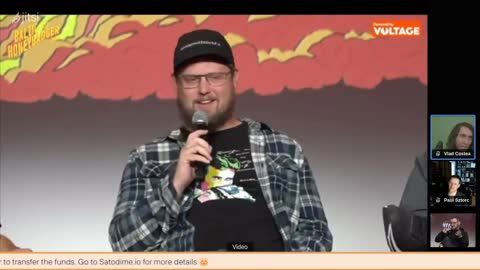
0:00 I think this one might be a little bit spicy. Ladies and gents, please, if you can settle down now because we've got something very spicy for you. 0:14 We have Peter Todd defending against Paul Sztorc and the latest attack on Bitcoin. 0:24 We have the Grand Emperor of Tabcomp himself, Michael Tidwell, refereeing this fight. 0:34 Peter Todd. 0:44 I want a clean fight. 1:02 Verbal only. No physical. No strong manning. No overly steel manning. No manning. 1:12 You know what I mean. 1:24 You might be wondering what I'm doing up here. I'm just going to blow my whistle if there's a deadlock in the conversation, which I feel like happens a lot of times with Drivechain conversations. 1:34 I'm going to blow this whistle, which means we're screwing up and we have to figure it out. I represent a neutral referee. 1:44 You're representing time. That's not neutral. We all die. 1:54 What is Drivechain? The idea basically is to take the unused OPNAT5 and use it to count to 13,000. 2:06 If you can successfully count to 13,000, the transaction goes through, and if it can, then it doesn't. 2:12 It turns out that in my view, this is the optimal SPV proof, and it allows Bitcoin to travel to other pieces of software, other blockchains, which solves most of our problems. 2:24 Please count it. There's an integer in the code, and the miners can move the counter up once per block if they wish, or they can ignore it, or they can do other things about it. 2:38 Hey, I'm sorry. Real quick. In order for us to really know the result of this debate, if you don't really care about Drivechain, like you don't really have a strong opinion, keep your hand down, 2:48 but if you have a really strong opinion in favor of Drivechain and you don't care about doxing yourself, can you raise your hand? 2:54 Okay, so we've got about five. If you are highly against Drivechain, can you raise your hand? 3:06 So at the end of this debate, we're going to do a vote again, and I like that it's fairly even, 3:19 and we're going to see whose heart, you know, if Peter's won your heart or Paul's won your heart, okay? 3:30 All right. Let's go. And if you become even more confused, there's a third option. 3:36 And then the third option is you can raise your hand if you still don't care. 3:41 Okay, continue. Sorry. We're counting to 13,000. 3:48 All right. So we're counting to 13,000. That's what? Three months? 3:53 It's supposed to be at 13,150, and it's supposed to be three months worth of blocks. 3:57 Okay. And when do we stop counting? 4:02 26,000 blocks, and it turns out it dies. 4:05 Okay. So who decides what this count means? 4:13 The scripting server will throw an error if you try to withdraw from the coins that are locked behind this op-nop. 4:22 So if the counter reaches 13,000, you can withdraw the coins, and if it doesn't, you cannot. 4:28 So I guess, I don't know, the Bitcoin block validity rules. 4:32 Okay. So I think, like, maybe we can go and explain this in a different way. 4:36 So let's start with a goal here. You have, like, Bitcoin Hivemind as an example, right? 4:43 I do. 4:44 Well, long story short, Bitcoin Hivemind, roughly speaking, has a set of rules. 4:49 It's not in Bitcoin right now. We'll probably never get into Bitcoin because we arbitrarily hate it. 4:54 No, it's also because – 4:59 I'm not sincere in distracting the audience. 5:03 But that's one point of all. First one of 300. 5:08 And just so you know, it's – 5:09 As a person, he knows because he actually did me the favor of reviewing it back in 2015, 5:13 and Bitcoin Hivemind has all kinds of bizarre experimental state and things that it would never come to Bitcoin by itself. 5:19 So as a side change, it's sort of a – 5:21 All right. So we agree on that part. 5:23 But you still want to go try. 5:25 I think it solves other problems as well, but that was how I first got interested in this topic. 5:30 Okay. And the important thing here is, from the point of view of Bitcoin, 5:35 that you want to denominate the stuff in Bitcoin Hivemind in Bitcoin. 5:39 It's not merely the denomination. It's like, you know, if you go to an ATM, 5:43 you wouldn't say, like, the check income is denominated in dollars. 5:47 You put a $20 bill in, it goes up by $20. 5:50 It really is an abstract dollar. 5:52 Same way that the Lightning Network is denominated in BTC. 5:57 It really is renewable. 5:58 When you move coins into the Lightning Network, you get the one-to-one thing, so to speak, 6:03 and then you withdraw them again. 6:05 With risk, of course, as we all know. 6:07 Or we put our money into the fiat bank account. 6:09 We might get broke both ways. 6:11 Yes. There is new risk. 6:13 It would be a neat trick if you could do the sidechains and they had the exact same security as L1, 6:18 but I think we both agree that in that case, no, we wouldn't have this problem. 6:22 We wouldn't have any problems. 6:24 That would be nice, but it's not possible. 6:26 You have to sacrifice something. 6:27 And the goal, the design criterion for Bitcoin Hivemind is that the sacrifice is totally borne 6:33 by whoever chooses to put the coins in. 6:35 And people who do not want to participate do not even notice what is happening. 6:41 That is the goal. 6:42 Well, I mean, it's always good to think of things that could go wrong. 6:46 So what's an example where I could go put my money into Bitcoin Hivemind, 6:50 and even though I won all the Hivemind bets or whatever it is, I still lose all my money. 6:55 How could that happen? 6:56 Well, you could lose money by the rules of the sidechain, of course, 6:59 if you place a bet and lose. 7:00 So you could lose within the protocol rules. 7:02 Obviously. 7:03 Unless I'm a good better, so we'll do it that way. 7:05 So you win, yes. 7:06 Yes. 7:07 Well, I think it's well known that the main risk of Drivechains, the BIP300, 7:13 is that the miners are the ones setting the destination, 7:15 and the miners are the ones setting the output. 7:18 They're the ones counting the $13,000. 7:21 And so they are the ones who can set the withdrawal destination, 7:25 and they can take all the coins in this layer 2, which is the main drawback. 7:32 But I have a lot of arguments for why they probably would not. 7:35 If they do, they would have left back where they were. 7:37 So it's a term metric, right? 7:39 That actually describes what it is. 7:41 And I'll point out that so Blockstream, Integate, MergeLine, SideChainSync, 7:48 they might have been the first people to introduce the idea of HashRedesco. 7:52 I got it from them. 7:55 I got the SPV proof idea from them, and I just thought, 7:58 I don't know why I thought HashRedesco was a better name for the Bitcoin. 8:02 How do you use SPV proofs? 8:04 Well, as you know, I kind of use that phrase in kind of a slightly more abstract way 8:09 than they used it because in Blockstream's October 2014 paper, 8:14 what they had in mind was literally you would take on the sidechain 8:18 like a bunch of headers there and put them into an L1 transaction. 8:23 You'd see like kind of a glimpse of the headers of this different blockchain. 8:28 And that was their version of an SPV proof. 8:30 But I have a slightly different version, 8:32 where, as you know, I have the work kind of flipped around. 8:34 I just assume that everything will be MergeLined. 8:36 I assume the set of miners is the same. 8:38 I assume that what they're doing when they move the – 8:44 since it's the same group of people, I assume that when they move the counter up 8:47 from like 12,999 to 13,000 that they are, in effect, 8:53 putting the work of finding that block into the withdrawal that they stand behind. 9:00 So it's the same group of people, but I mean BIP301 talks about like blind MergeLining. 9:07 I mean how does this separate? 9:09 Well, I think – I'm totally happy to talk about blind MergeLining, 9:13 but I do worry that it gets a little – like blind MergeLining is sort of optional, 9:17 and it's like you cannot possibly really even enforce sidechain to use blind MergeLining. 9:23 I think everyone would use blind MergeLining. 9:26 I mean I think it's actually not only easier to BIP, 9:29 but it's also the natural equilibrium outcome of any MergeLining 9:33 because the miners don't want to pay any costs. 9:35 They want as little hassle as possible. 9:37 So the best thing of all would be for them to not run any sidechain node 9:42 and then just partner with someone who is, and BIP301 makes this trustless. 9:46 And so I think that blind MergeLining is a cool idea, 9:50 but it's kind of like a cherry on top or it's kind of like an extra thing. 9:55 And I'm happy to talk about it, but it does seem to me that people are struggling an awful lot 9:59 with accounting for $13,000. 10:01 Hey, we have people leaving because they're bored. 10:04 You've got to stop putting these long responses. 10:08 So, all right, so we mentioned blind MergeLining. 10:12 So you're saying that this is trustless for the miner, 10:16 but the thing that kind of surprises me when I was looking at BIP301, 10:20 I don't see any relation to BIP300. 10:22 I mean, how does this blind MergeLining thing relate to the hashrate escrow? 10:27 You are correct. It's orthogonal. 10:30 You could have blind MergeLining of an altcoin that's not the hashrate escrow, 10:34 and you could also have a BIP300 sidechain that does not use blind MergeLining. 10:40 Okay, so we have this potential way of doing consensus, 10:43 but it has nothing to do with who decides who actually gets state money out of the sidechain. 10:50 Well, there is a relationship. 10:52 If you use blind MergeLining, then you have the same, you know, 10:56 the layer one miners on BTC are the miners of the L2, 11:00 so they are progressing the L2, so they know the real withdrawal, 11:05 and they also set the L1 withdrawal, so they know everything. 11:09 Now, to be clear, but then you also say, and I think I've heard you say this before, 11:13 that some, you know, Drivechains don't affect Bitcoin mining necessarily. 11:20 Okay, I think you're right to point that out because I think this is kind of like maybe a miscommunication on my part, 11:26 which is that you and I, we've been in Bitcoin for a long time. 11:29 We've lived through, like, the invention. 11:31 No one cares about our history. 11:33 So, like, but it's like many things have happened. 11:35 The miners have a list of things they have to do, like buy ASICs and cool the ASICs, 11:41 and find cheap power. 11:42 So they have a list of things they have to do, and they have money that they earn. 11:46 And that list has been changing a lot over the last few years, 11:49 and so it does change further with this, but to me it doesn't really seem to register as any kind of normal chain. 11:54 Well, all right, so let's be clear. 11:56 So let's suppose Bitcoin pipeline gets implemented. 12:00 Let's suppose, you know, it's quite popular, like half a billion dollars goes on there. 12:05 How is it that money would be withdrawn from the Bitcoin pipeline Drivechain without the participation of miners? 12:12 Because when I go look at BIP300, it seems like I need a majority of hash power to sign off. 12:16 Yeah, you do, and the miners don't need to – what the miners are going to do, 12:22 the way that BIP300 works is the miners are the same people. 12:26 So nothing is crossing from L2 to L1, but since the miners will run both, the miners are like the conveyors. 12:32 But to answer your question – 12:34 So you said the miners are the same people, but we also have this Blind Merged Mining idea. 12:40 How does this fit? 12:43 The relationship is that the miners can, the day-to-day of not running the sidechain node, 12:51 they don't have to run day-to-day, but if there's ever some kind of dispute or problem, they could run the sidechain node. 12:57 Blind Merged Mining means that L2 and L1 – 13:01 So you said day-to-day, they don't have to run it, but if there's some dispute, 13:07 yet if I want to withdraw money from the Bitcoin pipeline Drivechain, 13:11 I have to in a six-month period get 50% of blocks to agree that the withdrawal should happen. 13:18 I mean, how does this compute with they don't day-to-day have to run the software? 13:23 The way they would know with absolute certainty what the true withdrawal hash is, 13:30 because this is just one hash every three months, is to run the sidechain full node, 13:34 and that will tell them, okay, for Q3, this is the hash, this is the one withdrawal that's valid for this three-month period. 13:41 But they can also learn it in any other way, so they can run the sidechain in SPV mode, 13:45 or they could just call a friend who's running the node and get it from them. 13:50 So they have the best of both worlds. 13:53 No, they have the best of both worlds. 13:55 So they have the option to achieve absolute certainty by running the node themselves, 14:00 even if they haven't been running one at all for years. 14:03 They can say, well, it's finally happened, there's finally a dispute. 14:06 They could then run the node, and because of the way sidechains work, 14:10 the node may have UTXO commitments or things that may not need us all, but it's history. 14:15 But the point is, to obtain absolute certainty, they would run the node, but they don't need to. 14:20 They can learn about it the same way anyone learns about anything. 14:24 They could just guess, or they could hear about it from someone else. 14:27 So you want to – so in my example, say, half a million dollars stored in a pipeline chain, 14:32 obviously someone could go create a withdrawal proposal that just steals all the money. 14:37 Correct. 14:38 And you're expecting this to be based on people potentially just guessing? 14:42 No, I don't. I think it's based on self-interest. 14:46 The security model of GOOG 300 is that the miners are collecting transaction fees from all these chains 14:52 in return for basically not doing really any additional work. 14:56 And so it's a relationship where – it's a relationship of fear and greed on both sides. 15:02 So we, as the user, we would fear that the miner would steal from us, 15:06 and we would greedily want the new feature. 15:09 But the miner side, it actually looks the same way. 15:12 The miners are thinking, are we going to make – we want all this transaction fee revenue, 15:17 and they think if we don't get this money, we will go out of business 15:22 and we will instead of being a profitable business, we'll be an unprofitable business. 15:26 And their fear is that they won't be able to entice anyone. 15:30 Well, so let's be clear here. 15:32 So in this – I mean, correct me if I'm wrong, but basically the wage-Drivechain's proposals right now 15:37 can have up to 256 Drivechains. 15:40 That's correct. 15:41 Now you can imagine a future where fee revenue through line-merge mining 15:46 is spread across 256 Drivechains. 15:48 Do you expect me as a miner to like nearly every day try to research yet another proposal 15:56 to go figure out whether or not this is a fraud attempt or not? 15:58 I mean, this sounds like a lot of work. 16:00 No, it's designed to be the reverse because it's the sidechain node 16:03 that automatically generates only one true withdrawal every three months. 16:07 So it's only 32 bytes every three months. 16:10 I don't really think there will be 256 sidechains, so there might be. 16:14 And, of course, there could be more because miners could solve for 1,500 A, B, C, D, 16:19 and they could just put – 16:20 Well, to be clear, I mean, when you say one true withdrawal every three months 16:24 over all the sidechains out there, that means quite frequently if I'm going to be a miner 16:31 and it's not potentially allowed theft, I need to go figure out for yet another piece of software 16:37 what on earth is going on. 16:38 It's true, but I don't see a problem with that at all. 16:41 I think it's the enticement of the fees that encourages miners to support the hashrate escrow 16:49 or the sidechain as I would see it. 16:52 All right, so there's this enticement of fees. 16:55 But, again, we're still creating an enormous amount of work. 16:59 And, I mean, let's give a slightly different example. 17:01 Let's suppose that we get Strategy V2 working. 17:04 And, as we know, Strategy V2 is meant to allow someone like myself writing however many terahash worth 17:11 of mining on a small scale to actually produce blocks. 17:14 I might be earning, say, $100 a month producing blocks. 17:19 Yeah, but what Strategy V2 does is it allows you to propose the block. 17:23 The pool can still override it. 17:25 So I think Strategy V2 is great, but I think it doesn't do anyone near enough. 17:29 I also don't think it's a big problem because the pools, in general pools, 17:33 they have so little agency that to me they almost don't exist. 17:36 Wait, wait, wait. You're saying pools don't have agency? 17:39 Yeah, I think in this example they're the ones who basically gatekeep whether or not money gets sold. 17:45 Well, the reason why I don't agree with that is because it's so slow that it's not as though – 17:52 sometimes people say, well, why don't you just have a multisig with the four biggest pools? 17:56 Isn't that the same thing? 17:57 But no, the four biggest pools are going to have this key and just withdraw at 3 a.m. 18:02 and take the money before any of their own clients realize what is happening. 18:08 So the pools only exist if they are benefiting financially their customers. 18:14 The customers will say, hey, I'll do it again. 18:16 When you say it's so slow, remember, 18:20 it may be slow for an individual direction, yet there may be many of these things we have to worry about. 18:24 That's not slow. 18:25 I have to do much work every couple of days to quote, unquote, honestly mine Bitcoin. 18:30 I think even in a situation where the sidechain software has huge blocks and is very difficult to run 18:37 and you must catch up months' worth of history, 18:40 it really just doesn't take three months to sink – it doesn't take three to six months to sink a blockchain. 18:49 I feel like you're setting this up for a haymaker. 18:52 I just want to make sure we do a health check. 18:58 The people who are following along here, 19:02 has anyone changed their mind about any of the discussions so far after listening to the conversation so far? 19:11 Okay. 19:13 We have one person. 19:16 I do feel like we're setting up the premise for an epic tale like we're doing a prelog, 19:23 but I would say if you could try to get a little bit more pointed, if that's okay. 19:30 I think what we're leading up to pretty quickly is I think we seem to both agree on the fact that with Drivechains, 19:39 if they work the way you expect them to, we're adding a hell of a lot of overhead for miners. 19:44 I mean the fact is that if I want to go be someone participating in a Stratafy 2 pool or something like that as a decentralized miner, 19:51 I now have far more overhead that I'm meant to go and deal with. 19:56 And if I fail to deal with that and a lot of other people fail to deal with that, 19:59 at best Drivechain coins will just get stuck and it won't be possible to go spend. 20:06 I think that's correct. 20:07 But the reason it doesn't worry me the slightest is because miners' overhead and fixed costs have skyrocketed ever since Bitcoin has been created. 20:14 Like I was saying, now they have to have ASICs, now they have to have immersion cooling, now they have to have the natural gas credits, etc. 20:21 And in fact, like I was saying, with leverage mining being the equilibrium outcome for miners, 20:26 it's like this is an open source software that anyone can run. 20:31 They run the software and it costs them a lot. 20:34 Are we sure Drivechains are going to be open source? 20:36 I mean there's obviously nothing we can do to standardize it. 20:39 That's true. 20:40 How do you have closed source? 20:41 Well it's funny, the amusing thing is of course Liquor is closed source in Africa. 20:45 And of course you can have – well one example, a counterexample I would give has become popular this week, 20:50 which is the Riot's use of the Curtailment Credits, where you have basically the government of Texas, 20:58 or through a proxy of the government of Texas that is a non-profit. 21:02 Look, the government of Texas can cash to miners, not to mine. 21:08 And not just to any miner. 21:10 They only pay to the one they have a signed agreement with, Riot. 21:13 But this is handled as a good thing, even though if you compare it to running software, 21:20 and especially with the blind verge mining as the equilibrium of them not even running the software, 21:25 you have all these other people who are actual users, who have already run the software, 21:29 and they just tell the miner what the hash of the next block is going to be. 21:34 Exchange order. 21:35 Twitter or something. 21:36 Yeah. 21:37 Whatever other scenario is handled as a very good thing, it's just a waste of time. 21:43 Look, I think where you're really going with this, you expect this to be acceptable, 21:49 because you think – you expect miners to log a bridge. 21:52 Of course, I may disagree there. 21:53 I may point out things like, well, I expect miners to run on things like solar power, 21:57 where I just go mine because I happen to have my house have a bit of extra energy. 22:02 I mean, if we want Bitcoin to be – 22:04 I don't agree with this very well. 22:06 Hold on, hold on. 22:07 Yeah. 22:08 If we expect Bitcoin to end up with decentralized mining, that's the kind of thing I'd expect to happen. 22:12 Also, of course, to go say that something like, say, immersion pooling represents an overhead. 22:18 Again, I can't agree with that precisely because there are lots of people who do not use that tech. 22:23 I think we have very strong disagreements on economics here. 22:26 I guess so. 22:27 But, I mean, again, can you describe the disagreement? 22:29 Because I'm not good at it. 22:30 Okay. 22:31 I think what you're saying is that it's not literally mandatory to use immersion pooling. 22:36 So how is it that I claim that it is a fixed cause of mining? 22:42 Something like that, right? 22:44 Yeah. 22:45 Well, you know, of course, when we say mining, we're as technical people. 22:48 What we're really talking about is the act of creating blocks, not the act of doing hashing. 22:53 Yeah, but as you know, I just – I say that the pools don't really have very much agency. 22:58 And if they construct blocks that are bad, the hashers will point their hash to a different pool because, as we both know, it's very easy to point your hash to a different pool. 23:07 It's not as easy for someone who has a pool to – 23:10 Because we can only use it around Bitcoin Core. 23:12 I mean, you're suggesting a future where you could have 200 different pieces of software, and you need to know how to mine them, quote-unquote, honestly. 23:19 Well, that's kind of – I mean, the – I don't know if I would refer to it that way because we already have merge mining of things like Namecoin. 23:28 Namecoin merge mining was invented by Satoshi in 2010, and now, as you know, you have to run the Namecoin software. 23:33 To be clear, Namecoin is nearly worthless. 23:35 Yeah, right. 23:36 We agree on that. 23:37 Like, we're not talking about something that's economically relevant here. 23:40 Yeah, but you would agree that even though it's worthless, it's – it demonstrates that merge mining cannot be – classical merge mining cannot be stopped by L1. 23:51 Look, it's economically worthless. 23:53 It's not interestingly good to discuss. 23:55 I think somebody else would agree more, too. 23:57 Well, can we talk about ORAM, though? 23:58 It's important. 23:59 Well, I mean, again, we – I can't – 24:02 It's a fixed cost of a huge – the fixed costs are basically zero for running software, in my view. 24:07 It's like very cheap because of – even if you don't literally use line merge mining, you don't – you – imagine that software is costing like $10 million a day. 24:18 I – 24:19 The miner is going to think like, well, wait a minute. 24:21 How is it that I can collect these fees? 24:23 To be clear, when you said line merge mining, we already established that it is not relevant to the question of – the really fundamental question of protecting the bitcoin on the direction. 24:35 Yeah, we agree that – I think that's interchangeable. 24:38 But as I also said earlier, not only is it a BIP and not only is it something that helps miners and full nodes cooperate trustlessly and privately. 24:48 Not only is it that, but I also think it's kind of just a description of the equilibrium outcome of mining. 24:53 Again, line merge mining is not relevant to this discussion of how is it that the coins on the sidechain are protected. 25:02 Okay, and I'll explain it without using line merge mining. 25:07 Now, I also want to – 25:08 I was saying if the node had cost a lot of money to run, a miner would be thinking, well, I like collecting all these fees, but I don't like paying these costs. 25:18 What can we do to not pay the costs? And then they will, you know, they'll turn off the outsources to the pool or in the extreme case of this floating phrase that I'm not going to say, 25:28 they'll just call up someone who's already running the node because, of course, remember, each of these could be a real blockchain network. 25:34 They must have a bunch of actual full nodes that aren't mining at all. 25:37 So if you have a full node and you have a bunch of actual end users, people are just running like Zcash, sidechain, the software. 25:44 These are like what you might call 0% miners. 25:48 They are. 25:49 Again – 25:50 People are not mining at all and they still run the node, so they must exist. 25:52 So the node cost really does have a very ceiling in practice. 25:55 Again, we're talking about – 25:56 We're talking about – 25:57 We're having a $10 million a day node where people are – 26:01 Again, we're talking about a situation here where this easily degrades to you go call a friend and hope they go tell you something. 26:08 But, anyway, I think it would be useful. 26:10 I think we're on – 26:11 Yes. 26:12 This is crucial, though, because if it does degrade to that, it will only mean that the sidechain – 26:17 if the developers have done a bad job, then it will fail. 26:20 So that's a good thing. 26:22 We want there to be competing pieces of software. 26:25 We want some of them to fail. 26:26 We want people to try very experimental ideas. 26:29 We do not want people to be trying things that are so safe that they have more options. 26:34 I think we're in a semantic deadlock right now where I think maybe just really concisely phrase – 26:41 Well, I thought it would be useful to move on to the Blind Merged Mining concept because, of course, you also have this idea that – 26:53 I mean, and again, I think we've established that there's issues with the hashrate escrow. 26:58 But secondly, you have this idea of Blind Merged Mining as a way of not having miners involved in the day-to-day consensus. 27:05 But a problem with it is when you go and say that you have, say, a three- to six-month period. 27:11 Now, let's suppose that, again, we have, say, a bottom line structure. 27:17 There's non-trivial fees generated. 27:20 Well, if I'm participating in the Blind Merged Mining process, someone is proposing blocks to be mined. 27:30 Assuming there's someone paying me, but if I'm then paying miners fees to try to convince them to blind merge mine that, 27:39 I don't get access to those fees for at least another three months, assuming everything goes perfectly. 27:45 So now I have an enormous chunk of money tied up on the promise that maybe in the future Drivechains will get working. 27:52 I mean, this actually sounds a bit centralized because how many people by their decisions will do this? 27:57 Well, I think it's – I don't think it has any differential effect on any particular person. 28:02 So it's no matter who is – no matter who collects the L2 Coinbase fees, whoever does that, 28:09 it doesn't matter if they are L1 miners or they are people using Blind Merged Mining, 28:14 or a poor guy or a rich guy or somebody in Japan or somebody in Europe, it doesn't matter. 28:19 No matter what, those are coins that have the block maturity period on L2, 28:24 which is 100 blocks still in our examples, and then it has to wait for three months to get out. 28:29 So that's – it's the same disadvantage for everyone, and so it doesn't affect anyone differently. 28:36 But let's just be clear on one thing. With Blind Merged Mining, there is a backdooring way, 28:42 in that miners do not need to be blinded. If miners are not blinded to the Blind Merged Mining, 28:49 there is not this problem with the cost of holding money. 28:55 You do not need to have this enormous, say, 1,000 bitcoin reserve to deal with the fact you get paid three months, six months into the future. 29:03 But again, this is not – well, you're right about that, but to me it is actually a pro, not a con, 29:08 because what it means is to the miners – 29:10 Is it a pro or a con? You said both. 29:12 It's a pro and not a con. 29:14 Not a con. 29:15 So it's good because the miners will always be willing to buy the sidechain coins at 99 cents on the dollar 29:20 because to them they're equal and they can market back over the system. 29:24 So to me it is actually a good thing. It means that not only are they worth 99 cents on the dollar for miners, 29:30 they're worth 99 cents on the dollar for everyone because there's this open market. 29:35 Of course, there's still this problem that you have all this money going to be tied up with this call-a-friend kind of consensus. 29:43 Yeah, but again, it doesn't really lie in a call-a-friend. 29:46 It's just as – you can imagine a world where I force, at some point, everyone to run the sidechain now. 29:53 This is like, you know, Luke Dasher in the world. 29:55 So it's a massively increased block size, effectively, but worse. 29:59 It's like 200 different pieces of software. 30:02 Because the reason what the block size was about was what the LMO now must do. 30:06 So this is no more block size increase than would be Namcoin or Litecoin or OpenTax did. 30:12 So you don't think it's critical that mining be something that anyone can easily get into? 30:17 Well, just think about that chip as basically completely stale because it's because of proof of work 30:24 that because of the upward difficulty adjustments that it costs so much money to mine. 30:29 That's not a statement that's true, though, because with $1,000 worth of hashing equipment, 30:36 my percentage relative to my percentage of hashing power has not changed. 30:43 It used to be back when I was mining maybe 2012, 2013, you could run P2 pool and you could go make money. 30:51 And provided we go and fix those technical problems with P2 pool, we can get the exact same place again. 30:57 Except, of course, we add, you know, things like Drivechains, 31:01 which suddenly makes it totally infeasible for me to easily run P2 pool. 31:04 Now, I think this is a mistake. 31:05 Like, having huge amounts of fees come from Drivechains and come from merge mining, online merge mining, 31:14 that is what would re-decentralize mining. 31:17 Why do you de-centralize mining if it becomes much more difficult to run the pool? 31:21 Because, as I've said, I don't see running the software as something that could ever cost a significant amount of money, 31:28 whereas something like the Riot Curtailment Credits is something that is not feasible for, like, one random guy to do. 31:35 Although, it would be an interesting exercise to find out if it is, 31:37 if some random guy can just call up the government of Texas and say, 31:41 I have one S9 and I want to lock it up. 31:44 I mean, if you realize, in that specific example, that is exactly what is being proposed in automated systems, 31:49 where you can go turn off loads and change the money. 31:51 I mean, this is something that is being proposed. 31:54 Yeah, I don't understand. 31:56 I don't understand enough about what the scale of it is. 31:59 You have to sign a legal document. 32:01 The scale is relative to the amount of power you're using. 32:05 I mean, again, this is a linear thing. 32:08 This is actually superior, though, 32:10 because running the node is a very small cost that can be reduced to zero. 32:15 So, again, you say running potentially, like, 200 different sidechains. 32:19 Well, it could be more. 32:20 If you say 200, it could be any number, 32:22 because they could add sidechains off sidechains, or they could have... 32:27 To be clear, we're talking about your bid-miss-proposal, not some even more complex, I should say, thing. 32:32 Yeah, sure. 32:33 I know it's 250. 32:34 Say 200, roughly. 32:35 Yeah, but miners have a list of things they have to do. 32:37 I mean, would you say that buying an ASIC is a box-sized increase? 32:40 No, because buying an ASIC is something that's low overhead. 32:44 Like, it's not a fixed overhead, no matter how much I go buying. 32:47 It's a very... 32:48 No, exactly what it is. 32:49 It's a fixed... 32:50 Buying an ASIC is a fixed cost, and then the electricity is the vertical cost. 32:54 I can't agree that it's as significant. 32:56 It's not in the same way that now I have to... 32:58 Do you really think that there's going to be... 33:00 Do you think there's any software that anyone could write down, 33:02 how much do you think it's going to cost, like, thousands and thousands of dollars? 33:06 How much do you think this software is going to cost? 33:08 Yeah, yeah, bare minimum is quite low to get in. 33:10 This is why so many people are using space eaters and stuff like this. 33:14 Yeah, but I don't really think there's going to be any software that's going to cost as much as Duke. 33:19 For anyone to create a statistically significant-sized model... 33:23 For me to install a piece of software that takes 30 minutes with my billable hour rate is a lot of money. 33:31 I mean, that's how this stuff works. 33:33 It's a huge over budget. 33:35 I mean, that's just reality. 33:37 Like, people's time is very expensive. 33:39 Yeah, but it's not really the point. 33:41 It's like, miners have a whole list of things they're required to do. 33:45 Well, okay, you were happy making that list a lot longer. 33:49 Do you agree on that? 33:51 I think I made the list longer, and I made the revenue side much bigger. 33:57 I think it's actually possible that there will be 10,000 times more fees eventually. 34:02 That's not a guarantee, but I think there will be huge amounts of fees. 34:08 All right, guys, look, we've got 10 minutes left. 34:11 We're entering the final round. 34:14 I think the audience is more gassed than us up here. 34:21 I need y'all to hit your hard-hitting final points. 34:25 Peter, maybe you can drive some of this conversation. 34:29 I think it's just that miners may have spent more money. 34:33 Yeah, so let me give another example, something I'm worried about, given we've kind of already been in circles here. 34:39 Of course, I personally am being sued by Craig Wright for two different lawsuits, 34:43 one of which is to go and seize a whole bunch of money and give it to him. 34:48 Obviously, a problem that you are adding is that now you have all of these coins, 34:54 if Drivechains are successful, subject to death by miners. 34:59 I mean, this does invite legal risks. Do you agree? 35:03 No, I don't. 35:04 Why not? 35:05 Well, I mean, what are they going to do, exactly? 35:08 They're going to say, we sue Foundry and force them to withdraw the tribal reservable coins. 35:15 Foundry and Anpol have a collectively majority passion for it. 35:19 They absolutely can go and, you know, whatever goes. 35:22 The only question is, because it's very simple, 35:25 there's a simple question of, is it in the customer of Foundry, that Foundry's clients, 35:32 is it in their best interest to steal the coins? 35:38 I mean, we can give them a split of it, then the government order is not required. 35:42 We can obviously give them a split of it. 35:44 I mean, after all, in the example where there's half a billion dollars in a pipeline, 35:49 we can certainly go and split that 50-50 with the people going in and helping out. 35:54 Yeah, but if it's in their financial best interest, 35:56 the government order or the lawsuit or whatever is superfluous, 36:01 and if it's not in their best interest, then they'll start, 36:03 they'll get one 13,000th of the way there, you know, at the end of day one, 36:07 and then they'll have a group on every single mining report 36:11 to something else. 36:13 Let's give it a different example. 36:15 What if we did this with a small transaction? 36:18 Yeah, the ratio of what the miners think they'll be getting in fees 36:23 versus the total number of coins in the Drivechain at any given moment, 36:28 that is crucial. That's absolutely crucial. 36:31 So you're absolutely right about that. 36:32 But I see it as kind of like, you know, it's like a relationship. 36:35 Like the miners, again, the miners are thinking, 36:37 how am I going to get a bunch of fees out of this in the future? 36:39 I want miners to be very greedy and to think, 36:43 we need to get everyone using Bitcoin, 36:45 and we need to get $0.50 from every transaction in the world, 36:48 and they're thinking, like, oh, we're going to get a ton of money. 36:50 So at first, it would be great for people. 36:52 Let's be clear, this is the same argument to go make blocks bigger. 36:54 You know, we can go make miners… 36:56 It is a similarity in that way, but it's not a similarity in how long it costs, 36:59 as you know. You know, the total… 37:01 Well, I can agree with you, because it is very important 37:03 that people be able to run Node to go and actually mine. 37:07 That is how you can imagine how it would be similar. 37:09 But you would agree that build 300 does not increase the L1 block size? 37:14 No, I don't. I agree that… 37:16 Hang on, hang on. 37:18 There's a block size problem. 37:20 Let me finish. I believe that in these types of failure modes, 37:24 in practice it does, is to the extent that Drivechains work, 37:27 and to the extent they don't work, 37:31 of course, we've taken on a pile of risk 37:34 for something that didn't work out. 37:36 I mean, first, why are you doing this on Litecoin? 37:39 Well, I don't really want Litecoin to succeed. 37:42 I'm not that interested in Litecoin. 37:44 But I wouldn't be opposed to people doing it on Litecoin. 37:46 That's fine. 37:47 Are you planning to do… 37:48 Are you working with any other coins at all? 37:50 No, but there is someone who launched a funny altcoin 37:54 that is using build 300. 37:57 What's the name of it? 37:58 It's called Sky Doge, but I'm not… 38:01 They're very funny, and they hang out in a telephone booth, 38:04 and they have great gifs and stuff like that. 38:07 Like a stealth bomber with a giant Doge face on it. 38:11 The great thing about this is if they do launch, 38:14 you can always just go with it and see if it works. 38:17 I mean, there's certainly no rush frame in this. 38:19 There's certainly no rush, 38:20 and I find it to be quite a compliment 38:22 for people to pay so much attention to my idea. 38:25 And if people say something like, 38:26 I don't have a hard time to think about it, 38:28 I fully respect that. 38:29 What I often find to be kind of ridiculous and annoying 38:31 is people clearly haven't even read the bit. 38:33 They don't know anything. 38:34 They haven't been to drivechain.info, 38:35 they haven't been to the FAQ, 38:37 and then they start talking about it 38:38 and say, oh, I don't like it or whatever. 38:40 I want to ask a question. 38:42 You mentioned why not Litecoin, 38:44 but from what I understand, 38:47 no altcoins necessarily want Drivechain necessarily. 38:50 Not even Bitcoin Cash, not Litecoin. 38:52 None of these coins necessarily want to just say, 38:54 hey, bring Drivechain here. 38:56 And then there's also the situation where Paul mentioned, 38:58 hey, Sky Doge is using Drivechain, 39:00 but we're talking about potentially networks 39:03 that have no value anywhere compared to Bitcoin. 39:08 So how could we potentially even have a, 39:12 like even if we do deploy it on Litecoin or something 39:15 and it doesn't get exploited or hacked for years, 39:21 how does that even give us confidence 39:23 that it would still be okay for Bitcoin? 39:25 I mean, it's better than having zero confidence at all. 39:28 I mean, we have a play money testnet, 39:31 which I think that should be enough for some of the things. 39:34 Well, I mean, everything you describe 39:37 talks about financial incentives. 39:38 You can't test this on the testnet. 39:40 Well, that's also difficult to test on Litecoin, 39:42 I think, for the same reason. 39:44 Okay, minor activated software thoughts. 39:46 I think we have to talk about 39:48 whether or not it's a block size increase 39:49 because I deliberately set out to ensure that it was not. 39:53 So it's unfortunate to be misunderstood in that way. 39:56 Your layer one node, when it runs with 300, 40:00 it only looks at the L1 blockchain. 40:04 It only looks at messages that are 40:05 income-based transactions on L1. 40:07 It does not need to look into the other blockchain. 40:11 And the reason miners can steal is because of that. 40:15 Real quick, explain why it's an abstract block size increase 40:19 because maybe people are confused. 40:21 You have to explain it because L1 literally is getting bigger. 40:23 So why are you saying it's getting bigger? 40:25 Explain that. 40:27 We're talking in puzzles, I feel like. 40:29 Because what happens is if I want to go participate in mining fully, 40:33 if I am going to go and participate in any of this 40:36 in such a way that works, 40:38 the fact is I have to go and start 40:41 either doing this whole call-a-friend business. 40:44 Hey, let me explain. 40:45 Doing this whole call-a-friend business 40:47 to go and learn more about mining software 40:49 or doing some other system 40:51 to go and be able to mine Bitcoin in a way 40:54 where the Drivechains work properly or don't get stolen. 40:58 I mean, that is fundamentally why this is 41:01 analogous to a block size increase. 41:04 Well, L1 aren't too much worse, 41:05 at least with a block size increase. 41:06 You can go use software for a cheap hardware program. 41:09 This is having to go through a whole lot of human labor at the problem, 41:13 which is a very, very ugly thing to do. 41:16 We want mining to be simple 41:18 based on just writing some simple software 41:20 that doesn't have to change very often. 41:22 In much the same way, 41:23 that is a dream of things like P2Pool. 41:25 There is a dream of things like Stratum V2. 41:28 Okay, but it is very hard to define. 41:31 Wait, wait, wait. 41:32 No, no, no, no. 41:34 But you are defining L1 based on its functions. 41:37 Agreed? 41:38 You are defining L1 on what it should be doing, 41:42 on its usefulness or whatever. 41:45 Well, to keep in mind, 41:47 because you are still abstracting. 41:49 Hang on. 41:50 During the block size debate, 41:51 this argument was made in the exact same way, 41:53 saying SPV is fine. 41:55 You do not need to go and validate fully. 41:58 And I think the problem fundamentally is 42:01 what does it take to participate fully in Bitcoin? 42:04 Part of participating fully in Bitcoin is mining. 42:06 And you want to make mining a much more complex thing 42:09 with a lot more overheads. 42:12 It is not even in the right curtailment credits. 42:15 I think it is much greater. 42:17 And there are all kinds of things that miners do 42:19 that we cannot stop them from doing. 42:21 Like if you have a swimming pool, 42:23 you can use the miner to heat your swimming pool. 42:25 But if you are not rich enough to afford a swimming pool, 42:27 then you cannot. 42:28 And so there are many little cost curves you can draw. 42:31 If miners decide to destroy and set all their money on fire, 42:35 then it is a weird decision. 42:37 And if they decide to forego earning some money, 42:40 then there is no literal requirement at all 42:43 to do any merge mining 42:45 in order to run a fully validating L1 node. 42:50 So the full node cost is the important thing. 42:53 We do want that to be as low as possible. 42:55 But miners, there is no sense in which we want mining to be cheap. 43:01 Because every time the difficulty increases, 43:04 it becomes more expensive to mine. 43:08 If you are against mining becoming more expensive, 43:13 then you are just against approval. 43:17 You are talking around what I said here. 43:20 Hang on. 43:21 You are not talking about overhead here. 43:23 When you go talk about mining becoming cheap and so on, 43:26 you are talking about what it takes for you to hatch. 43:29 I am saying what does it take to fully participate in mining? 43:32 What does it take to run a pool? 43:33 What does it take to solo mine? 43:36 If you push this argument so far 43:38 that you include a tiny piece of software 43:40 must be amortized over cash, 43:42 then it is not even possible to run Bitcoin Core in the end 43:46 because the fixed cost is not literally zero. 43:53 All right. 43:54 Final thoughts, Carter? 43:56 We are running out of time. 43:58 They can run zero if they choose. 44:00 They don't get the transaction fees. 44:02 All right. We are running out of time. 44:03 I need you to give your final thought. 44:07 Your final thought. 44:08 But you can't have your final thoughts at the same time. 44:11 Yes, we can. 44:12 Just talk over each other. 44:13 It will be great. 44:14 All right. 44:15 Then we have a couple of questions from the audience as well. 44:17 Okay. 44:18 So Walton has got the mic. 44:20 Does anybody have a question? 44:22 Sorry, guys. 44:23 You all are awesome. 44:25 I am just getting my steps in. 44:26 Other people have questions too. 44:30 All right. 44:31 This is a very interesting conversation. 44:33 I sort of think about this in the framework of like fees, right? 44:38 And I have always been worried about fees being too high, 44:40 which is why I work on Lightning. 44:42 But a lot of people that support drive train 44:44 are very worried about fees being too low. 44:46 And obviously, we don't want fees too high. 44:49 Things aren't usable. 44:50 We don't want fees too low. 44:51 Then we have security issues. 44:53 So is there some sort of metric that the both of you could agree on 44:56 where if XYZ happens, indeed, fees are too low, 44:59 and that's a concern, something should be done about it? 45:03 Well, so I've made the point recently that between the different alternatives 45:07 of, for instance, just doing a block size increase 45:10 or doing a block size increase by having a Drivechain, 45:15 which is meant to be essentially identical to Bitcoin, 45:17 so you put Lightning channels and so on. 45:19 Between those two things, it is far simpler, 45:21 cheaper, and less overhead to just have the block size increase. 45:25 There's a lot less risk. 45:26 There's no coins being tied up that could be stolen. 45:28 I mean, between the two, that's actually the thing that gets you something better. 45:33 Of course, in general, I'm very confident we're not that worried about fees with Lightning 45:39 because we seem to be really good at scaling it. 45:41 And this is like a 10-year timescale thing to worry about. 45:45 Jim, can we also say something else? 45:47 We've got a few more questions here. 45:49 I don't know about the exact question, 45:50 but you can search security budget, 45:52 and you can find it. 45:55 Lucky is in favor of a block size increase. 45:57 He hates the Drivechain so much he's in favor. 45:59 Block size increase is the NTR mission. 46:04 So we have two people, like Walton said, answering questions. 46:07 Keep it super short so we can get to everyone with questions. 46:11 The main question I have is actually, 46:13 a lot of this discussion has been framed in the sense of you saying, 46:18 or you, Peter, saying that you're trying to advocate for miners 46:22 and whether or not they would be able to bear the cost of even participating 46:25 and that this should be grounds for not admitting a proposal. 46:30 Why is it that you believe that we can speak for them? 46:40 Or that we should deny the opportunity to participate? 46:45 See, I don't care about speaking for the miners necessarily today. 46:51 Like if you were to talk about that, 46:53 you would probably go and say, 46:54 all right, Foundry USA and Anpool, 46:56 they're obviously the most important miners out there. 46:58 Let's go see what they say. 47:00 That's not actually what I care about. 47:02 I care about how can we go make a Bitcoin 47:04 where miners in general can participate fully 47:07 and have a very large number of them? 47:09 Because after all, Bitcoin right now is a very… 47:10 So why don't you set the difficulty to zero then? 47:12 Yeah. 47:13 Minimal difficulty. 47:14 Bitcoin right now is a very… 47:15 Why don't you make it very easy to mine? 47:17 Hang on, listen. 47:18 Bitcoin right now is fairly busted 47:20 in that we've wound up with a lot of miner centralization. 47:23 I certainly don't want to make the problem worse. 47:25 How do you measure the miner centralization? 47:27 I want to put 30 seconds on the clock 47:30 and then we have 30 seconds to get to each question. 47:32 Is it the number of pools or… 47:34 Use your whistling, we're good. 47:36 And then you've got a hint if you're over. 47:38 Okay, so Paul, do you remember the question? 47:40 Yeah, it's an excellent question 47:42 because it's the why should we speak for the miners 47:44 and also it speaks to a bigger principle of 47:47 if Peter thinks the miners should do something 47:50 and the miners think that they should do something, 47:52 who do you think is going to ultimately win 47:54 when the miners wake up at 9 a.m. tomorrow? 47:56 It's probably them. 47:58 But yeah, he's again skirting the… 48:01 The reason to care about the long term is the node side 48:04 and that is exactly what I have successfully firewalled off 48:07 and that is what everyone should focus on across the room. 48:13 Okay, so… 48:15 Good. 48:16 So my question is also for you, Peter, around like… 48:21 It sounded on a similar vein. 48:24 You said a lot of the conversation was around 48:28 an individual being able to fully participate as a miner. 48:31 Again, I heard the other side incorrectly. 48:34 So I guess to like push on the opposite of that 48:38 and try to understand what you mean is like 48:40 what's bad about me half participating 48:44 or just like turning my ladder on 48:46 and not really investigating the software 48:49 and just like letting the algorithm try to… 48:53 Well, so… 48:54 Thirty seconds left. 48:57 The simple example of how of course you can participate in the leaks 49:00 is you just point your hash card at the pool. 49:02 What I want you to be able to do is participate in Bitcoin's consensus. 49:06 That's an important thing so that we do not have 49:09 a very small number of pools able to do things 49:11 like sensor transactions, 49:13 prevent other miners from getting in and so on. 49:15 Push came to shove. 49:16 Foundry and pool. 49:18 In a lot of scenarios, 49:19 they really could just push every other miner off the network 49:21 and that's not what we want. 49:23 All right. 49:24 It was an excellent question. 49:25 There's nothing wrong with half participating 49:27 or quarter participating and doing whatever else you feel 49:29 is the right thing to do. 49:30 It correctly emphasized that the consensual option 49:34 to increase the block size 49:35 is completely different from a mandatory L1 block size 49:38 that we're all stuck with. 49:40 That's the difference between being forced to have food 49:44 until you die and eating as much food as you want. 49:46 That's the difference in consent. 49:48 And I have other things to say, 49:50 but I'm going to run out of time. 49:55 Just to piggyback on that, 49:57 if it's an opt-in bit, right? 50:00 Miners aren't forced to use it. 50:02 They would only use it if they were incentivized to. 50:06 In this case, they really should use it 50:09 because it's so miner-centric. 50:10 We need lots of miners and some users to use it, 50:13 or it's not going to make any sense 50:15 because the bit was keeping miners on a short leash, 50:17 and it's also the whole thing involves 50:20 minor participation and miner incentives, 50:22 so it doesn't really make sense 50:24 unless we have a super majority of miners 50:27 and some users active in it. 50:30 All right. 50:32 To be clear, I mean, 50:35 the way that the bit bit right now has been set up 50:37 is that unless you get majorities and minors participating in things, 50:41 really bad things start to go happen. 50:43 So from that point of view, 50:44 it's certainly not a consensual opt-in. 50:46 And the bigger issue, of course, 50:47 is difficulty is difficulty, and it adjusts. 50:50 If you are a miner who's much more profitable than me because of something, I'm kind of forced to go do whatever you're doing, too. We don't want to do that. 50:59 Yeah, so one thing that I'm always really curious about is that the reason why companies like Foundry have gotten so big is because they can do things that aren't even considered in Bitcoin's consensus game theory model. 51:24 Like, for example, borrow a whole bunch of money and cut tons of deals for people, get really good prices on transformers that nobody else can get even access to. 51:32 Never mind that a lot of this stuff is in shortage, and that has nothing to do with what kind of code anyone can run. 51:40 Well, my answer to that is very simple. Direct change makes this problem worse. There's no reason why we want to go make these problems worse rather than at least keep the status quo and try to go make things better. 51:52 And as you can imagine, I have the opposite view. I think this proves the fact that such things occur and nothing bad has happened as a result. 52:01 Like, the bad things that miners can do are, like, censor transactions or reorder blockchain, but those things really don't happen at all. 52:08 And the fact that we have all these weird things happening, such as what that gentleman just described, and nothing bad happens in mining, that proves to me that this whole phenomenon is not really an issue at all. 52:18 And for direct change to make it maybe one millionth of a percent as worse as the miners' total credits, it doesn't help at all. 52:29 Why are Drivechains even relevant when we talk about things like FedEx, for example? 52:39 I think that Lightning and FedEx are not comparable. So I think Drivechains solve a lot of problems. We don't have enough time to really explain them all. 52:50 But I would say number three and four on my list would be scalability and privacy. So the scalability idea is just, what can we give 8 billion people tomorrow that works? 53:00 That has no onboarding problem and no other pain and failure problem and other things like that. 53:12 Well, you know, that 8 billion example, it's pretty clear that's a massive block size increase and you get all these problems for running Drivechain nodes. 53:20 You know, we have a timer for a reason here. More generally, my suspicion is actually that the Drivechain use cases aren't actually that interesting. 53:30 But, you know, giving them the benefit of the doubt and saying, hey, let's assume this is successful, what does it look like? 53:36 I agree with that. So far, most of what we have built has not. 53:40 We have another question about networks as well. 53:44 Hello, yeah, my question is kind of similar. Let's say that Drivechain goes through. 53:49 Can you step up a little bit? I think you're losing it. 53:53 Let's say that the proposal goes through and that a Drivechain launches, it's super successful, and all of the community goes there. 54:03 How does that affect traditional class of people? 54:07 Traditional what? 54:09 The traditional class? 54:10 Yeah, like how does that affect the network overall, right? 54:13 Not at all. It just looks like money is going into a weird UTXO secure route and I'm fine. 54:18 But could that network, could that Drivechain have totally different rules and totally different... 54:24 Yeah. 54:25 Would that effectively fork, kind of like fork Bitcoin in general? 54:29 Like wouldn't that effectively fork Bitcoin if all the money floated around for some reason? 54:33 I don't know. Do you know anything? 54:35 Yeah, I don't think. The money is going to this UTXO. 54:39 It would be a different piece of software, but it's the same type of million coins. 54:44 On L1, it just looks like 700,000 coins are in some UTXO. 54:49 Okay, are we going to try to get one or two more questions? 54:51 I think two more questions. 54:52 We'll try to get two more questions. 54:56 Alright, I'll give a very simple example of how it affects Bitcoin. 54:59 Like I keep on saying, there's a lot of failure modes which cause problems with Bitcoin. 55:03 As an example being, you can go with legal threats. 55:06 Go say, hey, let's go seize these coins. 55:08 You know, and now you have problems with miners. 55:11 You can't seize with 200% tax to make this work. 55:13 I mean, there's just a lot of edge cases here. 55:15 That's a problem. 55:16 Let's take the new question. 55:18 Yeah, so like you said, nothing impressive about Drivechains now, 55:22 but there's a bunch of different alternatives for accomplishing similar things in the future. 55:28 So why, for example, Drivechains over something like a ZK rollup or just something where 55:34 who's the user of the Drivechain who would not be satisfied with one of these other ones 55:39 which would be less contentious and less subject to just specifically miners? 55:44 Well, I think that part of the draw is that someone can launch a completely new piece of software 55:51 without permission from the existing Bitcoin community. 55:55 And that means you don't have to justify whatever it is you're doing to a bunch of people 56:00 who haven't looked into it. 56:01 And so I think that we would have had 1.19 on a sidechain by now. 56:05 We would have had ZK swarm privacy on a sidechain by now. 56:09 We would have had all that stuff years and years ago. 56:13 And I don't have time to explore any more of that stuff years ago. 56:16 And so then it would be just faster for us to focus on what it is we want to do. 56:19 To be clear, I mean, when you say launch it without permission, 56:23 you've rid the Drivechain in such a way that you need 90% of miners to go off. 56:27 Hey, hey, hey, we're going to take one last question then also. 56:31 No discussion between the two. 56:34 Final questions. 56:37 My question for Peter would be, would you agree that BIP301 is actually not that contagious 56:43 because we already have workarounds? 56:46 Like when Thomson came up with the thing that it's basically the same thing as BIP301 56:51 and we can already do it today? 56:53 Also, we have merge mining and a couple of other consensus mechanisms that we can provide from base chain. 56:59 Well, I mean, the simple answer there is I think BIP301 by itself is just actually not a very interesting thing. 57:06 I mean, it doesn't actually achieve much. 57:08 And, you know, there's certain technical things about it that I think are very busted and broken. 57:12 And I just don't think it's very relevant. 57:14 The relevant discussion is what do Drivechains look like? 57:17 And speak for the hashrate escrows. 57:20 I would almost agree because I wrote BIP301 like just about January 2017 or something. 57:25 It's very old and a lot of new stuff has been invented by then. 57:28 And I think if it's similar, then we're not doing it now. 57:31 So why do it? 57:32 Okay. 57:33 All righty, all righty. 57:35 Let's give a round of applause for the 20-odd minutes. 57:38 Thank you. 57:39 Thank you. 57:40 Thank you. 57:41 Thank you. 57:42 Thank you. 57:43 Thank you. 57:44 Thank you. 57:45 Thank you. 57:46 Okay. 57:47 So here's what we're going to do. 57:49 If you are opinionated and you think Drivechain BIP300 or 301 is a good idea, can you raise your hand? 57:57 Wow. 58:00 Is that 20, 25 people maybe? 58:03 I count 21 people or 22 if they – okay. 58:07 Sorry. 58:08 The dog's here. 58:09 So 22. 58:10 Okay. 58:11 Put your hands down, and you're not allowed to vote again. 58:13 Raise your hands if you are anti or against BIP300 Drivechain. 58:18 Yeah. 58:21 That's like 40 at least, the ones that voted. 58:23 I'm just an expert behind the curtain, so. 58:26 Yeah. 58:27 So roughly about 40. 58:28 I'll see if that's enough. 58:29 Okay. 58:30 Now raise your hand if you still don't care if you're confused. 58:34 So it's a roughly 35. 58:36 Okay. 58:37 So those are the stats, and I would say, Peter? 58:40 Peter, give him a round of applause. 58:42 So congratulations. 58:43 I don't have any trophy or anything, but, you know. 58:45 I'll just take the trophy. 58:46 Thank you. 58:47 Thank you. 58:48 Thank you. 58:49 Thank you. 58:50 Thank you. 58:51 Thank you. 58:52 Thank you. 58:53 Thank you. 58:54 Thank you. 58:55 Thank you. 58:56 Thank you. 58:57 Thank you. 58:58 Thank you. 58:59 Thank you. 59:00 Thank you. 59:01 Thank you. 59:03 I'll just take that. 59:05 And thank y'all so much for coming. 59:06 Make sure to read up if you are interested. 59:08 Make sure to read the book and do your own research and talk to these guys afterwards. 59:12 And let's hear it for this excellent referee, too. 59:15 Give him a round of applause. 59:17 Thank you. 59:18 Thank you. 59:19 Thank you. 59:20 Thank you. 59:21 Thank you.